Specialist Economics Education Professional Website Template
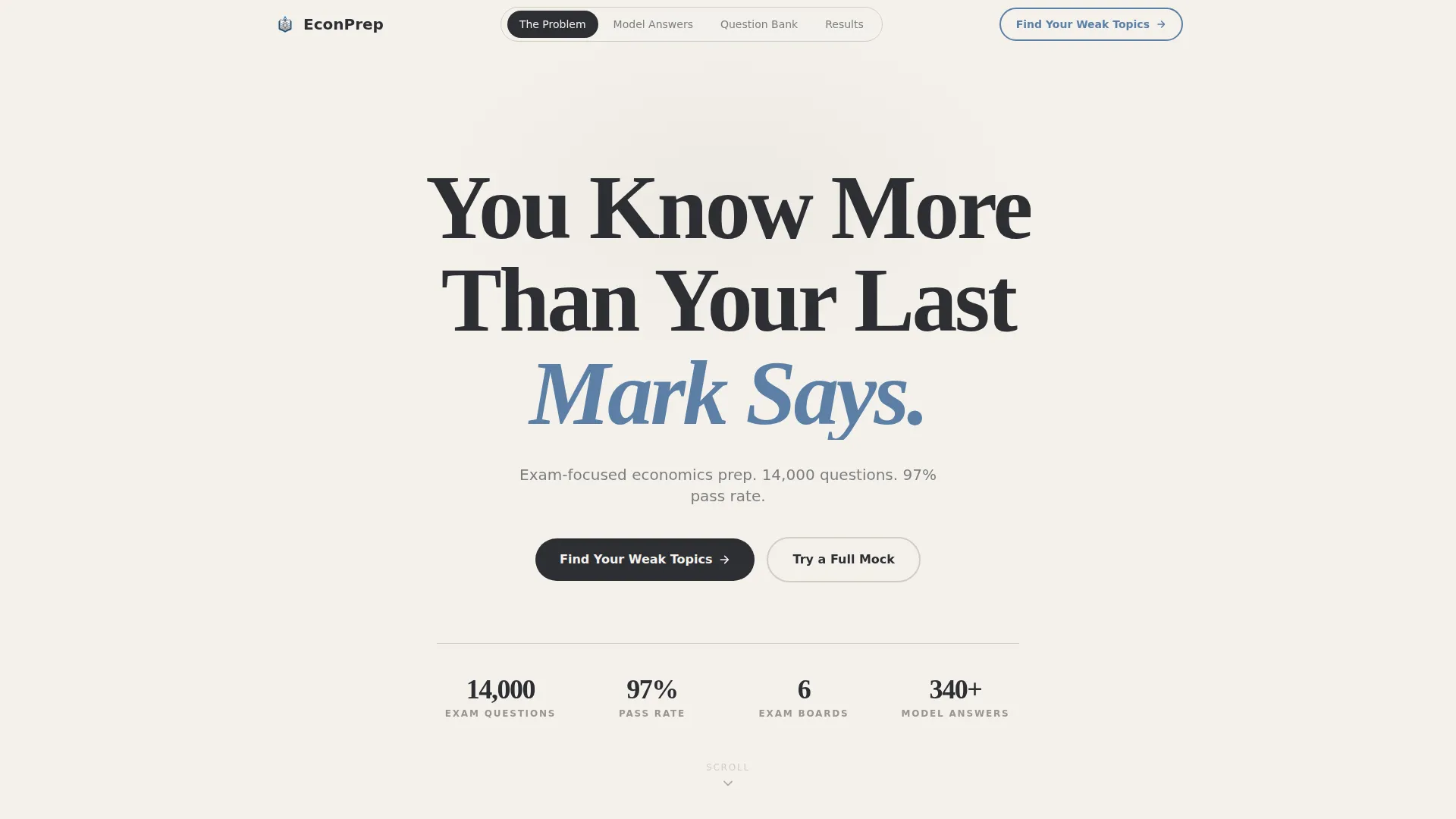
Econprep is a hub-and-spoke economics exam prep landing page built for serious students. It combines a 14,000-question bank, timed mock papers, and model answers written by real examiners. A ten-question adaptive diagnostic finds weak topics fast, while a structured Problem-to-Solution layout guides visitors from confusion to confidence before they ever sign up.
by Rocket studio
Quick summary
Econprep is a single-page economics exam prep landing page. It uses an anchor navigation hub-and-spoke layout to walk visitors from a raw exam problem all the way to timed full mock practice. Built around 14,000 questions, examiner-written model answers, and a free adaptive diagnostic, it earns every click by teaching something real before asking for anything in return.
Who this template is for
This template suits anyone launching or showcasing an economics exam prep service. The audience it speaks to is clearly defined, and the layout is built around their specific anxieties.
- Second-year undergraduates preparing for intermediate microeconomics finals
- A-Level candidates who can write fifteen-mark essays but freeze on diagram questions under pressure
- International Baccalaureate students chasing a top grade who keep dropping marks on evaluation paragraphs
What problem this template solves
Most exam prep pages tell students what they offer. This template shows them. Visitors land on a page that feels like opening an exam booklet when you actually know the material, not a sales pitch dressed in academic language.
- Students do not know which topics are costing them marks until a diagnostic reveals the gaps
- Generic revision sites offer content without structure, leaving students unsure what to do next
- Timed exam pressure feels unmanageable when students have never practiced under real conditions
What you get with this template
You get a complete, ready-to-customize landing page built around a clear teaching arc. Every section moves the visitor one step closer to starting the diagnostic or the full mock paper.
- A bold centered headline and typographic header with a confidence-building subline showing core proof points
- An anchor navigation bar linking to every spoke section for fast, non-linear browsing
- An adaptive ten-question diagnostic flow that collects exam board selection upfront and requests only an email at the results screen
Feature list
This template is built around focused, functional sections that work together to demonstrate credibility and drive action.
Adaptive Diagnostic Quiz Flow
The primary call to action launches a ten-question diagnostic that adjusts difficulty after each answer. It covers microeconomics, macroeconomics, and quantitative methods. Students select their exam board before the first question, and receive a topic-by-topic confidence breakdown at the results screen.
Examiner-Written Model Answers
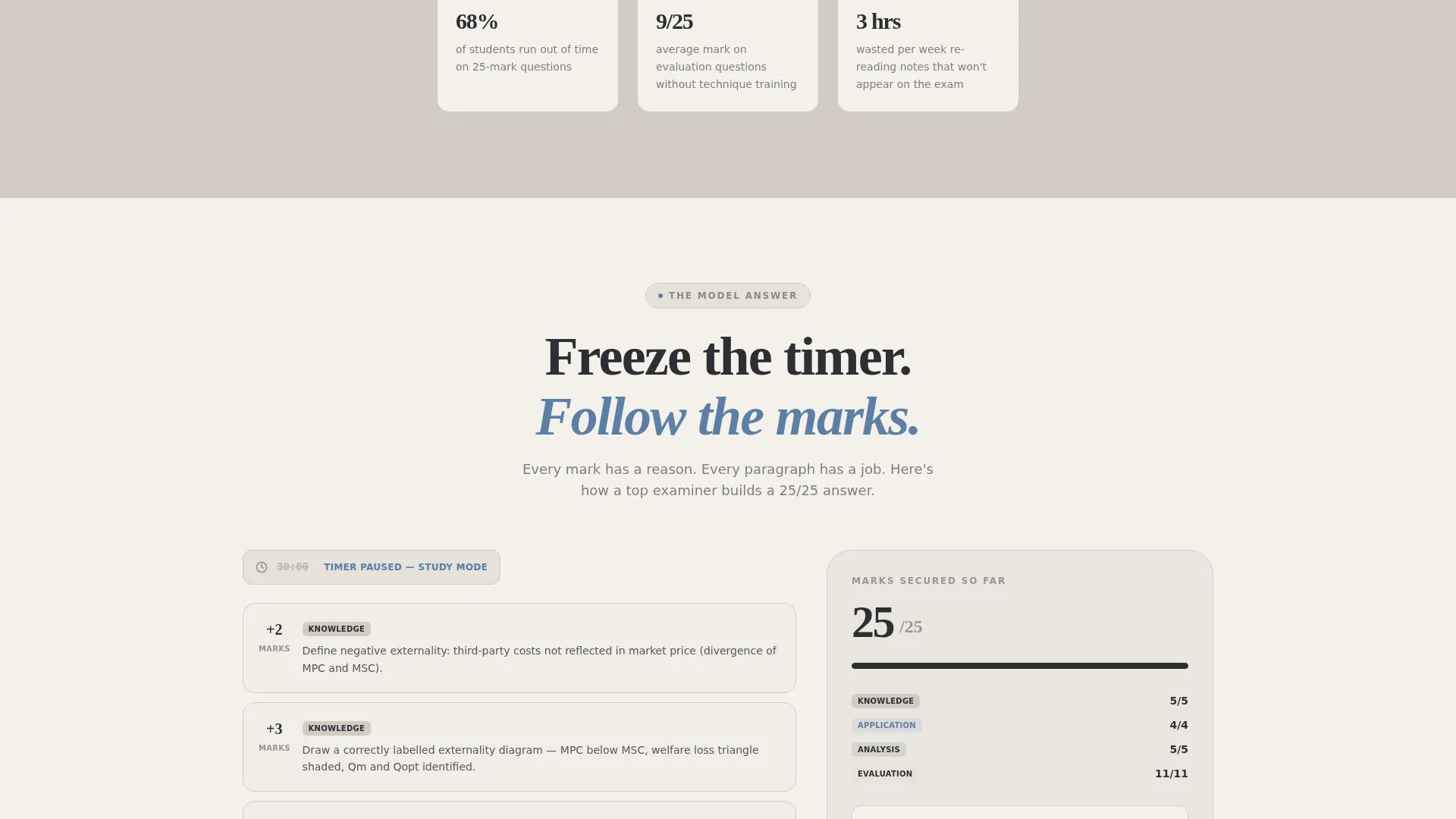
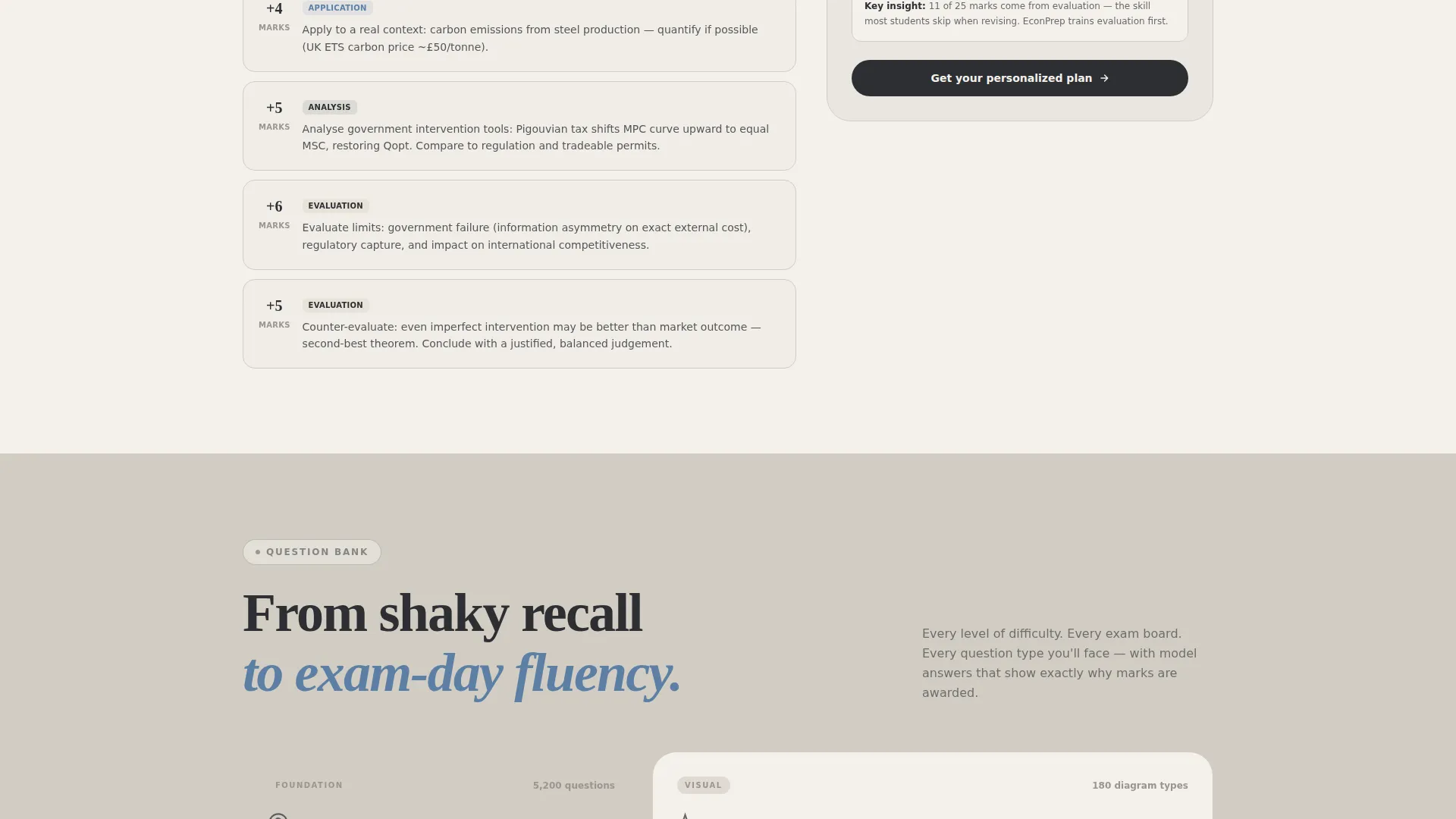
Each spoke section that walks through a question shows how marks are allocated line by line. The model answers are written by actual examiners, which gives the feedback a level of specificity that generic revision guides cannot match.
Timed Mock Paper Path
A secondary call to action, labeled "Try a Full Mock," gives students who already know their weak areas a direct route into timed practice. This keeps the page useful for both first-time visitors and returning students.
Problem-to-Solution Scroll Arc
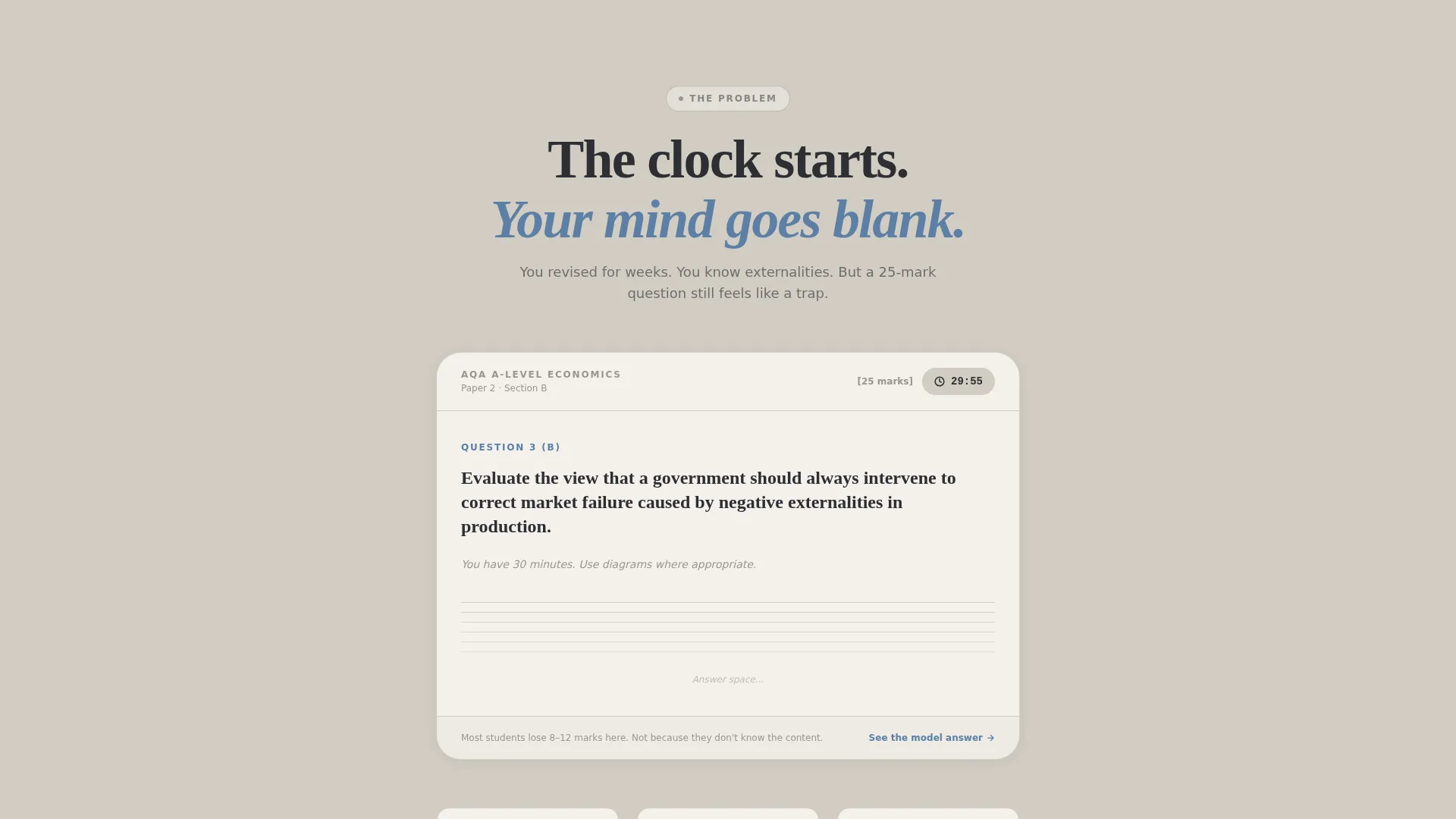
The hub-and-spoke layout opens on a live exam question with a running timer to surface the panic of not knowing where to start. Each subsequent spoke escalates in difficulty, mirroring the student's own journey from recall questions to full fifteen-mark essays.
14,000-Question Bank Structure
The template is built to showcase a question bank of 14,000 items spanning multiple exam boards and difficulty levels. This scale is surfaced early in the header subline to establish immediate credibility.
Anchor Navigation Hub
A sticky anchor navigation bar connects every major spoke section. Visitors can jump between topics without losing their place, making the page navigable for students who return across multiple sessions.
Page sections overview
| Section | Purpose |
|---|---|
| Typographic hero header | Establish authority with a bold headline and proof-point subline |
| Anchor navigation bar | Allow fast jumping between spoke sections |
| Live exam problem | Open the problem arc with a raw question and visible timer |
| Model answer walkthrough | Freeze the timer and show mark allocation line by line |
| Short-answer recall spoke | Build confidence with single-choice and recall-level questions |
| Essay structure spoke | Escalate to fifteen-mark essay planning and evaluation technique |
| Full mock spoke | Show the timed full-paper experience and scoring overview |
| Diagnostic quiz call to action | Drive the primary action with the adaptive topic-finder quiz |
| Full mock call to action | Offer a fast entry point for students ready to practice immediately |
Design & branding system
The visual identity follows an Institutional Authority theme. Every color and type choice is intentional, evoking the quiet focus of a library desk rather than the noise of a typical ed-tech product page.
- The Soft Mist color palette uses chalk-dust white (#F4F1EC) and seminar-room gray (#D1CCC3) as alternating section backgrounds, with blackboard slate (#2C2E33) anchoring all body text
- Margin-note blue (#5B7FA5) is reserved for links, active navigation states, and call-to-action borders, keeping interactive elements visually distinct without breaking the muted tone
- Typography is set in a heavy serif at headline scale, giving the page the visual weight of a printed syllabus rather than a digital product card
Mobile & speed optimization
The layout is designed to remain clear and navigable on smaller screens. The anchor navigation and spoke structure support students who study on phones between lectures or on the morning of an exam.
- Spoke sections are self-contained, so a student can read one section fully without needing context from the previous one
- The diagnostic quiz flow is designed to work as a focused single-screen interaction, reducing friction on mobile devices
How this template helps you convert
Conversion happens before the call to action appears. The page is structured so that visitors are already experiencing the product by the time they reach the quiz button.
- The Problem-to-Solution scroll arc teaches something real in every spoke section, so the visitor arrives at the diagnostic having already seen the method work
- The two-path call-to-action structure, a diagnostic for students finding their gaps and a full mock for students ready to test themselves, means every visitor has a relevant next step regardless of where they are in their preparation
Other information about this template
This template is built for the economics exam prep niche but can be adapted for any exam-focused education service that relies on question banks and model answers.
- The exam board selection step at the start of the diagnostic supports multiple syllabi, including AQA, Edexcel, IB, AP, and university-level economics
- The 97% pass rate claim is surfaced in the header subline as a direct trust signal, positioned alongside the 14,000-question figure for immediate credibility
- The template is suitable for services covering A-Level economics, International Baccalaureate economics, and undergraduate intermediate microeconomics
- The email capture is intentionally deferred to the results screen of the diagnostic, reducing friction at the point of first engagement
Theme
Institutional Authority
Creative direction
Problem→Solution Arc
Color system
Soft Mist
Style
Hub & Spoke (Anchor Nav)
Direction
Quiz/Assessment
Page Sections
Adaptive Diagnostic Quiz Flow
Examiner-written Model Answers
Problem-to-solution Scroll Arc
Timed Full Mock Paper Path
Anchor Navigation Hub
14,000-question Bank Showcase
Related questions
Who is this landing page template designed for?
What is the primary call to action on this page?
Does the template include the quiz or just the layout for it?
Can I adapt this template for a subject other than economics?
How does the page collect student information?