Cloud & DevOps Professional Website Template
Edge is a modular card-grid landing page template built for edge computing platforms. It pairs a Dark Glass Panels header with animated latency comparisons, use-case cards, and a competitive benchmark table. The Teal Catalyst color system and Dynamic Motion theme create a high-focus, cockpit-style interface. The freemium trial flow converts visitors in three fields and no credit card.
by Rocket studio
Quick summary
Edge is a single-page, card-grid landing page template designed for edge computing platforms. It opens with a six-panel monitoring header, moves through animated data storytelling sections, and closes with a focused trial signup. The Teal Catalyst palette and Dynamic Motion theme make every illuminated element feel purposeful, not decorative.
Who this template is for
This template is built for technical decision-makers who need to communicate the real cost of latency. It speaks the language of infrastructure, not marketing fluff.
- DevOps leads at manufacturing firms retrofitting legacy industrial control systems
- Platform engineers at telecom companies rolling out fifth-generation mobile edge compute nodes
- CTOs at autonomous logistics startups who need inference at the vehicle, not the data center
What problem this template solves
Most landing pages for infrastructure products lead with features. This template leads with stakes. It structures the page like a published industry report, walking visitors from the latency problem to the proof to the cost of inaction.
- Generic software landing pages fail to convey the urgency of millisecond-level decisions
- Technical buyers distrust pages that hide benchmarks or bury use-case evidence
- Freemium signups stall when the form asks for too much before trust is established
What you get with this template
You get a fully structured, section-led landing page that guides a technical audience from problem awareness to trial signup without a single wasted scroll. Every card module is designed to function as a finding, not a feature list.
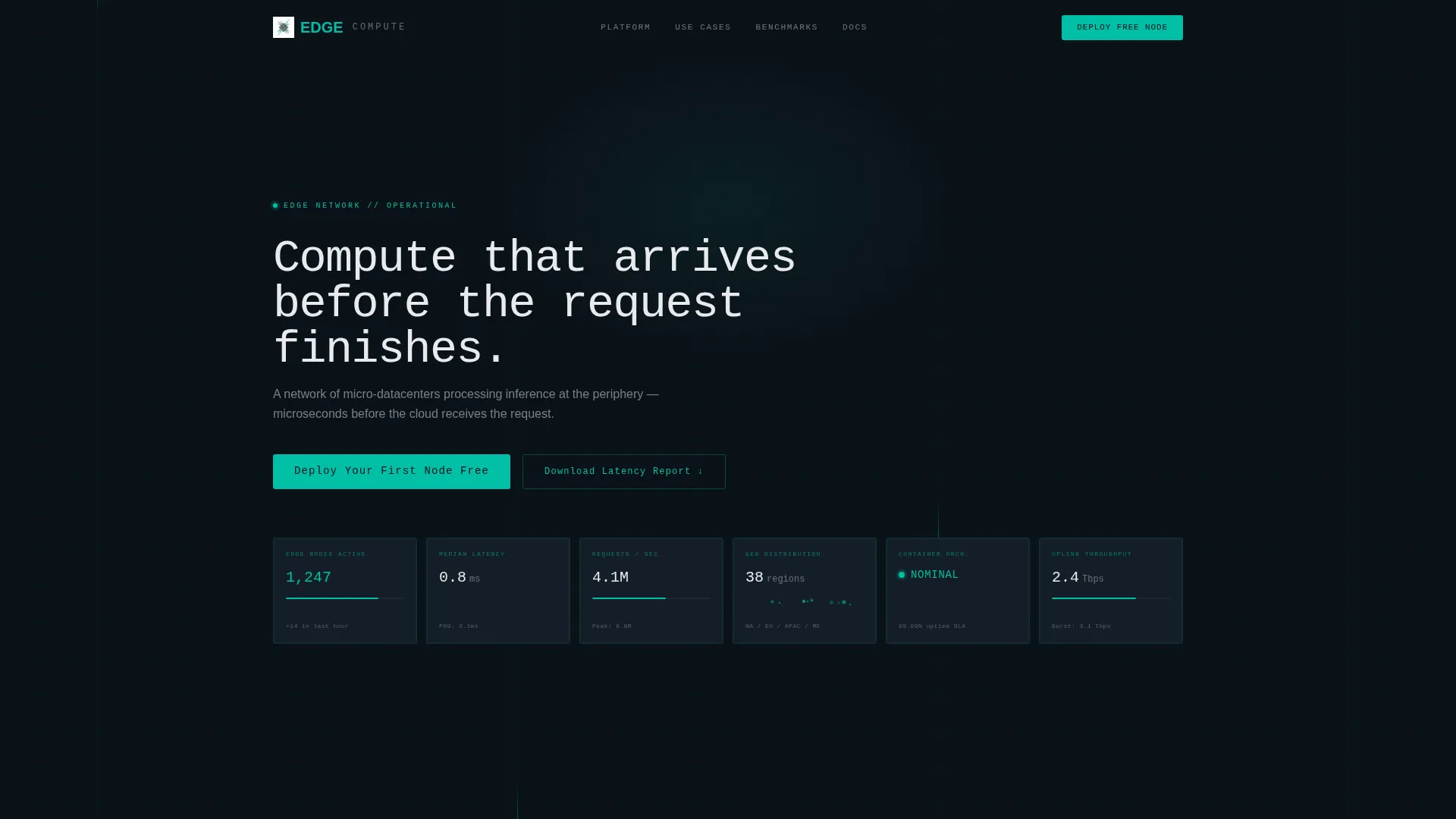
- A staggered six-panel header showing live-style metrics including node count, median latency, and uplink throughput
- Three content rows covering latency data, use-case evidence, and competitive benchmarks
- A freemium trial signup with three fields, no credit card required, and a secondary email-gate path for the latency report
Feature list
This template includes purpose-built components drawn directly from the edge computing brief. Each one serves a specific role in the visitor journey.
Six-Panel Monitoring Header
Six translucent Dark Glass Panels are arranged in a staggered grid against a pure black viewport. Each panel displays a distinct real-time metric, including edge node count, median latency in microseconds, requests per second, geographic heat distribution, container orchestration status, and uplink throughput. A monospace headline types itself across the view: "Compute that arrives before the request finishes."
Animated Latency Comparison Row
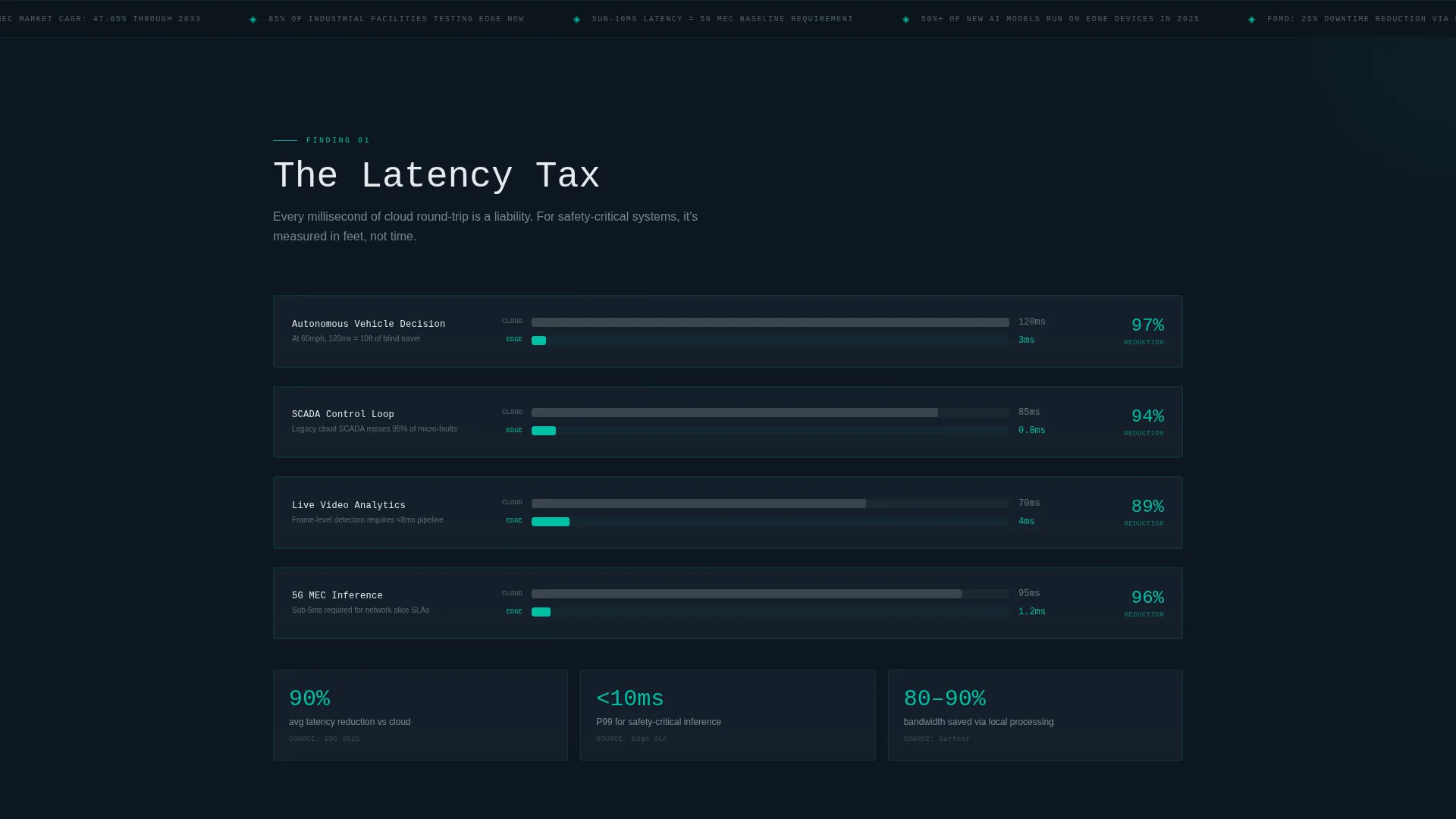
The first content row presents the latency problem using animated bar charts. These charts compare cloud round-trip response times against edge response times, giving technical visitors an immediate visual proof point before any copy needs to argue the case.
Use-Case Card Row with Inline Case Studies
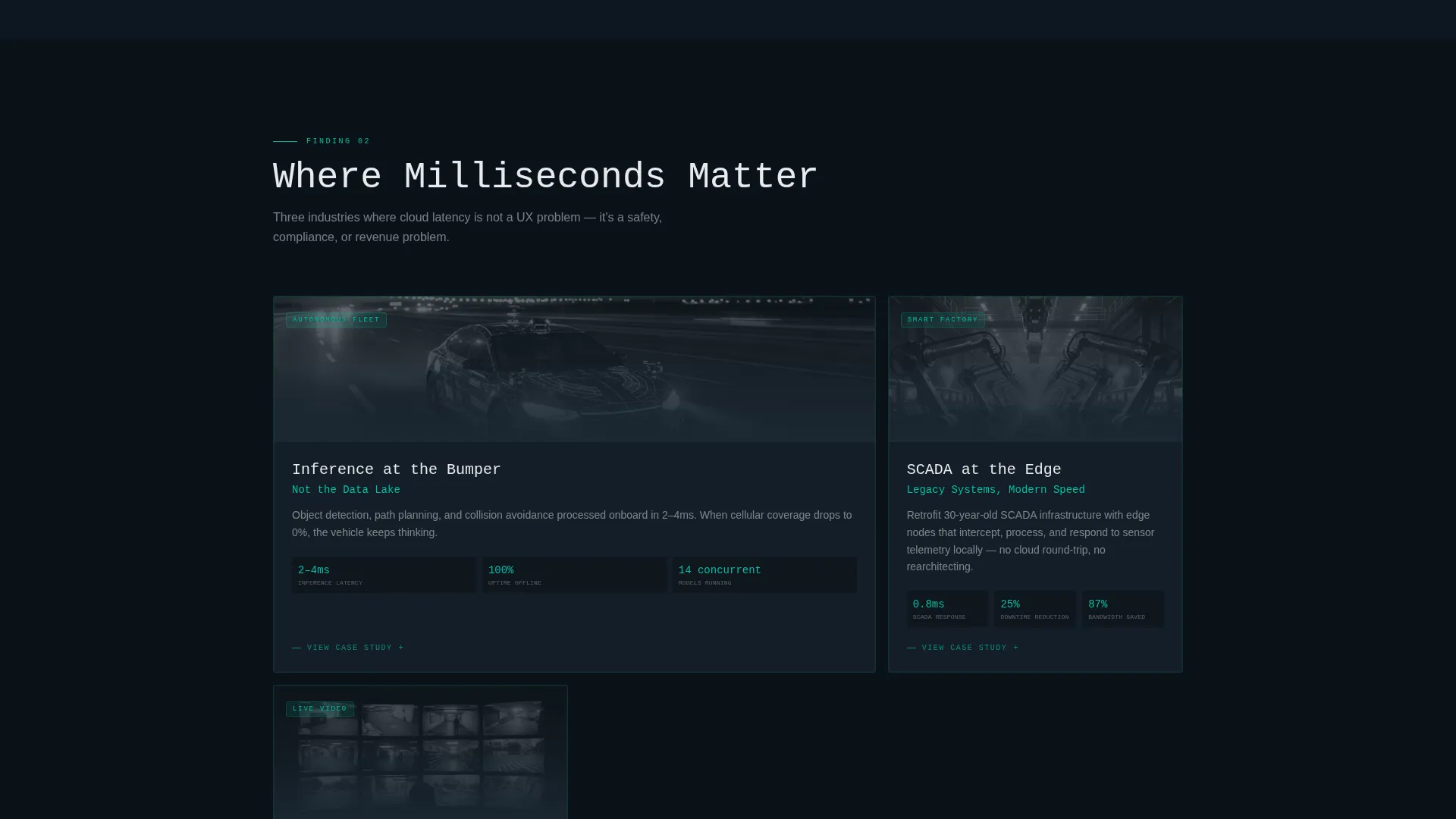
The second row breaks into three use-case cards covering autonomous fleet, smart factory, and live video infrastructure. Each card includes a mini case study that opens inline, keeping the visitor on-page while delivering the specific evidence they need.
Competitive Benchmark Table
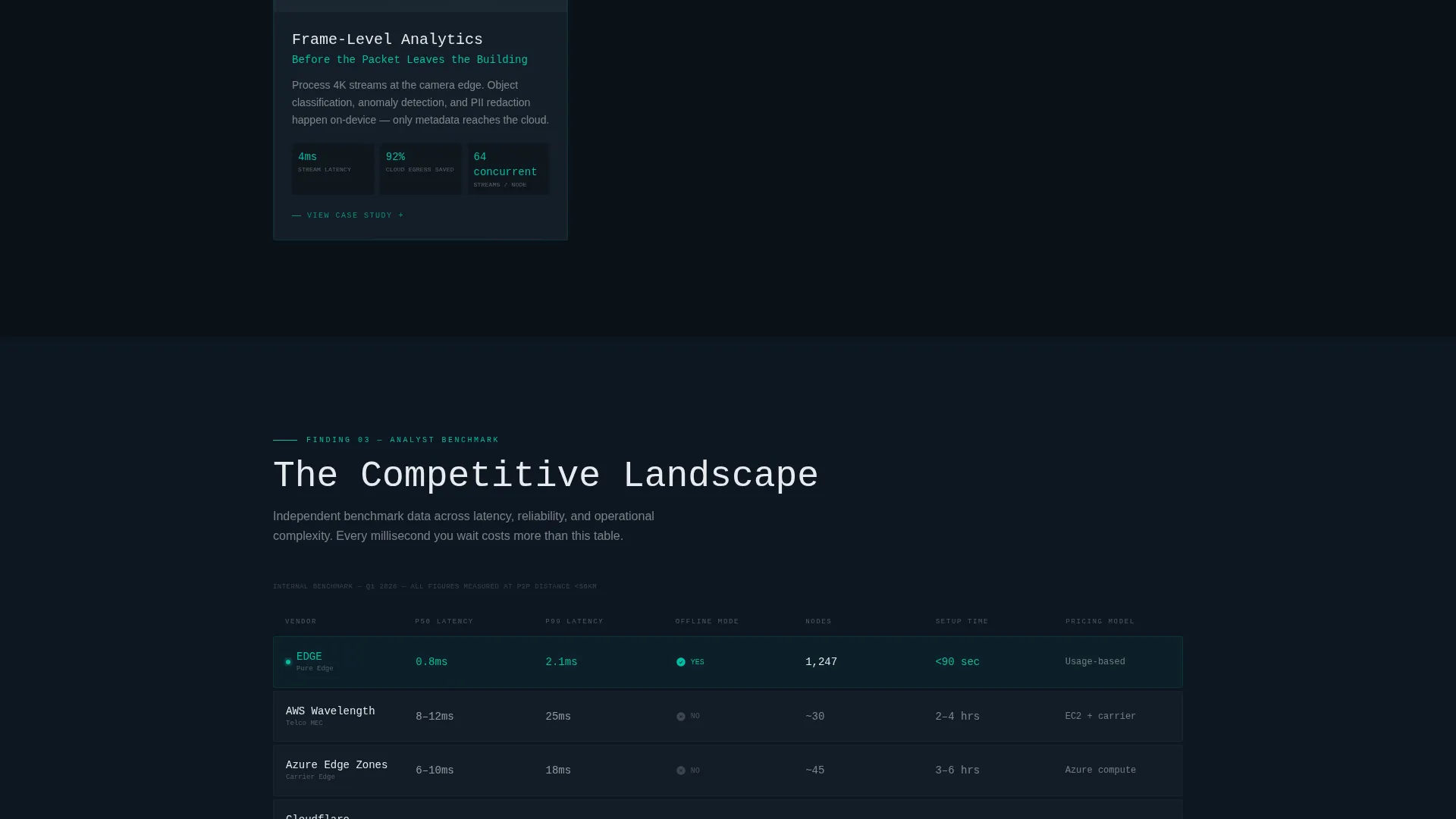
The third row presents a benchmark table styled to feel like a leaked analyst report. It escalates the stakes from problem to proof to cost of delay, landing the visitor at peak motivation directly before the primary call to action.
Freemium Trial Conversion Flow
The primary call to action reads "Deploy Your First Node Free" in reactive teal. It appears immediately after the benchmark section. The trial signup collects work email, primary use case via dropdown, and estimated monthly requests. Three fields, no credit card, cluster ready in under ninety seconds.
Secondary Email-Gate Path
Visitors not ready to commit infrastructure can download the full latency report behind a single-field email gate. This secondary path captures intent from researchers and evaluators who are still in the discovery phase.
Page sections overview
| Section | Purpose |
|---|---|
| Dark Glass Header | Display six live-style metric panels with a self-typing monospace headline |
| Latency Comparison Row | Animate cloud versus edge response time with bar charts |
| Use-Case Cards Row | Present autonomous fleet, smart factory, and live video evidence inline |
| Benchmark Table Row | Show competitive data styled as an analyst report to escalate urgency |
| Primary Trial call to action | Convert visitors with a three-field freemium signup after peak motivation |
| Email Gate Path | Capture early-stage leads with a single-field latency report download |
Design & branding system
The Teal Catalyst color system is built around contrast and intention. Every color in the palette earns its place, the same way every indicator light earns its place on an instrument panel.
- Core palette: deep terminal black (#0B1219) for backgrounds, reactive teal (#00BFA6) for active states and calls to action, gunmetal panel (#1C2833) for card surfaces, and signal white (#E8EAED) for body text
- Accent teal appears on hover states, live data pulses, and active toggles only, keeping decoration minimal and meaning high
- The Dynamic Motion theme drives scroll behavior: cards slide in like dossier pages being placed on a briefing table, and motion is purposeful rather than performative
Mobile & speed optimization
The modular card-grid structure adapts naturally to narrower viewports. Each card module is self-contained, so the layout reflows without breaking the visual hierarchy or the narrative sequence.
- The staggered six-panel header collapses into a readable single-column stack on smaller screens
- Scroll-triggered card animations are designed to feel intentional at any screen size, maintaining the dossier-reveal pacing on mobile
How this template helps you convert
The page is structured to build conviction before it asks for anything. By the time a visitor reaches the call to action, they have already seen the problem, the proof, and the competitive stakes.
- The benchmark table places the cost of inaction directly in front of the visitor at peak engagement, making "Deploy Your First Node Free" feel like a logical next step rather than a sales ask.
- The secondary email-gate path ensures that visitors who are not ready to start a trial still convert as leads, capturing intent from engineers and evaluators in the research phase.
Other information about this template
This template is designed for the edge computing and Cloud & DevOps category, with a niche focus on distributed compute infrastructure. It is well-suited for platforms serving industrial IoT, mobile edge compute, media delivery, and autonomous inference workloads.
- The template style is Card Grid (Modular), making it straightforward to reorder, add, or remove card rows to match your specific platform messaging
- The freemium and trial conversion model is built in from the start, with the primary and secondary conversion paths clearly separated
- The Industry Report creative direction makes the page credible to technical buyers who distrust traditional marketing layouts
Theme
Dynamic Motion
Creative direction
Industry Report
Color system
Teal Catalyst
Style
Card Grid (Modular)
Direction
Freemium/Trial
Page Sections
Six-panel Dark Glass Header
Animated Latency Comparison Charts
Use-case Cards with Inline Case Studies
Analyst-style Benchmark Table
Three-field Freemium Trial Signup
Single-field Email Gate
Related questions
Who is this landing page template designed for?
Can I customize the use-case cards for my specific industry?
Does the trial signup require a credit card?
What is the secondary conversion path for visitors not ready to sign up?
Can the Dark Glass Panels header be adapted to show different metrics?