Advanced Space & Advanced Aerospace Comparison Website Template
Excavate is a modular card grid landing page built for asteroid mining ventures targeting serious institutional audiences. It pairs an Engineering Blueprint visual theme with a Warm Stone color palette to present off-world resource economics with the weight and clarity they deserve. Timeline Progression and Comparison/Versus layouts move visitors from current terrestrial benchmarks to full-scale orbital refinery economics, earning every call to action along the way.
by Rocket studio
Quick summary
Excavate is a single-page, card grid landing page designed for planetary and asteroid mining ventures. It uses a Timeline Progression structure and Comparison/Versus data layout to walk institutional visitors through the economics of off-world resource extraction. The Engineering Blueprint theme and Warm Stone color system give it the technical credibility that sovereign wealth managers, aerospace procurement directors, and deep-tech investors expect.
Who this template is for
This template is built for organizations operating in the space resources sector who need to communicate mission economics to high-stakes audiences. It speaks the language of data-driven decision makers, not general consumers.
- Sovereign wealth fund managers evaluating off-world resource investment plays
- Aerospace procurement directors sourcing in-situ propellant or platinum-group metals
- Deep-tech venture capital firms mapping the next-generation commodity supply chain
What problem this template solves
Presenting asteroid mining economics to institutional audiences is difficult. Generic pitch decks feel thin, and standard landing pages lack the technical credibility serious investors and procurement directors expect. This template closes that gap.
- Terrestrial versus off-world comparisons often get buried in reports; this template makes the delta impossible to miss
- Visitors lose trust without visible proof points; milestone annotations and Technology Readiness Level (TRL) callouts anchor every claim
- Standard forms gate content too early; here the comparison data earns the click before any form appears
What you get with this template
You get a fully structured, single-page card grid layout ready for a planetary and asteroid mining venture. Every section is mapped to a specific stage of the investor or procurement journey.
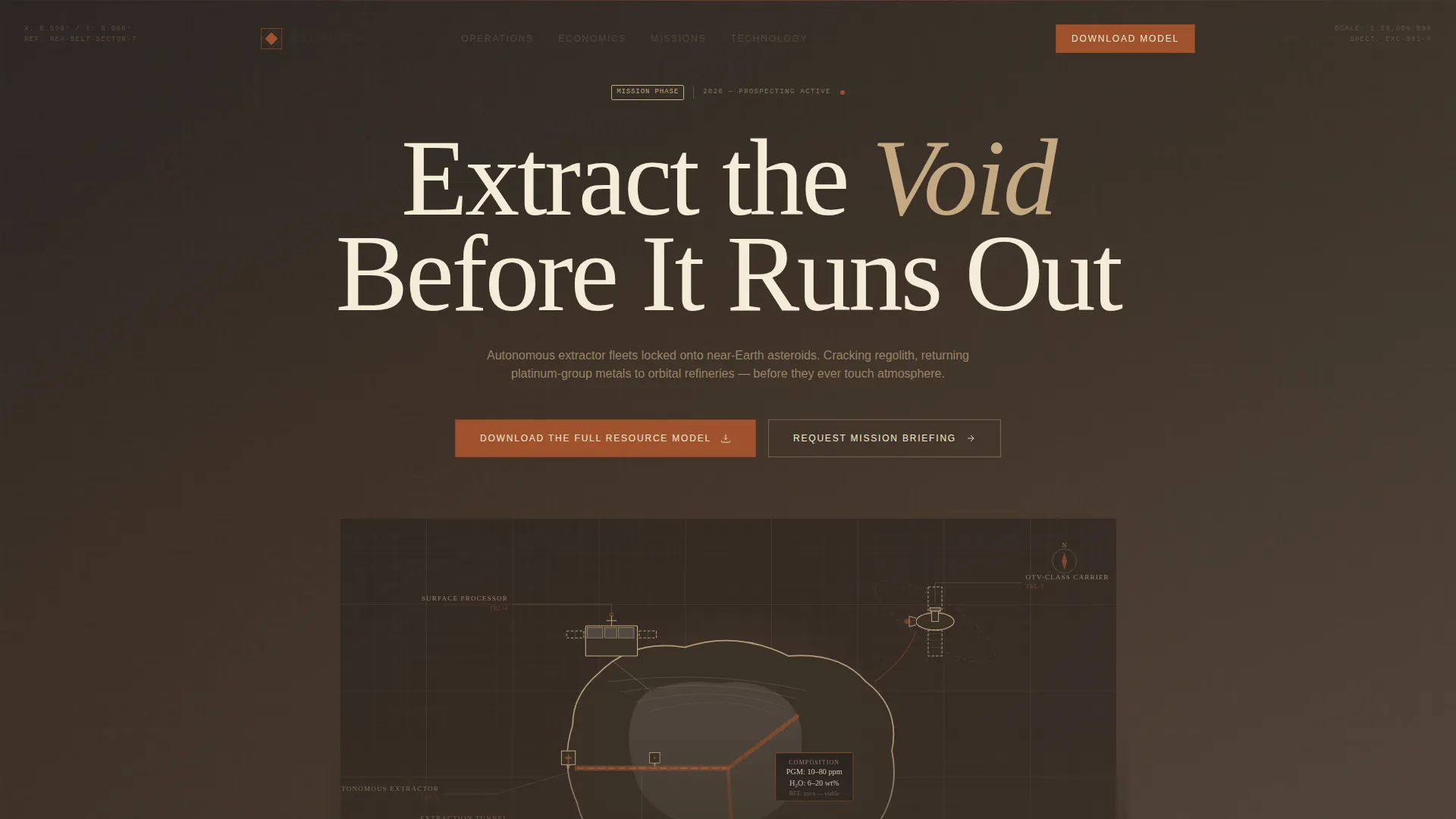
- An isometric cutaway header illustration showing a cross-sectioned C-type asteroid with extraction tunnels, autonomous drill units, a surface processing plant, and an orbital transfer vehicle
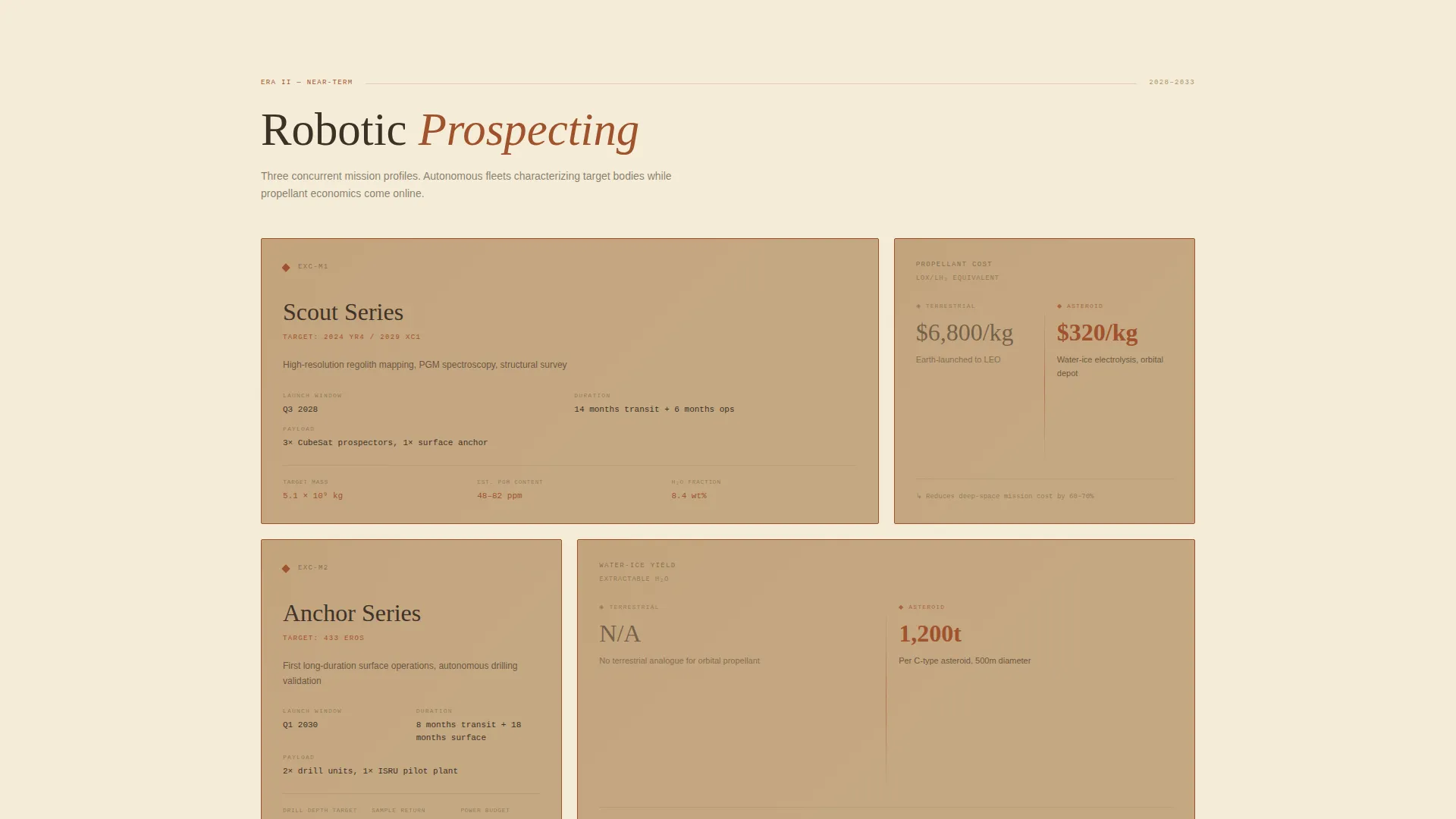
- Four era-based card rows progressing from terrestrial mining benchmarks through near-term robotic missions, first-return extraction economics, and full-scale orbital refinery operations
- Two conversion paths: a primary "Download the Full Resource Model" call to action and a secondary "Request Mission Architecture Briefing" form with a three-step field set
Feature list
This section walks through the core capabilities built into the Excavate template.
Isometric Cutaway Header
The header features a detailed technical illustration of a C-type asteroid in cross-section. Extraction tunnels, autonomous drill units, a surface processing plant, and an orbital transfer vehicle are all annotated with sans-serif labels and dimension lines. TRL numbers accompany each subsystem, rendered in sandstone and cream strokes against a deep basalt background.
Timeline Progression Card Grid
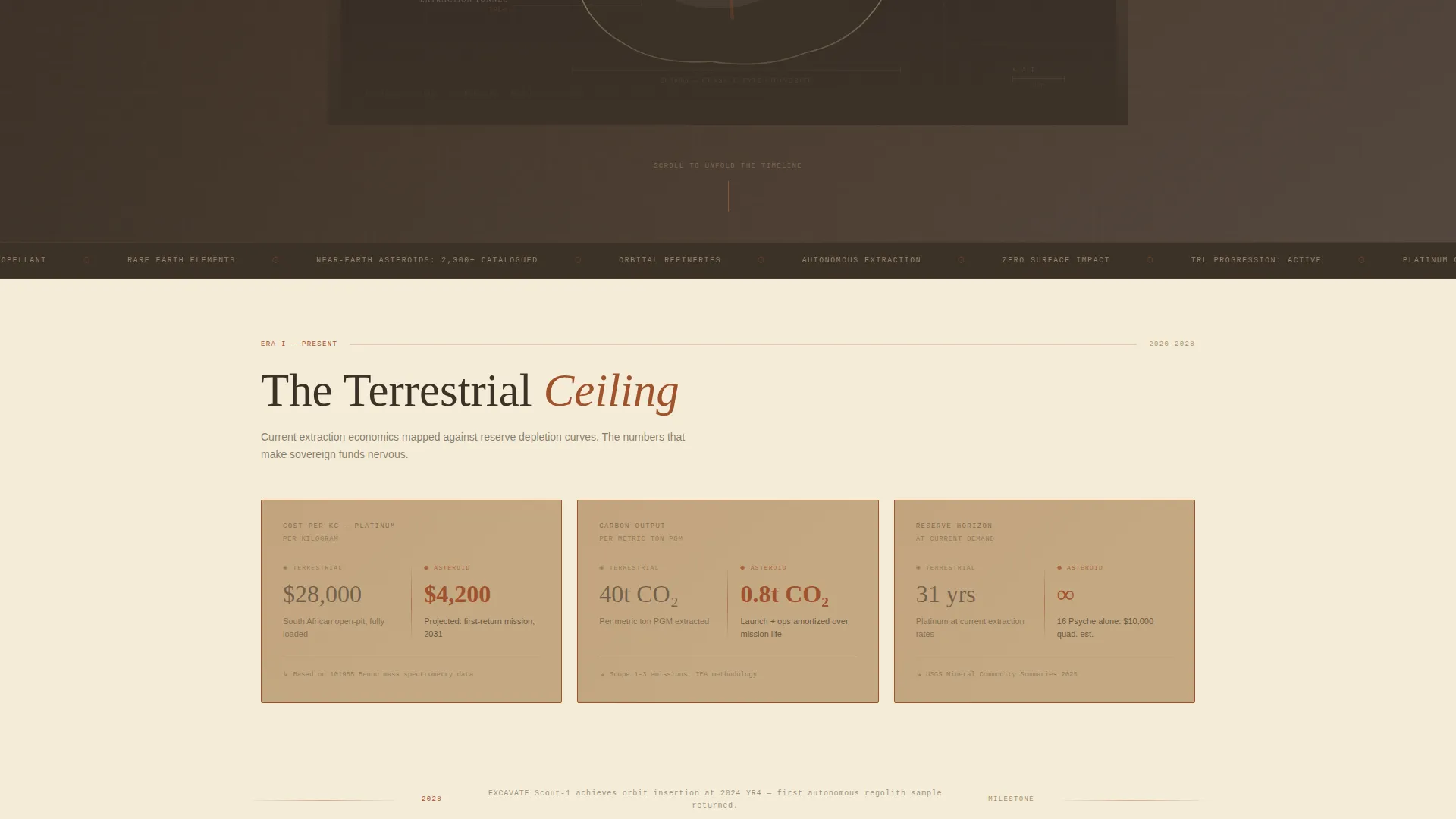
The card grid reorganizes era by era as the visitor scrolls. Row one covers current terrestrial mining benchmarks. Row two presents near-term robotic prospecting mission profiles. Row three details first-return extraction economics. Row four shows full-scale orbital refinery operations. Each row's cards grow slightly larger and warmer in tone, pulling the reader forward like a Gantt chart.
Comparison/Versus Data Cards
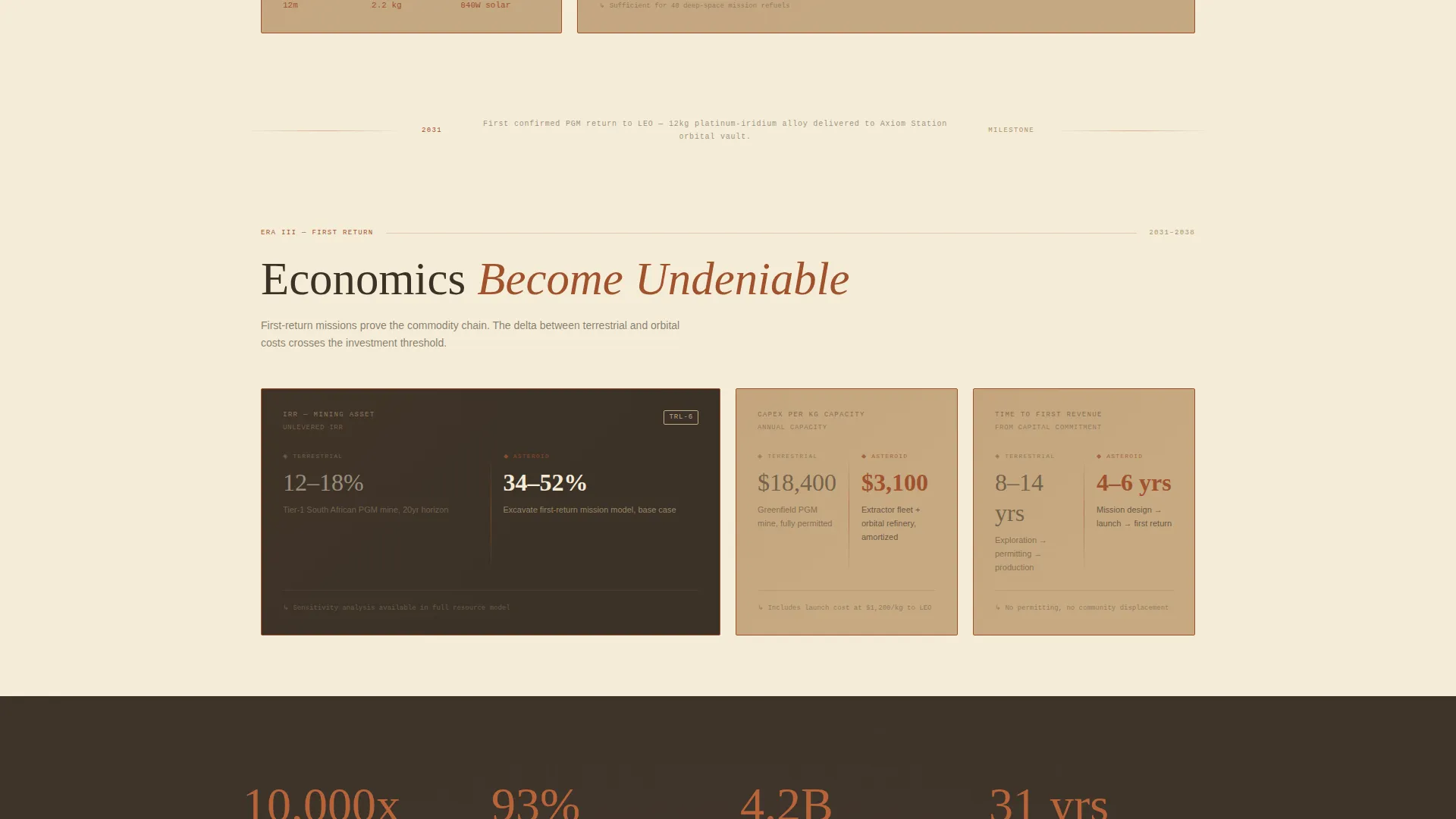
Every card holds a split data point. Terrestrial mining figures appear on the left in muted sandstone. Asteroid mining figures appear on the right in ferric oxide. Metrics include cost per kilogram of platinum, carbon output per metric ton extracted, and years of remaining supply. The visual contrast does the persuading without a single line of sales copy.
Milestone Horizontal Rules
Between each era row, a single horizontal rule carries a date stamp and a one-sentence milestone. These rules function as civilizational timeline markers. They punctuate the scroll and reinforce the sense of forward momentum through each decade of the roadmap.
Dual Conversion Path Design
The primary call to action, "Download the Full Resource Model," appears in ferric oxide on cream after the third row. A secondary path, "Request Mission Architecture Briefing," lives on the final card. The three-step form collects organization name, role category, and resource interest, keeping friction low for procurement-level leads.
Alternating Background System
Page backgrounds alternate between drafting-paper cream and deep basalt. Card surfaces sit in quarried sandstone with ferric oxide rule lines. Body text uses basalt for readability on light surfaces, while data callouts reverse to cream on dark cards. The result is a layered geological palette that reads like a core sample under halogen light.
Page sections overview
| Section | Purpose |
|---|---|
| Isometric Header | Establish technical credibility and mission scope |
| Terrestrial Benchmarks Row | Ground the visitor in current mining costs and limits |
| Robotic Prospecting Row | Present near-term mission profiles and timelines |
| First-Return Economics Row | Show extraction cost models and resource yield data |
| Orbital Refinery Row | Illustrate full-scale operations and long-term upside |
| Timeline Milestone Rules | Mark era transitions with date stamps and key milestones |
| Primary call to action Block | Drive resource model download after economic delta lands |
| Mission Briefing Card | Capture procurement-level leads via three-step form |
Design & branding system
The visual identity follows an Engineering Blueprint theme expressed through a Warm Stone color palette. Every color choice is drawn from geological and industrial references, giving the page warmth without sacrificing technical authority.
- Core palette: quarried sandstone (#C4A882), drafting-paper cream (#F5ECD7), deep basalt (#3B3228), and ferric oxide accent (#A0522D) for interactive borders and hover states
- Typography and line work use sans-serif annotation style labels and dimension lines throughout the header illustration and card components
- Backgrounds alternate between cream and basalt; card surfaces use sandstone with ferric oxide rule lines for a sedimentary layering effect
Mobile & speed optimization
The modular card grid structure is designed to reflow cleanly across screen sizes. Each era row and comparison card is a self-contained module, making responsive adaptation straightforward.
- Card grid modules stack vertically on smaller screens without losing the era-by-era narrative progression
- Alternating background sections and milestone rule lines remain legible and proportional at reduced viewport widths
- The isometric header illustration scales within its container, preserving annotation readability across devices
How this template helps you convert
Excavate is built around the idea that the data itself should earn the conversion, not a gate placed in front of it. The layout sequences trust before it asks for anything.
- The comparison data cards make terrestrial extraction numbers look like a constraint and asteroid figures look like an inevitability, so visitors arrive at the primary call to action already persuaded
- The milestone timeline structure gives institutional visitors a logical, evidence-led path from current benchmarks to orbital refinery economics before they reach either conversion point
- The dual call-to-action design routes two different buyer types, resource model seekers and mission architecture inquirers, to the right next step without confusion
Other information about this template
Excavate sits in the Aerospace and Defense category under the Space and Satellite subcategory, with a niche focus on planetary and asteroid mining. A few additional details worth noting for buyers evaluating this template.
- The template style is Card Grid (Modular), meaning individual card components can be rearranged or extended to accommodate additional mission phases or data sets
- The Intersection Match Score for this template's category, subcategory, and niche combination is 13, reflecting a highly specialized audience alignment
- The three-step lead capture form collects organization name, role (investor, procurement, government, or researcher), and resource interest (platinum-group metals, water-ice, or rare earths)
- The Engineering Blueprint theme and Warm Stone color system are a matched pair from the intersection context, ensuring the visual identity is internally consistent across all card states and background alternations
Theme
Engineering Blueprint
Creative direction
Timeline Progression
Color system
Warm Stone
Style
Card Grid (Modular)
Direction
Comparison/Versus
Page Sections
Isometric Cutaway Header Illustration
Era-by-era Timeline Card Grid
Comparison/versus Data Cards
Milestone Timeline Horizontal Rules
Dual Conversion Path Layout
Warm Stone Alternating Background System
Related questions
Who is the primary audience for this landing page template?
What conversion actions does the template support?
What makes the comparison card design effective for this audience?
Can the card grid rows be extended beyond four eras?
What does the three-step lead form collect?