Privacy-First Federated Learning Platform Landing Page
Federate is a privacy-first federated learning landing page template built for ML engineers who train models across siloed datasets without ever moving raw data. Styled in a Tech Glass aesthetic with glassmorphic panels, animated node topology, and a Feature Matrix scroll sequence, it positions a federated learning framework for healthcare, fintech, and research audiences with precision and technical credibility.
by Rocket studio
Quick summary
Federate is a single-page, split-screen landing page template designed for a federated learning framework. It communicates one core promise: model training happens locally, across dozens of participating nodes, and no raw data ever leaves its origin. The layout uses a 50/50 split with an animated topology header and a scrollable Feature Matrix that builds technical trust with every section.
Who this template is for
This template is purpose-built for teams who need to explain a complex, privacy-first federated learning system to a technically sophisticated audience. It speaks to engineers who evaluate infrastructure, not casual visitors who scan headlines.
- Machine learning engineers at healthcare consortiums who need to train models on patient data held across multiple hospitals without centralizing it
- Fintech teams building fraud detection models across banking partners who will never share ledgers or expose sensitive data to a central location
- Research labs federating sensor data from edge devices scattered across global sites, where data governance and data ownership are non-negotiable
What problem this template solves
Standard SaaS landing pages are not built for federated learning. They lack the visual and structural vocabulary to explain a decentralized machine learning approach to an audience that reads code before it reads marketing copy. This template solves that gap directly.
- Traditional landing pages cannot convey why keeping local data on-device matters, or how a central server can improve a global model without ever touching raw data
- ML engineers evaluating frameworks need proof before trust: real topology diagrams, architecture breakdowns, and benchmark data that speaks to communication overhead, convergence rounds, and privacy budget
- Teams operating under data privacy regulations need a page that communicates regulatory compliance credibility from the first scroll, not buried in footnotes
What you get with this template
You get a fully structured, single-page layout designed to walk a machine learning engineer from curiosity to click-through. Every section is purposeful and sequenced for trust-building. There is no form on the page; the conversion mechanism is a focused call-to-action that sends visitors to a hosted quickstart or managed cloud signup.
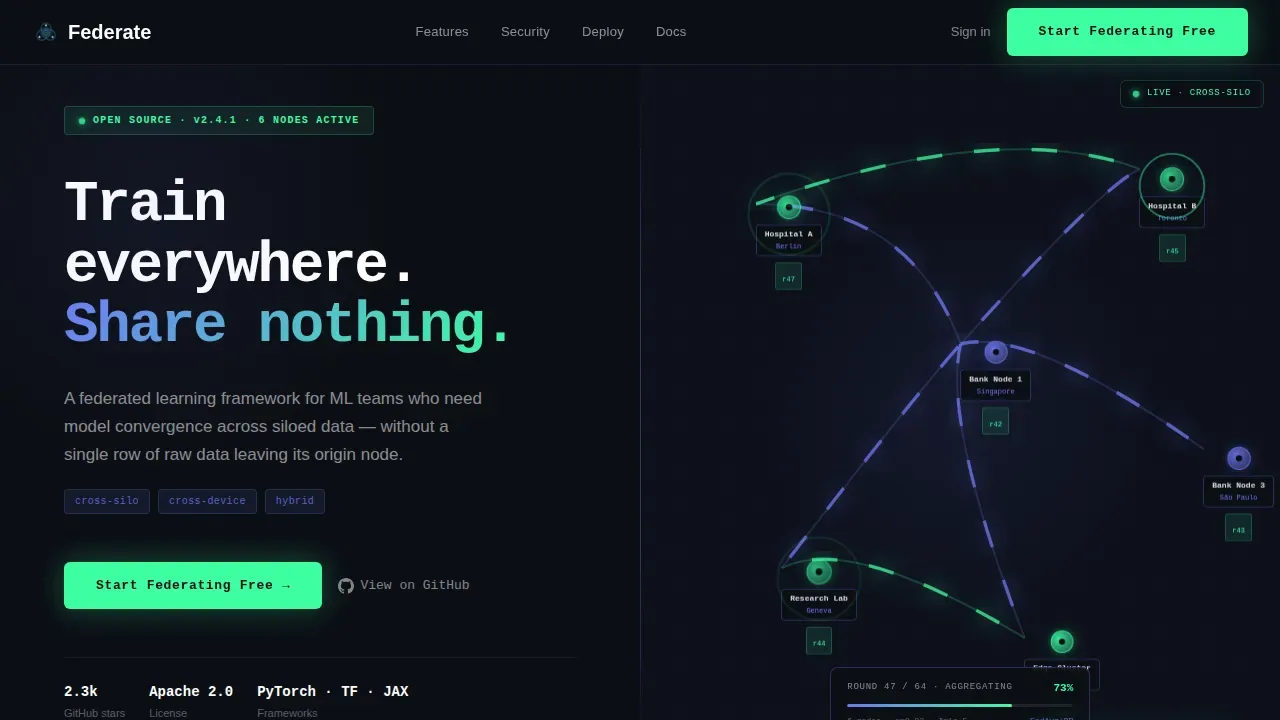
- A 50/50 split-screen hero with an animated node topology visualization on the right and a bold mono-type headline with a primary call-to-action on the left
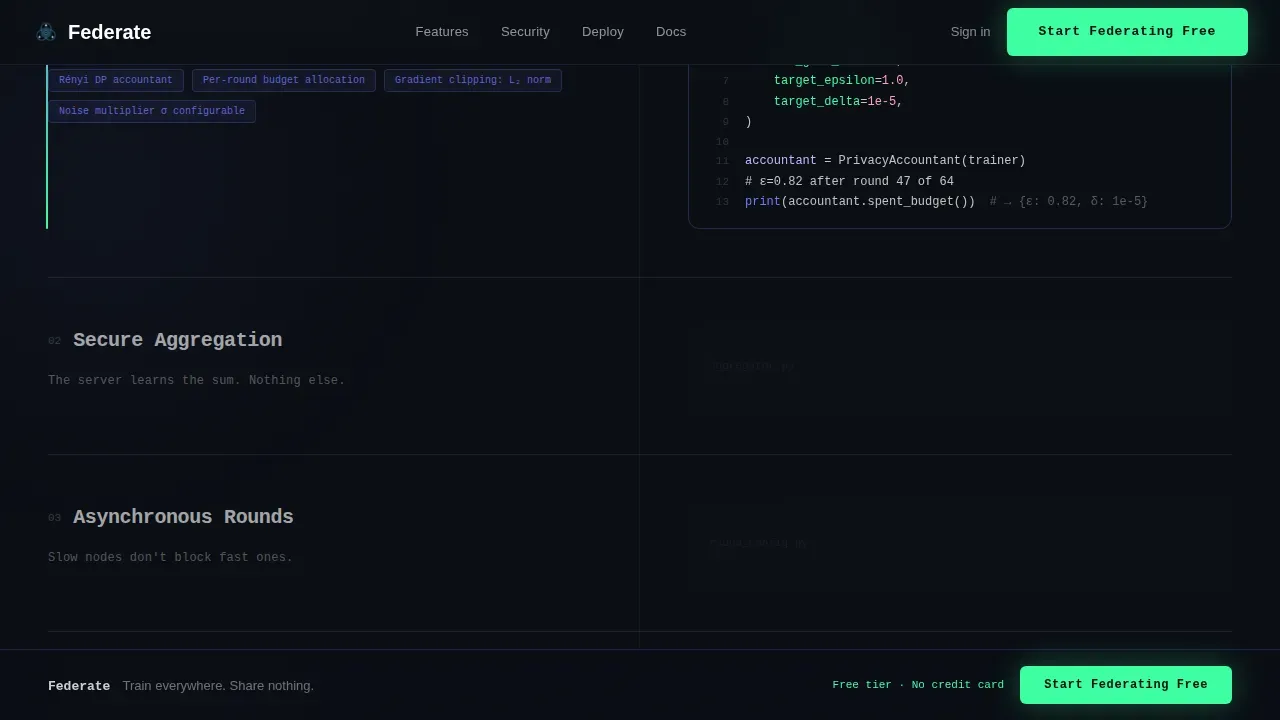
- A scrollable Feature Matrix that pairs capability descriptions on the left with frosted-glass terminal windows showing architecture diagrams or code snippets on the right, covering four core federated learning capabilities
- A comparison table section (Federate versus alternatives) with a final call-to-action anchor above it, and a sticky bottom call-to-action bar that activates after the second scroll section
Feature list
This template presents its capabilities through a structured sequence of visual and content components. Each feature is grounded in the source brief and designed to serve the ML engineer audience.
Animated Federated Node Topology Header
The right panel of the hero section renders a live topology view showing six federated nodes mid-training round. Gradient updates arc between nodes as animated dotted lines. Each node carries a realistic label such as Hospital A in Berlin, Bank Node 3 in São Paulo, or Edge Cluster in Seoul. An aggregation progress indicator sits at 73%, giving visitors an immediate visual understanding of how federated learning works in a real distributed deployment without sharing raw data.
Feature Matrix Scroll Sequence
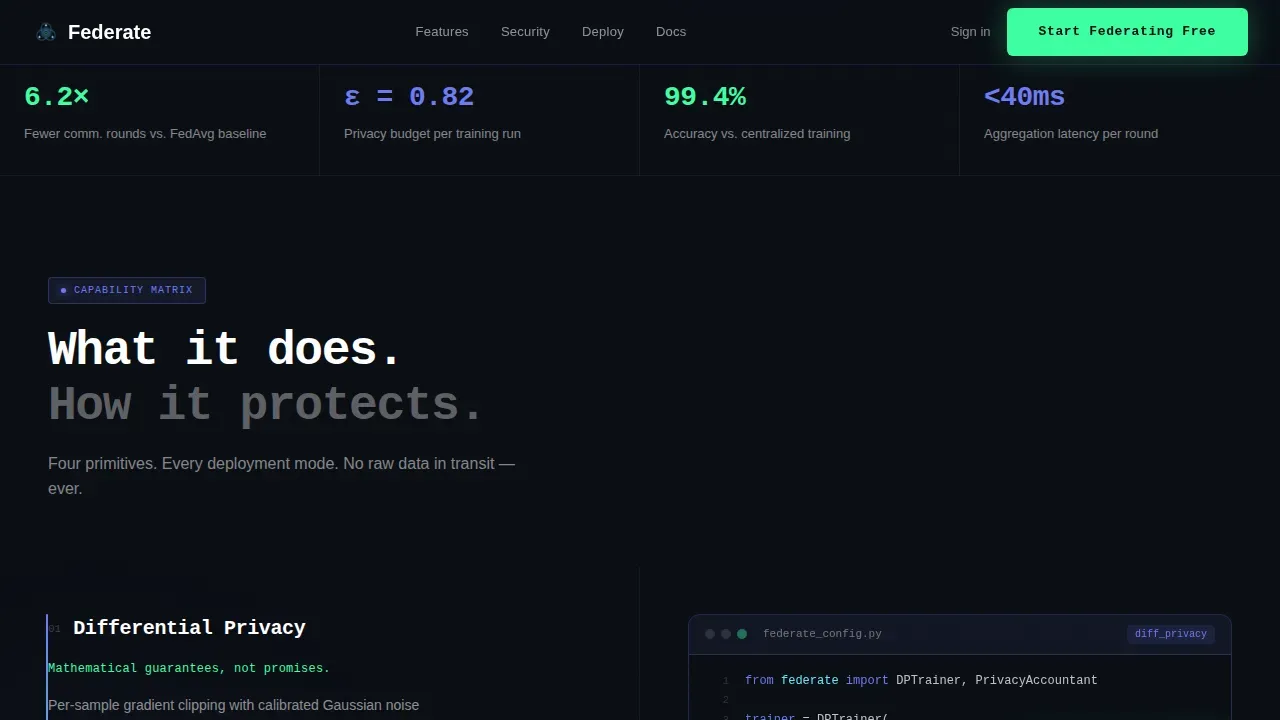
The core scroll experience pairs a capability column on the left with a corresponding architecture diagram or code snippet on the right. The matrix covers four federated learning capabilities: differential privacy, secure aggregation, asynchronous rounds, and model-heterogeneous support. Each row escalates in technical depth, moving from what a feature does, to how it protects data, to where it deploys. This reward structure keeps engineers reading deeper. The sequence demonstrates how participating clients train a local model, share only model parameters with the central server, and how the central server applies a model aggregation algorithm to update the global model without ever accessing private data.
Frosted-Glass Terminal Windows
Each capability in the Feature Matrix is paired with a frosted-glass terminal window rendered on the right panel. These windows display architecture diagrams or real code snippets that illustrate the federated training process. The terminal aesthetic reinforces technical authenticity. Visitors see how local model training is configured, how updated model parameters are transmitted, and how secure aggregation is applied. This presentation makes the federated learning system feel real and production-ready rather than theoretical.
Security Guarantees Section
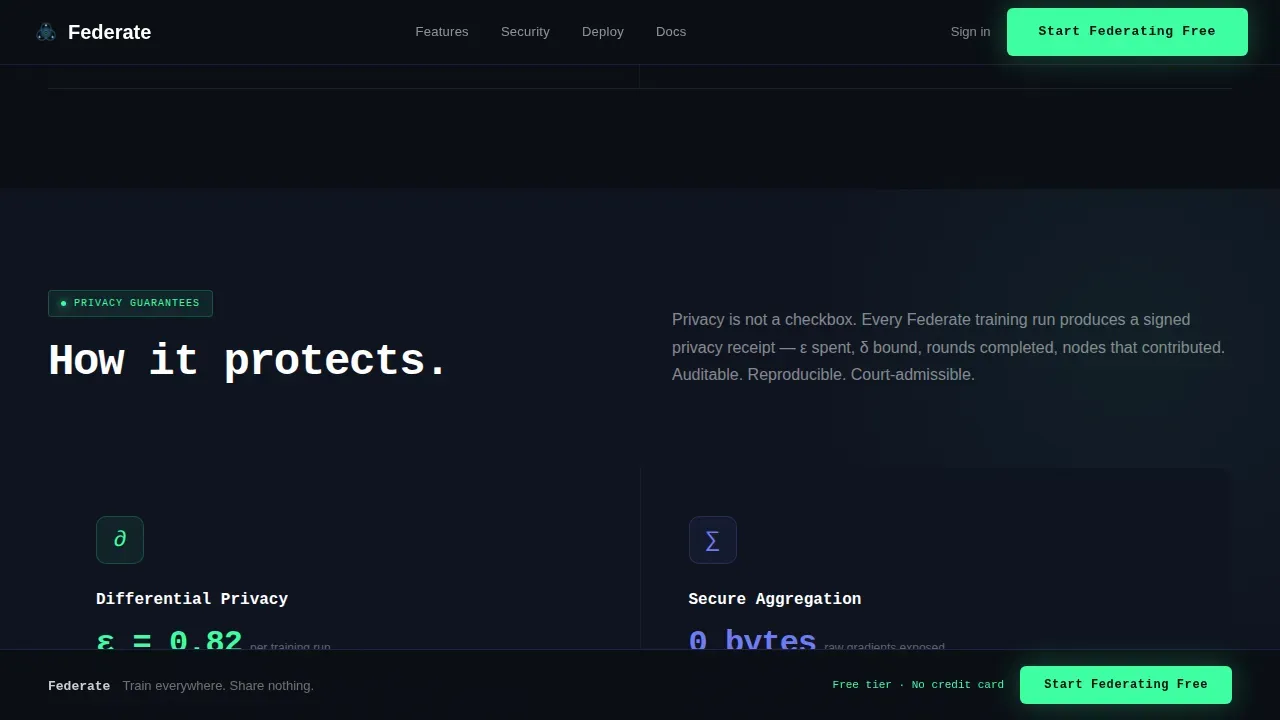
A dedicated section visualizes the privacy and security layer of the framework. It covers differential privacy budget visualization, secure aggregation proofs, and privacy math. Differential Privacy adds mathematical noise to updates, making it impossible to trace them back to a specific user. Secure Aggregation encrypts updates so the central server can compute the average without seeing individual contributions. These layered security proofs address the security concerns that any engineer evaluating a federated learning system will bring to the page.
Infrastructure Compatibility and Deployment Modes
A section dedicated to infrastructure compatibility presents the three deployment modes supported by the framework: cross-silo, cross-device, and hybrid. This section directly addresses data and system heterogeneity, which is one of the practical challenges teams face when deploying federated learning across organizations with different devices, data distributions, and network conditions. The section reassures engineering managers and CTOs that the framework handles real-world complexity.
Comparison Table with Final Call-to-Action
The final scroll section presents a structured comparison table. It anchors the page with a definitive proof point for engineers who have evaluated other options. A signal-green call-to-action button sits immediately above the table, repeated from the hero, reinforcing the conversion path without cluttering the page with multiple competing actions.
Page sections overview
| Section | Purpose |
|---|---|
| Hero split screen | Introduces framework with animated topology and primary call-to-action |
| Feature Matrix rows | Escalates federated learning capabilities with code snippets and diagrams |
| Security Guarantees | Visualizes differential privacy, secure aggregation, and privacy math |
| Infrastructure Compatibility | Presents cross-silo, cross-device, and hybrid deployment modes |
| Comparison Table | Benchmarks framework against alternatives with final call-to-action anchor |
| Sticky call to action bar | Persistent conversion trigger activating after the second scroll section |
| Footer row | Single-row linear footer with minimal links |
Design & branding system
The visual identity follows a Tech Glass theme built on a Glassmorphic color system. The aesthetic is deliberately evocative: dark, luminous, and layered, like holding smoked glass up to a datacenter window at 2 a.m. Every color choice serves the privacy-first message by making data feel contained, protected, and unreachable.
- Background uses deep void black at hex #0B0E14 with subtle grain texture; panels and cards float on frosted-glass blurs with 1px iris-blue borders at hex #6E7BF5; text is crisp anti-aliased white with secondary copy dropping to 60% opacity
- Signal green at hex #3DFFA2 is reserved exclusively for active states, success badges, and call-to-action pulses; every interactive element glows signal green on hover as if the interface is acknowledging user presence
- Typography combines JetBrains Mono for oversized headlines and code elements with DM Sans for body copy, reinforcing the developer-tool positioning throughout
Mobile & speed optimization
The template is designed with a desktop-first priority. The federated node topology visualization and the Feature Matrix side-by-side layout require screen width to communicate effectively. The topology arcs, pulsing node animations, and frosted terminal windows are optimized for large displays where ML engineers work.
- Animations use CSS keyframe animations and animated SVG topology arcs with GPU-accelerated transforms, keeping the visual experience smooth without heavy JavaScript dependencies
- Interactive elements including signal-green hover states and the sticky call-to-action bar are built with minimal JavaScript, relying on CSS animations for performance-conscious rendering
How this template helps you convert
The conversion strategy in this template is deliberately focused. There is no form on the page. The single conversion action is a click-through to a hosted quickstart notebook or a managed cloud signup. Every design and content decision serves that one goal.
- The hero section earns immediate attention with the animated topology and the oversized mono headline, then presents the primary call-to-action button in signal green directly below the subline naming the three deployment modes, capturing engineers who are ready to act early
- The Feature Matrix builds technical credibility across multiple scroll sections by showing real code, real architecture diagrams, and real benchmark numbers including convergence curves, communication rounds saved, and privacy budget spent, so that by the time a visitor reaches the sticky call-to-action bar or the comparison table anchor, the decision is already made
Other information about this template
This section covers additional context about federated learning as a domain, relevant compliance frameworks, the broader landscape of federated learning tools, and future directions that make this template relevant for years to come.
Federated learning (FL) is a decentralized machine learning approach that enables multiple clients to collaboratively train a shared global model without sharing their local data. In a federated learning system, each participating client performs local training on its private dataset and shares only model parameters with the central server. The central server applies a model aggregation algorithm, most commonly federated averaging, to combine the updated model parameters and improve the global model over successive rounds. This training process significantly reduces communication overhead compared to approaches that require centralized data collection.
The federated learning FL paradigm supports horizontal federated learning, where participating clients share the same feature space but have different data instances, as well as vertical federated learning, where clients share the same data instances but have different features. Federated transfer learning extends this further to scenarios where data distributions and feature spaces differ across clients. These distinctions matter when deploying across healthcare consortiums, banking networks, and IoT edge devices simultaneously.
Preserving data privacy while achieving strong model accuracy is the central challenge of any federated learning system. Federated learning reduces the risk of model inversion attacks and other privacy threats by ensuring that private information, private data, and sensitive customer records stay on local devices. Clients share only model parameters, never their local dataset or private dataset. The central server never has access to raw data, training data, or any private key material from client nodes. This keeps data local and enforces data sovereignty across all participating clients.
Regulatory compliance is a core requirement for any team deploying federated learning in healthcare or finance. The general data protection regulation (GDPR) and the California Consumer Privacy Act (CCPA) both impose strict limits on data movement and data transmission across jurisdictions. Federated learning enables compliance with these regulations by keeping sensitive data localized and minimizing data sharing. Teams working with patient data, sensitive data, and other private information benefit from an architecture that does not require data collection into a central location.
From a practical standpoint, federated learning supports medical research by allowing clinics to build predictive models for disease detection without sharing raw patient data. In finance, it allows institutions to train fraud-detection models across decentralized data held by multiple banking partners. For IoT applications, edge devices can train locally and contribute to a shared AI model without transmitting large volumes of data. Federated learning also supports smart-city use cases such as traffic flow prediction, and it can be applied in agriculture for crop yield forecasting by aggregating insights from distributed data sources.
The broader ecosystem of federated learning frameworks includes TensorFlow Federated (TFF), an open-source framework developed by Google; Flower (FLWR), a flexible framework-agnostic platform for rapid prototyping across different machine learning backends; and NVIDIA FLARE, which evolved from the NVIDIA Clara Train SDK and enables hospitals and medical institutions to collaboratively train AI models without sharing sensitive patient data. FATE focuses on secure cross-organizational collaboration, particularly in vertical federated learning scenarios. This template includes a comparison table that benchmarks Federate against these alternatives, giving ML engineers the side-by-side evidence they need to make an informed decision.
Looking ahead, federated learning is evolving to address challenges in trust, security, scalability, and computational capability. Blockchain technology is being explored as a mechanism to enhance trust and transparency in federated learning systems. Quantum federated learning combines federated learning with quantum computing to exploit computational advantages and enhance security. Future research is expected to explore personalized federated learning to tailor the global model for individual clients. Federated learning is increasingly recognized as a general-purpose collaborative intelligence framework applicable across scientific and engineering disciplines, poised to play a critical role as artificial intelligence becomes more integrated into sensitive domains.
- This template is categorized under Technology and specifically targets the Federated Learning Tool and Framework niche
- The page type is a click-through landing page with no on-page form; the single conversion action sends visitors to a quickstart notebook or cloud signup
- The layout uses a Split Screen 50/50 structure as specified in the template style, optimized for desktop-first viewing
- The header concept uses a product screenshot of a live federated node topology, which is one of the most effective ways to show a federated learning system in action to a technical audience
- The creative direction follows a Feature Matrix pattern that escalates from capability to security guarantee to infrastructure compatibility, rewarding engineers who scroll deep
- Communication efficiency is addressed through the template's benchmark section, which shows convergence curves, communication rounds saved, and privacy budget spent
- Data governance and data ownership are surfaced in the infrastructure section, which explains how each deployment mode handles decentralized data across organizations
- The template directly addresses security concerns such as gradient inversion attacks, membership inference risks, and the importance of keeping user devices and user privacy protected throughout the federated training process
- Collaborative learning across organizations is the foundational value proposition, and the template communicates it through every layer of visual design and content structure
Theme
Tech Glass
Creative direction
Feature Matrix
Color system
Glassmorphic
Style
Split Screen (50/50)
Direction
Click-Through
Page Sections
Animated Federated Node Topology
Feature Matrix Scroll with Code Terminals
Security Guarantees Section
Infrastructure Compatibility Display
Comparison Table with Anchored Call to Action
Tech Glass Glassmorphic Design System
Related questions
Who is this landing page template designed for?
Does this template include a contact form or lead capture form?
How does the template communicate the privacy benefits of federated learning?
Can this template be adapted for any federated learning framework?
What deployment modes does this template present?