Forge - Photorealistic Automotive Landing Page Template
Forge is a bold, brutalist-themed split-screen landing page template built for an automotive AI image generator. It uses a Carbon Fiber color system, spec-sheet-style comparison sections, and a photorealistic product screenshot header to stop the scroll immediately. Designed for conversion through evidence, not persuasion, it lets the output do the selling.
by Rocket studio
Quick summary
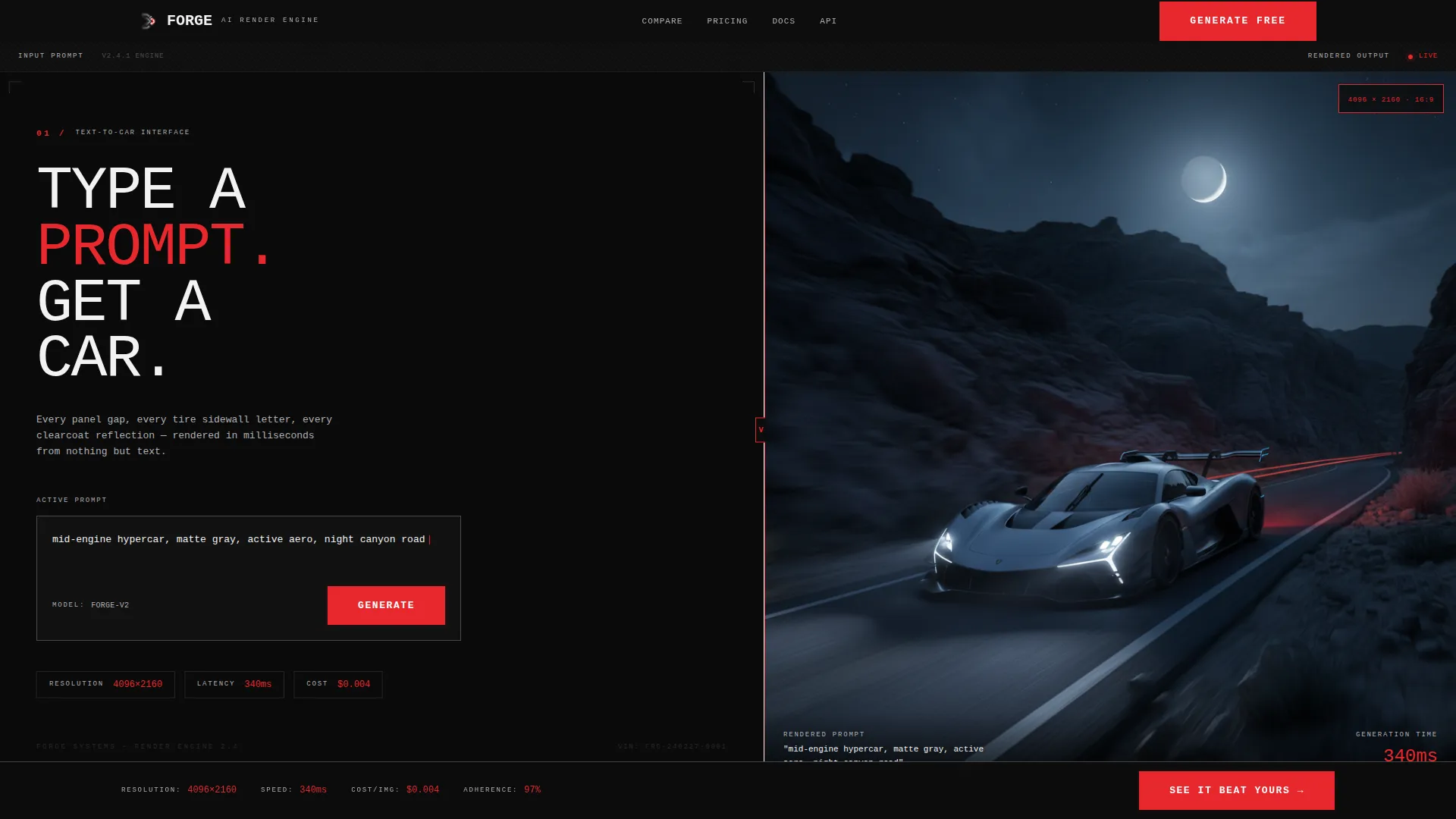
Forge is a single-page, split-screen landing page template for an automotive AI image generator. It opens with a side-by-side product screenshot that shows a text prompt alongside its photorealistic car output. Every section below the fold is structured like a vehicle spec comparison card, stacking evidence until the primary call-to-action lands with full force.
Who this template is for
This template is built for teams and individuals who generate automotive visuals at speed and need a page that earns trust fast.
- Automotive designers who rough out concepts before committing to clay models
- Aftermarket brands mocking up body kits for product drops and social content
- Indie game studios that need a fleet of hero vehicles without licensing real-world badges
What problem this template solves
Most AI tool landing pages bury the proof. They lead with feature lists and ask visitors to imagine the output. Forge flips that logic entirely.
- Visitors see photorealistic car renders before they read a single headline
- Competing tool outputs are shown directly alongside Forge results, making quality differences impossible to ignore
- The primary call-to-action only appears after the third comparison pair, when the evidence is already undeniable
What you get with this template
You get a complete, ready-to-build single-page layout with a defined visual system, structured sections, and a conversion flow built around real-time output evidence.
- A 50/50 split-screen header with a dark-mode prompt input on the left and full-resolution generated image on the right
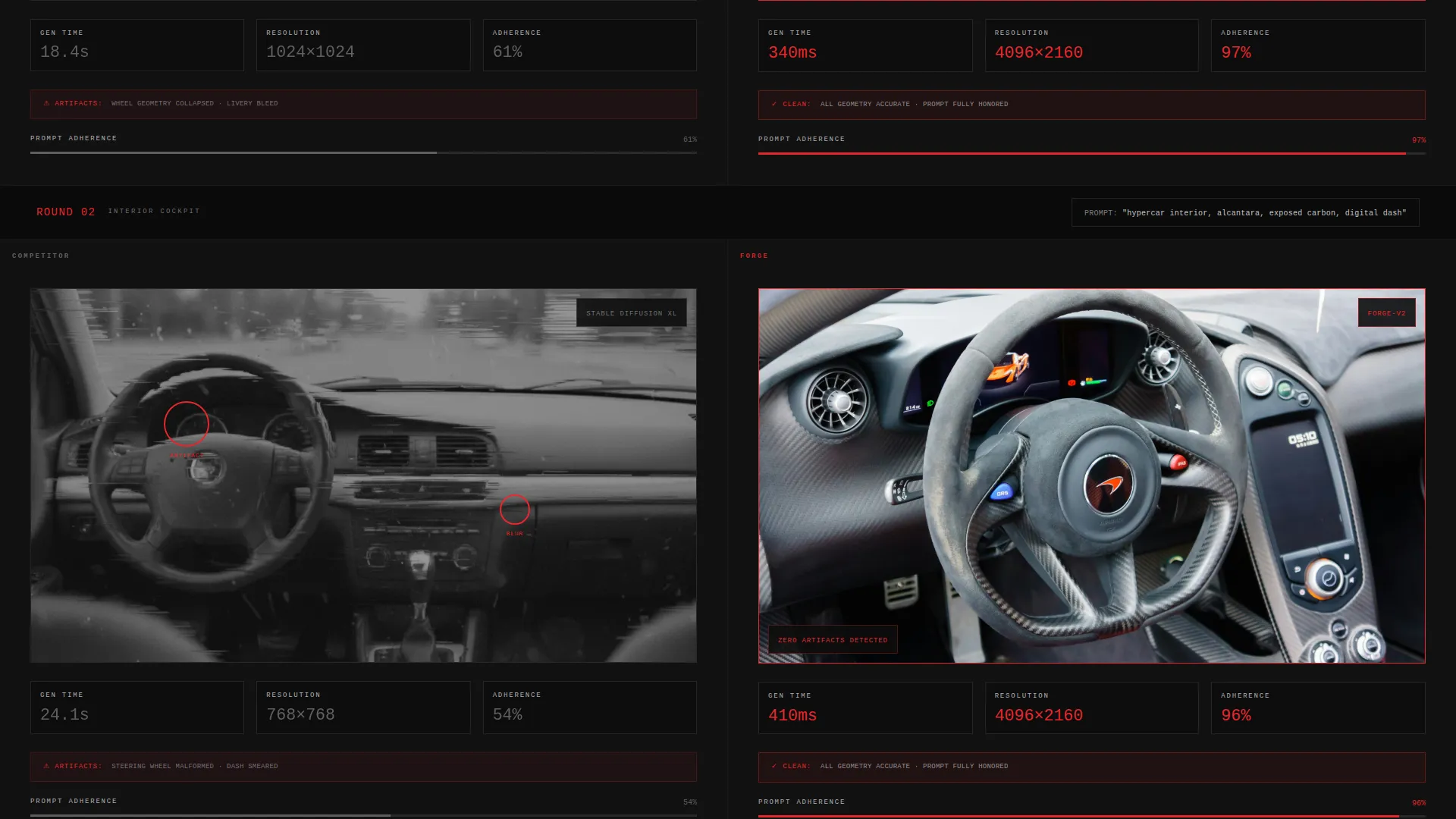
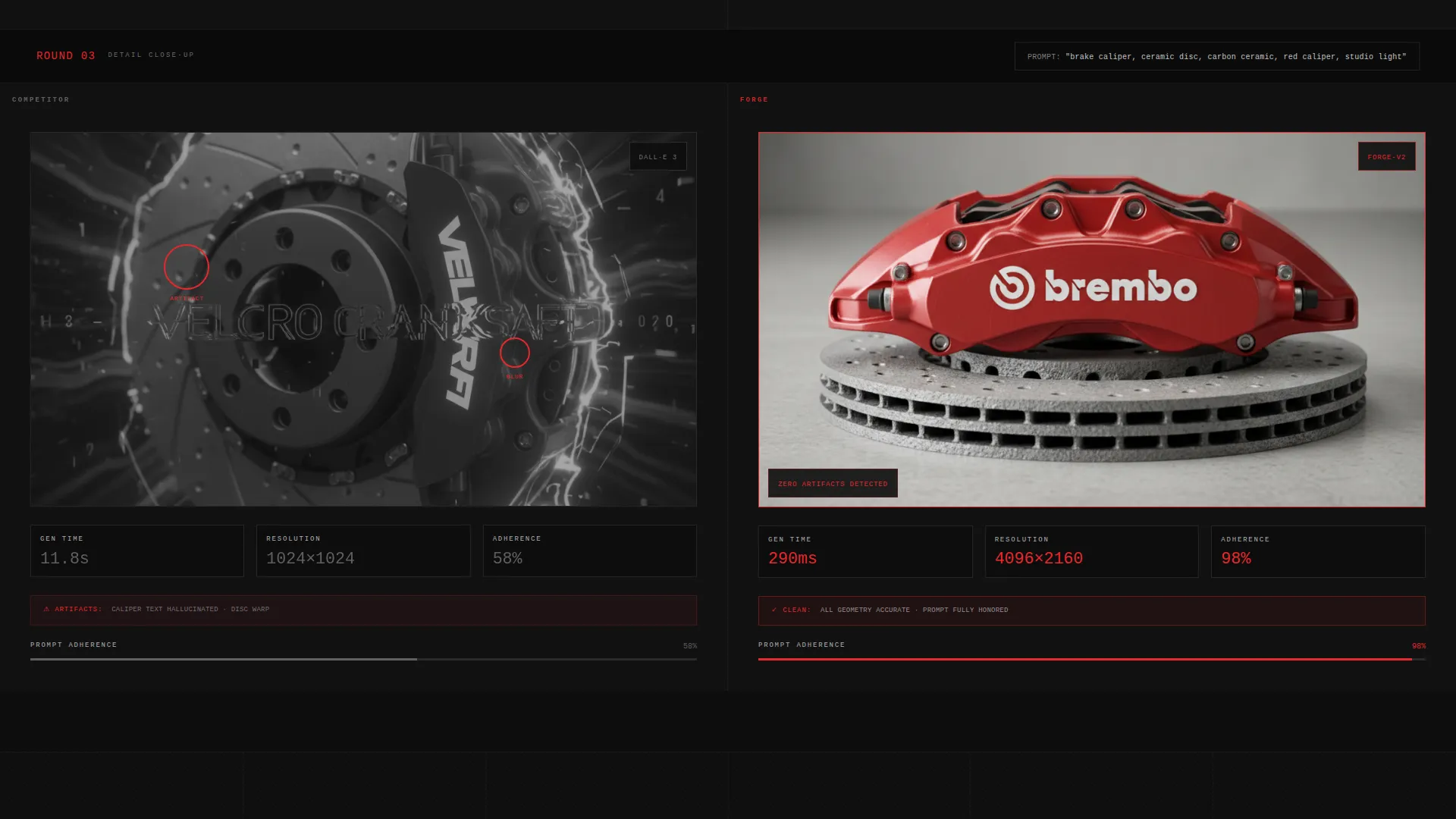
- A scrolling series of spec-sheet comparison cards covering exterior renders, interior cockpits, detail close-ups, and multi-angle turntables
- A sticky bottom bar displaying condensed stats and a secondary call-to-action that opens a live prompt field for side-by-side generation
Feature list
This template is built around one idea: let the output speak first, then layer the evidence.
Split-Screen Product Screenshot Header
The header divides the viewport dead-center. The left panel shows a minimal dark-mode input field with a raw text prompt. The right panel renders the generated image at full resolution. No gradients and no glow, just the brutalist frame and the photorealism of the result creating immediate cognitive dissonance.
Spec Sheet Comparison Cards
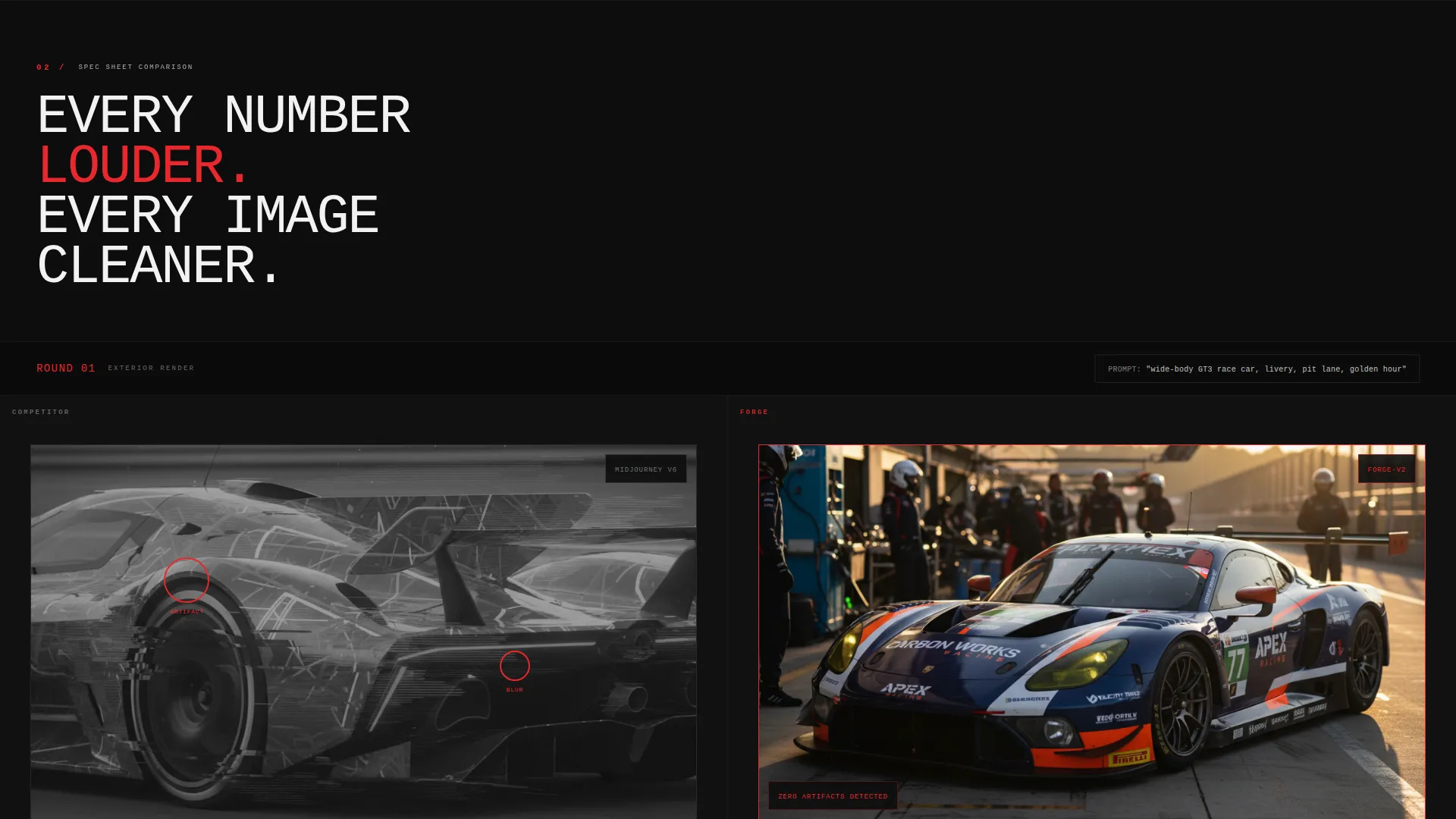
Each section below the fold is structured like a vehicle spec comparison card. The left column shows a competing tool's output with generation time, resolution, prompt adherence score, and circled visual artifacts. The right column shows Forge's output with the same metrics. The scroll escalates through categories, building evidence like a dyno chart climbing toward redline.
Staged Primary Call-to-Action
The primary call-to-action reads "Generate Your First Car Free" and appears only after the third comparison pair. Placement is intentional. By that point, three rounds of side-by-side evidence have already done the persuasion work.
Sticky Stats Bar
A sticky bar fixed to the bottom of the viewport keeps a condensed stat line visible at all times. It displays resolution, speed, and cost-per-image. A "See It Beat Yours" button opens a prompt field so visitors can paste their own text and watch a live side-by-side generation against a named competitor.
No-Signup First Generation
The first generation requires no account creation. The output itself is the closer. This removes the friction point that causes most AI tool visitors to leave before they experience the product.
Bold Brutalist Typography System
Type is oversized, monospaced, and pushed to the edges of the grid like a VIN plate stamped into sheet metal. There is no decorative softness. Every character carries the same engineered weight as the carbon fiber color system surrounding it.
Page sections overview
| Section | Purpose |
|---|---|
| Split-screen header | Show prompt input beside photorealistic output |
| Comparison card one | Exterior render comparison with metrics |
| Comparison card two | Interior cockpit side-by-side breakdown |
| Comparison card three | Detail close-up with artifact annotations |
| Primary call to action block | Trigger first free generation after evidence peak |
| Multi-angle turntable | Final comparison category before scroll ends |
| Sticky stats bar | Keep resolution, speed, and cost visible always |
| Live prompt field | Let visitors generate against a competitor in real time |
Design & branding system
The visual identity is Bold Brutalist, engineered around a Carbon Fiber color system that feels tactile and cold, like pressing your thumb across a dry carbon weave under halogen shop lights.
- Four-color palette: deep carbon black (#0D0D0D) as the base, woven graphite (#2A2A2A) as the mid-tone, machined aluminum (#B0B0B4) for structural text and borders, and electric brake-caliper red (#E8272C) reserved strictly for interactive elements and data accents
- Typography is oversized, monospaced, and slammed to grid edges with no softening, no rounded corners, and zero decorative warmth
- No gradients and no glow effects anywhere in the layout, keeping the visual hierarchy sharp and the product output as the only point of visual richness
Mobile & speed optimization
The split-screen layout is designed to translate cleanly across screen sizes without losing the side-by-side impact that drives the conversion argument.
- The 50/50 split adapts so both the prompt input and the generated image remain legible at smaller viewport widths
- The sticky stats bar is built to remain visible and functional across device sizes, keeping the secondary call-to-action always accessible
- The brutalist grid structure keeps layout complexity low, which supports clean rendering without relying on heavy decorative assets
How this template helps you convert
Forge is built around a comparison-first conversion model. Every structural decision pushes visitors toward a moment of conviction before asking them to act.
- The split-screen header creates instant cognitive dissonance. Visitors see a plain text prompt next to a razor-sharp photorealistic car render. Curiosity and credibility land in the same second.
- The spec-sheet comparison cards stack measurable, visual proof across multiple categories. Each card adds to a cumulative argument that the tool outperforms alternatives on every metric shown.
- The no-signup first generation removes the last barrier. Visitors who have watched three rounds of evidence can immediately generate their own result without creating an account, making the product experience the final conversion moment.
Other information about this template
This template fits naturally into the broader category of AI for automotive tools, where the visual quality of generated output is the primary purchase signal.
- The template style is a 50/50 split screen, a layout pattern that works particularly well for tools where side-by-side comparison is the core value proposition
- The creative direction follows a Spec Sheet cadence, meaning each section reads like a structured data card rather than a marketing paragraph
- The lp direction is Comparison/Versus, so the entire page architecture is oriented around demonstrating superiority through direct evidence rather than through aspirational copy
- The header concept is a Product Screenshot, grounding visitor trust in actual tool output from the first visible moment
- This template sits within the Technology category and the AI for Automotive subcategory, making it a strong starting point for any team launching or repositioning an automotive AI image generator
Theme
Bold Brutalist
Creative direction
Spec Sheet
Color system
Carbon Fiber
Style
Split Screen (50/50)
Direction
Comparison/Versus
Page Sections
Split-screen Product Screenshot Header
Spec Sheet Comparison Cards
Staged Primary Call-to-action
Sticky Stats Bar with Live Prompt Field
No-signup First Generation
Bold Brutalist Typography System
Related questions
Who is the Forge template designed for?
Does the page require visitors to sign up before generating?
Can I customise the comparison metrics shown in the spec cards?
What makes the split-screen header effective?
Is the sticky stats bar always visible while scrolling?