API-First Enterprise Software Directory Website Template
Forge is a bold brutalist bento grid landing page built for an API-first manufacturing execution system (MES). It speaks directly to integration architects, DevOps leads, and plant IT directors. Every section functions as a live spec sheet, stacking head-to-head comparisons, latency benchmarks, code snippets, and a gated comparison PDF form against legacy MES platforms.
by Rocket studio
Quick summary
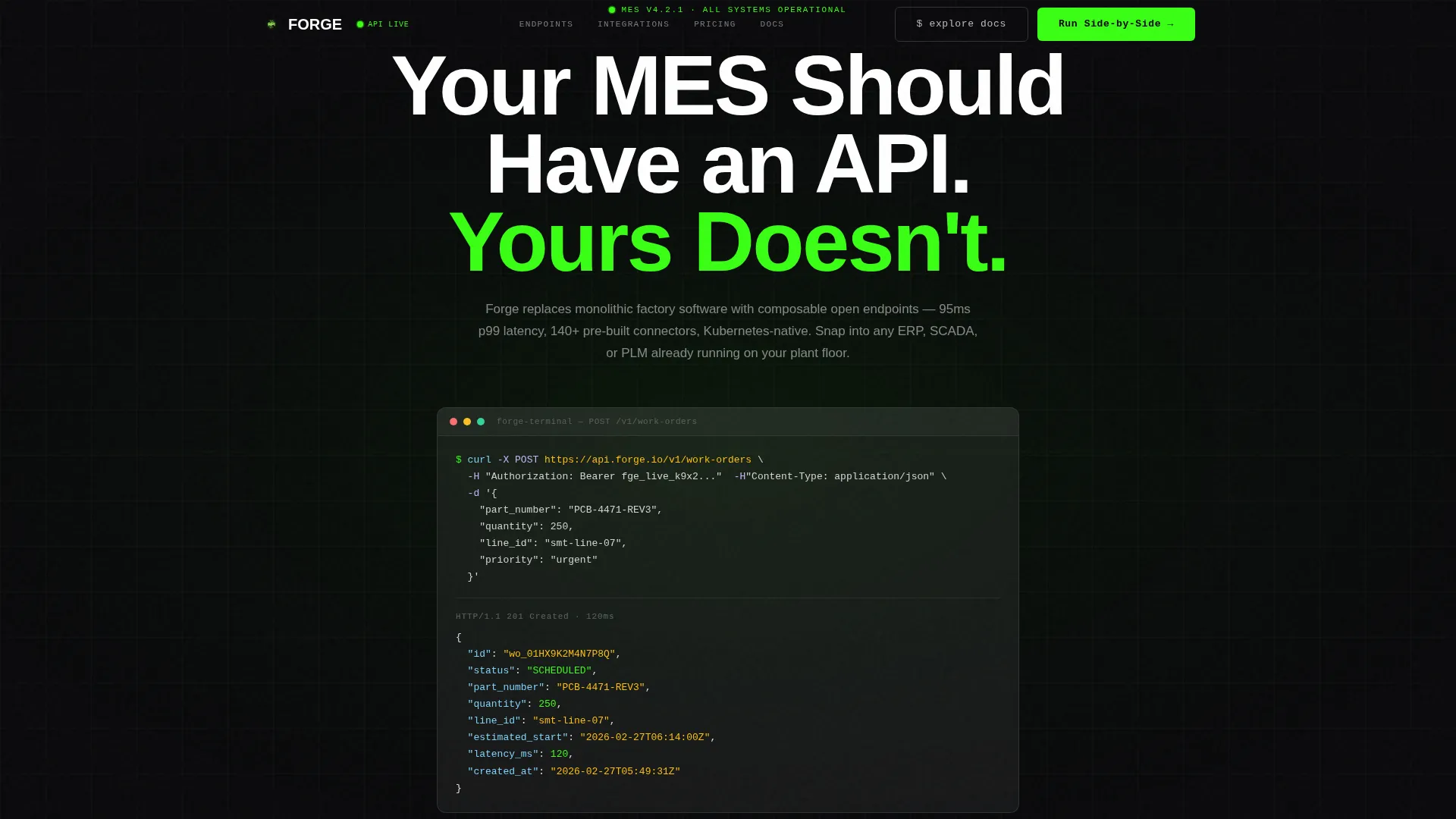
Forge is a single-page bento grid landing page template designed for an API-first manufacturing execution system. It replaces the typical hero image with live code, uses glassmorphic dark-mode tiles to present head-to-head capability comparisons, and drives conversion through a personalized side-by-side comparison PDF form.
Who this template is for
This template is built for technical buyers and decision-makers in industrial manufacturing environments. It speaks the language of people who evaluate software by reading documentation, not watching demo videos.
- Integration architects at mid-market discrete manufacturers evaluating ERP, SCADA, or PLM connectivity
- DevOps leads at contract electronics assemblers who need containerized, zero-downtime deployment options
- Plant IT directors tasked with digitizing the shop floor on constrained budgets and tight timelines
What problem this template solves
Legacy manufacturing execution system platforms are notoriously closed. Evaluators struggle to compare them honestly because vendors hide pricing, obscure latency numbers, and lock integrations behind a sales call. This template solves the trust gap head-on.
- Presents raw performance data, integration counts, and deployment models side by side with incumbent platforms
- Replaces vague marketing copy with falsifiable claims, code snippets, and live-styled API responses
- Gives technical evaluators a direct path to API documentation without filling out a form first
What you get with this template
You get a fully structured bento grid landing page with every section mapped to a specific conversion goal. The layout is dense with information but easy to scan, because every tile carries a distinct purpose.
- A full-bleed dark header with an animated cURL command and live JSON response as the hero element
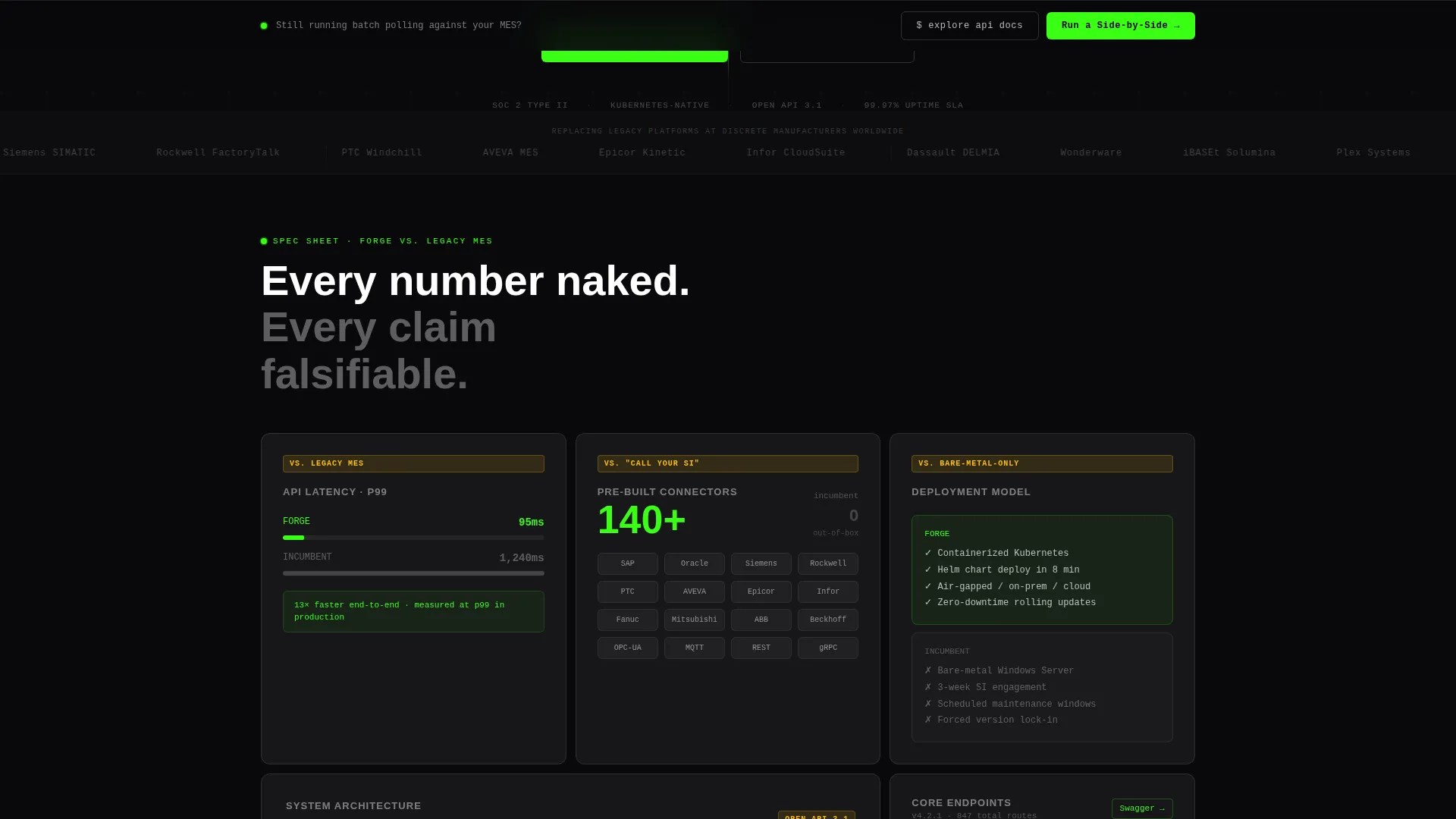
- A scrollable bento grid spec sheet with comparison tiles, micro-charts, architecture diagrams, and endpoint references
- A sticky bottom bar and a closing bento tile, both containing the primary "Run a Side-by-Side" call-to-action form
Feature list
This section covers the core capabilities built into the Forge template as described in the source brief.
Animated Code Hero Header
The header section replaces a traditional hero image with a character-by-character animated cURL command. A JSON response block appears beneath it, showing a work order created in 120ms. A slow-pulsing phosphor green radial glow breathes across the full-bleed black field once every four seconds, making the section feel live and operational.
Bento Grid Spec Sheet Layout
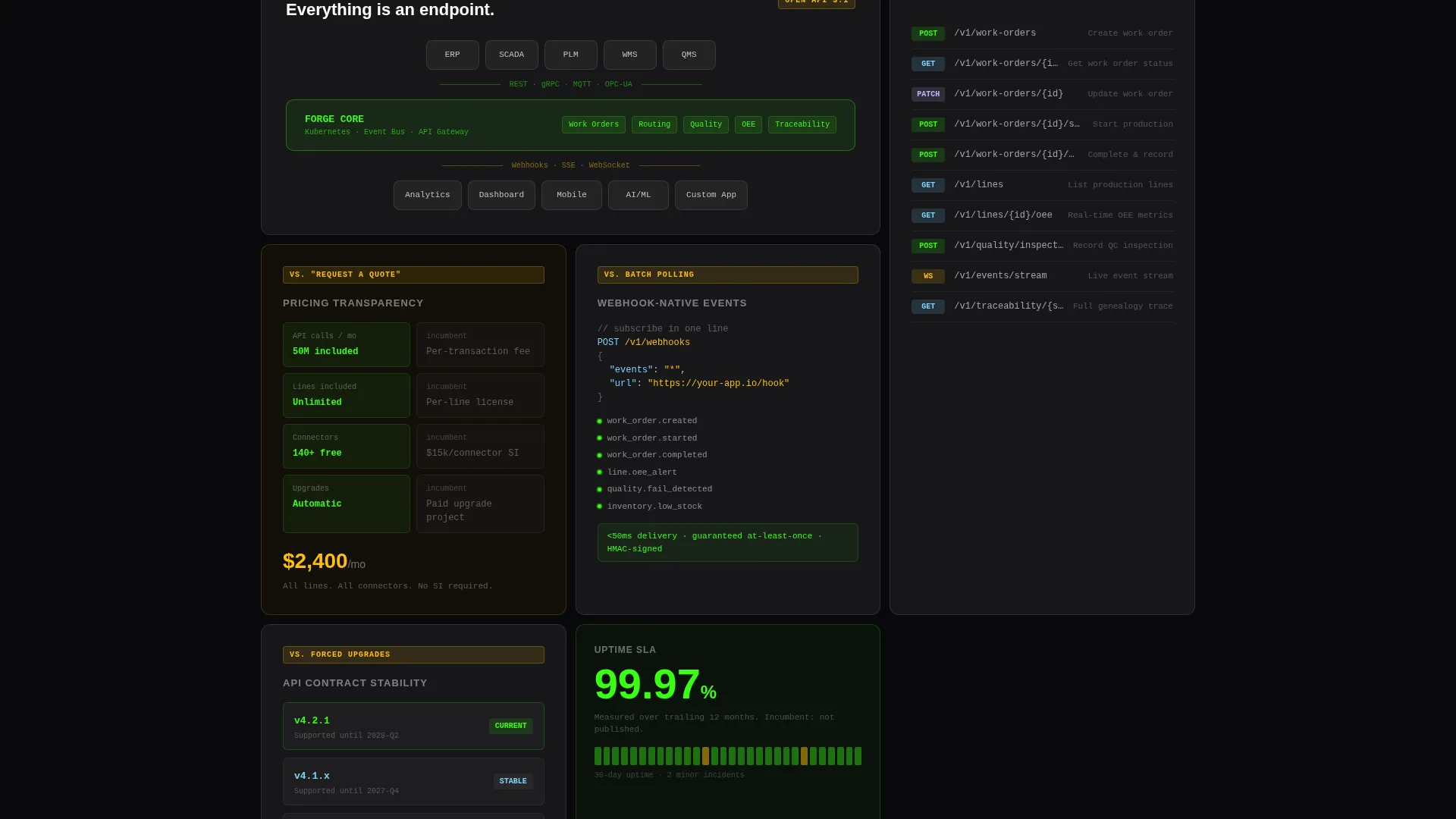
The page body is structured as a bento grid where each tile represents a discrete capability comparison. Tiles scale between small single-stat cards, wide architecture diagrams, and tall scrollable endpoint references. This gives the scroll natural rhythm while keeping every card information-dense and purposeful.
Head-to-Head Comparison Tiles
Each bento tile contains a direct versus data point pitting Forge against legacy MES platforms. Comparisons include latency benchmarks (95ms p99 versus 1.2s), integration connector counts (140-plus pre-built versus "call your SI"), deployment model (containerized Kubernetes versus bare-metal-only), pricing transparency, webhook-native event streams versus batch polling, and semantic versioning versus forced upgrades.
Dual Conversion Path Design
The template supports two conversion flows simultaneously. The primary path drives visitors to "Run a Side-by-Side," a short form collecting current MES platform, number of production lines, and work email, then delivers a personalized comparison PDF within sixty seconds. The secondary path links technical evaluators directly to a public Swagger API reference without a gate.
Sticky Bottom call to action Bar
A persistent sticky bar sits at the bottom of the viewport throughout the scroll. It surfaces the primary call-to-action continuously so visitors never have to scroll back up to convert. The same call-to-action appears again inside the final bento tile as a closing reinforcement.
Glassmorphic Dark-Mode Visual System
Every bento card is styled as a frosted translucent panel floating above a void black background. Borders are 1px rgba white. Blur backdrops run at 12 to 16 pixels. Typography combines monospaced fonts for data and code with oversized grotesque sans-serif headlines, giving the page the feel of a dark-mode terminal overlaid on smoked glass.
Page sections overview
| Section | Purpose |
|---|---|
| Full-Bleed Header | Establish credibility with animated API code hero and pulsing glow |
| Animated Code Block | Show a live work order API call and 120ms JSON response |
| Latency Benchmark Tile | Compare Forge p99 response time against legacy MES baseline |
| Integration Count Tile | Display 140-plus connectors versus incumbent "call your SI" |
| Deployment Model Tile | Containerized Kubernetes versus bare-metal-only comparison |
| Pricing Transparency Tile | Show open pricing against quote-request black boxes |
| Event Stream Tile | Webhook-native streams versus batch polling comparison |
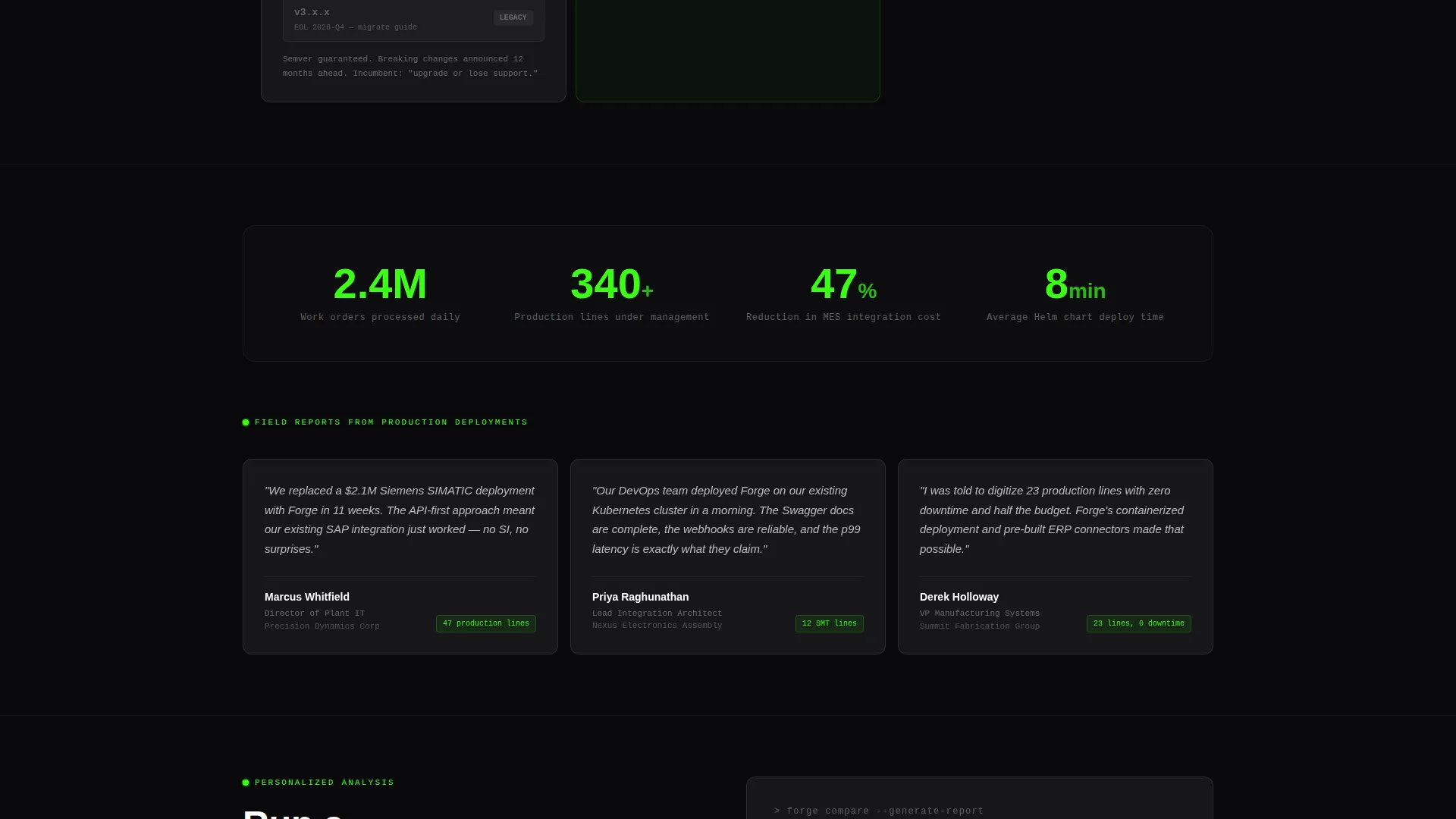
| Versioning Model Tile | Semantic versioning versus forced upgrade comparison |
| Architecture Diagram Tile | Wide-format composable API architecture overview |
| Endpoint Reference Tile | Tall scrollable tile with live endpoint documentation preview |
| Side-by-Side Form | Primary call to action form with MES dropdown, line count, and work email |
| Sticky call to action Bar | Persistent bottom bar surfacing the primary conversion action |
Design & branding system
The Forge template uses a Bold Brutalist theme expressed through a Glassmorphic color system. The palette is built for a dark-mode terminal aesthetic where every element feels operational and alive.
- Core colors: void black (#09090B) background, phosphor green (#39FF14) for live-status accents and code highlights, frosted panel white (#FFFFFF at 6% opacity) for glass bento cards, and signal amber (#FFBE0B) for warnings, comparison callouts, and call-to-action hover states
- Typography: monospaced fonts for all data, code, and benchmark figures; oversized grotesque sans-serif for headlines; both used at large, unapologetic scale
- Glass card styling: 1px rgba white borders, 12 to 16 pixel blur backdrops, translucent tile surfaces that catch edge light like a heads-up display panel
Mobile & speed optimization
The bento grid layout is designed to adapt across viewport sizes. Tile scaling ensures that single-stat cards, wide diagrams, and tall endpoint references reflow without losing the core comparison structure.
- Bento tiles scale from multi-column desktop grids to single-column stacked layouts on smaller screens
- Sticky bottom call to action bar remains accessible at all viewport widths, keeping the conversion path always visible
- Typography sizing is set at oversized scale on desktop and adjusts proportionally so headlines remain impactful on mobile
How this template helps you convert
Every design and copy decision in Forge is structured to move a skeptical technical buyer from doubt to action. The page earns the click before it asks for anything.
- The animated code hero establishes immediate technical credibility. Visitors see a real API call and a real response time before reading a single marketing claim, which builds trust with developer and architect audiences before the pitch begins.
- The bento spec sheet stacks falsifiable evidence across the full scroll. By the time a visitor reaches the comparison form, the latency numbers, connector counts, deployment model, pricing model, event architecture, and versioning policy have already made the argument on the template's behalf.
- The dual conversion path removes friction for both buyer types. Technical evaluators can jump directly to API documentation without a gate, while business decision-makers are guided toward the personalized comparison PDF form, ensuring neither audience hits a dead end.
Other information about this template
This template is a strong fit for software vendors, platform teams, and agencies building go-to-market pages for API-first enterprise software in industrial or manufacturing technology verticals.
- The template style is Bento Grid with a Bold Brutalist theme, making it distinct from standard SaaS landing page conventions
- The Glassmorphic color system and void black base palette are fully defined in the brief and can be adapted to related dark-mode enterprise products
- The side-by-side comparison PDF flow is described as delivering a personalized output to the visitor's inbox within sixty seconds of form submission
- The public Swagger API reference link is a secondary conversion path designed for ungated technical exploration
- This template is built as a single landing page and is not a multi-page website template
Theme
Bold Brutalist
Creative direction
Spec Sheet
Color system
Glassmorphic
Style
Bento Grid
Direction
Comparison/Versus
Page Sections
Animated Code Hero Header
Bento Grid Spec Sheet Layout
Head-to-head Comparison Tiles
Dual Conversion Path Design
Persistent Sticky Call to Action Bar
Glassmorphic Dark-mode Card System
Related questions
Who is the Forge landing page template built for?
What makes the header section different from a typical hero?
How does the comparison form work?
Can technical evaluators access proof without filling out a form?
Is this template suitable for non-manufacturing software products?