Powerful API-First Landing Page Template
Endpoint is a dashboard and data grid landing page built for API-first point-of-sale systems. It combines glassmorphic JSON panels, a spec-sheet grid layout, and a phosphor-green call-to-action flow to speak directly to developers. The template helps CTO-founders, agency engineers, and solo builders understand and adopt a RESTful checkout layer in minutes.
by Rocket studio
Quick summary
Endpoint is a single-page developer landing page designed for an API-first point-of-sale system. It surfaces live-formatted JSON panels, a scannable endpoint directory, and an inline sign-up form. The visual language feels like a CRT terminal running at full brightness. Developers arrive, scan the capability grid, and request API keys without friction.
Who this template is for
This template is built for technical founders and developers who ship products, not slide decks. If your audience reads request/response pairs the way others read bullet points, this page speaks their language.
- CTO-founders at vertical SaaS companies who need to embed checkout into their own platforms
- Agency developers building custom kiosk experiences for restaurant groups or retail clients
- Solo engineers prototyping hardware concepts at hackathons who need a transaction layer fast
What problem this template solves
Most landing pages for developer tools bury the product under marketing copy. Developers arrive, scroll past hero images and testimonial carousels, and leave before seeing a single line of actual capability. This template treats the API surface as the product and puts it front and center.
- No lifestyle photography or abstract hero visuals dilute the message
- Visitors can scan endpoints, latency benchmarks, and payload previews before committing to sign up
- The freemium path removes credit card friction and delivers API keys in under sixty seconds
What you get with this template
You get a complete, desktop-first landing page structured around how developers actually evaluate tools: browse, scan, drill, repeat. Every section is purposeful and data-forward.
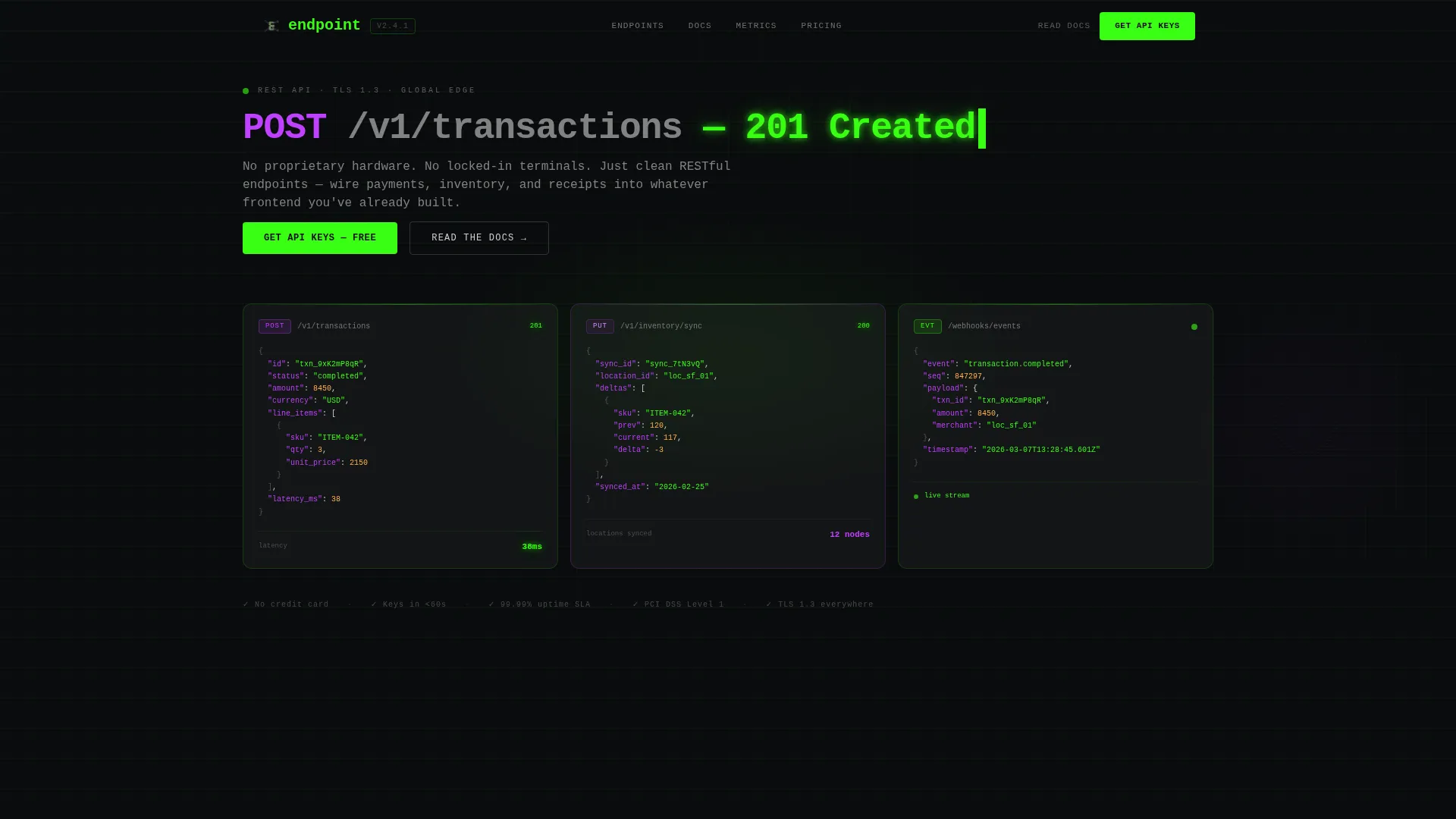
- A header with three glassmorphic JSON panels showing live-formatted transaction, inventory, and webhook response objects
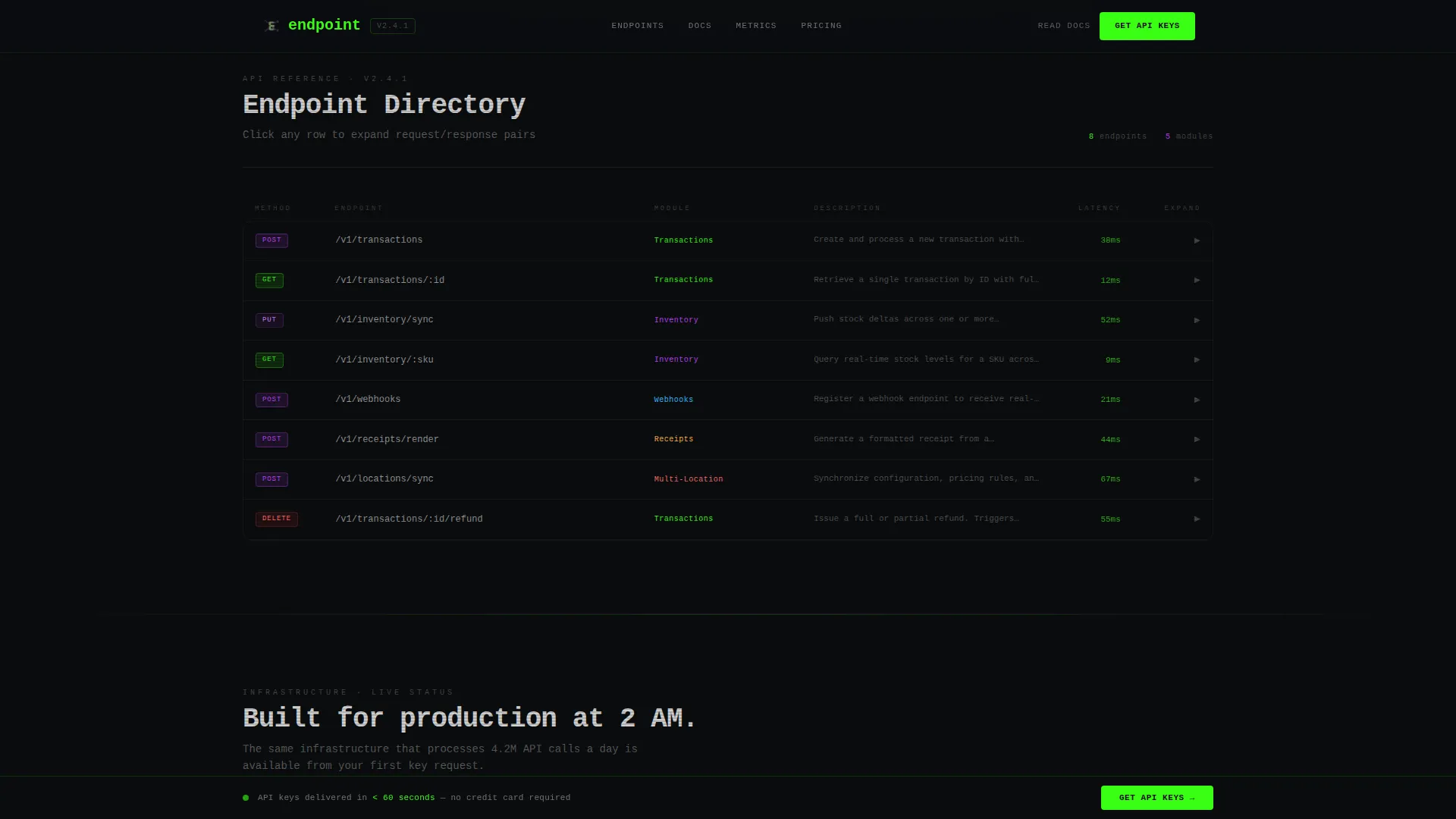
- A spec-sheet API directory grid with endpoint names, method badges, latency benchmarks, and expandable payload previews
- An inline sign-up form with a contextual dropdown and a sticky call-to-action bar that persists after first scroll
Feature list
This section describes the key built-in components and layout capabilities included in the Endpoint template.
Glassmorphic JSON Header Panels
Three frosted, translucent Dark Glass Panel cards float on a void-black background. Each displays a live-formatted JSON response: a transaction object with itemized line items, an inventory sync payload with stock deltas, and a webhook event with a real-time ticking timestamp. Phosphor-green reflections catch at the panel edges.
Spec-Sheet API Directory Grid
The API Directory section renders as a data grid where each row shows an endpoint name, a method badge colored in UV purple (for GET, POST, and PUT), a latency benchmark in phosphor green, and an expandable payload preview on the right. The rhythm mirrors how developers already browse API reference documentation.
Expandable Payload Explorer Cards
Each module in the Payload Explorer section expands on click to reveal full request and response pairs. Transaction processing, inventory management, multi-location sync, webhook configuration, and receipt templating each live in their own discoverable card. No content is hidden behind separate pages.
Infrastructure Metrics Block
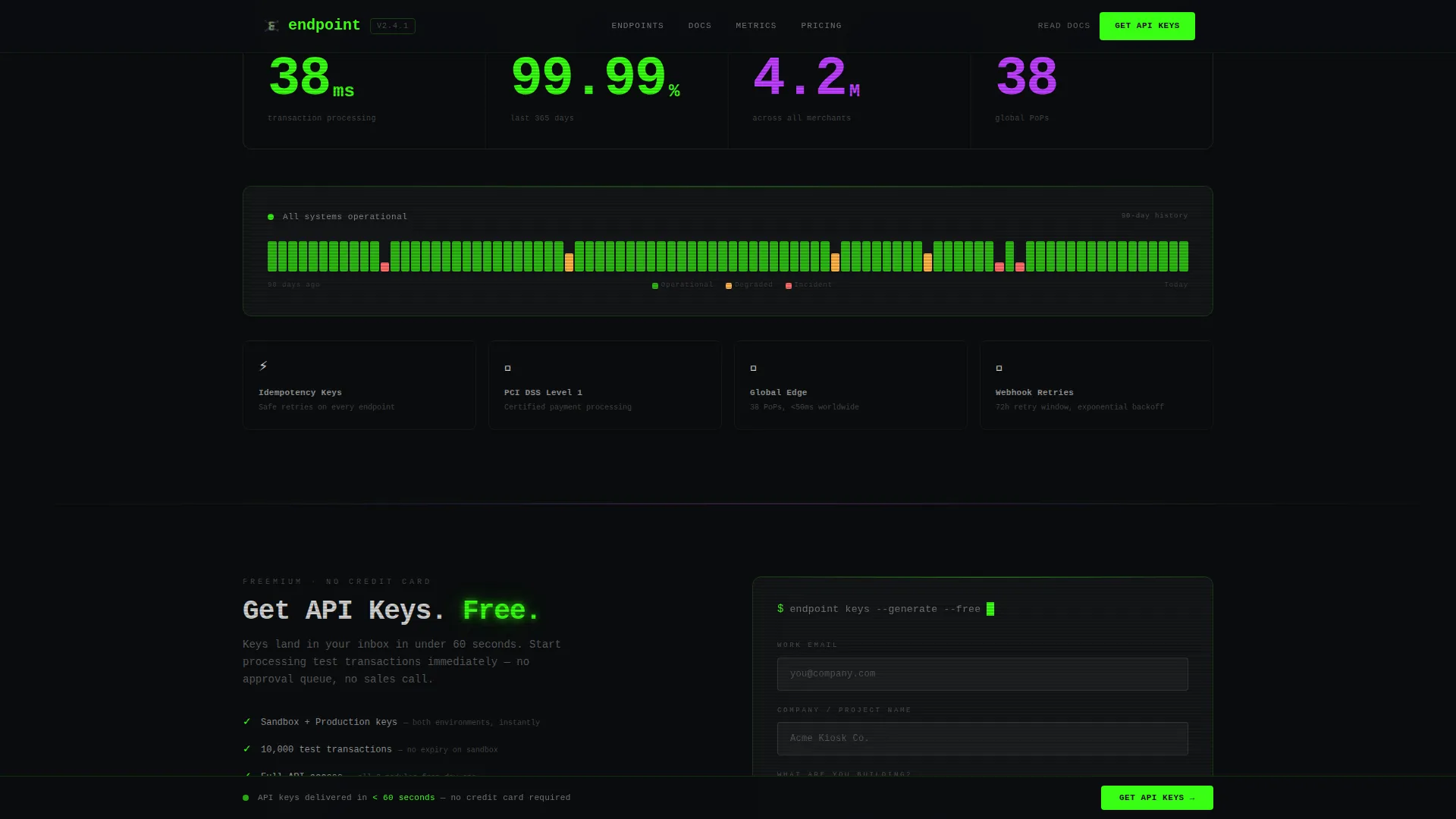
A dedicated section surfaces uptime figures, p99 latency benchmarks, throughput numbers, and global node counts. These are presented as live-signal data points in phosphor green, giving developers the social proof they need to trust the infrastructure before writing a single line of integration code.
Inline API Key Sign-Up Form
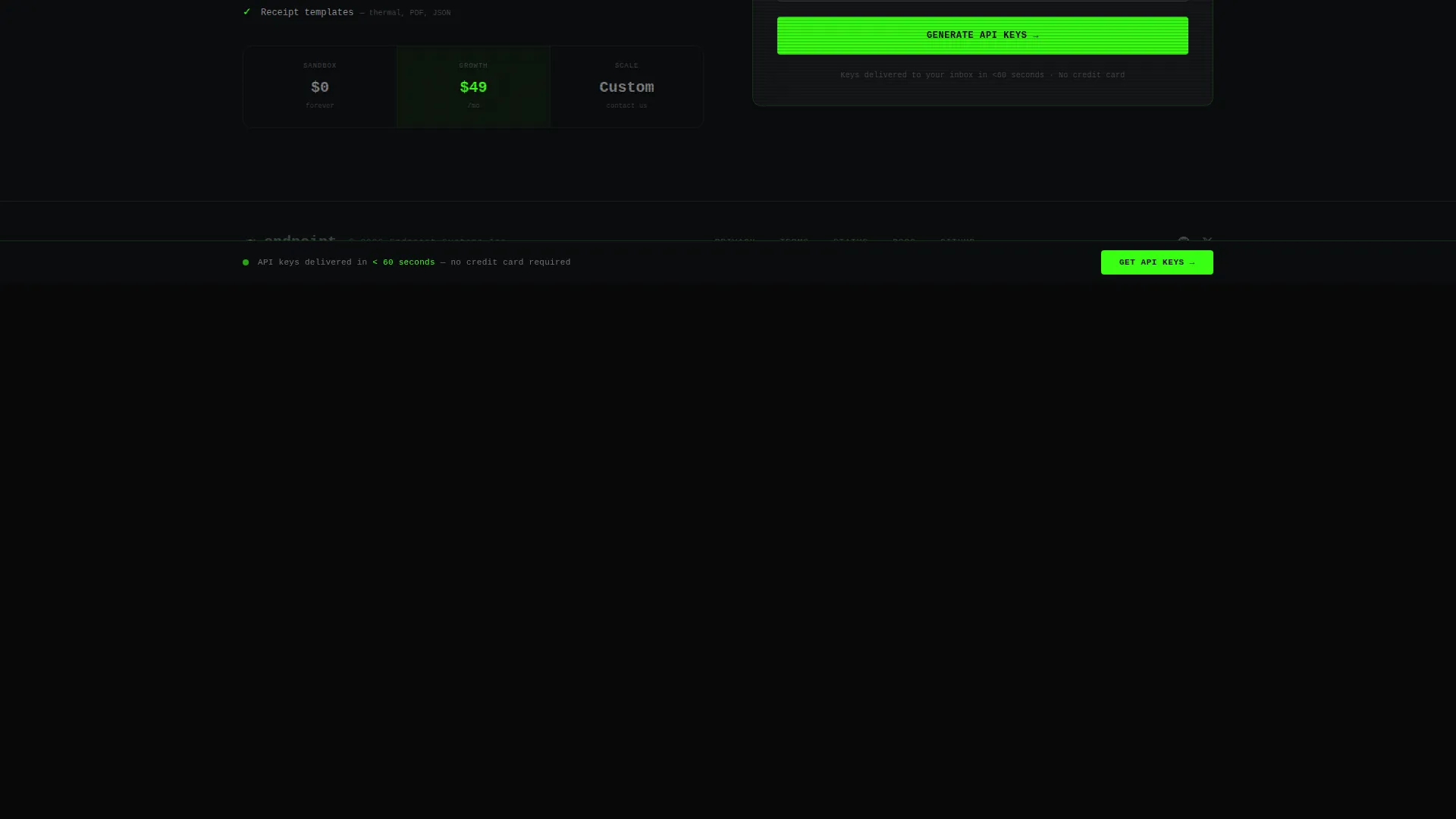
The "Get API Keys" call-to-action opens an inline form asking for email, company name, and a single dropdown: "What are you building?" Options include Custom kiosk, SaaS embed, Mobile checkout, and Just exploring. No credit card is required. The page explicitly promises key delivery in under sixty seconds.
Sticky Call-to-Action Bar
After the first scroll, a sticky bar floats persistently at the bottom of the viewport with the primary "Get API Keys" action in a phosphor-green button. A secondary "Read the Docs" link sits alongside it for visitors who need to evaluate before committing.
Page sections overview
| Section | Purpose |
|---|---|
| Hero JSON Header | Introduce the product through live-formatted JSON panels and a monospace headline |
| API Directory Grid | Let developers scan all endpoints, method badges, and latency benchmarks at a glance |
| Payload Explorer | Allow drill-down into request and response pairs per module |
| Infrastructure Metrics | Surface uptime, throughput, and latency figures as trust signals |
| Get API Keys | Convert visitors with an inline freemium form and no credit card requirement |
| Developer Footer | Provide minimal GitHub-style navigation and documentation links |
Design & branding system
The visual identity follows the Acid Digital color system inside a Directory and Discovery theme. Every color choice is functional: it signals status, not style.
- Void black (#0B0D0F) covers every background surface, UV purple (#BF40FF) marks endpoint method badges and hover states, phosphor green (#39FF14) highlights live data and primary actions, and terminal silver (#D0D0D0) carries all documentation body text
- Typography pairs JetBrains Mono for all code, endpoint names, and JSON output with DM Sans for supporting interface copy
- Animation runs high throughout: a blinking cursor in the header, a real-time JSON ticker in the webhook panel, sticky bar entrance, and expand/collapse transitions on payload cards
Mobile & speed optimization
This template is designed desktop-first, reflecting the reality that its target audience builds and evaluates tools inside desktop IDEs and wide-viewport browser environments. The layout prioritizes horizontal data grids and multi-column panel arrangements that read best at full width.
- Interactive components such as the expandable payload cards and inline form use client-side rendering only where needed, keeping the rest of the page on optimized server components
- The sticky call-to-action bar and JSON ticker animations are scoped to avoid unnecessary layout recalculation on scroll
- The developer footer follows a GitHub-minimal pattern, keeping the page weight low at the bottom of the scroll path
How this template helps you convert
The entire conversion architecture is built around reducing the gap between "I just arrived" and "I have working API keys." Every structural decision moves developers closer to that first successful response.
- The three JSON panels in the header act as immediate proof of capability, replacing abstract claims with real data structures that developers recognize and trust on sight
- The spec-sheet grid and expandable payload explorer let visitors self-qualify by drilling into the exact endpoints relevant to their use case before touching the sign-up form
- The sticky "Get API Keys" bar combined with the inline form and explicit sixty-second key delivery promise removes every remaining barrier at the moment of intent
Other information about this template
This template is part of a broader set of developer-focused landing page designs built for API infrastructure and fintech tooling use cases. It is worth noting a few additional practical details about how the template is positioned and structured.
- The template style is classified as Dashboard and Data Grid, making it well suited for any API-first enterprise software product that needs to present structured endpoint data in a scannable format
- Localization defaults are set to English, United States Dollar currency formatting, and ISO 8601 timestamp display throughout the JSON panels
- The footer follows the GitHub Developer Minimal pattern, providing clean links to documentation, status pages, and repository references without visual noise
- This template works well for any RESTful API product in the developer tools, fintech, or payment infrastructure space that needs a freemium or trial-driven acquisition flow
Theme
Directory & Discovery
Creative direction
Spec Sheet
Color system
Acid Digital
Style
Dashboard/Data Grid
Direction
Freemium/Trial
Page Sections
Glassmorphic JSON Header Panels
Spec-sheet API Directory Grid
Expandable Payload Explorer
Infrastructure Metrics Display
Inline Freemium Sign-up Form
Sticky Call-to-action Bar
Related questions
Does this template require any proprietary hardware or terminal setup?
Can I adapt the endpoint names and JSON panel content for a different API product?
Is the Get API Keys form connected to a backend by default?
What developer audience does this landing page serve best?
Does the page include a path for visitors who are not ready to sign up?