Biology Education Portfolio Website Template
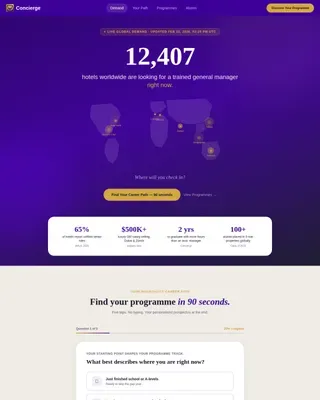
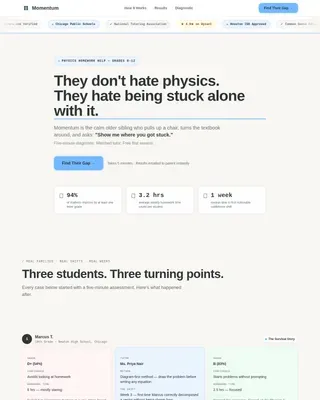
Nucleus is a single-column biology study guide landing page template built for students who need more than summaries. It pairs a Corporate Precision visual system with a Case Study Narrative structure, guiding visitors through real exam scenarios before presenting a live session registration form. The design is clean, credible, and engineered to convert pre-med students, AP Biology juniors, and graduate teaching assistants into engaged learners.
by Rocket studio
Quick summary
Nucleus is a focused, single-column flow landing page template for biology education. It uses a Case Study Narrative layout to present real study scenarios, then moves visitors toward event registration or a sample chapter download. The design follows a Corporate Precision aesthetic with a Slate and Sky color system, making complex biological content feel structured, authoritative, and immediately trustworthy.
Who this template is for
This template is built for educators, course creators, and EdTech companies that serve biology students at the pre-collegiate and undergraduate level. It speaks directly to the study materials audience and positions a biology resource as a precision system rather than a casual note collection. Whether you are launching a study vault, promoting a live walkthrough session, or capturing email leads with a sample chapter, this template gives you the right structure.
- Pre-med sophomores and AP Biology juniors grinding through cellular processes and genetics at exam time
- Graduate teaching assistants who need clean, projectable reference materials for recitation sections
- EdTech companies and independent educators offering structured biology study guides and notes resources
What problem this template solves
Biology students at every level face the same core problem: the volume of content is enormous, and most available materials are either too dense or too shallow to be genuinely useful. Nuclei diagrams without clear labels, enzyme pathway charts without logical flow, and gene expression summaries that blur together the night before an exam all contribute to the same frustration. This template addresses that trust gap head-on.
- Students arrive at study resource pages skeptical; the Case Study Narrative format presents evidence before asking for commitment
- Educators and companies struggle to convey the depth of their materials on a single page; the case study scroll structure proves value section by section
- Generic landing page designs undermine the scientific credibility of biology resources; this template's clinical precision aesthetic signals accuracy before a visitor reads a single word
What you get with this template
You get a fully structured, single-column landing page layout designed specifically for biology study guide promotion and event registration. Every section is purposeful and ordered to build trust progressively. The page opens with a Logo Bar that displays social proof immediately, then leads visitors through three escalating case studies before presenting the registration form.
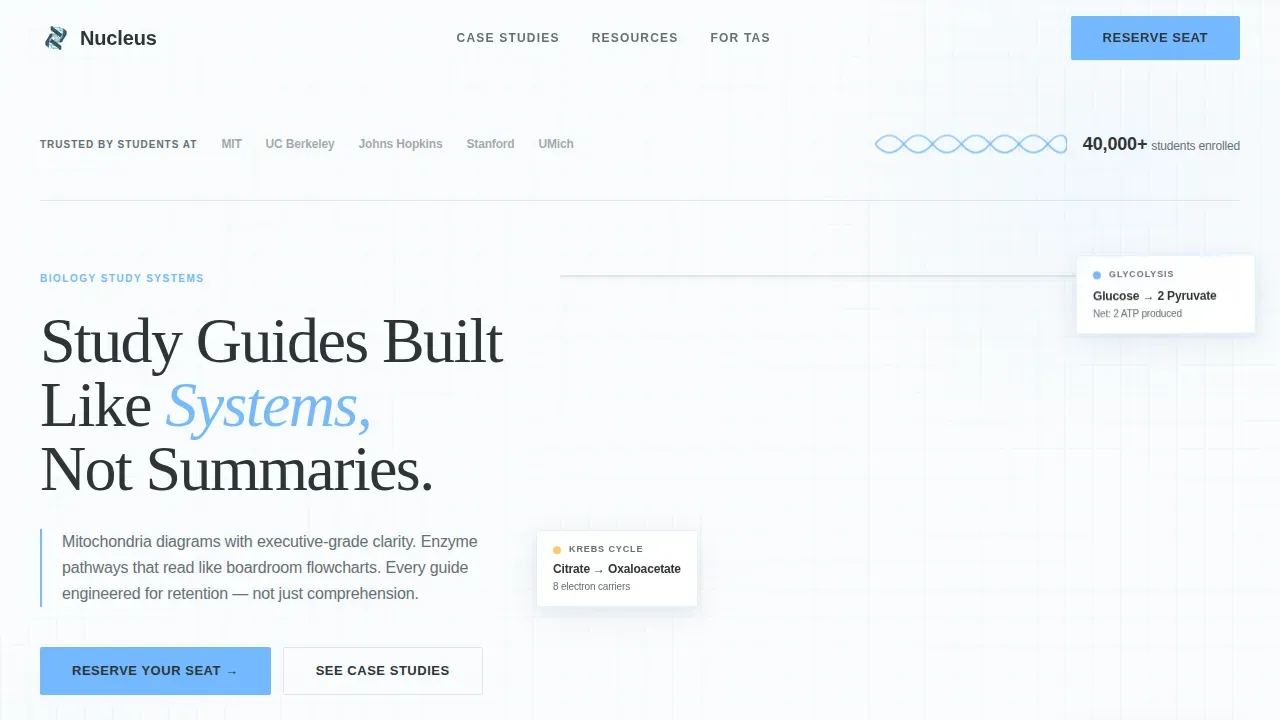
- A Logo Bar hero section with a wordmark strip, social proof counter, and animated DNA helix line that traces horizontally across the header
- Three case study scroll sections covering cellular respiration, visual mnemonics for AP Biology exam prep, and graduate-level reference sheet use cases
- A dual-conversion registration section with a seat reservation form and a secondary email capture path for sample chapter downloads
Feature list
This section covers the core built-in capabilities of the Nucleus landing page template, drawn directly from the design brief and interaction specifications.
Animated Logo Bar Header
The header opens with a slim, confidence-establishing strip that displays the Nucleus wordmark in deep graphite slate alongside university biology department logos and a live student counter showing usage at scale. A subtle animated double-helix line traces left to right across the bar, referencing DNA structure visually without competing with the headline. Below the bar, a single oversized headline anchors the page in restrained authority.
Case Study Narrative Scroll Sections
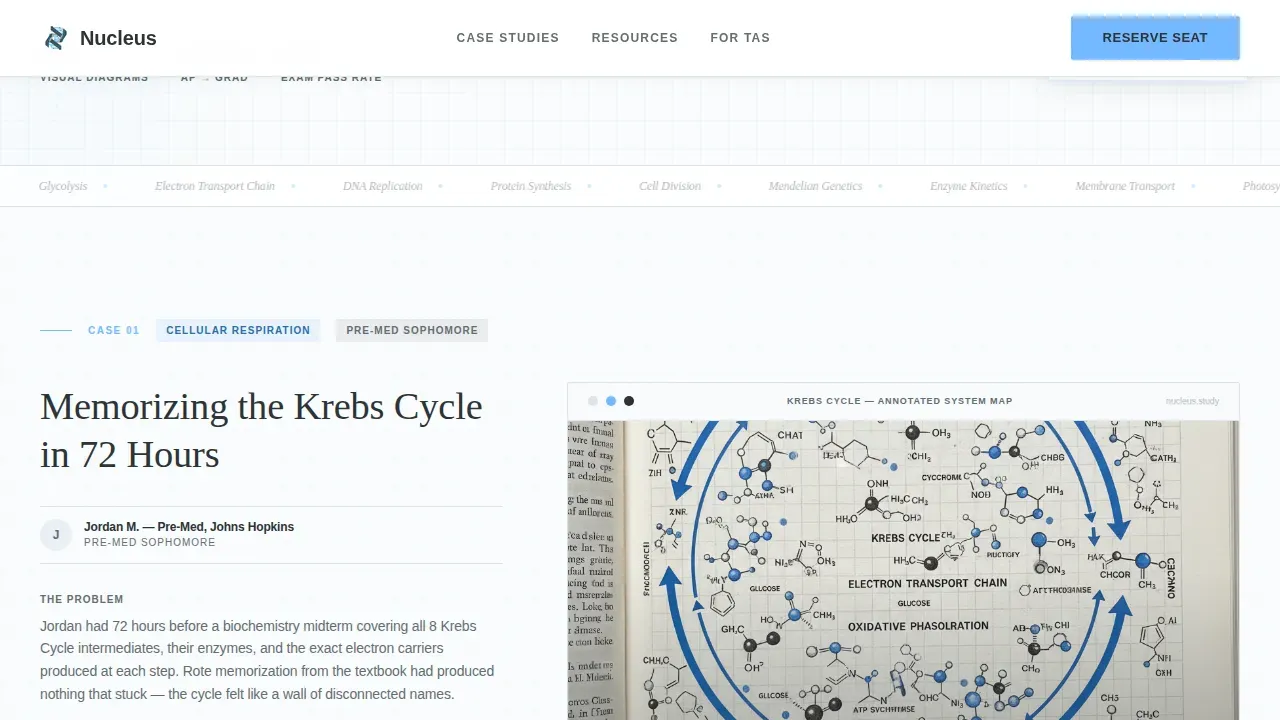
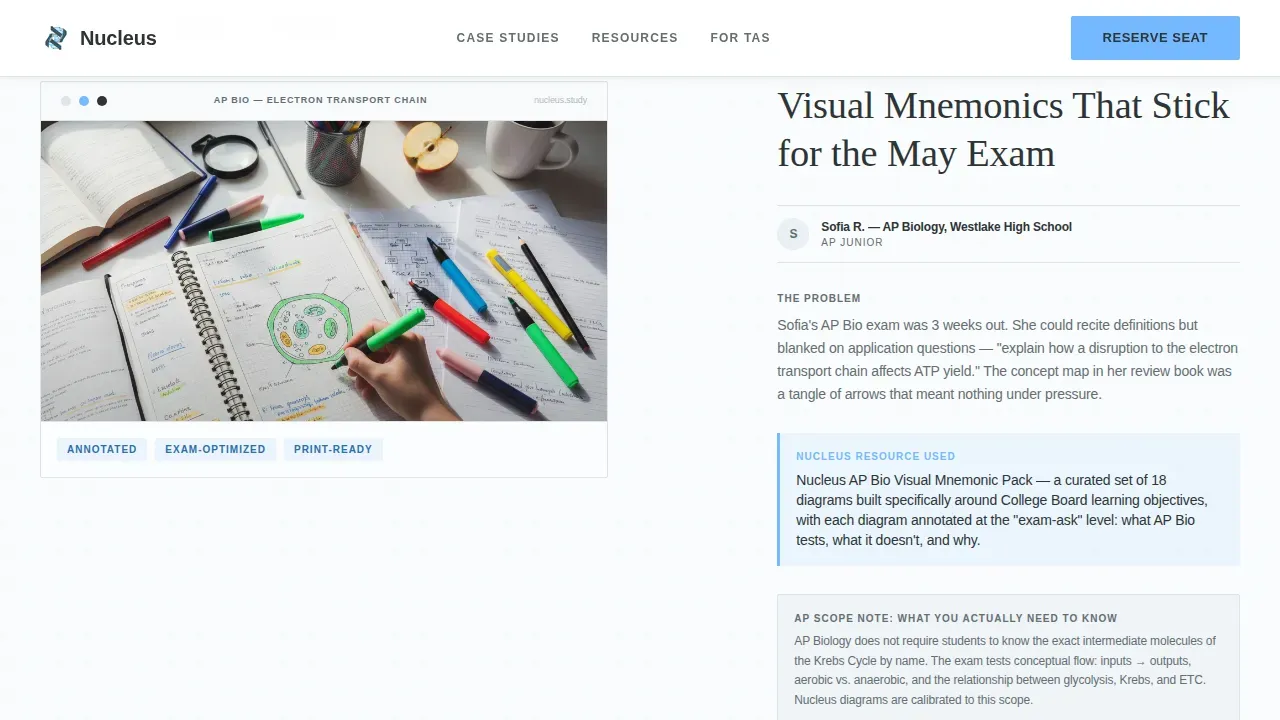
Three scroll-triggered case study sections form the body of the page. Each case profiles a realistic study scenario: the first covers memorizing the Krebs Cycle in 72 hours, the second addresses AP Biology visual mnemonics for May exam preparation, and the third presents graduate teaching assistant reference sheet use. Each case opens with a student problem, reveals the specific resource used, shows an annotated diagram mid-study, and closes with the exam outcome. The biological complexity escalates across cases, moving from cell structure and cellular processes through genetics and into ecology, building institutional confidence in the depth of the materials.
Dual-Conversion Registration Section
The page includes a primary registration form for live walkthrough session seats and a secondary email capture form for sample chapter downloads. The primary form collects first name, university or school name, current biology course via dropdown, and preferred session time. The secondary path asks only for an email address, reducing friction for visitors who are not yet ready to commit to a live event. Both conversion paths are presented within the same section, making the choice clear without creating visual conflict.
Corporate Precision Visual System
The template applies a Slate and Sky color system throughout. Deep graphite slate is used for primary text and section dividers, mid-tone surgical gray handles secondary copy and figure labels, clinical sky blue acts as the accent on buttons, highlighted terms, and diagram callouts, and sterile white forms the background field. This palette functions like a freshly calibrated instrument: temperature-neutral, sharp-edged, and precise. The single thread of blue draws the eye to the most important structures on each screen.
DM Sans and Fraunces Typography Pairing
Body text is set in DM Sans for maximum clarity at reading size. Display headings use Fraunces, a serif typeface that gives scientific hierarchy and weight to section titles without sacrificing the clinical precision of the overall system. The combination signals both academic credibility and modern readability, which is crucial for a biology study resource aimed at students who associate clean formatting with trustworthy content.
Scroll-Triggered Micro-Animations
The template includes medium-complexity animations designed to reinforce the content structure rather than distract from it. Floating card micro-animations accompany the case study diagram reveals, and the animated counters on the social proof elements add live credibility to usage data. All animations are scroll-triggered, meaning they activate as visitors reach each section, maintaining the forward momentum of the case study narrative.
Page sections overview
| Section | Purpose |
|---|---|
| Logo Bar Hero | Establish trust instantly with wordmark, university logos, student counter, and animated DNA helix |
| Case Study One | Profile the Krebs Cycle memorization scenario for pre-med sophomores |
| Case Study Two | Present AP Biology visual mnemonic use case for junior exam preparation |
| Case Study Three | Show graduate teaching assistant reference sheet use case |
| Registration and Download | Deliver dual conversion paths: live session seat reservation and sample chapter email capture |
| Linear Footer | Close the page with single-row footer information |
Design & branding system
The visual identity of this template is built around a Corporate Precision theme that treats biological complexity the way a research institution treats data: with structure, clarity, and zero visual noise. The Slate and Sky palette keeps every element readable and purposeful. The restrained use of sky blue as the single accent color means that every button, callout, and highlighted term immediately draws the eye without overwhelming the sterile white field.
- Graphite slate (#2D3436) for primary text, headings, and section dividers; surgical gray (#636E72) for secondary copy and figure labels
- Clinical sky blue (#74B9FF) reserved exclusively for interactive elements, diagram callouts, and highlighted terms to direct reader attention precisely
- Sterile white (#FAFCFD) background field and DM Sans body type paired with Fraunces serif display headings for a lab notebook aesthetic
Mobile & speed optimization
The template is built desktop-first, reflecting the reality that biology students often work late-night study sessions on laptops. However, mobile parity is maintained across the layout so that every section, form, and case study remains fully usable on smaller screens. The single-column flow structure makes mobile adaptation straightforward because the content hierarchy is already linear.
- Single-column layout adapts cleanly to mobile viewports without restructuring the narrative flow of the case study sections
- Server Components power the static sections for consistent rendering, while Client Components handle the scroll-triggered animations and interactive form elements
- Registration forms are kept short and dropdown-driven to minimize input friction on touch devices
How this template helps you convert
The Nucleus template is designed to earn conversions rather than demand them. By the time a visitor has read through three escalating case study sections, the registration form feels like a natural continuation of the story rather than an interruption. The dual-path conversion structure ensures that even visitors who are not ready for the live session leave with a meaningful next step.
- The Case Study Narrative builds evidence progressively, so each scroll section increases confidence in the resource and reduces resistance to the registration ask
- The dual-conversion section presents two clear options at the moment of highest engagement: reserve a live session seat or download a sample chapter, capturing leads at different levels of readiness
Other information about this template
This template is designed for biology education at the intersection of academic rigor and digital presentation. The following context is relevant for teams evaluating this template for their specific use case.
- The page is localized for United States audiences in English, with pricing and course references oriented toward the American educational context including AP Biology and university biology department structures
- The nucleus is a fundamental organelle in eukaryotic cells, often referred to as the control center of the cell. It is a membrane-bound organelle that contains the cell's genetic material, housed within a nuclear envelope that separates it from the cytoplasm. Nuclear pores are large protein complexes that span this envelope, allowing the transport of molecules such as RNA and proteins in and out. The nucleolus, a dense region within the nucleus, is responsible for producing ribosomal RNA and assembling ribosomes, which are essential for protein synthesis.
- The nucleus controls gene expression by regulating the transcription of DNA into messenger RNA. It allows cells to respond to external signals by altering gene expression patterns, and it plays a pivotal role in cell growth, differentiation, and development. During cell division, the nucleus ensures the accurate replication and distribution of genetic material to daughter cells.
- Mutations in nuclear DNA can lead to uncontrolled cell division and cancer. They can also cause genetic disorders such as cystic fibrosis, sickle cell anemia, and Huntington's disease. Conditions such as progeria and muscular dystrophy are linked to defects in nuclear envelope proteins, which lead to abnormal nuclear structure and function.
- Understanding the structure and functions of the nucleus is crucial for comprehending cell biology and the mechanisms underlying various diseases. This scientific grounding is why the template's case studies escalate in biological complexity, from basic cell structure through genetics and into ecosystem-level analysis.
- Nucleus segmentation methods are essential for accurate image analysis in research fields such as developmental biology and pathology. Deep learning approaches have significantly improved the accuracy of nucleus segmentation, and annotated datasets are crucial for training the machine learning models used in this process. Various software tools are available for creating annotations for cell segmentation training or validation.
- Single-cell imaging technologies enable the study of cellular interactions and tissue organization at unprecedented resolution. Single-cell analysis encompasses genomics, transcriptomics, proteomics, and metabolomics at single-cell resolution, and high-resolution imaging allows for the detection of diverse cell populations within seemingly homogeneous tissues. Single-cell imaging platforms provide insights into cell-to-cell interactions and cellular processes within tissue samples.
- In the broader life sciences context, life sciences organizations focused on knowledge-sharing within their network often rely on structured educational materials to support members. The importance of clear, consistent reference materials in biology cannot be overstated, whether for students preparing for exams or researchers reviewing protocols related to drug discovery, biomarker discovery, or developmental biology applications.
- The template's case study format mirrors how research is presented in academic paper and abstract formats: problem stated, method identified, outcome presented. This structure helps biology educators communicate the significance and practical benefits of their study materials with the same authority used in peer-reviewed literature.
- Scientific manuscript submission contexts remind us that accurate attribution, clear author contributions, and consistent formatting are vital part of credibility in biology education. The template's clinical precision aesthetic reflects these same values at the visual level, making it a suitable solution for institutions, companies, and independent educators who want their study materials taken seriously.
- The template can support use cases that vary depending on the biology course level, from AP Biology exam preparation through university-level molecular biology, anatomy and physiology, and graduate-level recitation support. The dropdown course selector in the registration form captures this range precisely.
- In medicine and health research, human cells, cell lines, cell type identification, and cellular phenotypes are all areas where precision in educational materials matters. Whether students are studying cancer biology, tissue organization, proteins involved in cellular respiration, or the chemistry of enzyme pathways, the Nucleus template provides a landing page structure that presents these materials with the seriousness they deserve.
- The template's focus on cell segmentation as a concept is reflected in the way the page itself is segmented: each section is a distinct analytical unit, much like how cell segmentation methods isolate individual nuclei within a tissue sample for clearer analysis. This structural parallel reinforces the brand logic of the Nucleus name.
Theme
Corporate Precision
Creative direction
Case Study Narrative
Color system
Slate & Sky
Style
Single Column Flow
Direction
Event Registration
Page Sections
Animated Logo Bar with Social Proof
Three Escalating Case Study Sections
Dual-path Registration and Lead Capture
Corporate Precision Color and Type System
Scroll-triggered Animations and Micro-interactions
Single-column Flow Layout
Related questions
Who is this template designed for?
Can I customize the case study content and course dropdown options?
What conversion actions does this template support?
What makes this template different from a standard education landing page?
Does the template include the animated DNA helix and counter elements?