Cannabis Industry Services Professional Website Template
Canopy is a single-column flow landing page template built for cannabis private equity funds. It combines an Engineering Blueprint visual identity with a Forest Trust color system to project institutional authority. The template guides accredited investors from an animated SVG market map through fund thesis diagrams, regulatory timelines, and a progressive disclosure form designed to capture qualified leads.
by Rocket studio
Quick summary
Canopy is a precision-crafted landing page template for cannabis investment funds targeting family office principals and institutional allocators. It opens with a full-viewport interactive SVG market map, moves through blueprint-style supply chain schematics and regulatory Gantt timelines, and closes with a progressive disclosure form that gates the fund thesis deck. Every design decision communicates analytical depth before asking for contact information.
Who this template is for
This template is built for fund managers and capital allocators who need a landing page that earns institutional trust on sight. It speaks directly to professionals who understand that the cannabis market rewards precision over hype, and who need a page that reflects that discipline visually and structurally.
- Family office principals and institutional allocators seeking asymmetric returns in alternative sleeves, who require a page that feels boardroom-ready rather than retail-facing.
- Cannabis operators looking for growth capital from compliance-fluent partners, who need to quickly assess whether a fund understands plant-touching operations from seed round through Series B.
- Fund managers and financial communications teams who want a production-ready design that communicates regulatory sophistication, sector expertise, and a clear, compelling investment thesis without requiring traditional programming skills.
What problem this template solves
Raising institutional capital for a cannabis fund is a communications problem as much as a financial one. Most fund websites either look like generic private equity pages with no cannabis-specific depth, or they swing toward cannabis-culture aesthetics that alienate serious allocators. Neither approach builds the trust required to move a family office principal toward a document request.
This template solves that problem by treating the page itself as a piece of analytical work. The design language signals rigor before the visitor reads a single word of copy. Regulatory timelines, allocation cross-sections, and return scenario graphs deliver proprietary market intelligence visually, so the fund earns the download before the form appears.
- It replaces generic fund pages with a structured narrative that moves from market mapping through thesis to conversion, keeping the visitor engaged at every scroll depth.
- It addresses the compliance sensitivity of cannabis advertising by providing a framework that supports mandatory age-gating, legal disclaimer placement, and accredited investor attestation within the progressive disclosure form.
- It removes the visual credibility gap that costs cannabis funds qualified leads, replacing it with an engineering-blueprint aesthetic that institutional audiences in 2026 recognize as serious, wellness-oriented, and free of outdated clichés.
What you get with this template
You get a complete single-column flow landing page structured specifically for a cannabis investment fund's content and resource conversion goal. Every section is designed with a defined purpose: to add one more layer of analytical credibility before asking the visitor to act.
The template includes a full suite of built-in sections and interactive components:
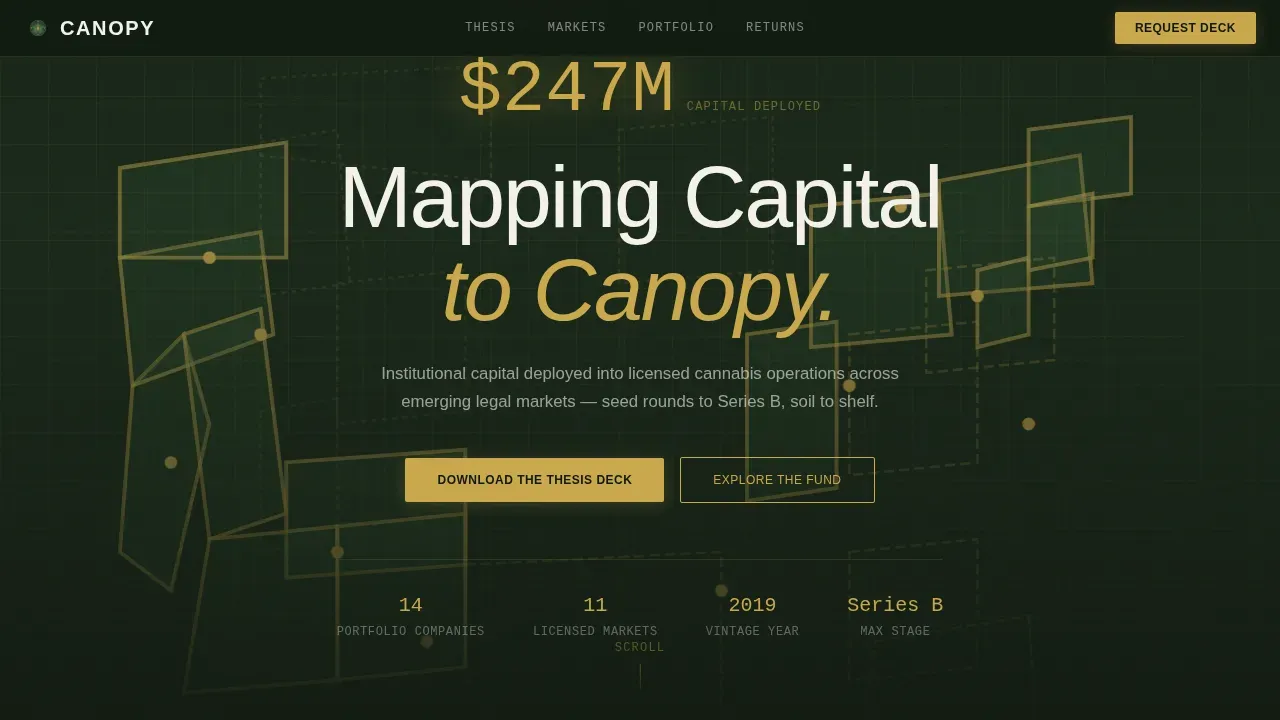
- An animated full-viewport SVG map showing licensed and pending cannabis markets, with pulsing gold pins at portfolio company locations, a slow continental drift animation, and a count-up capital deployed statistic rendered in vellum typography.
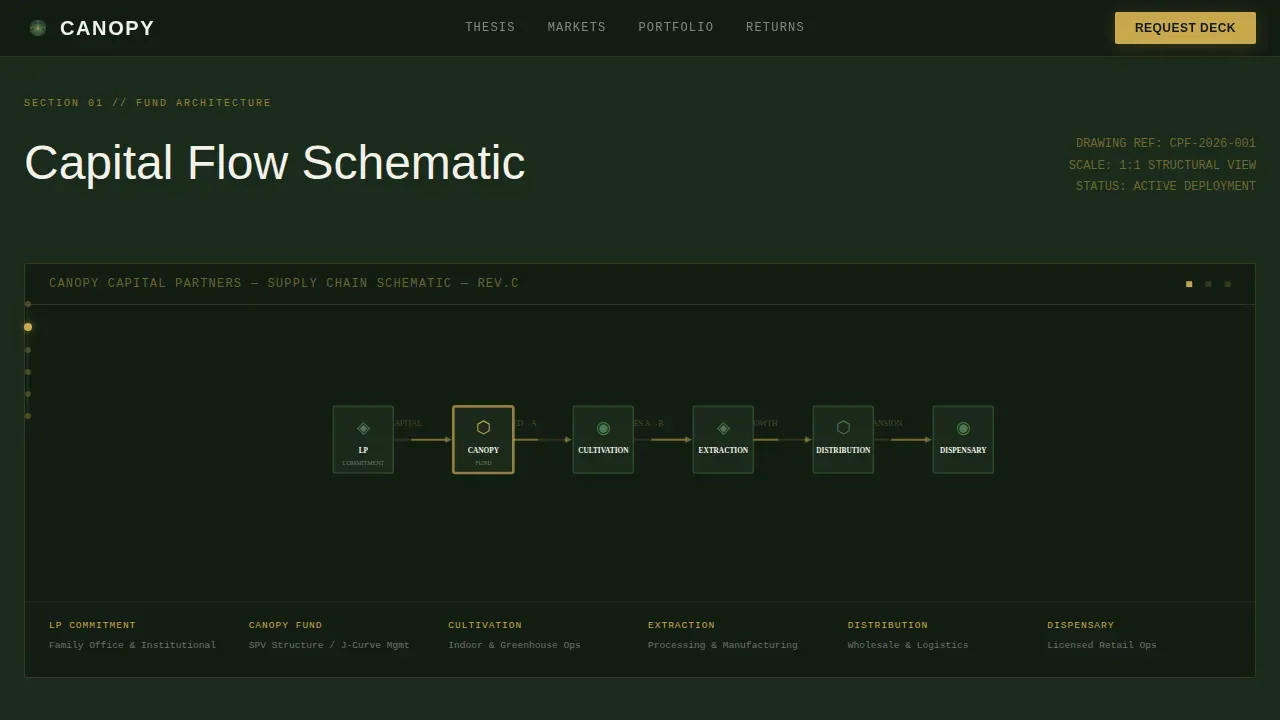
- A blueprint supply chain schematic visualizing the capital flow from limited partner commitment through cultivation, extraction, distribution, and dispensary, styled as an engineering diagram with cadastral gold accent lines.
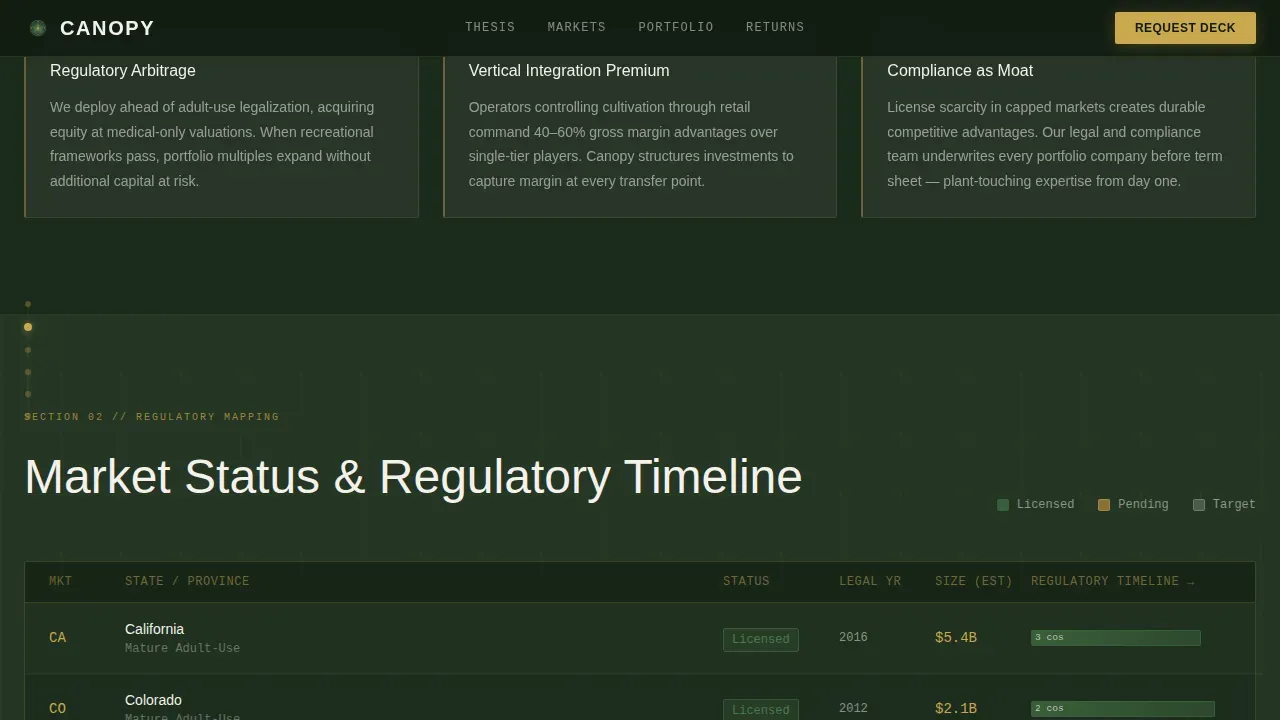
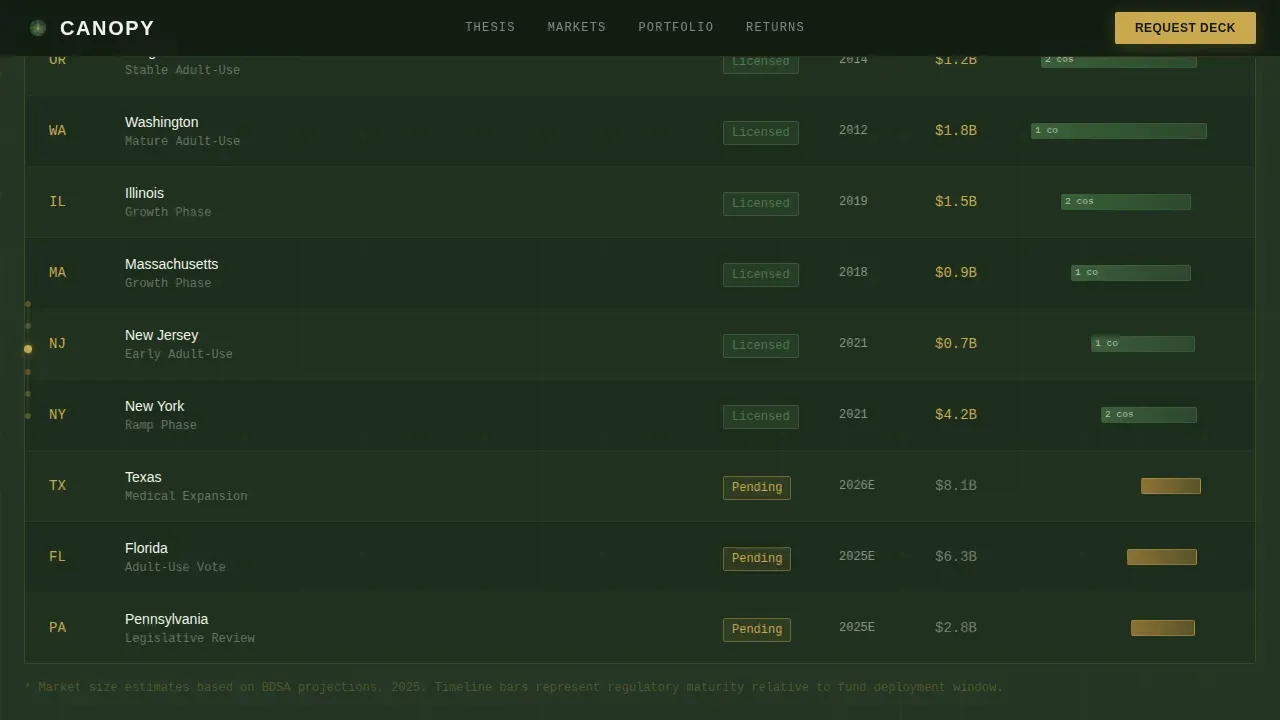
- Regulatory timeline Gantt bars organized by state and province, distinguishing legal from pending market status with dashed and solid cadastral outlines, plus a portfolio architecture cross-section showing allocation by vertical, performance graphs rendered on engineering graph paper, and a progressive disclosure form with a secondary newsletter subscription path.
Feature list
This section covers the core functional and design capabilities built into the Canopy template as described in the source brief.
Full-Viewport Interactive SVG Market Map
The hero section opens with a continental SVG map rendered in the Engineering Blueprint style. State and provincial boundaries are drawn in thin cadastral gold lines over a deep loam background. Licensed cannabis markets glow in surveyor's green with pulsing gold pins marking portfolio company locations. Pending markets appear as dashed outlines. A slow westward drift animation pulls the viewport across the continent, and a count-up statistic for total capital deployed animates in vellum type before the headline resolves. This section immediately communicates geographic coverage, analytical depth, and fund scale to any visitor who has spent time evaluating investments across international markets.
Blueprint Supply Chain Schematic
The fund thesis section renders the entire capital flow as an engineering diagram. The schematic traces the path from limited partner commitment through cultivation, extraction, distribution, and dispensary operations. Each stage is labeled with precision typography using JetBrains Mono for data notation and DM Sans for headings. The visual logic of the diagram mirrors the company's supply chain processes, making the fund's vertical integration thesis legible in seconds. This section supports the page's role as a content resource by delivering structural insight rather than bullet-point claims.
Regulatory Timeline Gantt Bars
The market intelligence section presents regulatory timelines as Gantt-style bar charts organized by state and province. Legal markets appear with solid cadastral gold outlines and surveyor's green fills. Pending markets use dashed lines to signal the distinction between confirmed and anticipated legal status. This visualization communicates regulatory and political conditions across multiple jurisdictions in a single scroll, giving allocators the kind of forward-looking market view that supports serious business and investment strategies without requiring a separate research document.
Portfolio Architecture Cross-Section
The portfolio section renders fund allocation as an architectural cross-section diagram. Each layer of the structure represents a different vertical: cultivation, processing, retail, and ancillary services. The cross-section format makes the fund's diversification strategy immediately readable as a physical structure rather than a pie chart. Visitors can assess relative market positions across the portfolio at a glance, which builds confidence in the fund's thesis before the performance section introduces return scenarios.
Engineering Graph Paper Performance Display
The performance and returns section plots internal rate of return trend lines on a graph paper background. Cadastral gold lines mark the return scenarios, and the grid format reinforces the template's engineering precision aesthetic. This section is followed immediately by the primary call-to-action form, placing the most compelling financial visualization directly before the conversion moment. The pairing of proprietary-looking data with an immediate download offer is designed to convert visitors who have already decided the fund merits deeper review.
Progressive Disclosure Conversion Form
The thesis deck call-to-action section uses a two-stage progressive disclosure form. Visitors first see only name and email fields. After initial engagement, qualification fields appear: firm affiliation and an accredited investor status checkbox attestation. This approach reduces initial friction while ensuring that captured leads meet minimum qualification standards. A secondary path offers a newsletter subscription under the label "Subscribe to the Quarterly Map," capturing just an email address from visitors who are not yet ready to request the full deck. The form is the template's primary conversion engine and is repeated after the performance section and again at the page close.
Page sections overview
| Section | Purpose |
|---|---|
| Hero Map | Display animated SVG cannabis market map with count-up capital stat and headline |
| Fund Thesis | Render blueprint supply chain schematic from LP commitment to dispensary |
| Market Intelligence | Show regulatory Gantt timelines by state and province, legal versus pending |
| Portfolio Architecture | Present allocation cross-section diagram by vertical and diversification layer |
| Performance and Returns | Display engineering graph paper IRR trend lines with primary call to action form |
| Thesis Deck call to action | Host progressive disclosure form with secondary quarterly newsletter path |
| Footer | Deliver single-row linear footer with legal disclaimers and navigation |
Design & branding system
The Canopy template uses a Forest Trust color system applied through an Engineering Blueprint creative direction. The palette and typographic system are designed to feel like a forestry service map printed on aged cotton paper: institutional enough for a boardroom presentation, organic enough to respect what the fund actually grows.
- The color system uses four values: deep loam (#1B2A1B) anchors all section backgrounds; vellum white (#F4F1EB) carries body text and data panel content; surveyor's green (#3A5F3A) defines section borders, graph fills, and map territory fills; and cadastral gold (#C9A84C) marks fund performance figures, call-to-action buttons, active map pins, and accent lines throughout the page.
- The typographic system pairs DM Sans for all headings, Manrope for body copy, and JetBrains Mono for data notation and numerical figures, giving the page three distinct registers: authority, readability, and analytical precision.
- The spatial rhythm alternates between wide data-visualization panels and narrow text corridors, creating the cadence of walking through rooms of different scale inside the same building, while a fixed mini-map navigation element compresses from the hero and anchors to the left edge as the visitor scrolls.
Mobile & speed optimization
The Canopy template is designed desktop-first for an institutional audience that typically reviews investment materials on large screens. However, the layout includes a mobile fallback that maintains the structural narrative of the page across smaller viewports. Given that performance directly correlates with conversion rates, the template is structured to support fast load times through component-level architecture.
- Static sections such as the fund thesis text, regulatory timeline labels, and footer are structured using server-side rendering patterns, keeping their load contribution minimal and stable.
- Interactive components including the animated SVG map, count-up statistics, GSAP ScrollTrigger reveal animations, and the progressive disclosure form are isolated as client-side components, so they load and hydrate without blocking the static content that renders first.
- The template avoids heavy third-party embeds in the hero section by using a custom SVG map rather than a live map service integration, which eliminates a common source of first-paint delay on cannabis investment pages where every second of load time beyond 2.5 seconds can reduce conversions measurably.
How this template helps you convert
The Canopy template is built around a content-and-resource conversion model. The page earns the download by delivering enough proprietary-looking market data and regulatory mapping that the visitor recognizes the fund's analytical depth before being asked to surrender contact information.
- The hero map, supply chain schematic, and regulatory Gantt timelines build credibility through three consecutive sections of visual market intelligence, so the visitor arrives at the performance graph already confident in the fund's analytical rigor before the first form appears.
- The progressive disclosure form reduces initial friction by showing only name and email first, then revealing firm affiliation and accredited investor attestation fields after the visitor engages, which filters for qualified leads without front-loading a form that deters serious allocators.
- The secondary "Subscribe to the Quarterly Map" path captures the email addresses of visitors who are not yet ready to request the thesis deck, turning a single-session visit into a nurture relationship and extending the page's conversion footprint beyond the primary call to action.
Other information about this template
This template was designed with the institutional cannabis investment audience in mind, drawing on the established context of how major fund operators and publicly listed cannabis companies communicate financial performance and forward-looking strategy to allocators. The following details provide additional context for buyers considering this template for a cannabis fund presentation.
- Canopy Growth Corporation is one of the most widely referenced public companies in discussions of institutional cannabis investment strategy, and the template's analytical framework reflects the kind of reporting depth that sophisticated allocators expect. Canopy Growth Corporation reported a net loss of $62.6 million for the third quarter of fiscal 2026, representing a 49% improvement year-over-year. The company's cash and cash equivalents totaled $371 million as of December 31, 2025, with total assets rising to $1.1 billion from $917.7 million in March 2025.
- Canopy Growth Corporation's Adjusted EBITDA loss narrowed to $2.9 million in Q3 fiscal 2026, down from $3.5 million in the same quarter of the prior year. The company completed a strategic recapitalization in January 2026 that extended maturity dates for all outstanding indebtedness to 2031, strengthening its actual financial position and its net cash position heading into fiscal 2027.
- Canopy Growth Corporation has established a comprehensive ecosystem to realize opportunities in the United States cannabis sector through Canopy USA, LLC. Canopy USA's portfolio includes ownership of Acreage Holdings, Inc., a multi-state cannabis operator in the United States. This structure involves equity method investments and reflects the trust's future ownership interest model used by some publicly listed cannabis investment vehicles.
- Canopy Growth Corporation's acquisition of MTL Cannabis is expected to realize anticipated benefits for its global cannabis platform, with the company targeting positive Adjusted EBITDA during fiscal 2027 as part of the company's strategy to achieve cost savings acquisition synergies and improve anticipated future gross margins.
- Forward-looking statements contained in public cannabis fund materials are typically subject to known and unknown risks, including regulatory and political conditions across jurisdictions, continued consumer economic uncertainty, third party manufacturing risks, third party transportation risks, and anticipated and unanticipated costs that may affect future production costs and sufficient cash flow generation.
- Forward-looking statements contained in fund presentations must also address the securities and exchange commission requirements for United States investors, as well as applicable securities laws and applicable Canadian securities laws for Canadian dollar-denominated vehicles listed on the Toronto Stock Exchange or the Nasdaq Stock Market LLC.
- The drug enforcement administration classification of cannabis at the federal level in the United States remains a key factor discussed in fund risk disclosures, affecting company's business operations, stock exchange restrictions, and the ability of federally regulated cannabis producers to access conventional banking and capital markets.
- When funds report financial results, typical disclosures address income tax expense, income tax recovery, and calculations that exclude income tax recovery from non-GAAP measures. Free cash flow is a commonly cited non-GAAP measure. Free cash flow reconciliation tables typically include net cash inflow, free cash outflow, non cash foreign currency adjustments, and other financial assets to arrive at a free cash flow measure that differs from reported net income and from interim consolidated balance sheets prepared under standard accounting rules.
- Additional line items in fund financial summaries often include payable and accrued liabilities, shareholders equity current liabilities, cash equivalents balances, and a free cash flow reconciliation that helps allocators generate cash flow comparisons across periods. Such financial outlooks and expected future developments are subject to such factors as regulatory change, consumer demand shifts, and production and manufacturing capabilities constraints.
- The cannabis net revenue reported by public cannabis operators reflects traditional strong seasonal sales patterns in certain markets, alongside significantly increased sales velocity in newly legalized jurisdictions. Canada cannabis contributing to international markets cannabis totals has grown as international markets led by European medical programs have expanded.
- Municipal regulations pertaining thereto at the local level add compliance complexity on top of state and provincial licensing. Municipal regulations pertaining to zoning, signage, and operating hours vary by jurisdiction and are addressed by local regulatory authorities and state equivalent regulatory agencies in addition to federal bodies.
- Management believes that a well-structured landing page for an investment fund in this sector must maintain effective internal control over financial communications, align with the company's supply chain processes narrative, and present current and future operations with the same transparency applied to public market filings.
- Management believes that business involve risks unique to the cannabis sector, including those risk factors discussed in fund offering memoranda, and that such factors as federal scheduling, banking access, and municipal regulations pertaining to retail operations require detailed risk disclosure on any investor-facing page.
- Management believes that the medical cannabis benefit program landscape in Canada and emerging European markets creates differentiated consumer demand relative to adult-use channels, which affects anticipated future gross margins and free cash flow projections. Management believes that sufficient cash flow from current operations, combined with decisive cost reduction actions, supports the fund's ability to realize anticipated benefits from its portfolio construction. Management believes that relative market positions across cultivation, processing, and retail verticals create durable competitive advantages when assessed against expected future developments in the regulatory environment.
- This template was built using modern component architecture. AI-powered no-code tools allow users to build and customize applications using natural language prompts, and no-code platforms enable non-technical users to create production-ready applications without traditional programming skills. This template is compatible with that development approach, and subscription-based models for such platforms often include free trials and paid plans to suit different team sizes and budget levels.
- Security verification flows and security service integrations for age-gating are expected components of compliant cannabis investment pages. Security verification is required to confirm that visitors meet jurisdictional age and accreditation requirements before accessing fund materials. Security verification should be implemented in a way that does not obstruct the primary conversion flow, and security service providers vary in how they handle cannabis-sector pages due to federal classification uncertainty in the United States.
- The canopy precision capital cannabis investment landing page template is designed to be a complete, deployment-ready asset for fund managers who need to move from concept to live investor page without building from scratch.
- The chief financial officer of any fund deploying this page will recognize the financial reporting register used across the data sections. The template's use of JetBrains Mono for numerical displays and its graph paper background for return scenario charts mirrors the visual language of formal financial reporting without replicating a spreadsheet aesthetic.
- Two out of three cannabis investors cite the management team's experience as a top factor when making investment decisions, which is why this template reserves prominent above-the-fold visual real estate for the fund's analytical framework rather than generic biography panels. Third-party validation, such as media mentions and industry awards, can be incorporated into the social proof layer between the market intelligence and portfolio sections.
Theme
Engineering Blueprint
Creative direction
Spatial & Architectural
Color system
Forest Trust
Style
Single Column Flow
Direction
Content/Resource
Page Sections
Animated SVG Cannabis Market Map Hero
Blueprint Supply Chain Schematic
Regulatory Timeline Gantt Visualization
Portfolio Architecture Cross-section Diagram
Engineering Graph Paper Performance Display
Progressive Disclosure Conversion Form
Related questions
Who is this landing page template designed for?
What conversion goal does this template support?
Does this template include legal disclaimer or age-gate support?
Can this template be customized for my fund's specific market coverage?
Is this template suitable for a desktop-first institutional audience?