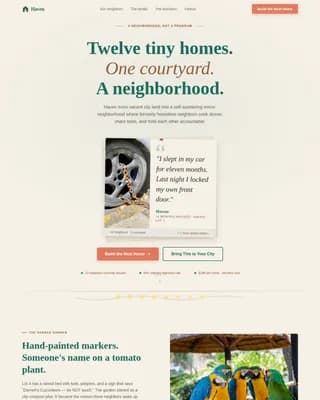
The Hearth affordable housing advocacy editorial landing page template gives nonprofit housing organizations a warm, magazine-style presence built around real people and real policy work. It blends grain-rich photography, serif editorial typography, and a resource hub into one cohesive page that moves visitors from emotional connection to meaningful action, downloading a toolkit or joining a monthly digest.
by Rocket studio
Loading preview…
Quick Summary
Hearth is an editorial landing page template designed for affordable housing advocacy organizations. It pairs human storytelling with policy substance, guiding visitors through tenant profiles, a wage-rent data visualization, staff micro-essays, and a tagged resource hub. The result is a page that earns trust before it asks for anything, then delivers a clear path to action.
Who This Template Is For
This template serves nonprofits and advocacy groups whose work centers on housing access, tenant rights, and community organizing. It is built for teams that want their page to feel like a publication, not a brochure.
Affordable housing advocates who need to present policy work and human stories side by side
Tenant organizers and housing providers looking to recruit volunteers, donors, and coalition partners
Community development teams that want a resource hub visitors can self-navigate by issue and city
What Problem This Template Solves
Housing advocacy organizations often struggle to balance urgency with depth. A plain donation page fails the complexity of the cause. A dense policy site loses the people it most needs to reach. This template bridges that gap by leading with faces and stories, then backing them with data and downloadable materials.
Residents facing housing insecurity need to feel seen before they will act, and the template's storytelling-first layout builds that connection early
Affordable housing organizations need to demonstrate expertise without overwhelming visitors, and the tagged resource hub lets each person self-select what is relevant to their life
Staff and organizers deserve a page that reflects the real scope and value of their work, not a generic nonprofit template
What You Get With This Template
You get a fully structured, single-page editorial layout ready to customize with your own photography, copy, and documents. Every section is purposefully sequenced to advance the reader from awareness to participation.
A half-page photo-and-text hero section with a serif headline, dateline sentence, and room for a grain-rich community photograph
Theme
Community Hearth
Creative direction
Team & People
Color system
Soft Mist
Direction
Content/Resource
Page Sections
Half-page Editorial Hero Section
Two-column Tenant Profile Feature
Full-width Wage-rent Gap Visualization
Staff Portrait Mosaic with Micro-essays
Tagged Resource Card Hub
Sticky Email Digest Banner
Related questions
What is an advocacy letter for people experiencing homelessness?
What strategies help address the affordable housing problem?
How can people experiencing homelessness advocate for their own concerns?
How do you market affordable housing advocacy effectively?
A two-column tenant profile feature, a full-width wage-rent gap visualization, a staff portrait mosaic with micro-essays, and a filtered resource card hub
A sticky "Join the Table" email banner with a minimal form asking only for a first name and email address
Feature List
This template is built around a small set of well-considered features, each chosen to protect the editorial tone while supporting real advocacy goals.
Half-Page Editorial Hero Section
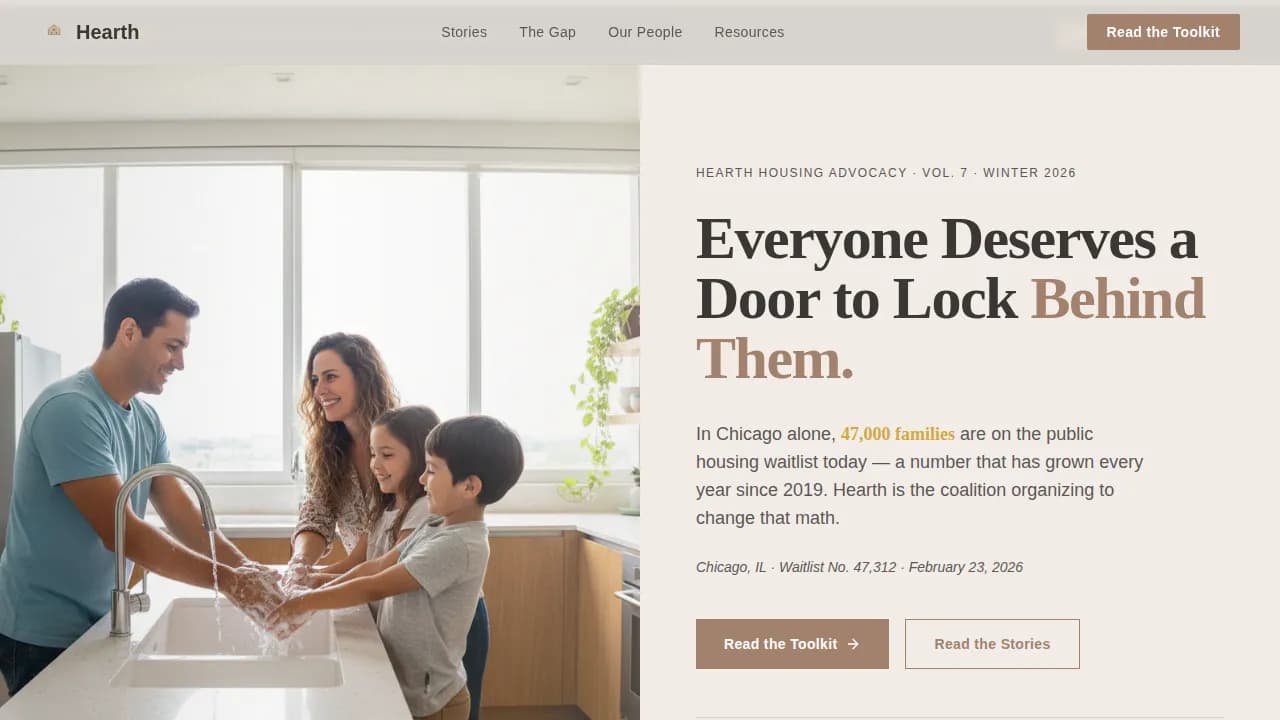
The hero uses a split composition: a candid photograph on the left and a large serif headline on the right. A dateline-style subheadline grounds the moment in a specific city, year, and waitlist figure. This approach communicates urgency without resorting to alarm, and it signals to visitors that real communities and real families are at the center of this work.
Two-Column Tenant Profile Feature
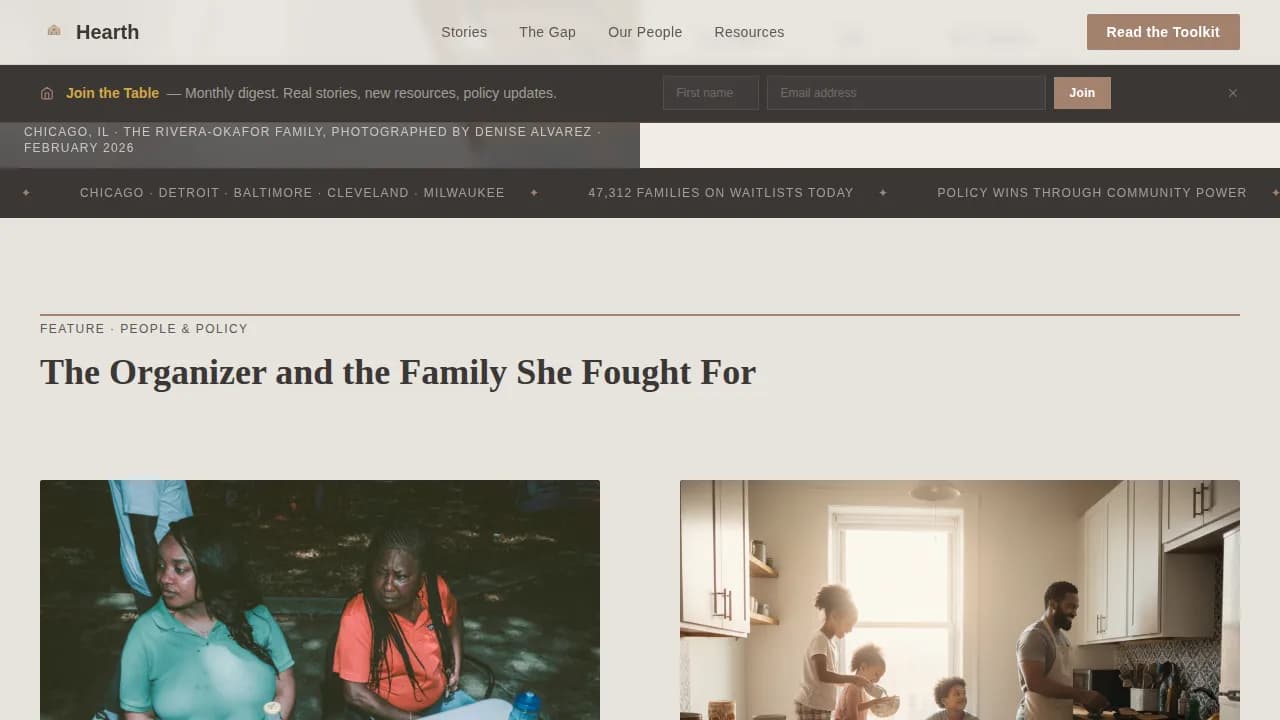
This section pairs a tenant organizer's story with the family whose eviction she helped reverse, presented in a magazine two-column layout. The primary call to action, "Read the Toolkit," appears directly below this profile so visitors have already formed an emotional connection before they are offered something to download. Research consistently shows that a powerful story of a person or family impacted by housing costs transforms abstract statistics into a relatable, human experience.
Full-Width Wage-Rent Gap Visualization
A scrolling data visualization shows how the gap between median wages and median rents widens over time. This section gives affordable housing advocates the systemic evidence they need to make the case to policymakers and donors without requiring a separate report. Infographics that highlight key data points build urgency and help communities understand the scale of the problem at a glance.
Staff Portrait Mosaic with Micro-Essays
Scrolling past the data section, visitors meet the people behind the policy papers. Each portrait is paired with a short first-person essay explaining why that team member does this work. Authentic voices enhance the credibility and relatability of the housing message, and this section makes that principle structural rather than optional.
Tagged Resource Card Hub
The page closes with a collection of downloadable materials including policy briefs, know-your-rights one-pagers, and hearing testimony transcripts. Each card is tagged by issue area and city, so visitors from Chicago, Detroit, or Baltimore can self-select what is most relevant. This model of organized access encourages deeper participation and positions the organization as a trustworthy source of expertise.
Sticky Email Digest Banner
A persistent banner at the top of the viewport invites visitors to "Join the Table" for a monthly email digest. The form asks only for a first name and an email address, keeping friction low and completion rates high. This secondary conversion point captures readers who are not yet ready to download a toolkit but want to stay connected to the work.
Page Sections Overview
Section
Purpose
Editorial Hero
Introduce the mission with a split photo-and-text composition and a dateline subheadline
Tenant Profile Feature
Present a two-column organizer-and-family story with the primary toolkit call to action
Wage-Rent Gap Visualization
Display a full-width scrolling chart showing the widening gap between wages and rents
Staff Portrait Mosaic
Humanize the team through photographs and first-person micro-essays
Resource Card Hub
Offer tagged downloadable policy briefs, guides, and transcripts filtered by issue and city
Page Footer
Display logo, tagline, and navigation links in a split Arc Browser layout
Design & Branding System
The visual identity follows a Community Hearth theme rooted in warmth, analog texture, and editorial credibility. Every color and type choice is meant to feel like a well-read Sunday magazine left open on a radiator.
The color palette uses warm fog gray (#E8E4DF) for open backgrounds, hearthstone clay (#A3816D) for pull-quotes and section borders, deep charcoal (#3B3735) for body text, and quiet goldenrod (#D4A843) for links, statistics, and hover states
Typography pairs Fraunces serif for headlines (large, unhurried, printed-page weight) with DM Sans for body text and interface elements
Grain overlays and newsprint texture details protect the analog warmth of the design across all sections, reinforcing the sense that every page element belongs to a community-made publication
Mobile & Speed Optimization
The template is designed desktop-first to give the editorial layout the space it needs, while still adapting cleanly to smaller screens. Mobile optimization is critical because many folks access advocacy alerts and resources via smartphones after seeing a link shared on social media.
Scroll-reveal animations, a subtle parallax effect on the hero photograph, and counter animations on statistics are set to low-to-medium intensity to protect performance on mobile devices
The sticky join banner, resource card tag filters, and profile hover states are all implemented with minimal JavaScript to keep the page responsive
Large call-to-action buttons and short form fields on mobile screens ensure that residents and supporters can participate and sign up without friction
How This Template Helps You Convert
An effective editorial landing page for affordable housing advocacy requires blending compelling, human-centric storytelling with clear, actionable steps. This template sequences those steps deliberately.
The hero section creates immediate emotional resonance through a real photograph and a headline that frames housing as a fairness issue, not just an affordability statistic, so visitors are oriented to the human reality before they encounter any ask.
The toolkit call to action appears only after the tenant profile feature, meaning visitors have already spent time with a real story before they see the download prompt, which increases the likelihood they will act and return.
The resource hub at the bottom rewards deeper engagement by offering a range of tagged materials so that tenants, donors, policy partners, and housing developers each find something directly relevant to their role and their city.
Other Information About This Template
This template draws on approaches that affordable housing advocates and community development practitioners have tested and refined over more than a decade of organizing work across the country.
Media advocacy research shows that framing messages around core values rather than policy details increases effectiveness with both the public and government officials. This template's editorial structure supports that approach by leading with stories and values before presenting data.
The Housing First model, which prioritizes getting people into stable housing before addressing other challenges, has garnered strong bipartisan support. One study found that between 75 percent and 91 percent of households remain housed a year after being rapidly re-housed. The wage-rent visualization section gives organizations a clear way to communicate why funding this model matters on an annual basis.
Nearly 40 percent of residences have at least one health or safety hazard. Removing hazards like mold or lead can protect residents' well being. Organizations that address these issues as part of their housing programs can use the resource hub to share relevant guides and promote safe housing as a basic necessity alongside food, school access, and other foundations of stable community life.
Coalition building across diverse stakeholders, including housing developers, housing providers, tenant groups, and policy partners, has led to significant legislative victories in cities like Portland, Oregon and across the broader Pacific Northwest. The Housing Alliance's success in Oregon was attributed to a unified message and the willingness of partners to collaborate rather than work at cross-purposes.
The tagged resource cards are designed to serve a wide scope of visitors: from tenants seeking a know-your-rights guide to policy allies looking for testimony transcripts. Organizations can expand the hub over time, adding new materials as campaigns develop and communities grow.
The Hearth affordable housing advocacy editorial landing page template is built specifically for the Community and Nonprofit category, with a focus on the affordable housing advocacy niche. It is one example of how editorial design principles can advance the cause of housing justice without sacrificing usability or clarity.
Washington-based advocacy groups and organizations working to extend their reach into new cities will find the city-tagged resource model easy to implement and straightforward to grow.
Displaying partner logos and a transparency statement can build additional trust. The footer layout provides dedicated room for these elements alongside the logo and tagline.