Design Thinking Course Landing Page Template
Ideate is a modular card-grid landing page template for a design thinking online course. It walks visitors through the five-phase Design Thinking process using interactive persona selection, phase-by-phase card clusters, and two clear conversion paths. The layout suits educators running live cohorts who want to earn trust before asking for anything.
by Rocket studio
Quick summary
Ideate is a single-page landing page template built for design thinking online courses. It opens with a Persona Selector header, guides visitors through a five-phase card grid, and offers a free micro-exercise before ever asking for an email. The result is a page that proves its value before making a request.
Who this template is for
This template is built for course creators and workshop facilitators who teach practical design thinking skills to working professionals. It works especially well if your students arrive with real job pressures and specific blind spots they need to fix fast.
- Product managers tired of shipping features nobody asked for
- User experience designers who moved into strategy roles without formal training
- Nonprofit directors trying to redesign internal processes on a tight budget
What problem this template solves
Most course landing pages describe a curriculum without showing why it matters to the specific person reading it. Visitors bounce because they cannot see themselves in the content. This template solves that by putting persona recognition at the very top of the page.
- Visitors self-select into a persona, so the content below instantly feels relevant to their role
- The free micro-exercise path removes friction for skeptical first-time visitors
- The gated toolkit download gives motivated learners a clear next action without pressuring the rest
What you get with this template
You get a fully structured, single-page layout that covers every stage of the visitor journey. The template is opinionated about sequence, visual rhythm, and conversion flow, so you spend less time guessing and more time customizing.
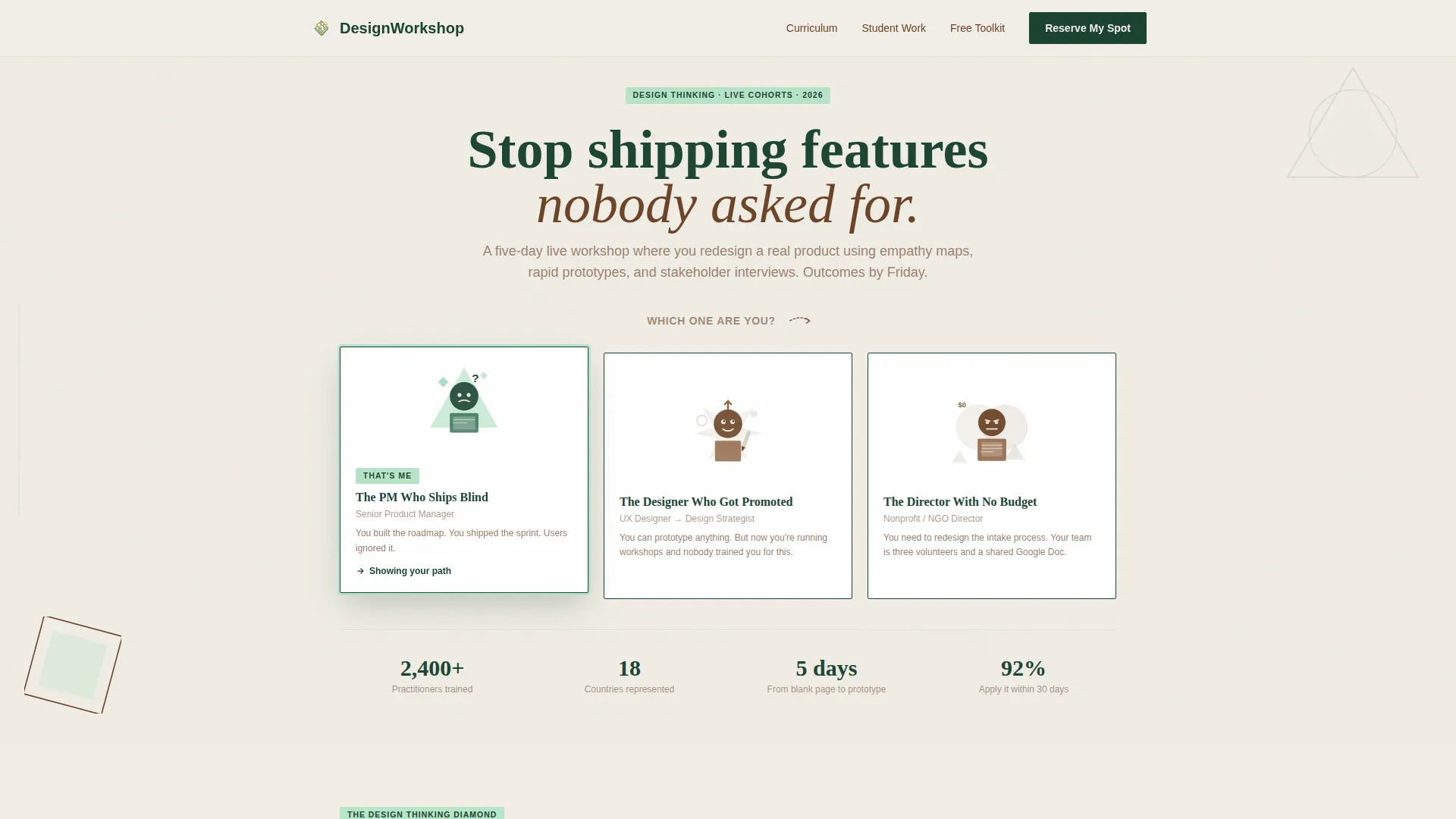
- A Persona Selector header with three illustrated geometric characters and animated hand-drawn arrow
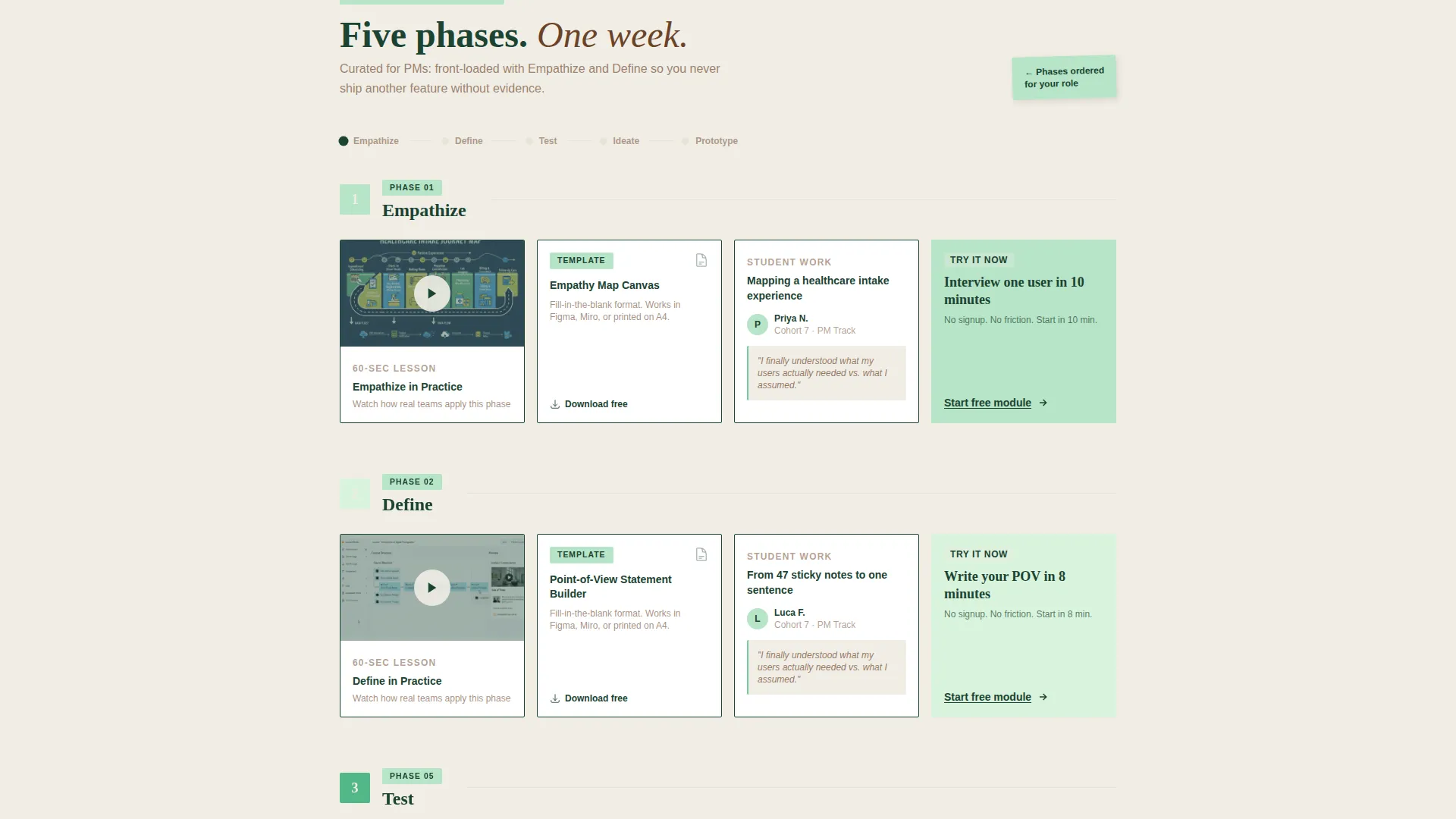
- Five phase-by-phase card cluster rows covering Empathize, Define, Ideate, Prototype, and Test
- Two conversion paths: a gated toolkit download and a no-form free module entry point
Feature list
This section covers the core built-in components that make the Ideate template work as a teaching and conversion tool.
Persona Selector Header
Three illustrated geometric characters represent the three learner types: "The PM Who Ships Blind," "The Designer Who Got Promoted," and "The Director With No Budget." Clicking a persona rearranges the modules, case studies, and testimonials below to match that visitor's specific context. A thin animated hand-drawn arrow moves between the three characters to prompt a choice.
Phase-by-Phase Card Grid
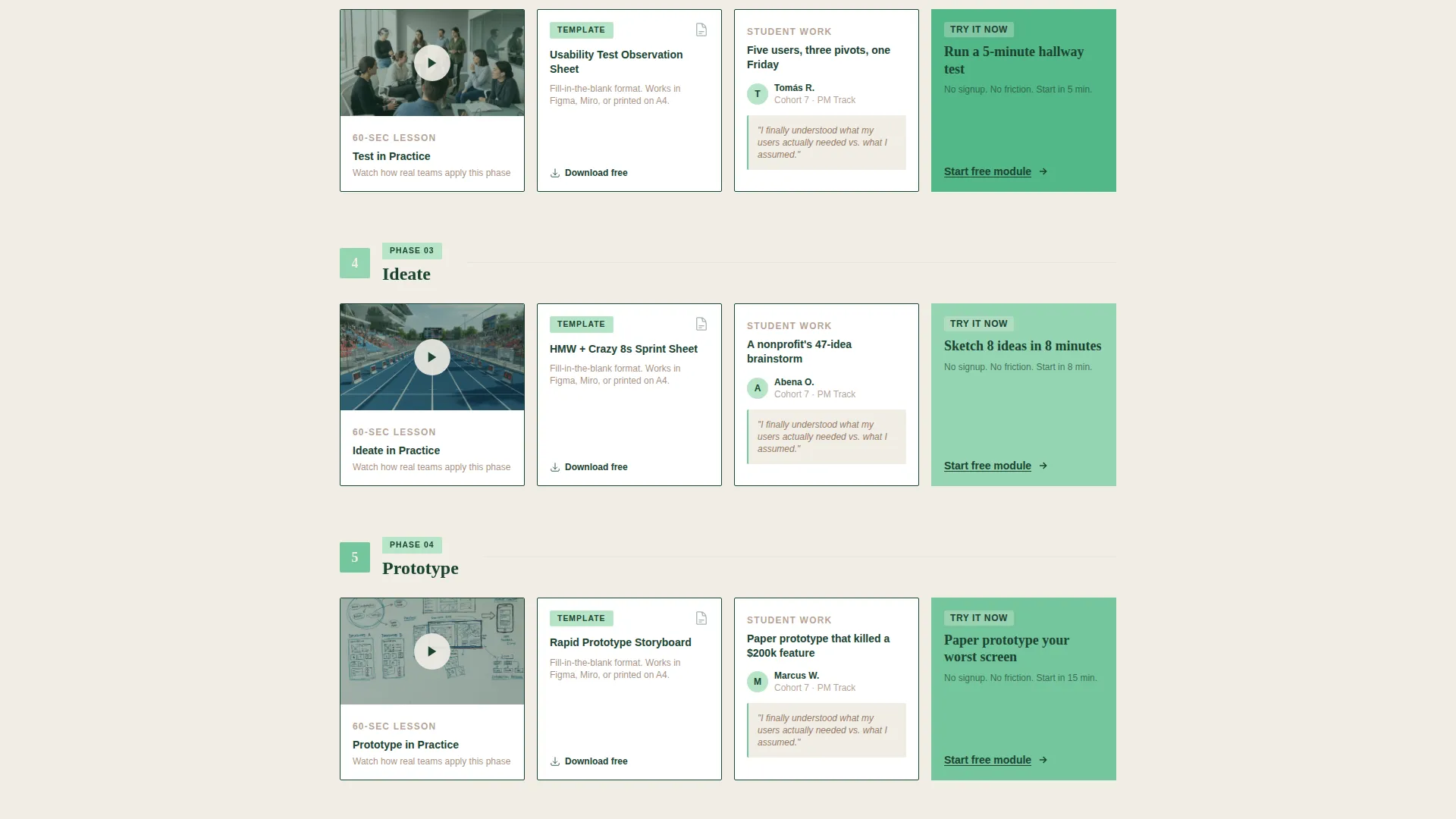
Each of the five Design Thinking phases gets its own row of four modular cards: a sixty-second video card, a downloadable template card, a student project showcase card, and a try-it-now micro-exercise card. Cards grow bolder in color as the visitor scrolls from passive learning toward active making. The progression mirrors the actual workshop experience.
Vertical Vine Progress Indicator
A thin vine illustration runs down the left margin of the page. It grows leaves as the visitor scrolls deeper into the content. This visual device makes progress feel tangible without relying on a standard progress bar, and it reinforces the nature-retreat character of the Forest Trust color system.
Dual Conversion Path Layout
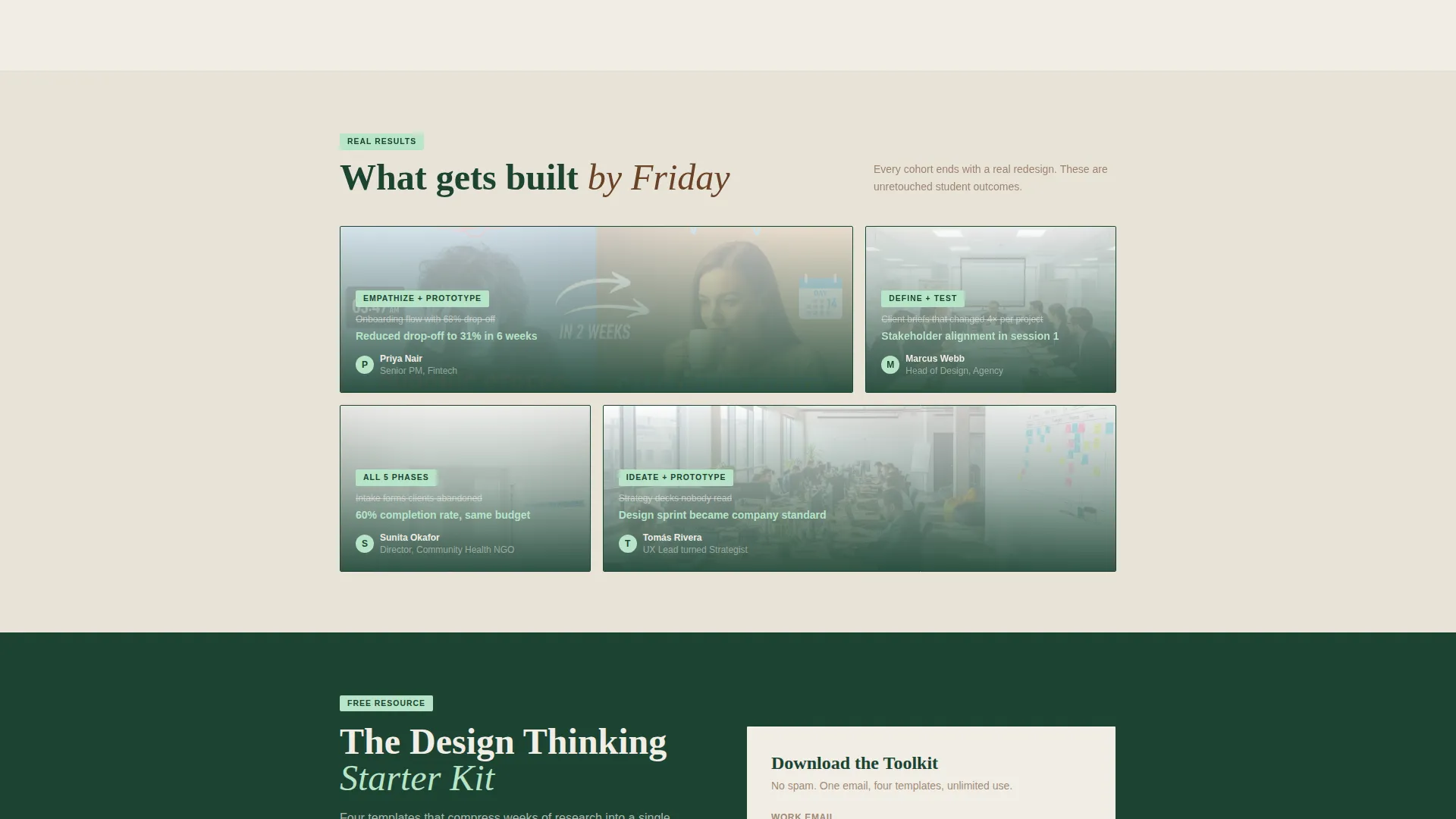
Every card cluster includes a primary call to action labeled "Download the Toolkit," which gates a PDF bundle behind an email address and current-role field. A secondary call to action, "Start the Free Module," drops visitors into a ten-minute Empathize exercise with no form required. Both paths coexist without competing.
Gated PDF Toolkit Bundle
The downloadable toolkit behind the primary call to action includes an empathy map template, a stakeholder interview script, and a prioritization matrix. These resources are practical enough to use immediately, which makes the exchange feel fair rather than transactional.
Playful Geometric Visual System
Abstract geometric character illustrations are built from overlapping triangles and circles. They are inclusive by design but specific enough that target learners recognize themselves. Hover states bloom chartreuse across card elements, and the overall aesthetic reads like a nature retreat where someone has pinned sticky notes to every tree.
Page sections overview
| Section | Purpose |
|---|---|
| Persona Selector Header | Lets visitors self-identify and personalizes the page below |
| Animated Arrow Prompt | Encourages persona selection with a playful visual cue |
| Empathize Phase Row | Delivers video, template, showcase, and micro-exercise for phase one |
| Define Phase Row | Delivers four modular cards focused on problem framing |
| Ideate Phase Row | Delivers four modular cards for concept generation activities |
| Prototype Phase Row | Delivers four modular cards for rapid prototyping exercises |
| Test Phase Row | Delivers four modular cards for feedback and iteration |
| Vine Progress Indicator | Tracks scroll depth visually in the left margin |
| Toolkit Download call to action | Gates the PDF bundle behind email and role fields |
| Free Module Entry | Provides no-form access to the ten-minute Empathize exercise |
Design & branding system
The visual identity follows a Playful Geometric theme using the Forest Trust color system. Every color choice references the natural world while staying sharp enough for structured learning content.
- Deep canopy green (#1B4332) for card borders and primary structural elements, chartreuse (#B7E4C7) for module tags and hover bloom states, fallen-log umber (#6B4226) for body text, and morning-fog off-white (#F0EDE5) as the page background canvas
- Abstract geometric character illustrations built from overlapping triangles and circles keep the aesthetic inclusive and visually distinctive
- Hand-drawn arrow animations and the growing vine illustration add organic warmth that contrasts deliberately with the modular card grid structure
Mobile & speed optimization
The card grid layout is modular by design, which means columns can restack cleanly across screen sizes without breaking the phase-by-phase flow. Each row of four cards adapts to narrower viewports while preserving the scroll rhythm the template relies on for engagement.
- Modular card clusters restack responsively so every phase row remains readable on smaller screens
- The vine progress indicator and persona selector are designed to translate across viewport widths without losing their visual function
- Lightweight illustrated assets keep the page visually rich without adding heavy file overhead
How this template helps you convert
The conversion strategy is built into the page structure itself. Every decision, from persona selection to card ordering to call to action placement, is designed to reduce hesitation and build confidence before asking for commitment.
- The Persona Selector immediately signals to visitors that this course was built for someone like them, which lowers bounce intent in the first few seconds of landing.
- The free micro-exercise path lets skeptical visitors experience the pedagogy firsthand before any form appears, earning trust through proof rather than promises.
- The gated toolkit download arrives only after visitors have already received value, making the email exchange feel like a natural next step rather than a toll gate.
Other information about this template
This template is categorized under Education and Training, specifically within the Online Skill Courses subcategory, with a niche focus on design thinking instruction. It is a strong fit for cohort-based learning programs where the live workshop model is the core product.
- The step-by-step guide creative direction maps directly onto the five-phase Design Thinking diamond, giving the page a clear narrative arc from empathy through testing
- The Content and Resource delivery model means the page leads with free value, which suits instructors who use a trust-first enrollment strategy
- The card grid template style supports future content expansion; additional phases, bonus modules, or alumni spotlights can slot into the existing row structure without redesigning the page
- This template suits course platforms, independent educators, and nonprofit training programs equally well because the persona system handles audience variation at the top of the page
Theme
Playful Geometric
Creative direction
Step-by-Step Guide
Color system
Forest Trust
Style
Card Grid (Modular)
Direction
Content/Resource
Page Sections
Persona Selector with Animated Header
Five-phase Modular Card Grid
Vine Scroll Progress Indicator
Dual Conversion Path Design
Gated Empathy Toolkit Bundle
Playful Geometric Illustration System
Related questions
Can I change which personas appear in the header?
What is included in the gated PDF toolkit bundle?
Does the free module path require any technical setup?
Who is this landing page template best suited for?
Can the card grid rows be reordered or extended?