Imprint is a bold brutalist printmaker portfolio landing page template built for hand-pull printmakers with serious exhibition histories. It uses scroll-linked layer stacking, a tarnished gold and obsidian color system, and a misregistered type-over-image hero to present juried accolades, selected editions, and commission services in one deliberate, high-impact page flow.
by Rocket studio
Loading preview…
Quick Summary
Imprint is a single-page portfolio template designed for printmakers who exhibit, sell numbered editions, and take commissions. The overlap and layered layout mimics prints stacking on a drying rack. Every scroll increment reveals another juried recognition, another selected work, and ultimately a direct commission form, building undeniable credibility before any ask is made.
Who This Template Is For
This portfolio website is built for working printmakers with a documented exhibition history and a body of numbered editions ready to show. It speaks directly to the people evaluating serious craft at a professional level.
Gallery curators scouting printmakers for juried group shows and emerging-talent exhibitions
Interior designers sourcing original hand-pulled prints for residential and hospitality projects
Private collectors who commission based on tactile instinct and verified artistic credibility
What Problem This Template Solves
Most personal portfolio pages flatten years of work into a gallery grid. For a printmaker with fourteen juried shows and numbered editions, that approach buries the evidence. Visitors leave before they understand the career weight behind each impression.
A standard design portfolio hides accolades inside a buried CV page nobody reads
No clear path separates curators ready to download an exhibition CV from collectors ready to commission
Generic portfolio design fails to communicate the physical, ink-on-paper reality of the work
What You Get With This Template
This portfolio template delivers a fully structured, scroll-driven landing page where every section has a defined purpose. The layout is deliberate and sequential, not decorative.
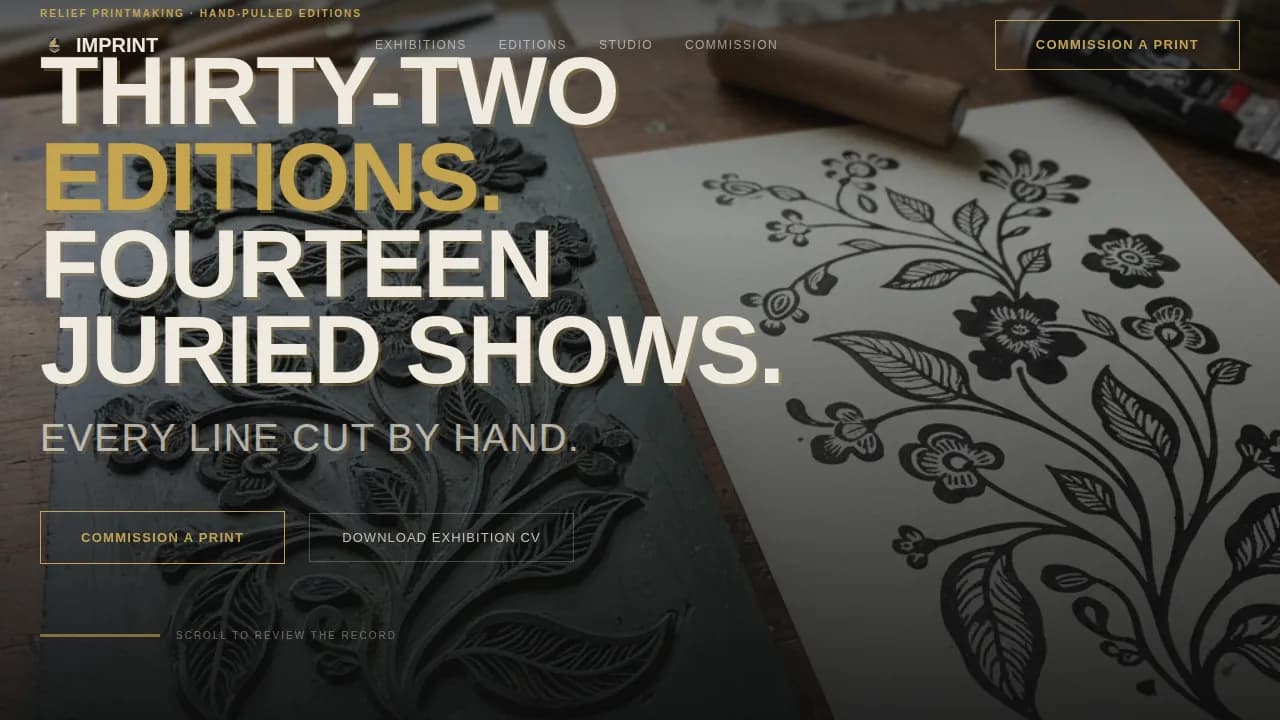
A full-bleed brutalist hero with oversized misregistered type stamped over a woodcut photograph
A layered awards stack where each juried show callout slides over the previous, in tarnished gold
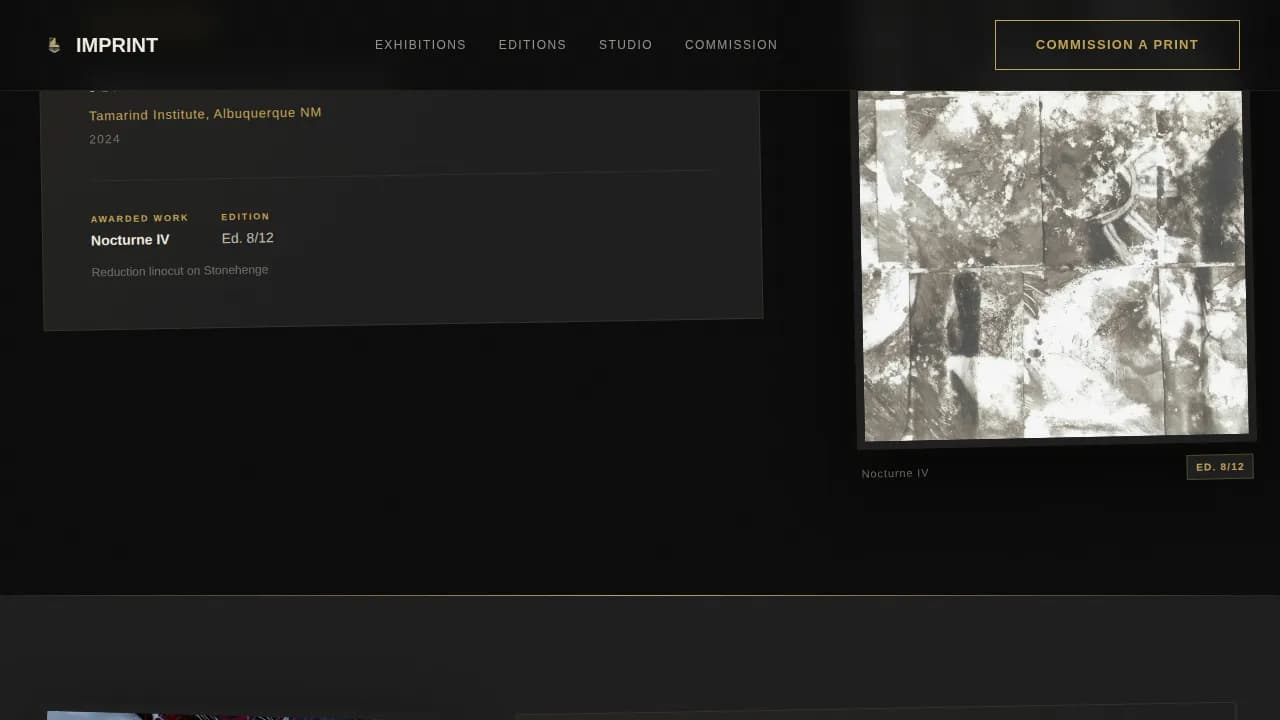
A selected works section with offset-angle print reveals and edition details at staggered positions
Theme
Bold Brutalist
Creative direction
Award & Recognition
Color system
Obsidian & Gold
Direction
Lead Generation
Page Sections
Scroll-linked Award Layer Stacking
Misregistered Brutalist Hero Section
Offset-angle Selected Works Display
Dual-path Commission and CV Section
Parallax Studio Photography Break
Tarnished Gold Hover and Badge System
Related questions
Who is this portfolio template designed for?
Can I customize the colors and typography without coding?
What does the 'Download the Exhibition CV' path do?
Does this template include the Commission a Print form?
Is this template suitable for other visual artists besides printmakers?
A parallax studio photograph section that grounds the accolades in physical studio reality
A dual-conversion section featuring a "Commission a Print" form and a gated "Download the Exhibition CV" touchpoint
A linear single-row footer
Feature List
This brutalist portfolio website is built around features that serve the printmaker's specific conversion goals, not generic web design conventions.
Scroll-Linked Award Layer Stacking
Each juried exhibition callout enters the viewport like a new print landing on a drying rack. Show name, venue, and year appear in tarnished gold as one layer slides over the previous. The rhythm is one proof, one recognition, repeated until the body of evidence is undeniable.
Misregistered Brutalist Hero
The header uses a full-bleed woodcut photograph with a massive slab-serif type block stamped over it in unbleached white. The type intentionally overlaps image edges, echoing the imperfection of relief printing. Bold typography here is not decorative; it is the first proof of craft.
Offset-Angle Selected Works Reveals
Prints enter at staggered angles during scroll, referencing the physical act of peeling a proof from a freshly inked block. Edition numbers and print details sit alongside each work. The high contrast between obsidian backgrounds and unbleached paper white keeps every image readable.
Dual-Path Commission Section
The primary call-to-action reads "Commission a Print" and collects name, project context (gallery, residential, hospitality, or private collection), desired edition size, and a free-text field. A secondary path, "Download the Exhibition CV," gates a PDF behind an email address, qualifying curators and designers who need more time.
Parallax Studio Break
A cast-iron press and ink-stained hands appear in a parallax-shifted photograph near the bottom of the page. It interrupts the award rhythm intentionally, grounding every accolade in a tangible, physical studio reality before the final conversion ask.
Hover States and Gold Accent System
Tarnished gold (#C5A44E) activates only on hover states, award badges, and pull-quotes. It never decorates; it distinguishes. Abrupt color changes on hover align with the brutalist aesthetic, where interaction feels functional and direct rather than smooth or polished.
Page Sections Overview
Section
Purpose
Full-Bleed Hero
Establish authority with brutalist type-over-image stamp
Juried Awards Stack
Layer exhibition callouts like stacking prints, gold accents
Selected Works Reveals
Show numbered editions at offset angles with details
Parallax Studio Break
Ground accolades in physical studio reality
Commission Call-to-Action
Capture inquiries via dual-path form and CV download
Linear Footer
Close with single-row contact and navigation links
Design & Branding System
The visual identity is built on an Obsidian and Gold color system that feels like a freshly pulled print drying on a black studio table under a single tungsten bulb. Every color decision is load-bearing. Nothing is decorative.
Obsidian black (#0B0B0B) dominates as the ground; charcoal stone (#1E1E1E) surfaces card layers; unbleached paper white (#F0EBE1) carries body text
Tarnished gold (#C5A44E) appears only on award badges, pull-quotes, and hover states, never as ambient decoration
Typography pairs DM Sans for body and interface copy with Fraunces as an editorial serif accent for quotes and pull-text, creating high contrast between functional and expressive type voices
Mobile & Speed Optimization
The template is desktop-first, reflecting how gallery curators and designers review artist portfolios. The layout is also mobile responsive, so the page remains usable when a collector checks it on a phone.
Scroll-linked animations use Intersection Observer and GPU transforms to keep layer stacking smooth without blocking the main thread
CSS scroll-behavior handles parallax natively, avoiding heavy JavaScript dependencies that would slow the experience for the visitors
The brutalist aesthetic naturally limits decorative graphics, which contributes to a leaner page and supports the website's performance
How This Template Helps You Convert
The landing page is structured so every scroll step moves the visitor closer to a decision. Curiosity becomes recognition; recognition becomes conviction; conviction becomes contact.
The gated CV download captures curator and designer email addresses early, creating a low-commitment touchpoint that qualifies leads before they are ready to commission
The "Commission a Print" form arrives only after fourteen layers of juried evidence, so visitors reach it already convinced, reducing friction and improving form completion
Other Information About This Template
This portfolio template was designed at the intersection of brutalist web principles and printmaking craft. Understanding that context helps you set it up and communicate its value to your audience.
The term "brutalism" in web design originates from brutalist architecture and the French phrase "béton brut," meaning raw concrete. Brutalist architecture peaked in the 1950s and 1960s. In graphic design and web design, brutalist aesthetics have been adopted as a deliberate rejection of over-polished digital surfaces.
Brutalist websites use monochromatic color schemes with a jarring accent color, oversized sans-serif fonts, asymmetrical grid-breaking layouts, and raw imagery without rounded corners or polished frames. These are not accidents; they are intentional graphic design choices.
This portfolio template can be deployed quickly once configured. Users can customize colors and typography without needing to write code, making it accessible to printmakers who are not web design specialists.
Webflow website builders and similar no-code tools are well-suited to this template's overlap and layered structure. The brutalist web approach here means minimal decorative graphics, which keeps the content of the website fast and focused.
When sharing your portfolio website on social media platforms, the high contrast imagery and bold type make preview cards visually strong without additional editing.
Connecting a tool like Google Analytics or Google Tag Manager to this template helps you understand how visitors interact with each section, track visitor behavior across the award stack, and review an analytics report for meaningful visitor data.
Google Analytics can provide information on metrics such as unique visitors, bounce rate, traffic source, and campaign data. Google Tag Manager allows you to manage tracking without editing code directly.
Performance cookies are used to measure the website's performance; analytical cookies are used to track visitor behavior patterns; advertisement cookies are used to experiment with advertisement efficiency across channels. Functional cookies help perform certain functionalities like form submission and PDF gating. A cookie stores information, sometimes anonymously via a randomly generated number, to identify trusted web traffic and help you understand key performance indexes of the website.
When analytical cookies are used alongside Google Analytics, you can review the site's analytics report to identify trusted web traffic patterns, understand visitors bounce rate, traffic source data, and rate traffic source breakdown. You can also visit anonymously how the number of visitors bounce compares against unique visitors to understand bounce rate and improve how you provide visitors with relevant content. This helps in delivering a better user experience over time.
Advertisement cookies are used to experiment with advertisement efficiency, and other third party features may be classified into a category as yet undetermined by standard cookie frameworks. Third party features and certain functionalities like social sharing may require additional setup depending on your hosting environment.
This brutalist portfolio template suits any creative professional who wants a strong brand identity online. It works equally well as a designer portfolio, a design portfolio for a creative agency, or a personal website for an emerging printmaker ready to present their services at a professional level.