Physics Education Professional Website Template
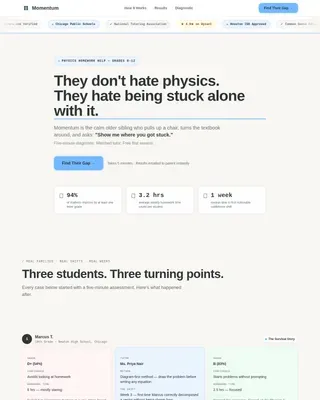
Momentum is a hand-drawn physics video lesson landing page template built for homeschool families and high schoolers who need physics to finally click. It features a zigzag alternating layout, an animated SVG pendulum hero, a five-question diagnostic quiz, and a warm science notebook visual identity that turns confusion into confidence one lesson at a time.
by Rocket studio
Quick summary
Momentum is a single-page template for a hand-drawn physics video lesson library. It pairs a Hero's Journey scroll narrative with a personalized diagnostic quiz, guiding visitors from their first moment of confusion all the way to a curated lesson playlist. The design feels like a well-loved science notebook brought to life on screen.
Who this template is for
This template speaks directly to the people who sit down with a student and realize physics is harder to explain than they expected. It is built for learners at every stage of that struggle.
- Homeschool parents managing multiple grade levels who need structured, visual physics video resources they can start using today
- High schoolers retaking or catching up on physics after a difficult school semester and looking for clear, step-by-step video lessons
- Curious younger learners around age ten who want to understand gravity, force, and motion without a textbook in the way
What problem this template solves
Physics stops many students cold. Textbook diagrams of vectors, torque, and collisions look intimidating before a single lesson begins. Parents feel the pressure too, especially when juggling several grade levels before lunch. This template gives creators a proven page structure to change that first impression fast.
- Replaces the fear of equations with hand-drawn video explanations of forces, velocity, acceleration, impulse, and momentum
- Removes the guesswork about where to start by routing each visitor through a five-question diagnostic quiz that returns a personalized lesson playlist
- Bridges the gap between school curriculum and real understanding, connecting gravity, collisions, and conservation of momentum to things learners already see in daily life
What you get with this template
You get a fully structured, single-page layout ready to present a physics video lesson library with clarity and warmth. Every section is pre-planned so you can focus on your content, not your page architecture.
- A zigzag alternating section layout that follows a Hero's Journey arc, from the learner's struggle through to their breakthrough moment
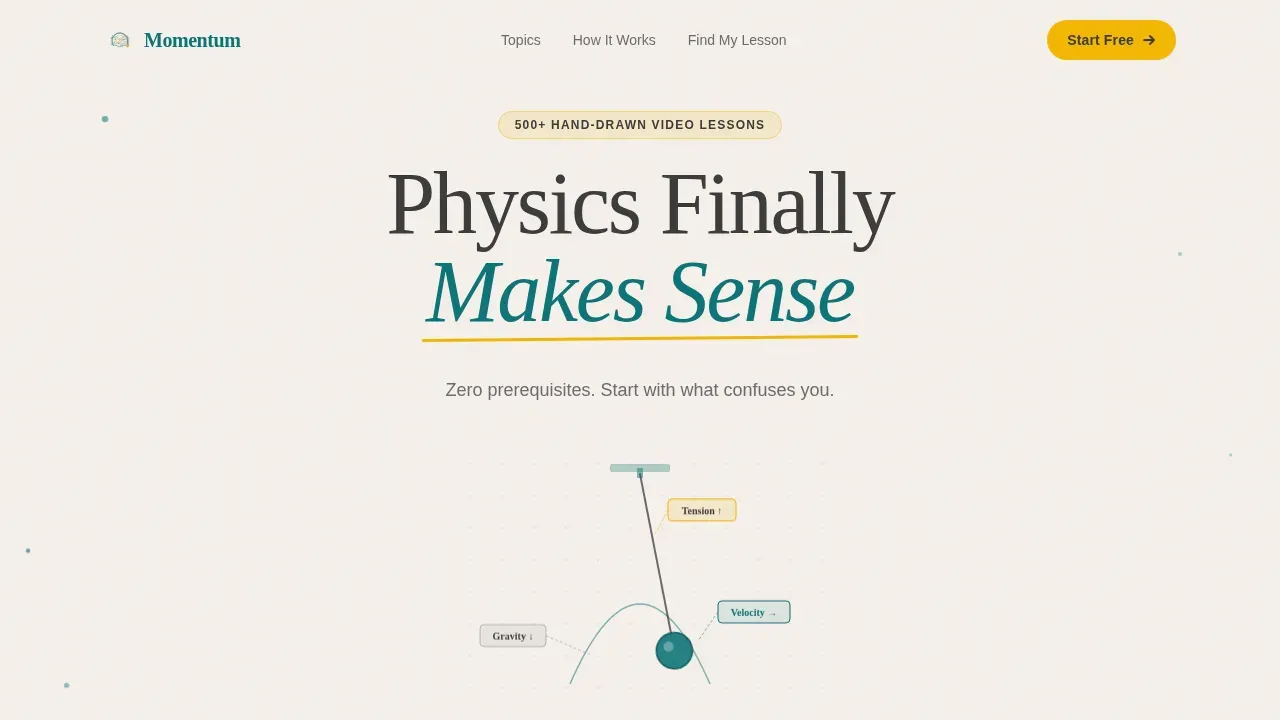
- An animated SVG pendulum hero with a dotted teal arc that labels velocity, tension, and gravity in real time, proving the lesson concept before a visitor reads a single word
- A five-question embedded diagnostic quiz that collects grade level, biggest physics struggle, learning context, math comfort, and goal, then returns a free first-unit playlist
Feature list
This template ships with a focused set of interactive and visual features drawn directly from the brief.
Animated SVG Pendulum Hero
The header opens with a looping hand-drawn pendulum whose dotted arc traces and labels velocity, tension, and gravity as it swings. No stock photography is used. The animation runs on CSS for smooth GPU rendering and makes the lesson concept immediately visible.
Zigzag Alternating Section Layout
Each content block alternates left and right as the visitor scrolls, following a Hero's Journey narrative. The sequence moves from "The Struggle" through "The Guide," "The Library," and "The Breakthrough," so the page itself mirrors the learner's arc from lost to capable.
Five-Question Diagnostic Quiz
The primary call to action is "Find Your Starting Lesson," a spark yellow button that opens a short quiz. It asks five questions covering grade level, biggest physics struggle (forces, waves, electricity, motion), solo or parent-led learning, comfort with algebra and math, and the learner's goal. Results return a personalized video playlist with a free first unit unlocked.
Topic Bento Card Library
A bento-style card grid presents the core physics topics: forces, waves, motion, electricity, torque, collisions, and more. Cards use staggered scroll-reveal entries to keep the page lively without overwhelming the visitor at once.
Social Proof with Named Quotes
Specific parent and student quotes appear alongside completion statistics and topic counts. Real names and real outcomes follow each testimonial block, building trust at every stage of the scroll.
Mobile-First Responsive Layout
The template is built with homeschool parents on phones and tablets in mind. The zigzag sections restack cleanly, quiz interactions stay thumb-friendly, and the animated hero scales without layout shift on smaller screens.
Page sections overview
| Section | Purpose |
|---|---|
| Hero, Pendulum Animation | Hooks visitors with a looping SVG pendulum and the headline "Physics Finally Makes Sense" |
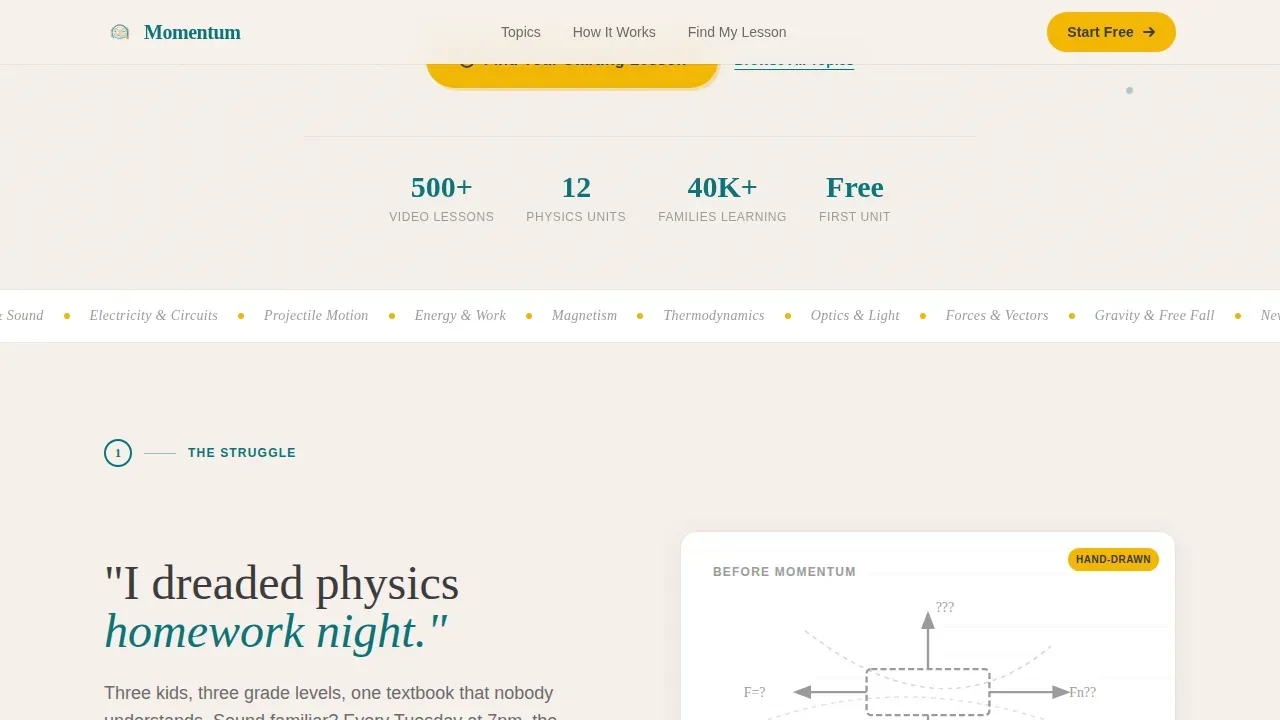
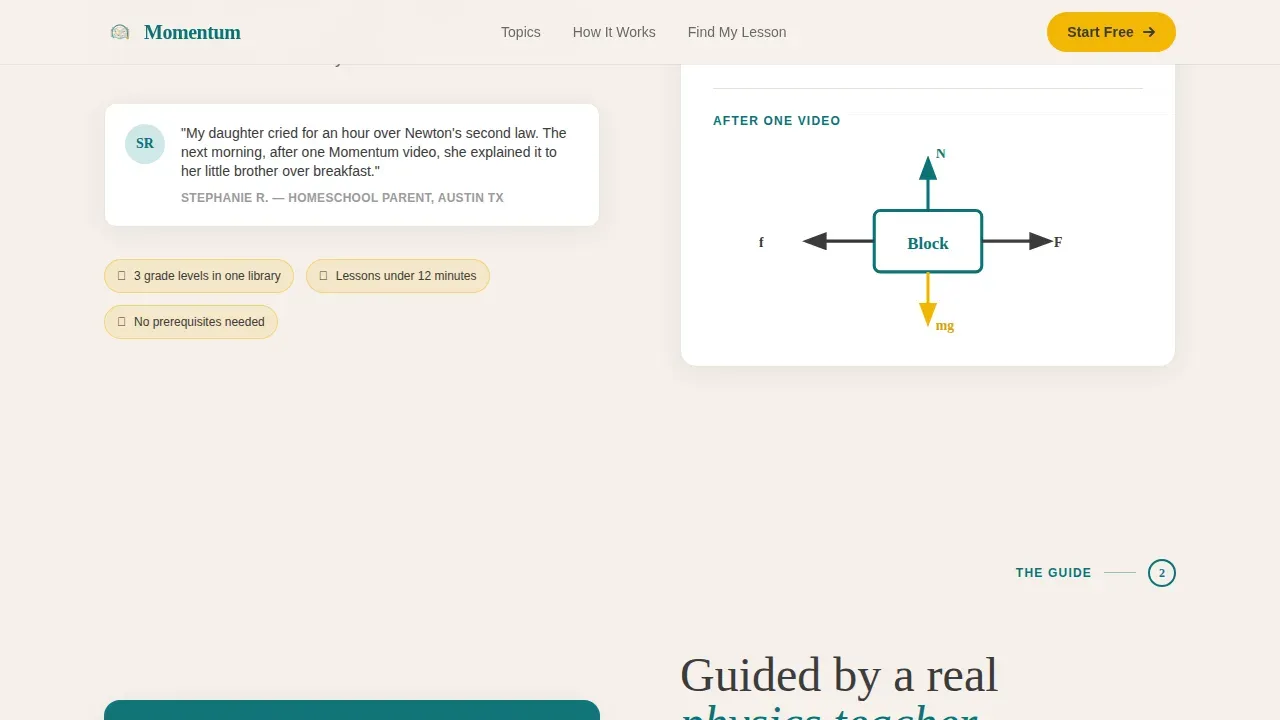
| The Struggle, Zigzag Left | Pairs a parent quote with a free-body diagram animation to validate the learner's frustration |
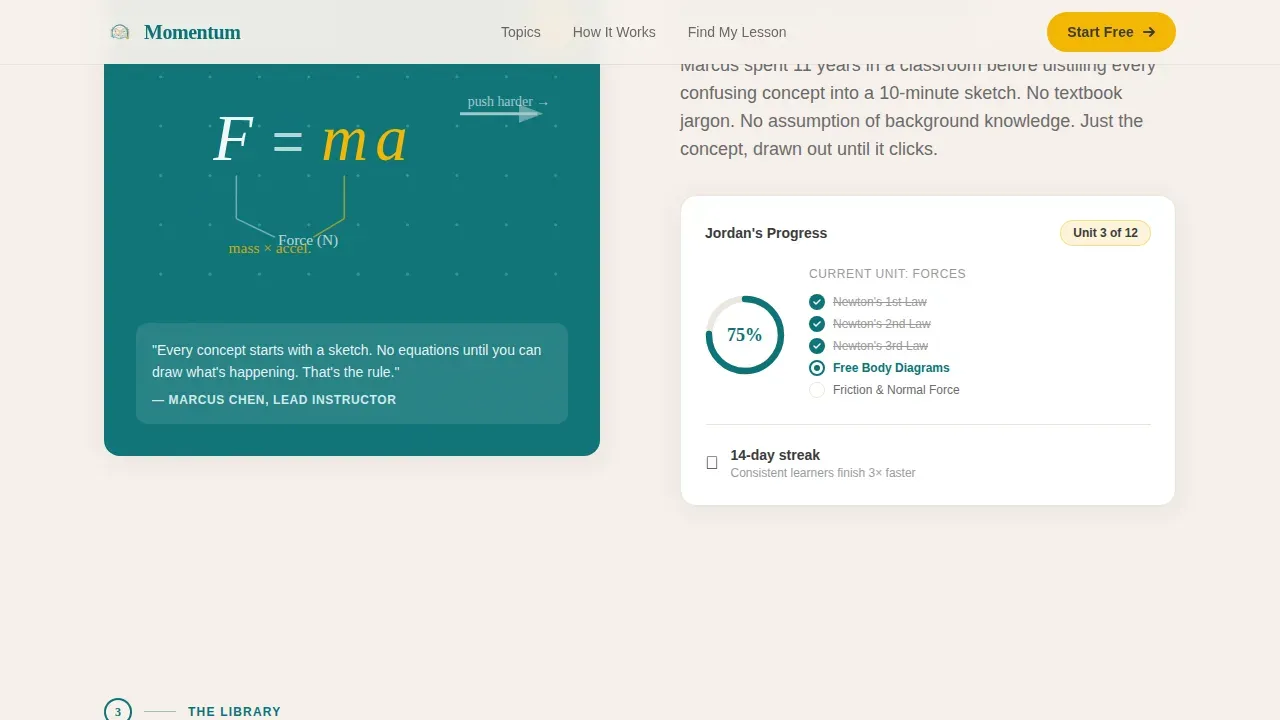
| The Guide, Zigzag Right | Shows the instructor's hand sketching Newton's second law beside a student progress dashboard |
| The Library, Zigzag Left | Displays topic bento cards covering forces, waves, motion, electricity, torque, and collisions |
| The Breakthrough, Zigzag Right | Features a family lesson moment and the embedded five-question diagnostic quiz |
| Footer, Single Row | Closes with a clean linear single-row footer |
Design & branding system
The visual identity follows a Family First theme using the Teal Catalyst color system. Every color choice reinforces the science notebook aesthetic: warm, tactile, and inviting rather than clinical.
- Teal (#0D7377) anchors headings, teal ink annotations, and interactive states; spark yellow (#F2B705) powers buttons and highlights; chalk-dust white (#F5F0EB) sets every background; soft graphite (#3B3B3B) keeps body text readable
- Typography pairs Fraunces (a serif display face for headlines) with DM Sans (a clean sans-serif for body copy), giving the page both warmth and legibility
- All illustration work is hand-drawn in style, with no stock photography or faces, keeping the visual focus on physics concepts like vectors, torque, and collisions rendered as sketch art
Mobile & speed optimization
The template is designed with a mobile-first priority, recognizing that homeschool parents often follow a lesson from a phone or tablet during the day.
- The SVG pendulum animation uses CSS keyframes for GPU-accelerated rendering, keeping motion smooth without heavy JavaScript overhead
- Scroll-triggered section reveals use IntersectionObserver, so off-screen content does not animate until it enters the viewport, reducing unnecessary work on slower devices
- The quiz interaction and all zigzag section transitions are designed to stay touch-friendly and readable at standard mobile widths without horizontal scrolling
How this template helps you convert
Every design decision pushes toward one end: turning a confused visitor into an enrolled learner with a clear starting lesson.
- The animated hero does the first job instantly. A looping pendulum labeling velocity and gravity communicates "these lessons make physics visual" before the visitor reads a headline, lowering the barrier to stay on the page.
- The Hero's Journey scroll arc does the second job emotionally. Visitors follow a narrative that mirrors their own experience, moving from validated struggle through guided steps to a breakthrough moment, building the trust needed to click the quiz button.
- The diagnostic quiz does the closing job practically. By asking five specific questions and returning a personalized video playlist with a free first unit, it removes the hardest objection: not knowing where to start.
Other information about this template
This is the Momentum hand-drawn physics video lesson landing page template, built for EdTech creators serving the homeschool and high school physics market. Several additional details are worth knowing before you use it.
- Momentum is defined as the product of mass and velocity. The lessons are structured to make that statement and its consequences, including impulse, conservation of momentum, elastic and inelastic collisions, torque, and vectors, visible through sketch animation rather than abstract algebra alone.
- The law of conservation of momentum states that momentum is conserved in a closed system with no external forces. Real-world examples used in the lesson library include car collisions, crumple zone energy analysis, a ball rolling across a horizontal surface, and objects at rest in a chair, making the physics tangible.
- The forces involved in collisions can be very large. The template supports lesson content that covers how crumple zones in cars absorb energy to reduce the force on occupants, and how the momentum of a car and the Earth follow equal and opposite force principles during acceleration.
- Elastic collisions conserve both momentum and kinetic energy. Inelastic collisions conserve momentum but not kinetic energy. The page structure can support video sets covering both collision types, from a billiard ball strike to a suppose-style thought experiment in one dimension.
- Interactive content built on this template can enhance student engagement in learning physics concepts. No-code tools allow creators to build and launch educational applications without traditional programming skills, and AI-powered platforms can help generate and iterate lesson content from natural language prompts.
- The template includes rights to customize all colors, copy, and layout sections. Check the platform license for specific usage rights and redistribution terms before publishing.
- Students can practice momentum concepts through problem sets that follow the video lessons. Educational resources built on this template can include supplemental products such as slide decks and worksheets to reinforce each concept.
Theme
Family First
Creative direction
Hero's Journey
Color system
Teal Catalyst
Style
Zigzag/Alternating
Direction
Quiz/Assessment
Page Sections
Animated SVG Pendulum Hero
Hero's Journey Zigzag Layout
Five-question Diagnostic Quiz
Topic Bento Card Grid
Named Social Proof Blocks
Mobile-first Responsive Structure
Related questions
Who is this template designed for?
Does the template include the quiz functionality?
Can I change the colors and typography?
What physics topics does the template support?
Is the template mobile-friendly?