Authoritative Benchmarking Landing Page Template
The Lakehouse template is a comparison table landing page built for a data lakehouse research lab. It opens with a live dashboard header packed with real benchmark numbers, then walks engineers through methodology-driven scroll sections. The design uses a Slate and Sky palette to keep dense data grids readable. A gated report download and an ungated CSV export work together to capture leads at every intent level.
by Rocket studio
Quick summary
This is a single-page benchmark landing page for a data lakehouse research lab. It leads with a data-dense interactive comparison table, then layers in per-dimension spec sheets, editorial verdicts, and a gated report download. The Slate and Sky color system keeps everything legible at a glance. Engineers get real numbers before they scroll a single pixel.
Who this template is for
This template is built for technically rigorous audiences who evaluate infrastructure before committing to it. It speaks directly to the engineers and architects who need hard evidence, not marketing copy.
- Staff data engineers assessing migration from legacy Hive warehouses to modern lakehouse engines
- Platform architects drafting request-for-proposal documents for enterprise lakehouse adoption
- Chief technology officers who need a one-page artifact to justify a large infrastructure investment
What problem this template solves
Engineering teams waste hours hunting for credible, apples-to-apples lakehouse performance data. Most comparisons are vendor-sponsored, shallow, or months out of date. This template gives a research lab a structured home for rigorous, transparent benchmarks.
- No authoritative single source exists for query latency, merge-on-read costs, and compaction behavior across competing engines
- Decision-makers arrive at procurement meetings without shareable, citable artifacts
- Generic marketing landing pages destroy credibility with technical buyers who distrust promotional framing
What you get with this template
You get a full single-page layout engineered for data-dense presentation and trust-first conversion. Every structural choice supports the "spec sheet" creative direction: disclose first, persuade never.
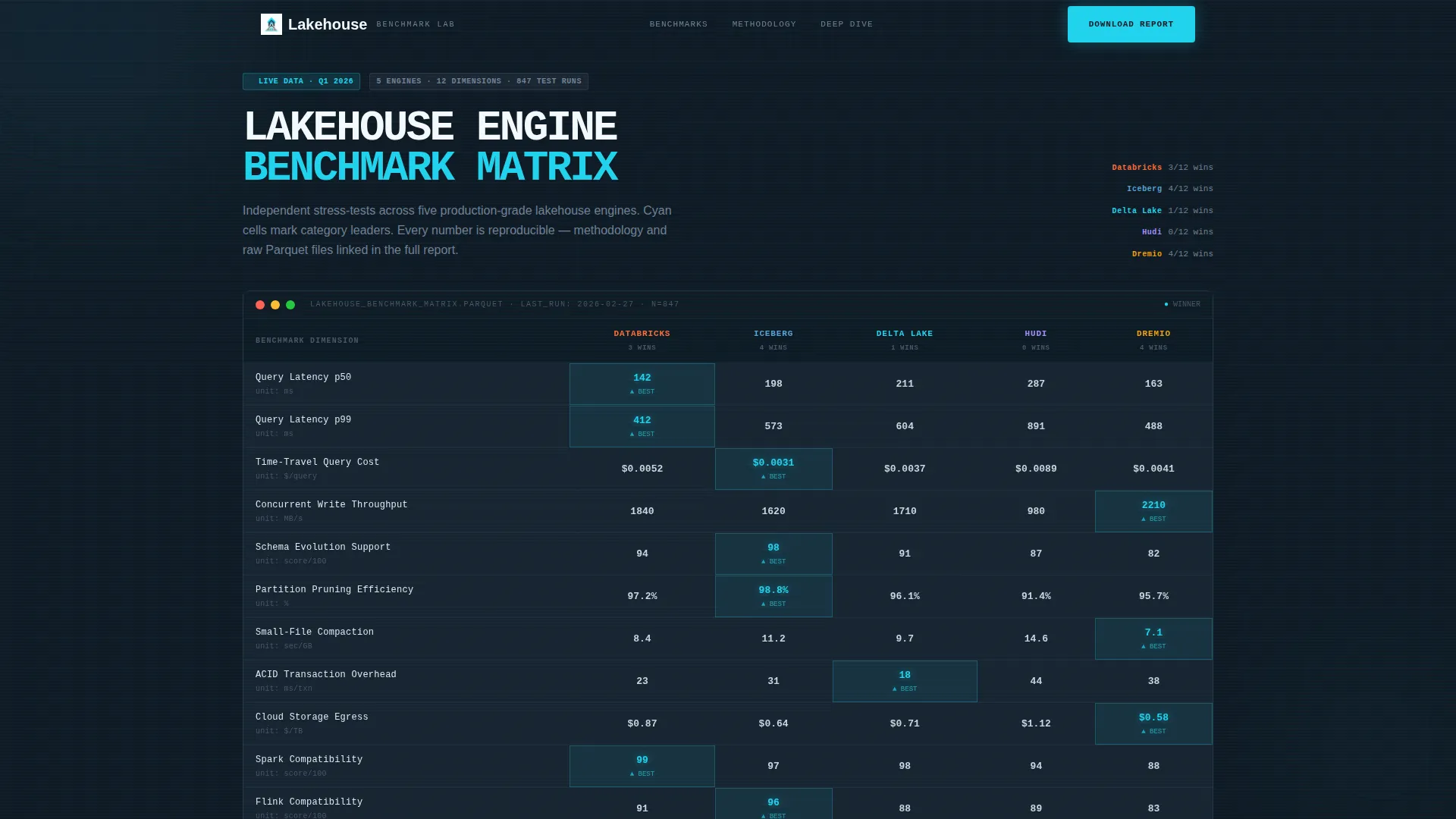
- A live dashboard header table showing five engines across twelve benchmark dimensions, with electric cyan highlights on category leaders
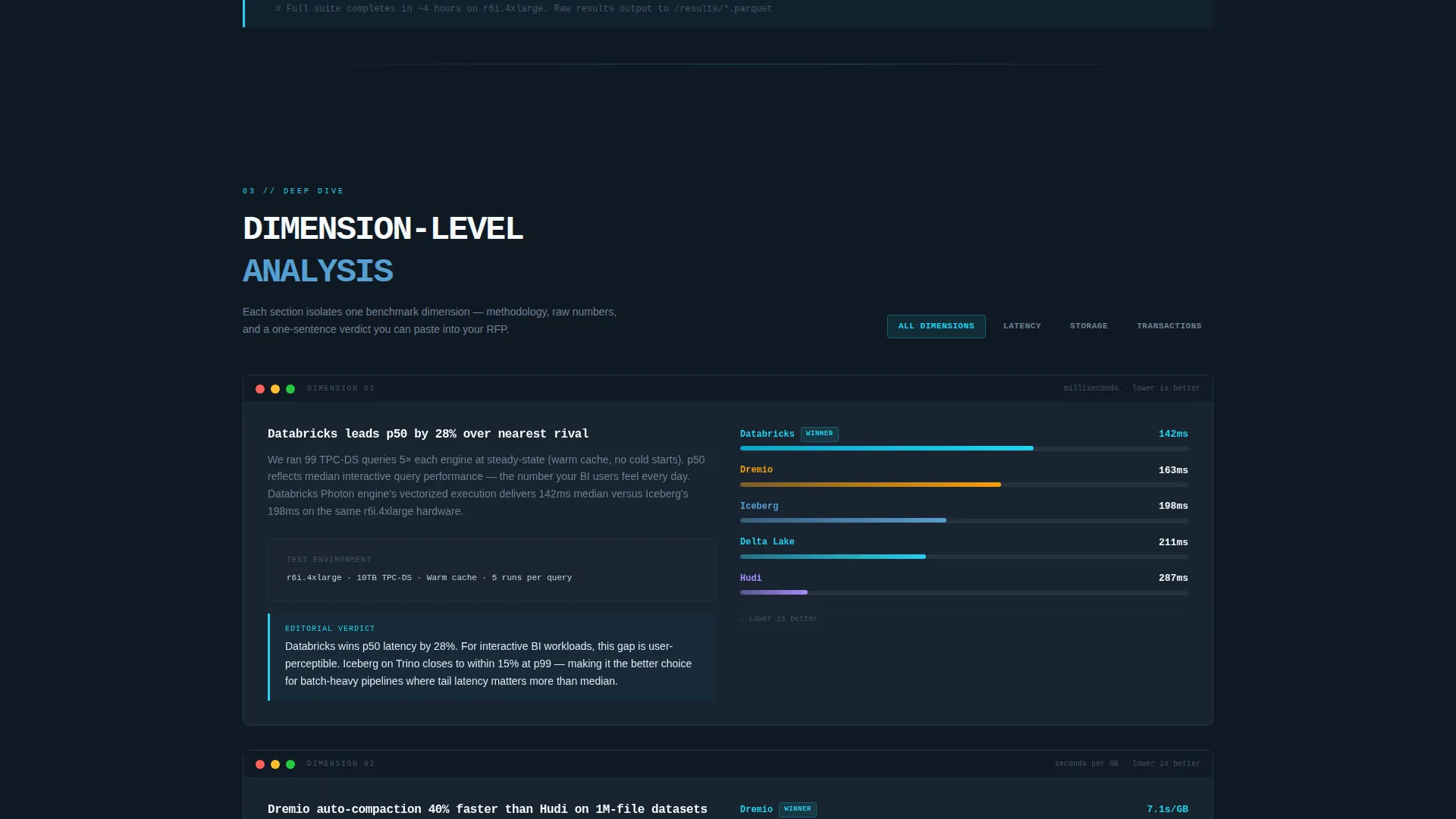
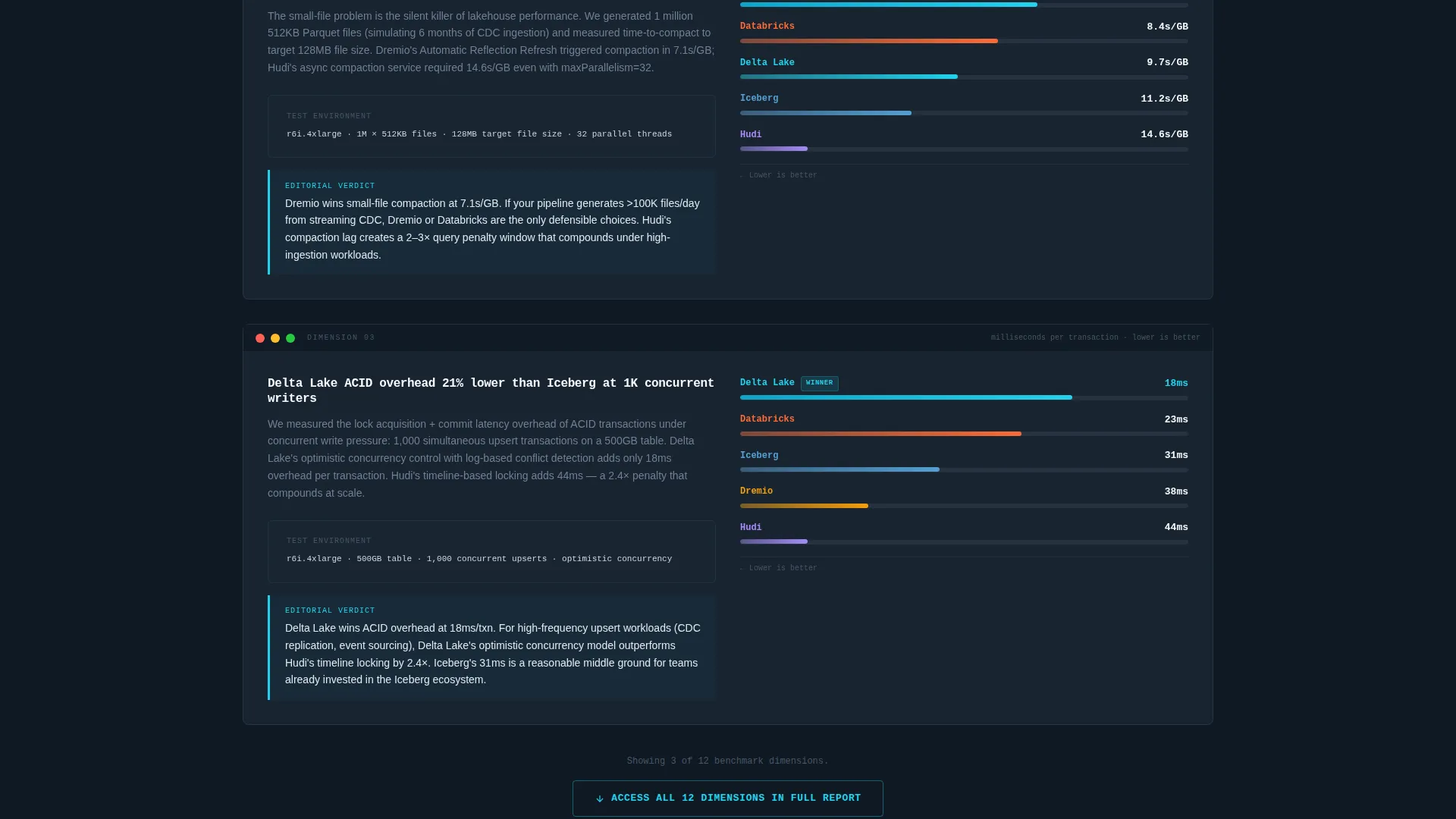
- Per-dimension scroll sections that each contain methodology notes, test environment specs, raw results, and a one-sentence editorial verdict
- A gated two-field download form for the full benchmark report alongside an ungated CSV export path for lower-intent visitors
Feature list
This section covers the core capabilities built into the template. Each one is grounded in the source brief.
Live Benchmark Dashboard Header
The header opens as a stylized interactive table. Five lakehouse engines run across the top axis. Twelve benchmark dimensions run down the left axis. Cells displaying the category-leading value glow in electric cyan. Visitors see real figures such as query latency in milliseconds and compatibility percentages before scrolling at all.
Per-Dimension Spec Sheet Sections
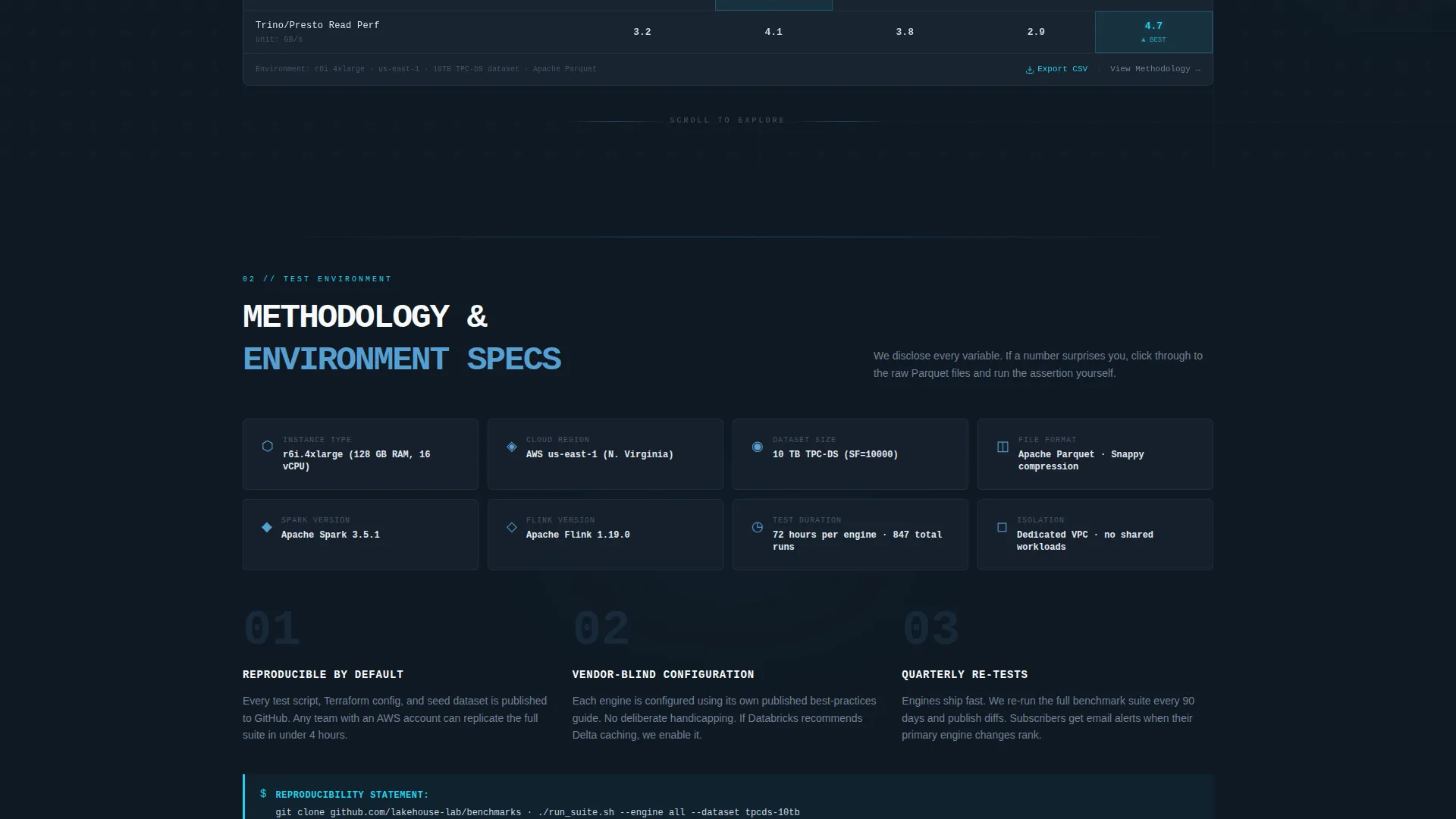
Each scroll section isolates one benchmark dimension. It presents the methodology, the test environment details including instance type, region, dataset size, and file format, the raw results, and a one-sentence editorial verdict. Sections are self-contained so a visitor can enter mid-page and still understand the context.
Three-Depth Comparison Table System
Comparison tables appear at three levels of detail. A summary lives in the dashboard header. Category-level tables appear mid-page alongside each benchmark section. A full-resolution exportable matrix sits at the bottom of the page for visitors who need the complete picture.
Dual Conversion Path Design
The primary call to action is a gated "Download Full Benchmark Report" form with two fields: work email and current primary lakehouse engine via dropdown. A secondary ungated "Export This Table as CSV" path captures intent from visitors not ready to share contact details. The open data strategy makes the gated exchange feel like an upgrade rather than a barrier.
Slate and Sky Color System
Deep terminal slate dominates headers, navigation, and data-dense grid regions. Open-sky blue activates on hover states, selected filters, and performance-leader badges. Electric cyan marks winning benchmark values. Crisp cloud white separates table rows so the eye stays comfortable across long scanning sessions.
Editorial Verdict Layer
Every benchmark section ends with a single authoritative sentence summarizing which engine wins the dimension and why. This layer transforms raw data into a usable signal without crossing into promotional language. Engineers get an opinion they can quote in an internal review doc.
Page sections overview
| Section | Purpose |
|---|---|
| Dashboard Header Table | Show all five engines and twelve benchmark dimensions with cyan-highlighted leaders above the fold |
| Benchmark Dimension Sections | Isolate each metric with methodology, test specs, raw results, and an editorial verdict |
| Mid-Page Category Tables | Provide category-level comparison grids that expand on header summary data |
| Gated Report Form | Collect work email and current engine via a two-field form to deliver the full report |
| CSV Export Path | Offer an ungated table download for visitors not ready to exchange contact details |
| Full-Resolution Matrix | Present a complete exportable benchmark grid at the page bottom for deep-dive review |
Design & branding system
The visual identity follows a Directory and Discovery theme. The palette is cold and precise, like infrastructure documentation should be. Every color choice has a functional role in the data grid.
- Deep terminal slate (#1E2A38) anchors headers, navigation bars, and dense data regions; mid-gray steel (#4A5568) handles secondary text and labels
- Open-sky blue (#56A0D3) activates on hover states, filter selections, and performance-leader badges; crisp cloud white (#F7FAFC) fills table cell backgrounds to reduce eye fatigue
- Electric cyan (#22D3EE) serves as the accent that marks winning benchmark values and top-ranked cells, making category leaders immediately visible without additional labels
Mobile & speed optimization
Dense comparison grids present a real challenge on smaller screens. The template is structured to keep critical data readable without sacrificing the spec-sheet feel.
- Benchmark tables are designed to scroll horizontally on narrow viewports so column relationships stay intact rather than collapsing into an unreadable stack
- Section-level self-containment means each benchmark block loads and reads independently, supporting fast scanning on mobile without requiring the full page to render first
How this template helps you convert
This template converts by earning trust before asking for anything. The open data strategy is intentional: show most of the value freely, then make the gated content feel like a meaningful upgrade.
- The dashboard header delivers real numbers above the fold, giving engineers immediate confidence that the lab has done the work and is not hiding results behind a form
- The ungated CSV export captures intent signals from lower-funnel visitors without friction, while the gated two-field form converts higher-intent visitors who want the full methodology, cost modeling spreadsheets, and quarterly re-test cadence
Other information about this template
This template is specifically designed for the data lakehouse technology niche, where technical credibility is the primary purchase driver. A few additional details are worth knowing before you deploy it.
- The benchmark dimensions included are query latency at p50 and p99 percentiles, time-travel query cost, concurrent write throughput, schema evolution support, partition pruning efficiency, small-file compaction speed, ACID transaction overhead, cloud-storage egress, Spark compatibility score, Flink compatibility score, Trino and Presto read performance, and total cost per terabyte per month
- The gated report adds methodology deep-dives, cost modeling spreadsheets, and a quarterly re-test cadence summary, which are the three elements that justify the contact-detail exchange for a senior technical buyer
- Engines covered in the comparison layout include Databricks, Apache Iceberg, Delta Lake, Apache Hudi, and Dremio, giving the table enough breadth to serve engineers evaluating any major lakehouse platform today
- The template style is Comparison Table under a Directory and Discovery theme, making it reusable for any research lab or analyst firm that publishes structured, multi-engine performance data
- Footnotes in each benchmark section link to raw Parquet files, and axis units are labeled on every chart, supporting the disclosure-first editorial standard the template is built around
Theme
Directory & Discovery
Creative direction
Spec Sheet
Color system
Slate & Sky
Style
Comparison Table
Direction
Comparison/Versus
Page Sections
Live Benchmark Dashboard Header
Per-dimension Spec Sheet Sections
Three-depth Comparison Table System
Dual Conversion Path Design
Editorial Verdict Layer
Slate and Sky Color System
Related questions
Can I add or remove benchmark dimensions from the comparison table?
How does the gated download form work?
Does the header table ship with real benchmark data?
Who is this landing page template designed for?
Can the template support a regularly updated benchmark cadence?