Decentralized Enterprise Software Professional Website Template
Ledger is a decentralized CRM landing page template built for Web3 founders, DAO operators, and crypto-native sales teams. It features a glassmorphic dark cockpit aesthetic, a side-by-side comparison table, an early access lead capture form, and founder case-study cards, all designed to convert visitors who believe CRM data should be sovereign by default.
by Rocket studio
Quick summary
Ledger is a single-page, conversion-focused landing page template for a decentralized CRM product. It puts a live-rendered comparison table at its center, surrounds it with founder social proof and a punchy data sovereignty manifesto, and closes with a clean early access form. The design runs on a glassmorphic dark cockpit system with animated panels and glowing data accents.
Who this template is for
This template was built for teams launching a Web3-native CRM or decentralized enterprise software product that needs to earn trust and capture early leads fast. If your audience is skeptical of centralized vendors, this layout speaks their language directly.
- Web3 founders managing token-holder relationships and on-chain pipelines
- DAO operators who need a structured contributor tracking solution without centralized vendor dependency
- Crypto-native sales teams ready to pitch CRM data sovereignty to early adopters
What problem this template solves
Centralized CRM tools create a trust problem for Web3 teams. Your pipeline data sits on someone else's server, under someone else's terms. Convincing a crypto-native buyer to adopt a new CRM requires proof, not just promises. This template makes that proof visible and immediate.
- No clear visual way to compare a decentralized CRM against familiar incumbents
- No structured path from skepticism to signup for a technically sophisticated audience
- No design system that communicates power and ownership without feeling like a generic SaaS page
What you get with this template
You get a fully structured, single-page landing page designed around a comparison table as the primary persuasion engine. Every section is sequenced to build conviction before asking for commitment.
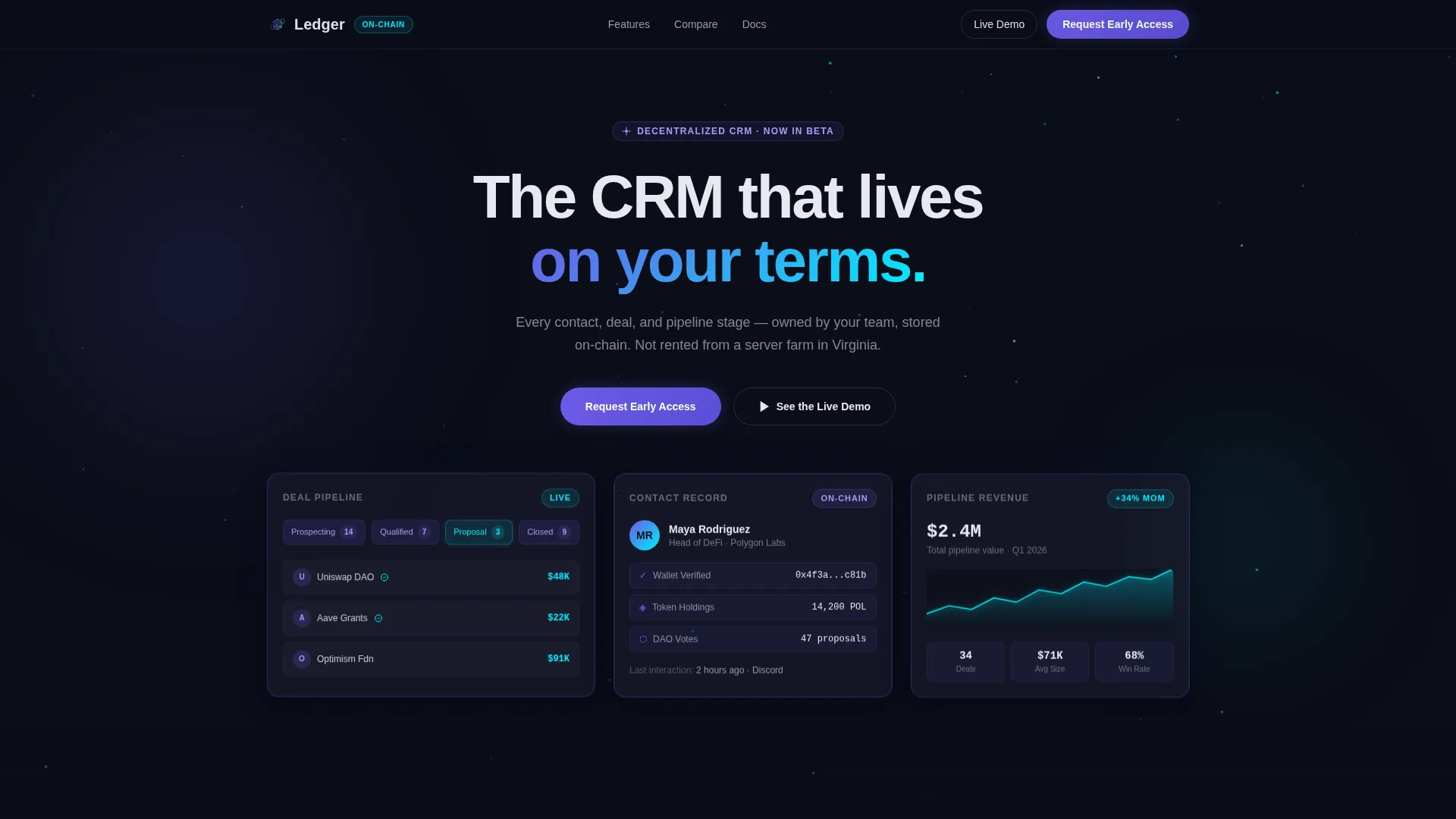
- A hero section with three floating glass panels showing real product views over an animated particle mesh
- A staggered comparison table, a full-width early access form, three founder case-study cards, and a manifesto block
- A sticky pill call-to-action in the top nav plus a secondary demo link that gives skeptics a proof path before signup
Feature list
This template ships with purpose-built components that work together as a persuasion sequence rather than a collection of independent blocks.
Animated Dark Glass Hero Panels
Three translucent frosted panels hover over a particle mesh background. Each panel renders a real CRM view: a deal pipeline with drag states, a contact record with on-chain verification badges, and a revenue chart with live-updating nodes. Soft inner glows and slow-moving gradient light give the header genuine visual depth.
Staggered Comparison Table
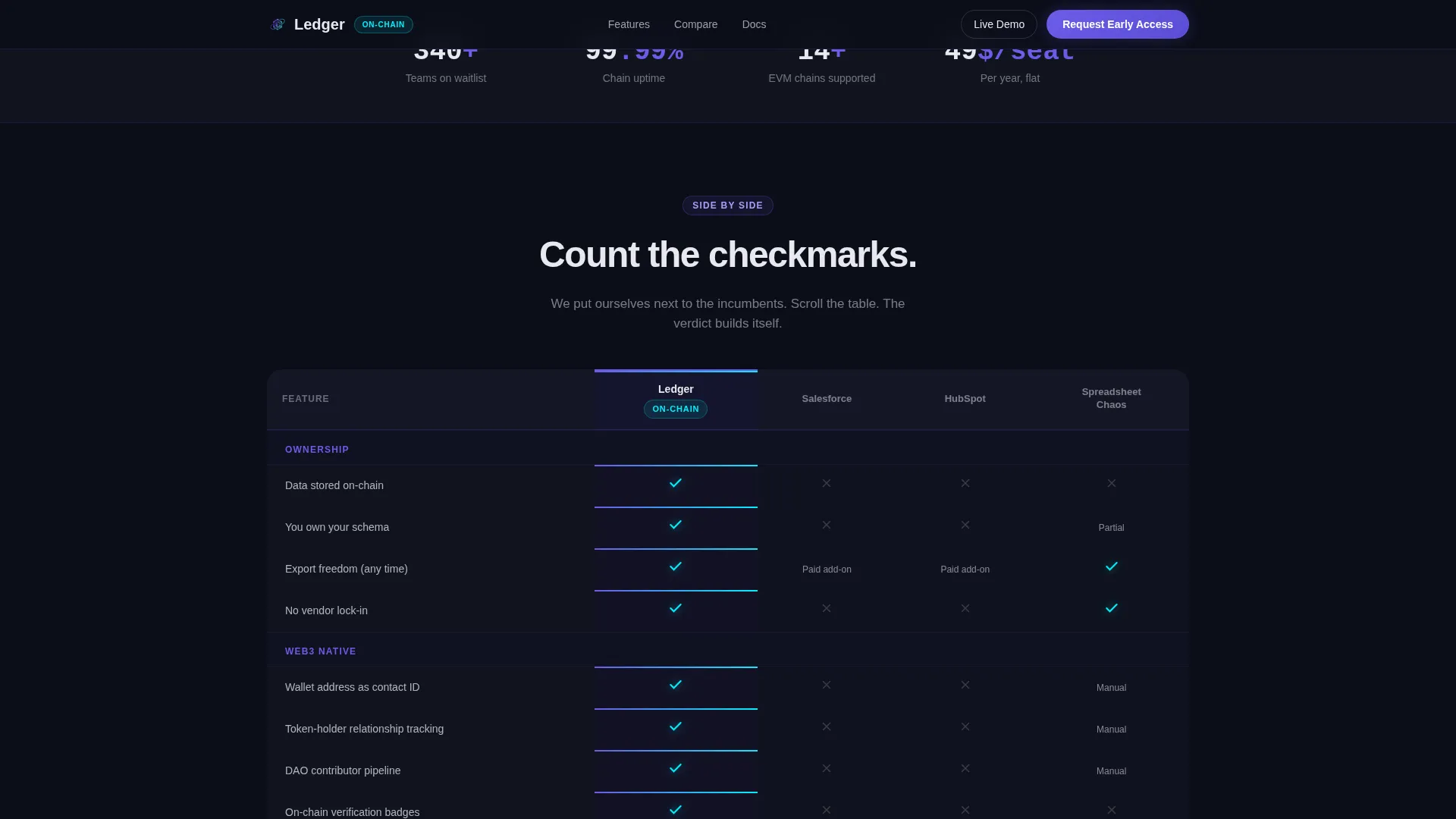
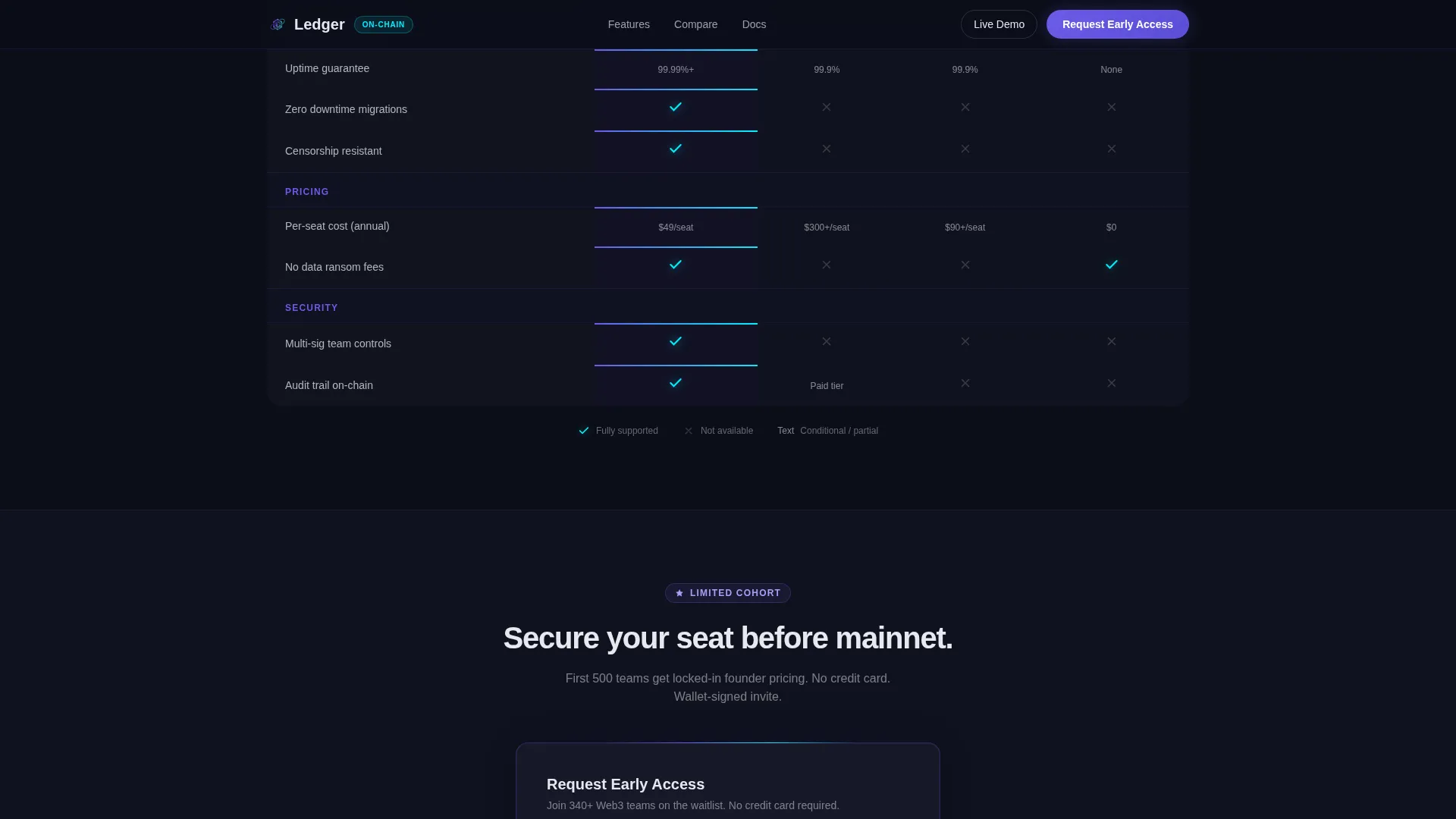
The centerpiece comparison table puts the decentralized CRM side-by-side against other CRM options. Rows cover data ownership, uptime, wallet infrastructure integration, export freedom, and per-seat cost. Checkmarks glow cyan on scroll entry; inactive marks stay dim. Each row animates in with a micro-stagger, building a visual verdict row by row.
Dual-Path Conversion System
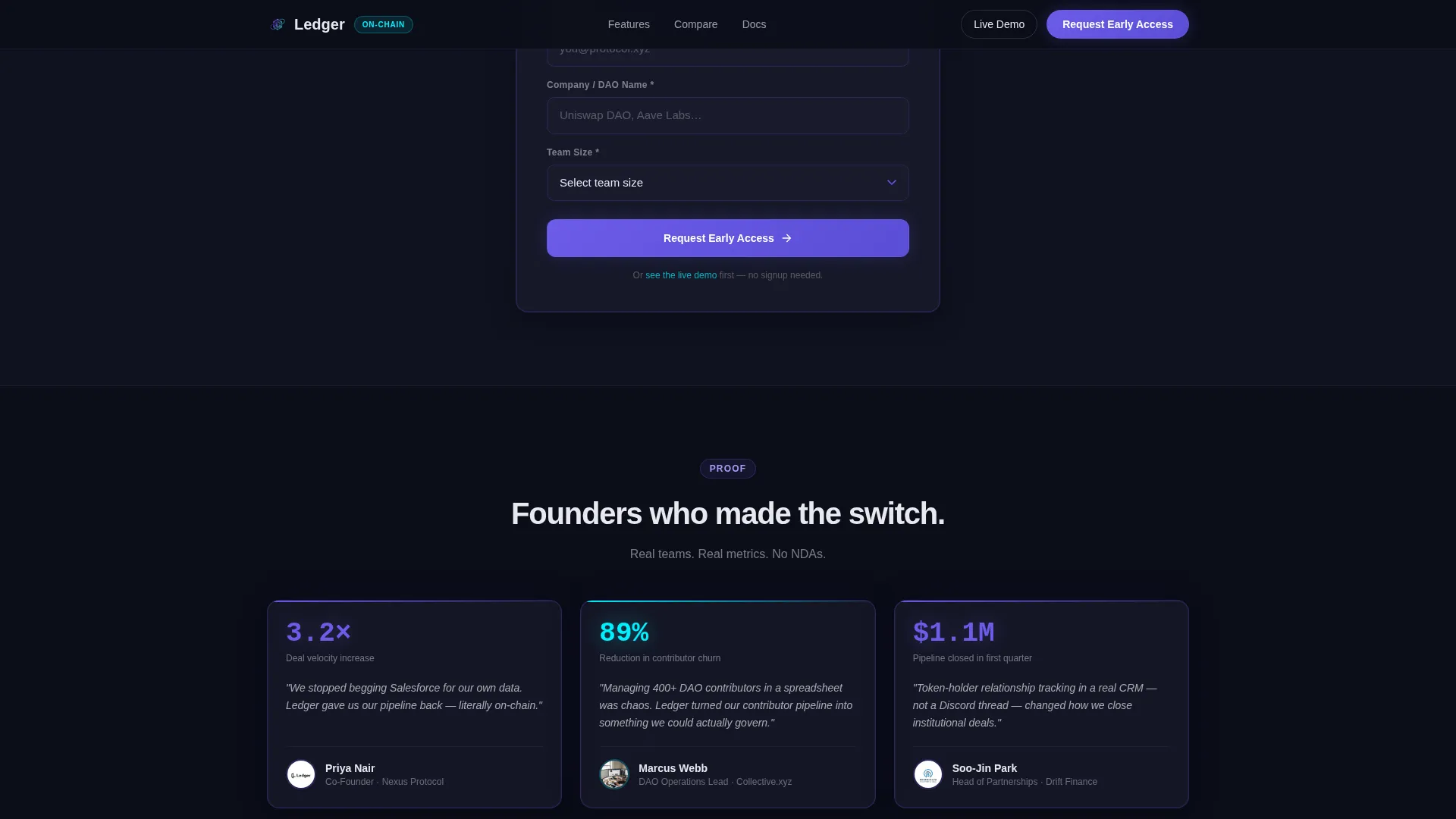
The primary call-to-action, "Request Early Access," appears as a sticky pill in the top nav and again as a full-width form below the comparison table. The form collects work email, company name, and team size. A secondary "See the Live Demo" link gives cautious visitors a sandbox path before they commit.
Founder Case-Study Cards
Three compact cards appear below the comparison table. Each card surfaces a founder headshot, company name, one key metric, and one direct quote. The cards deliver fast social proof without interrupting the page's momentum.
Manifesto Block
A single-column text block follows the case studies. Short, punchy lines build the data sovereignty argument in pitch-deck rhythm. The block reads fast and reinforces the emotional case made by the comparison table's data.
Glassmorphic Component System
Every card, panel, and row uses frosted-glass borders, 60-percent opacity layering, and a 12-pixel blur. Hover states activate signal cyan glows. Active rows and call to action pulses earn their brightness through importance, not decoration.
Page sections overview
| Section | Purpose |
|---|---|
| Sticky Nav Pill | Persistent early access call to action visible throughout scroll |
| Hero Glass Panels | Renders real product views behind frosted animated panels |
| Comparison Table | Side-by-side verdict across CRM ownership criteria |
| Early Access Form | Captures work email, company name, and team size |
| Founder Case Studies | Delivers fast social proof with metrics and quotes |
| Manifesto Block | Closes the argument for CRM data sovereignty |
| Footer | Horizontal flow pattern with standard site links |
Design & branding system
The visual identity follows a Startup Velocity theme executed through a glassmorphic color system. The palette reads like a cockpit at cruising altitude: deep matte surfaces with glowing information pushing through translucent layers.
- Core colors: void black (#0B0D17) for backgrounds, frosted panel (#1A1D2E at 60% opacity with 12-pixel blur) for cards, electric indigo (#6C5CE7) for primary accents, and signal cyan (#00F0FF) reserved for hover states, active rows, and call to action pulses
- Typography: DM Sans throughout, crisp white (#E8E8F0) as the default, with color used only where data demands it
- Animation profile: particle mesh background, scroll-linked parallax, staggered table row entry, counter animations, and GPU-accelerated glassmorphism panel transitions
Mobile & speed optimization
The template is desktop-first by design, built around the wide comparison table and cockpit aesthetic. A mobile fallback is included so the layout remains usable on smaller screens without losing the core conversion flow.
- GPU-accelerated transforms power all panel animations and hover states, keeping motion smooth across modern devices
- The canvas particle system is optimized to avoid blocking the main thread during scroll and interaction events
How this template helps you convert
The page is structured as a conviction sequence. Each section does one job, and they build on each other in a deliberate order.
- The hero panels show the product at full fidelity before a single word of copy has been read, creating immediate credibility through visual proof rather than claims.
- The comparison table does the persuasion work row by row, so by the time a visitor reaches the early access form, they have already counted the checkmarks and built their own case for switching.
- The dual-path call to action system removes friction by offering both a commitment path and a demo path, letting the visitor choose their own readiness level without abandoning the page.
Other information about this template
This template is suited for decentralized enterprise software products that need to earn trust from technically sophisticated buyers before asking for a signup. It is built as a lead generation landing page, not a full product site, so every design decision serves the early access conversion goal.
- The template uses the Vercel Horizontal Flow footer pattern, keeping the page close and the brand consistent to the end
- The design language is intentionally distinct from mainstream SaaS templates, signaling that this product operates in a different category
- Teams can adapt the comparison table rows to reflect their own specific differentiators without restructuring the layout
- The form's three-field structure keeps friction low while collecting enough qualification data to segment leads by team size
Theme
Startup Velocity
Creative direction
Launch Energy
Color system
Glassmorphic
Style
Comparison Table
Direction
Lead Generation
Page Sections
Animated Dark Glass Hero Panels
Staggered Comparison Table
Dual-path Conversion System
Founder Case-study Cards
Data Sovereignty Manifesto Block
Glassmorphic Component System
Related questions
Who is this landing page template designed for?
What sections are included in this template?
Can I customize the comparison table rows?
Does this template support a demo path alongside the signup form?
Is this template desktop-only?