Expert Government Software Privacy Policy & Terms Website Template
The Comply Bold Brutalist Government Compliance Management Landing Page Template is a dashboard-style landing page built for government compliance platforms. It turns dense regulatory data into a structured, scannable spec-sheet experience. Bold brutalist design, a charcoal and sky-blue color system, and a live audit tracker grid make every mandate, deadline, and framework impossible to overlook.
by Rocket studio
Quick summary
Comply is a single-page landing page template designed for government compliance software. It delivers a spec-sheet scroll experience, presenting platform capabilities as labeled data blocks separated by thick rules. The design style is Bold Brutalist: raw, high-contrast, and built to communicate authority. Every section earns attention through evidence density rather than decoration.
Who this template is for
This template is built for teams that sell or operate government-grade compliance platforms. The target audience includes professionals who live inside regulatory workflows daily and need a landing page that speaks their language without softening the message.
- Compliance officers managing federal and state mandate cycles
- Municipal IT directors proving legacy systems meet regulatory standards
- State agency liaisons coordinating overlapping audit schedules
What problem this template solves
Most compliance software pages look like every other SaaS landing page: gradient backgrounds, stock photography, and polished copy that says nothing specific. That approach fails when the audience is a compliance officer who reads Code of Federal Regulations citations for a living. They reject vague claims immediately.
- Visitors leave pages that fail to name their exact regulatory framework
- Soft design aesthetics signal a mismatch with government-grade rigor
- Generic lead forms collect noise instead of qualified demo requests
What you get with this template
This template gives you a full single-page layout structured around specification blocks. Each block presents one capability statement, a bold category header, and a supporting visual. The cumulative effect is persuasion through enumeration, not emotion.
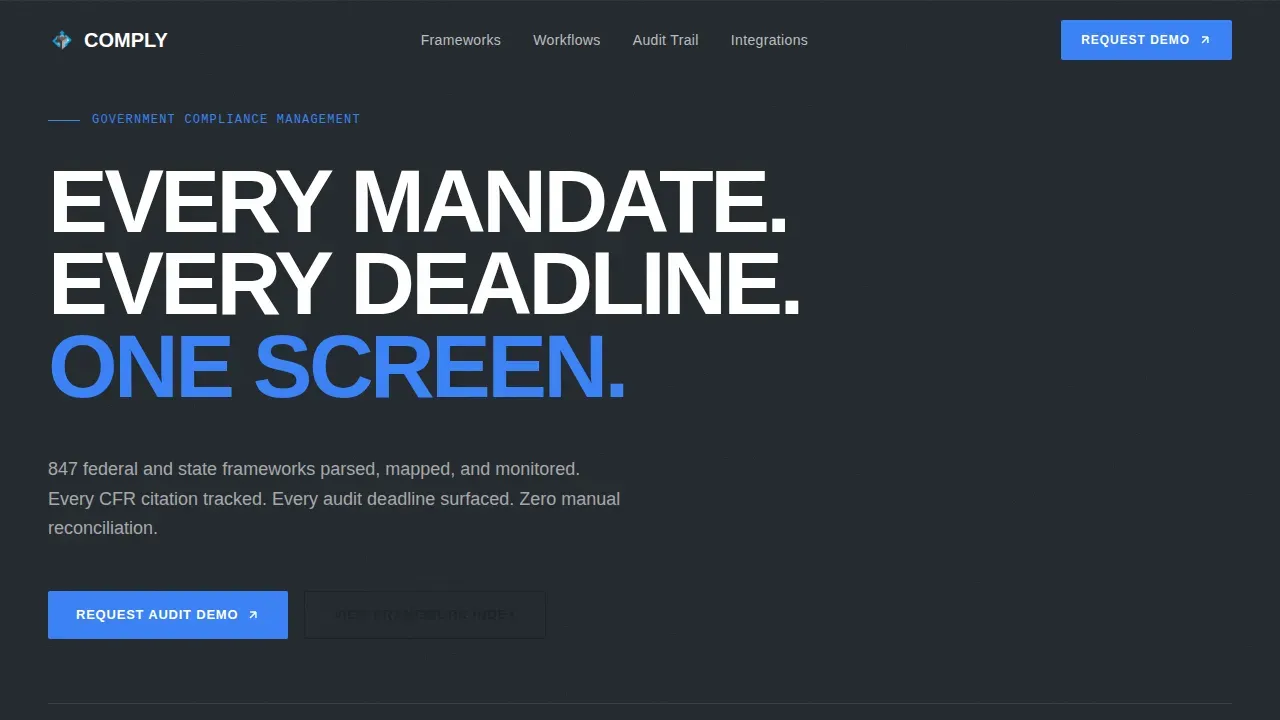
- Hero section with a full-viewport dashboard screenshot and stamped brutalist headline
- Four labeled spec blocks covering framework coverage, audit trail depth, workflow architecture, and evidence mapping
- A lead generation section with a demo request form, gated PDF download path, and a sticky call-to-action bar
Feature list
This template includes purpose-built features drawn directly from its compliance-platform brief. Each element is designed to work together as a cohesive, high-trust landing page.
Full-Viewport Dashboard Hero
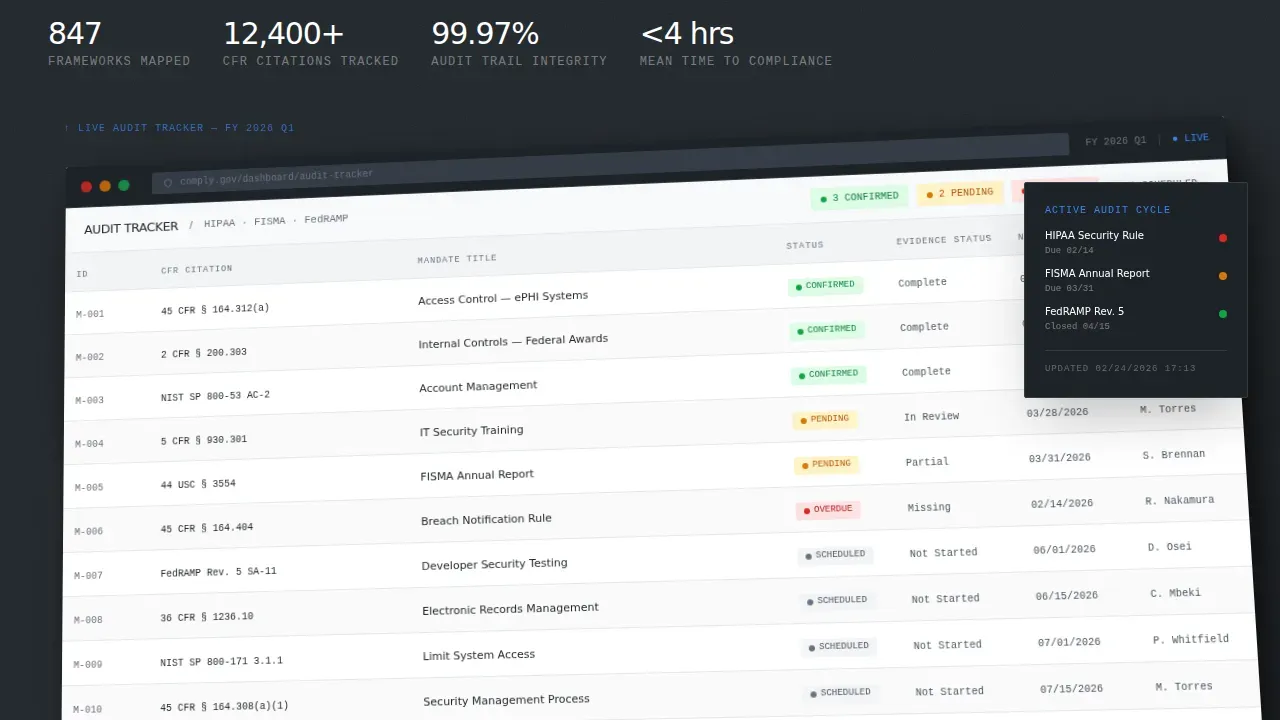
The hero section opens with a high-fidelity compliance dashboard screenshot set on a concrete-textured background with a hard drop shadow. A stamped all-caps headline sits above it in a heavy grotesque face. A floating audit status card shows live mandate states at a glance.
Spec Block Architecture
The page scrolls through four labeled specification blocks. Each block uses a bold category header, a single metric or capability statement, and a data visualization. Thick horizontal rules separate every block, giving each statement the visual weight of a contract clause.
Live Mandate Tracker Grid
The workflow architecture spec block features a live mandate tracker grid. Status indicators show mandates in confirmed, pending, overdue, and scheduled states. Column headers use real compliance terminology: CFR Citation, Evidence Status, Next Review, and Assigned Analyst.
Dual Lead Capture System
The lead generation section offers two conversion paths. The primary path is a demo request form collecting agency name, regulatory framework, work email, and role title. The secondary path is a gated PDF download of the full framework coverage index, capturing email and organization in exchange.
Sticky Call-to-Action Bar
A sticky bottom bar activates after the visitor passes the third spec block. It displays the primary call to action in sky blue against charcoal. The bar stays anchored as users scroll, keeping the conversion path visible without interrupting the reading flow.
Searchable Framework Dropdown
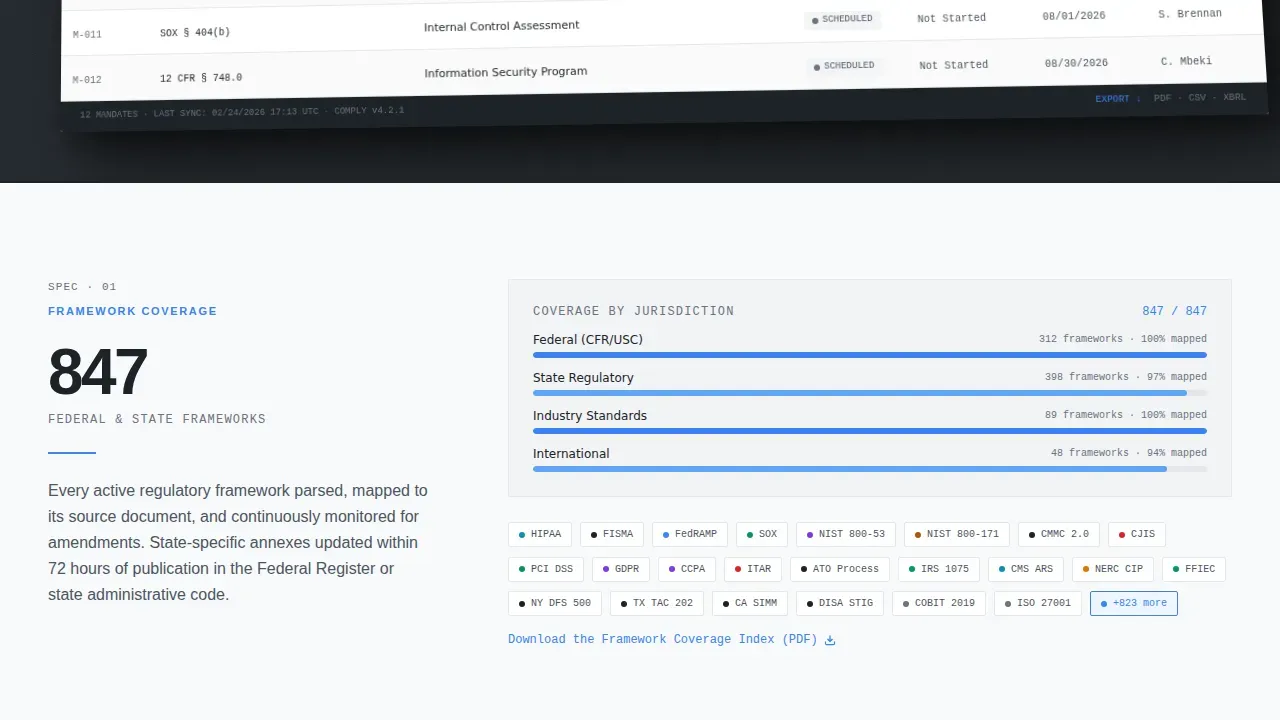
The demo request form includes a searchable dropdown for regulatory framework selection. Options cover FedRAMP, HIPAA, SOX, FISMA, and state-specific frameworks. This single field signals to the visitor that their specific compliance context is already understood and supported.
Page sections overview
| Section | Purpose |
|---|---|
| Hero Dashboard | Opens with full-viewport screenshot, stamped headline, and audit status card |
| Spec Block 1 | Presents framework coverage with 847 frameworks and searchable index |
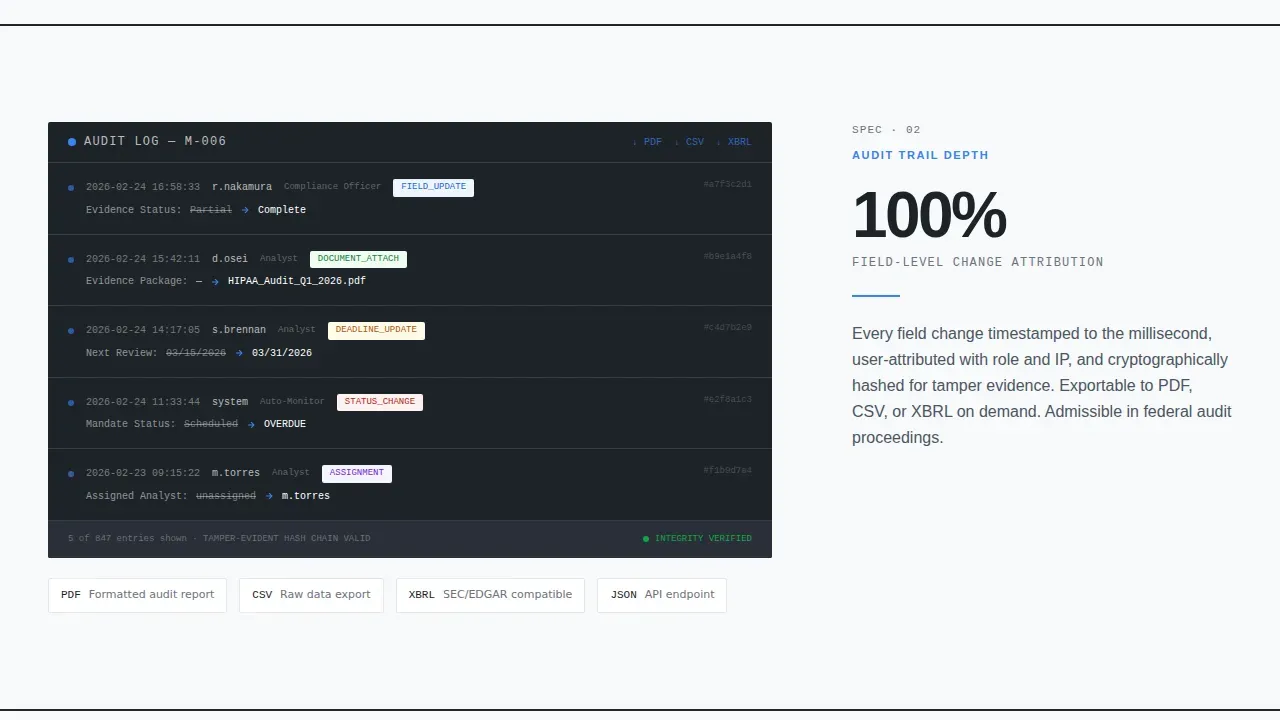
| Spec Block 2 | Shows audit trail depth with timestamped changelog and export formats |
| Spec Block 3 | Displays workflow architecture via live mandate tracker grid |
| Spec Block 4 | Maps integration and evidence at field level with system connectors |
| Lead Gen Section | Houses demo form, gated PDF path, and sticky call-to-action bar |
| Footer | Linear single-row footer with essential links |
Design & branding system
The design system is rooted in Bold Brutalist web design principles. It embraces raw, unrefined aesthetics and rejects decorative gradients, rounded corners, and polished stock imagery. The result is a site that feels like a federal filing system, not a startup homepage.
- Colors: deep charcoal (#1E2328) for backgrounds, cast-concrete gray (#6B7280) for supporting text, sky blue (#3B82F6) strictly for interactive elements and status indicators, and document white (#F8F9FA) for data cells
- Typography: DM Sans in heavy grotesque weights for headlines and labels, IBM Plex Mono for data fields, citations, and code-style elements
- Layout: rigid grid system with clearly separated blocks, exaggerated negative space, and thick horizontal rules as structural dividers
Mobile & speed optimization
This template is built desktop-first, reflecting the reality that compliance officers work primarily on large monitors. The layout and typography are optimized for wide viewports where the data grid and spec blocks can be read without compression.
- Responsive breakpoints ensure the landing page remains functional and legible on tablet and mobile screens
- Server-rendered components handle static spec blocks, while client-side rendering powers the demo form, sticky bar, and searchable dropdown
- Scroll-triggered reveals and staggered data row animations are set to medium intensity, keeping interactions purposeful without overwhelming the experience
How this template helps you convert
This landing page is engineered to move qualified visitors toward a demo request by the time they reach the form. The design does not rely on persuasion copy alone. It relies on accumulation.
- By the third spec block, visitors have seen their specific regulatory framework named, their audit workflow mirrored, and their pain described in language only someone who has lived it would write. The evidence density does the persuading.
- The dual conversion path means visitors who are not ready to talk to sales still sign up for the gated PDF, capturing a qualified lead at a lower commitment threshold.
- The sticky call-to-action bar keeps the demo request visible throughout the scroll, so users never have to hunt for the next step.
Other information about this template
This template is well suited for design studio teams and developers who need a ready-built foundation for a compliance-focused web project. The design is customizable, allowing users to match brand colors and fonts without rebuilding the layout from scratch. CSS variables control the core color system, making changes fast and consistent across all pages.
- Inspired by brutalist web design principles, the template uses bold typography, stark colors, and a raw grid-based layout to stand out from conventional software pages
- The template can work as a portfolio piece for agencies that want to present unique ideas in government technology web design
- Trust signals such as regulatory badges, framework count metrics, agency logos, and named use cases are built into the social proof areas, helping users feel confident that the platform is legitimate
- Compliance information and data handling descriptions are presented directly in the visitor's path, keeping consent and transparency front and center
- Cookies and data privacy notices can be integrated into the footer and form areas to protect user trust and meet standard web transparency expectations
- The brutalist design style makes the site stand out in a category where most software pages look identical, which is a strategic advantage when your audience is skeptical by profession
- Webflow offers a brutalist site website template format that this design is compatible with for no-code deployment; Figma provides a minimalist brutalist web template structure that this template's layout can be adapted into for design handoffs
Theme
Bold Brutalist
Creative direction
Spec Sheet
Color system
Slate & Sky
Style
Dashboard/Data Grid
Direction
Lead Generation
Page Sections
Full-viewport Dashboard Hero
Labeled Spec Block Architecture
Live Mandate Tracker Grid
Dual Lead Capture System
Sticky Call-to-action Bar
Searchable Framework Dropdown
Related questions
Is this template only for government agencies?
Can I customize the colors and fonts without coding?
What regulatory frameworks does the template reference?
Does the template include transition animations?
How does the sticky call-to-action bar work?