Data Mesh Technology Booking Website Template
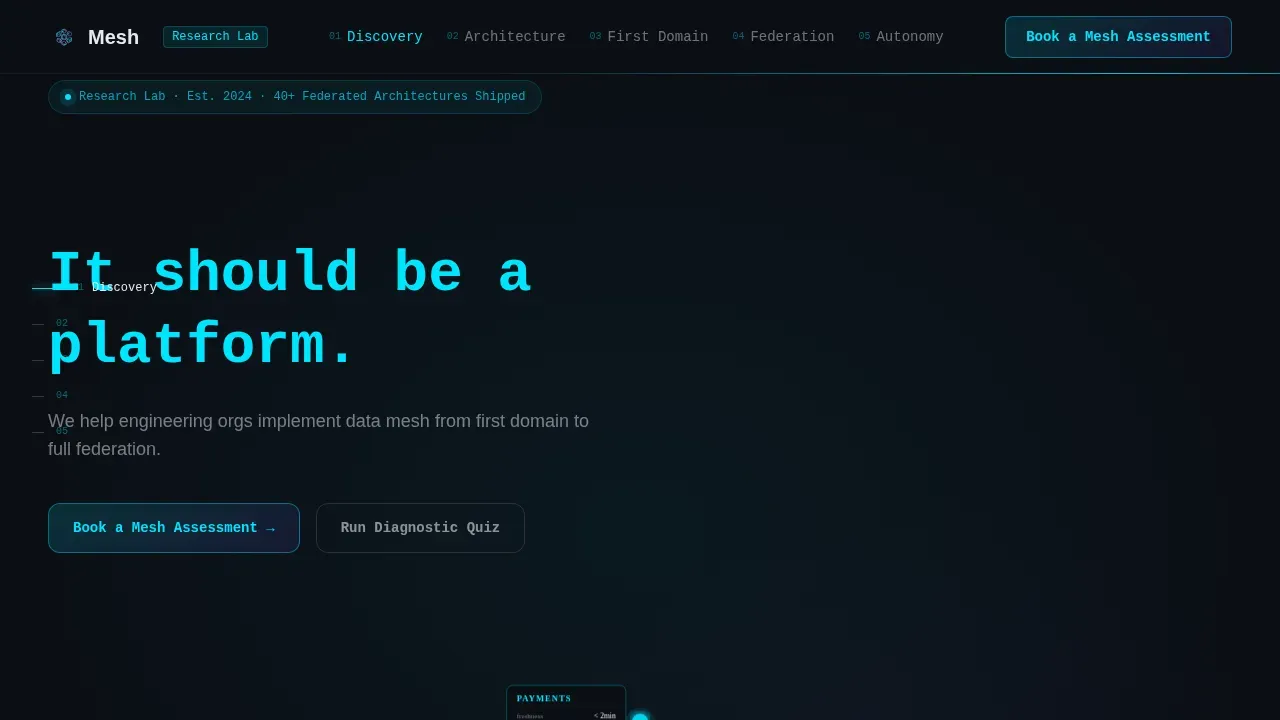
Mesh is a hub-and-spoke landing page template built for data mesh research labs and consulting practices. It targets VP Engineering and VP Data leaders at Series C+ companies whose central data team has become a bottleneck. The template combines a glassmorphic cockpit aesthetic, animated topology diagrams, a diagnostic quiz, and a three-step lead capture form to turn frustrated engineering leaders into qualified assessment bookings.
by Rocket studio
Quick summary
Mesh is a single-page, anchor-nav landing page template purpose-built for a data mesh research lab. It uses a glassmorphic, cockpit-at-night visual language to guide VP-level engineering leaders through a diagnostic journey, from recognizing their data team bottleneck all the way to booking a Data Mesh Assessment. Every section escalates in ambition, mirroring the feeling of a rocket clearing the tower.
Who this template is for
This template is designed for organizations that teach, consult on, or implement data mesh architecture at scale. If your practice helps companies move away from monolithic, centralized pipelines and toward federated, domain-owned data products, this page was built for you.
- Data mesh consultancies and research labs that sell scoped engagements to VP Engineering and VP Data buyers at Series C+ startups and mid-market enterprises
- Data platform teams and internal enablement groups looking to explain the data mesh concept to executive stakeholders and generate internal buy-in
- Independent data engineering practitioners and domain experts who offer 90-day pilot programs or readiness assessments to organizations hitting the limits of traditional centralized data platforms
What problem this template solves
Engineering organizations at growth-stage companies reach a familiar breaking point. Their central data team owns every pipeline. Analysts file tickets to access data instead of running queries. Data scientists wait weeks for relevant data that domain experts already have. The bottleneck of traditional data warehouses is a real and costly problem, and most landing pages for data mesh services bury the diagnosis under technical jargon.
This template solves the communication gap by placing the pain first and the solution second. It mirrors the visitor's exact situation back to them before asking for anything in return.
- Bottleneck recognition without jargon: The diagnostic quiz and before/after architecture diagram help visitors self-identify their problem in plain language, not in data engineering terminology
- Lead generation for high-consideration B2B services: The three-step progressive disclosure form and gated readiness scorecard create two distinct conversion paths for buyers at different stages of readiness
- Visual credibility for an abstract discipline: Animated topology maps, velocity metrics, and transformation timelines make data mesh architecture feel concrete and proven before the visitor ever reaches the call-to-action button
What you get with this template
You get a fully structured, single-page layout with a left-side vertical anchor navigation system. Each nav item corresponds to a named mission phase. The scroll itself is the sales sequence, moving visitors from self-diagnosis through architecture education, into pilot proof, federation evidence, and finally the autonomy end-state where they can see exactly what their organization looks like after a successful implementation.
- Six fully designed page sections spanning Hero, Discovery, Architecture, First Domain, Federation, and Autonomy, plus a minimal developer-style footer
- A full glassmorphic design system built on void black, electric cyan, and secondary violet, with frosted glass panels, animated node connections, and a live dashboard preview in the header
- Two built-in conversion paths: a primary three-step assessment booking form and a secondary gated PDF scorecard download, both designed to capture leads at different levels of buyer intent
Feature list
This section walks through the key components that make the Mesh template function as both a diagnostic experience and a lead generation engine. Every feature listed here is present in the template as described in the source brief.
Animated Topology Header with Live Dashboard Preview
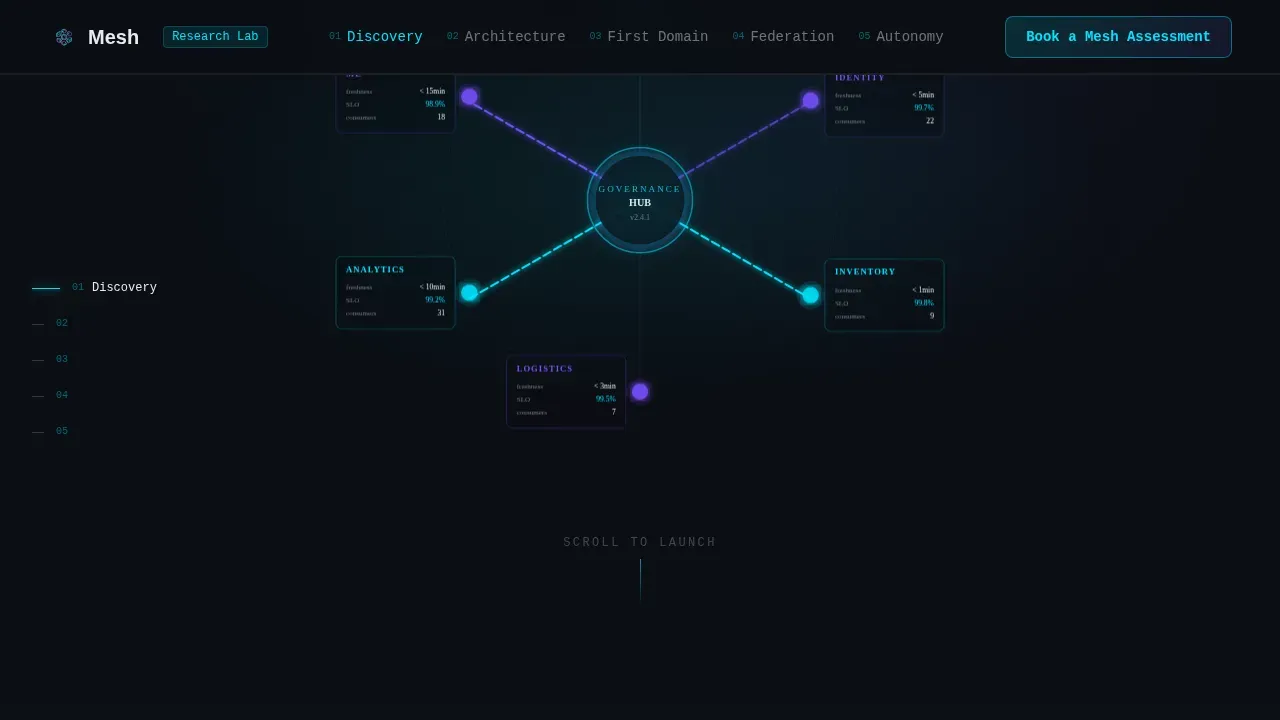
The header occupies the full viewport and displays a data mesh topology map with six labeled domain nodes orbiting a central governance hub. Animated data product packets flow between nodes as glowing cyan pulses. Each node sits inside a frosted glass card showing metrics for data freshness, service-level objective (SLO) compliance, and consumer count. A typewriter-effect headline renders in monospace font over the dashboard, giving the page an immediate sense of technical authority.
Hub-and-Spoke Anchor Navigation
A vertical anchor nav runs along the left side of the page throughout the scroll. Each nav item is labeled as a mission phase: Discovery, Architecture, First Domain, Federation, and Autonomy. As the visitor scrolls, the active nav marker advances like a stage separation indicator. This operating model for navigation keeps the visitor oriented at every point in the journey and reinforces the launch-energy creative direction.
Diagnostic Quiz with Bottleneck Pattern Recognition
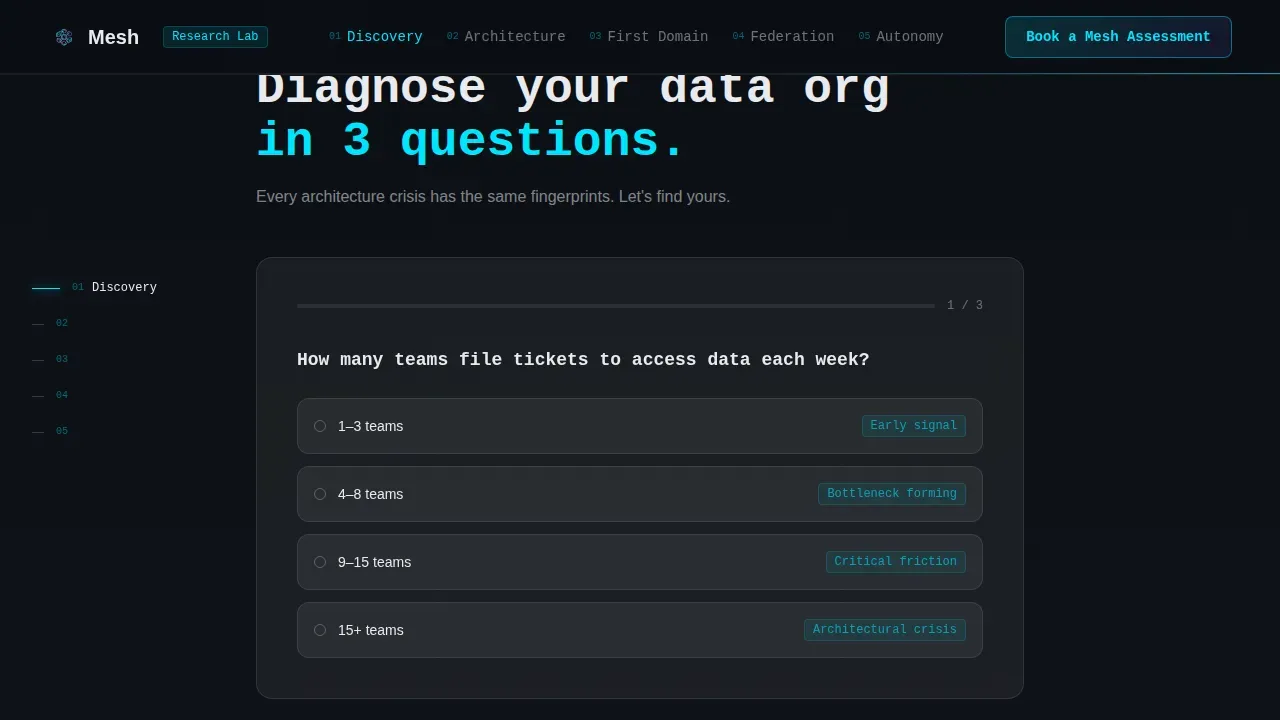
The Discovery section opens with a three-question diagnostic quiz. Questions probe how many domain teams file tickets to access data, how long it takes to get a new pipeline in production, and where data ownership currently sits in the organization. The quiz does not require an email to complete. Its purpose is to reflect the visitor's own pain back to them, building trust and demonstrating diagnostic depth before any conversion ask is made.
Interactive Before/After Architecture Diagram
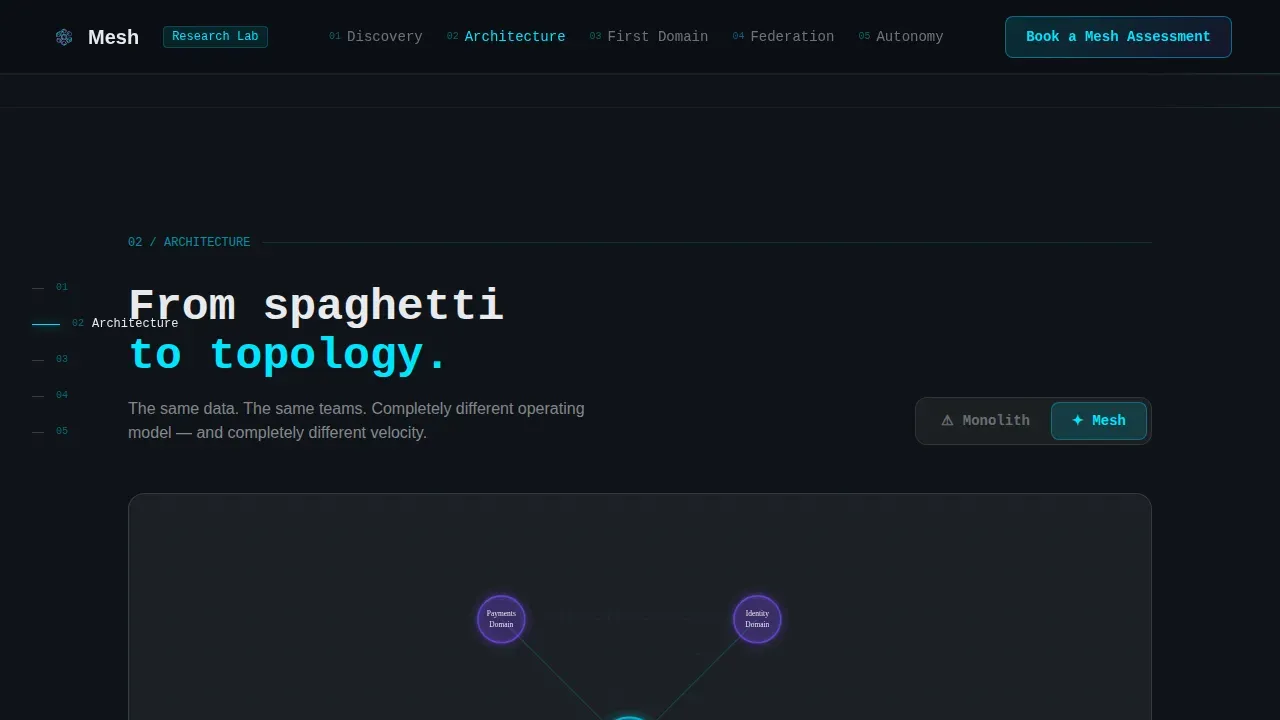
The Architecture section contains a toggleable diagram. One side shows a monolithic spaghetti architecture with a central data platform accumulating all domain data. The other side shows a clean data mesh architecture where each specific business domain owns and publishes its own data products. This visual contrast is one of the most effective ways to communicate the data mesh concept to a VP-level buyer who thinks visually and needs to see the operating model shift to believe it.
90-Day Pilot Case Study Bento with Velocity Metrics
The First Domain section showcases a pilot case study presented in a bento-grid layout. Velocity metrics are displayed as prominent stats: pipeline reduction time, SLO compliance improvement, and domain team independence benchmarks. Data product profiles include metadata, data quality scores, and ownership information. This section gives the data mesh architecture claim its first concrete, credibility-building proof point.
Three-Step Progressive Disclosure Lead Form
The primary lead generation mechanism is a three-step form. Step one captures company name and current data stack selection. Step two asks for domain team count and a free-text description of the biggest data access bottleneck. Step three collects name, email, and preferred assessment week. The form is progressive, meaning each step feels lightweight. A persistent bottom bar resurfaces the primary call to action after the Architecture section, so high-intent visitors always have a visible path forward.
Page sections overview
| Section | Purpose |
|---|---|
| Hero Topology Header | Establish authority with animated data mesh node network and typewriter headline |
| Discovery Diagnostic Quiz | Help visitors self-identify data bottleneck patterns through three targeted questions |
| Architecture Before/After | Show monolith versus mesh contrast with interactive toggle diagram |
| First Domain Pilot | Prove the model with 90-day case study metrics and data product profiles |
| Federation Timelines | Stack three client transformation stories with pipeline-to-mesh timelines |
| Autonomy End-State | Show the fully federated outcome with persistent call to action bottom bar |
| Developer Minimal Footer | Close with minimal GitHub-style footer pattern |
Design & branding system
The visual identity is built around a glassmorphic, cockpit-at-night aesthetic that feels like staring into a dark instrument panel where every glow is intentional. The palette channels Startup Velocity through a combination of deep void black, electric cyan, and secondary violet, creating a data visualization aesthetic that feels native to the engineering buyers who will be evaluating this page.
- Color system: Deep void black (#0B0E14) as the base layer, frosted glass panels in translucent white (#FFFFFF at 8% opacity) with 12px blur, electric cyan (#00E5FF) as the primary signal color, and secondary violet (#7C4DFF) for hover accents and gradient edges. Text is crisp white (#E8EAED) on dark backgrounds, cyan on interactive elements, and violet on visited states
- Typography: JetBrains Mono for headlines and monospace display text, Manrope for body copy. Together they create a precise, developer-native reading experience that earns credibility with a technical VP audience
- Animation and interactivity: Node pulse animations, beam borders on glass panels, a typewriter headline effect, scroll-triggered thrust transitions where content slides up with slight acceleration, and a stage-separation nav marker that advances through mission phases as the visitor scrolls
Mobile & speed optimization
The Mesh template is designed desktop-first, reflecting the reality that VP Engineering buyers conduct this kind of architectural research at their desk during working hours. The template prioritizes rendering fidelity on large screens, where topology diagrams and bento-grid layouts have the most visual impact.
- Desktop-first layout priority: The topology map, before/after diagram, and bento metrics grid are all optimized for wide viewport rendering, ensuring that the data mesh architecture visualization lands with full visual clarity for the intended audience
- Component rendering strategy: Static content sections use Server Components for fast initial load, while interactive elements including the topology animation, diagnostic quiz, and the three-step form use Client Components to isolate interactivity without affecting the static sections
How this template helps you convert
The Mesh template is engineered as a two-path lead generation system. Every section is sequenced to build trust before asking for anything, so visitors arrive at the conversion moment already convinced that the problem is real and that the solution is credible.
- Primary path through demonstrated diagnostic depth: The visitor encounters the diagnostic quiz and the before/after architecture diagram before seeing any form. By the time the persistent bottom bar appears, they have already recognized their organization in the bottleneck patterns. The three-step form then captures company context, domain team count, and contact details in a way that feels like the next logical step rather than an interruption.
- Secondary path through the gated readiness scorecard: Visitors who are not yet ready for a call can download a Data Mesh Readiness Scorecard PDF gated behind a single email field. This gives the practice a way to capture earlier-stage leads and nurture them toward a future assessment booking, ensuring that no high-intent visitor leaves without some form of value exchange.
Other information about this template
The Mesh template is built to work across a wide range of data mesh implementation contexts. Below are additional details about the technical, organizational, and content considerations embedded in this template's design.
- Data governance architecture baked into the content structure: The template communicates the four fundamental principles of data mesh: domain ownership, data as a product, self-serve platform, and federated computational governance. These core principles are woven into the Architecture and Autonomy sections, making them easy for a VP buyer to absorb without needing a whitepaper
- Federated governance model explained visually: The template's governance content distinguishes between global policies, which are informed by regulatory compliance obligations and industry standards, and local policies, which are created within specific domains and apply only to those contexts. The federated governance group model, where representatives from domain teams and the data platform team collaborate, is presented as part of the Autonomy end-state
- Data catalog discoverability built into the page narrative: The template positions the data catalog as a searchable, central discovery surface where domain teams can find and request access to data products across different domains. The data discovery narrative is consistent with how a governance group would want data assets described: with metadata, data quality metrics, and data ownership information visible at a glance
- Policy automation and access control framed as outcomes: The template presents policy automation and data access control as natural results of a successful data mesh implementation, not as prerequisites. This framing reduces perceived complexity for the VP Engineering buyer and positions the lab as the guide through that transition
- Data security and PII data handling addressed in governance framing: The federated governance content references how data mesh governance handles PII data through automated compliance checks and data contracts. Data contracts define schema, semantics, and SLOs. Consistent oversight ensures that global and local policies work together to maintain data integrity across organizational boundaries
- Cross-domain data analysis enabled by the mesh operating model: The template communicates that data mesh architecture enables domain teams to perform cross-domain data analysis independently, without filing tickets or waiting for the central data platform team. Domain experts gain direct access to relevant data from other bounded contexts through the data catalog and published data products
- Data lakes, raw data, and data lineage addressed in the architecture narrative: The template's Architecture section frames data lakes as one of the data assets that domain teams can manage within the mesh. Raw data ingestion, data lineage tracking, and lineage context visualizations showing data flow from source to consumer are presented as built-in features of a mature data mesh architecture
- Data mesh governance group structure explained in Autonomy section: The governance group consists of representatives from domain teams and the data platform team. The group is responsible for specifying requirements that allow the data platform to automate policies and ensure compliance with global standards including fraud detection controls and customer data protection obligations
- AWS Glue Data Catalog and AWS Lake Formation compatibility: Organizations deploying data mesh on a cloud provider infrastructure can use tools such as AWS Glue Data Catalog for centralized metadata management and AWS Lake Formation for connecting multiple clusters across different domains. The template's architecture narrative is compatible with these implementation patterns and supports teams evaluating their cloud provider options
- Data mesh concept origin and organizational change framing: The data mesh concept was introduced by Zhamak Dehghani in 2019 as a response to the scaling failures of centralized data platforms. The template frames data mesh as primarily an organizational change, one that shifts data ownership closer to the business value stream rather than concentrating it in a single bottlenecked team. Data scientists, data engineering practitioners, and domain experts all retain highly relevant roles in the federated model
- Knowledge graph and data models in the federation narrative: As organizations scale to multiple domains, the template's Federation section addresses how data models and knowledge graph structures help maintain interoperability across different bounded contexts. Efficient data sharing between domain teams depends on standardized data models and clear data lineage that consumers can trust
- Externally acquired datasets and data science use cases: The template's content framework can accommodate externally acquired datasets as data assets within specific domains, making it relevant for organizations where data science teams consume third-party data alongside internally produced data products. Machine learning pipelines that depend on cross-domain data products are one of the primary use cases addressed in the Autonomy section
Theme
Startup Velocity
Creative direction
Launch Energy
Color system
Glassmorphic
Style
Hub & Spoke (Anchor Nav)
Direction
Lead Generation
Page Sections
Animated Topology Header with Dashboard Preview
Hub-and-spoke Vertical Anchor Navigation
Diagnostic Quiz for Bottleneck Recognition
Interactive Before/after Architecture Diagram
Three-step Progressive Disclosure Lead Form
Day Pilot Case Study Bento Grid
Related questions
What type of organization is this template built for?
Does the template include the diagnostic quiz and before/after diagram as interactive components?
How does the lead generation system work across both conversion paths?
Can this template be adapted for a specific data platform stack?
How many sections does the page include?