Advanced Data Mesh Technology Professional Website Template
Mesh is a modular card-grid landing page built for open-source data mesh projects. It opens with live metric cards, walks through core architectural concepts one module at a time, and drives every visitor straight to the repository. The dark terminal palette, electric accent color, and frictionless call-to-action layout make it ideal for developer-first open-source projects.
by Rocket studio
Quick summary
Mesh is a single-page landing page template purpose-built for open-source data mesh frameworks. It leads with real traction numbers, then explains the architecture in focused modular cards. The visual identity feels like a late-night terminal session: deep slate backgrounds, electric blue accents, and crisp monospaced type. Every section builds toward one frictionless click to the repository.
Who this template is for
This template is built for technical teams who need to communicate a complex open-source project clearly and quickly. If your project challenges centralized data infrastructure, this layout gives it the right stage.
- Platform engineers who want to showcase a decentralized data framework to potential contributors
- Data architects and engineering leads at growth-stage companies evaluating open-source tooling
- Open-source maintainers who need a credibility-first landing page without a marketing budget
What problem this template solves
Most open-source projects lose potential adopters before the first scroll. A wall of documentation text, no visible traction signals, and buried calls to action all kill momentum. Mesh fixes that sequence.
- Visitors see proof of adoption before they see a single line of explanation
- Each architectural concept gets its own focused card, removing cognitive overload
- The path from curiosity to the repository has zero gates and zero forms
What you get with this template
You get a complete, ready-to-customize single-page layout built around a stats-first content strategy. Every section has a clear job, and the design system handles the rest.
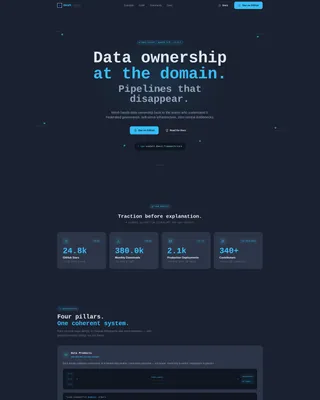
- A dark full-bleed header with a radial glow effect, faint network-node connection lines, and a monospaced headline
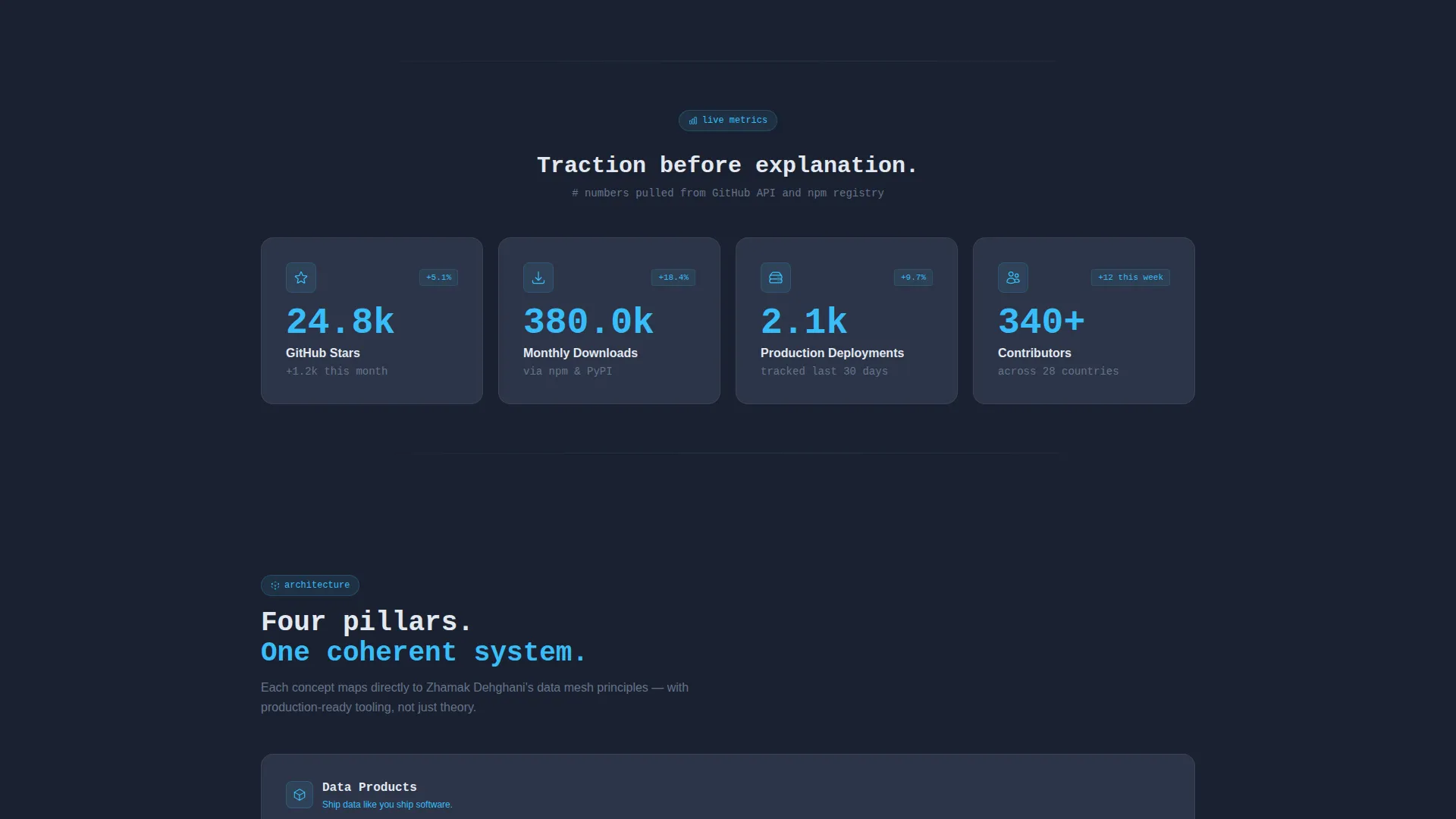
- A horizontal metric card row for live traction stats: stars, downloads, deployments, and contributor count
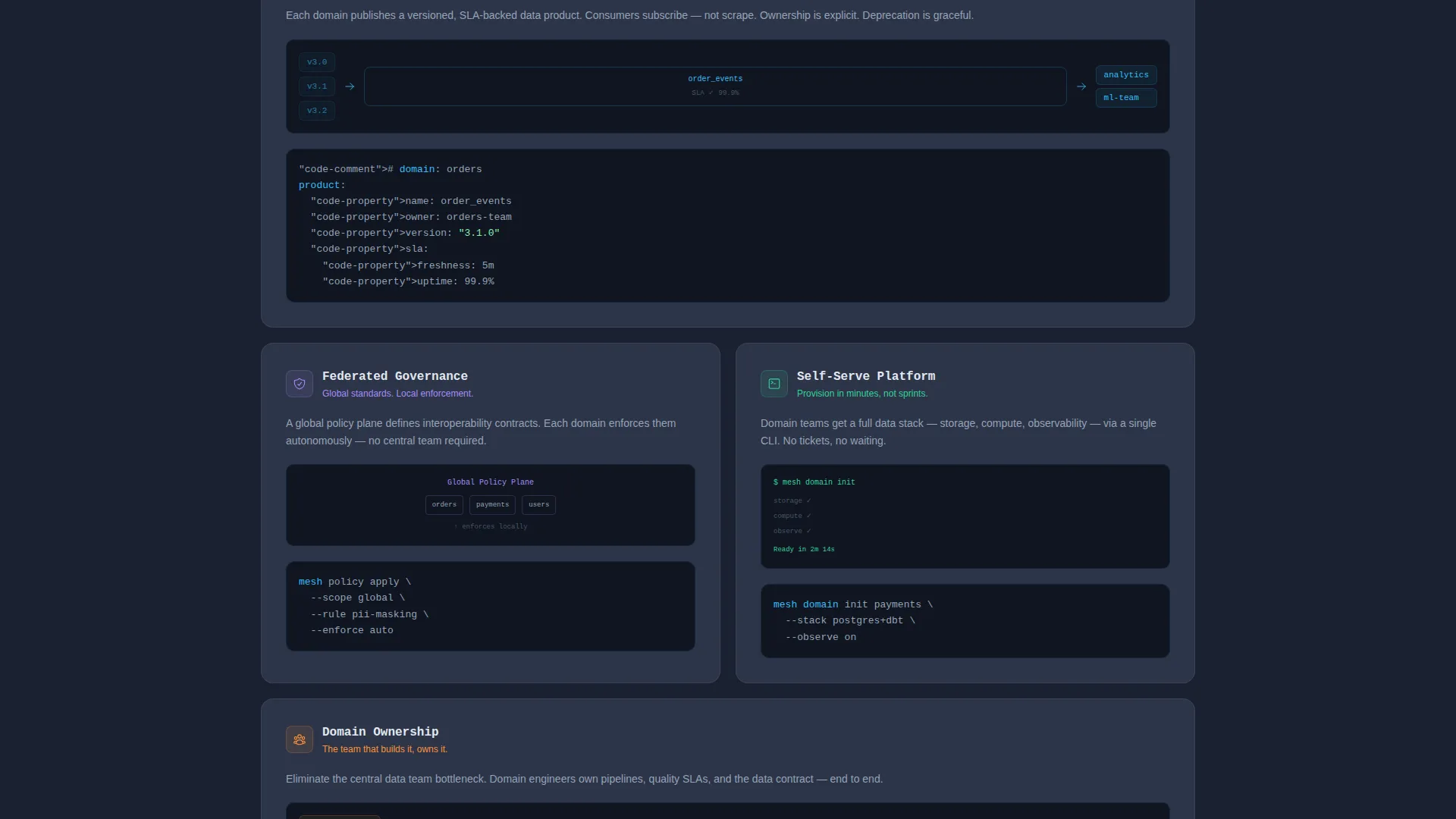
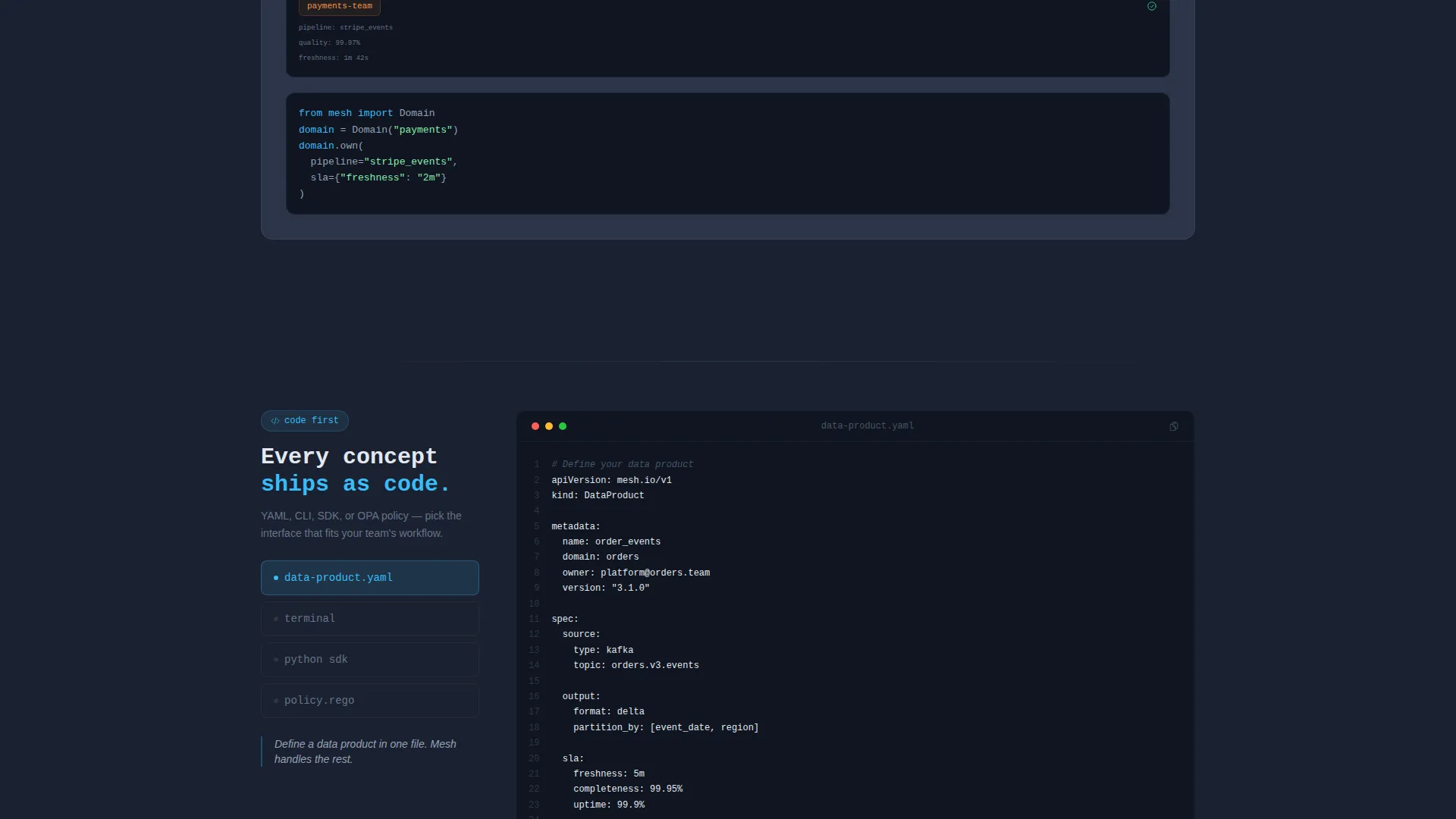
- Modular architecture cards, each covering one concept with a code snippet, a one-line benefit, and a compact diagram
- A testimonial strip featuring named engineering leads for social proof
- Paired primary and secondary calls to action repeated at header and footer
Feature list
This section covers the core capabilities built into the Mesh template.
Stats-First Metric Row
A horizontal row of oversized metric cards sits above every explanatory section. Each card glows faintly on hover and is designed to display live-pulled numbers like GitHub stars, monthly downloads, production deployments, and contributor count. Traction speaks before the project does.
Modular Architecture Cards
Each major concept in the data mesh model gets its own self-contained card module. The card holds a code snippet, a single-line benefit statement, and a sticky-note-sized diagram. The rhythm is deliberate: proof, then explanation, repeated across every domain concept.
Dark Full-Bleed Header with Glow
The header fills the entire viewport with a deep terminal slate background. A soft radial glow in electric sky blue pulses from the center, and faint connection lines trace between abstract domain nodes. The headline renders in cloud white, monospaced and unhurried.
Frictionless Dual Call to Action
The primary call to action and a secondary call to action appear together at both the header and the footer. There is no form, no email gate, and no friction between a visitor's interest and the repository link.
Testimonial Social Proof Strip
A dedicated strip near the bottom of the page features testimonials from named engineering leads at recognizable companies. The format is clean and scannable, designed to complete the credibility arc started by the metric row.
Slate and Sky Design System
Every color decision serves focus. The deep terminal slate background, mid-graphite card surfaces, electric sky blue interactive accents, and cool cloud white body text work together as a coherent system. The palette stays dark and quiet except where it matters most.
Page sections overview
| Section | Purpose |
|---|---|
| Full-Bleed Header | Establishes visual identity and primary calls to action |
| Live Metric Row | Delivers traction proof before any explanation |
| Project Introduction | Reveals what the framework does after stats land |
| Architecture Card Grid | Explains each domain concept in one focused module |
| Testimonial Strip | Provides social proof from named engineering leads |
| Footer Call to Action | Repeats both calls to action to close the page |
Design & branding system
The Mesh template uses a Slate and Sky color system that feels like an integrated development environment at midnight. Every visual decision reinforces focus, precision, and technical credibility.
- Core palette: deep terminal slate (#1B2130) for backgrounds, mid-graphite (#2D3548) for card surfaces, electric sky blue (#38BDF8) for interactive accents and data highlights, and cool cloud white (#E2E8F0) for body text
- Typography uses a monospaced style for headlines, keeping the tone unhurried and code-native without sacrificing readability
- Hover states on metric cards produce a faint glow in the accent color, adding interactivity without visual noise
Mobile & speed optimization
The modular card-grid structure adapts naturally to narrower viewports. Each card is a self-contained unit, so reflow on smaller screens preserves the reading hierarchy without restructuring content.
- The single-column scroll flow on mobile keeps the stats-first sequence intact, so traction proof still lands before explanation
- Lightweight visual effects, including the radial glow and faint connection lines, are decorative and do not rely on heavy asset loads
How this template helps you convert
The page is built around a specific conversion logic: accumulate evidence first, then ask for the click. Every section plays a role in that sequence.
- The metric row establishes real-world adoption immediately, so skeptical engineers trust the project before they read a single paragraph of documentation.
- The architecture cards build technical rigor section by section, giving architects and platform engineers the detail they need to evaluate fit.
- The testimonial strip adds human credibility from peers, and the repeated dual calls to action ensure the repository link is always one scroll away.
Other information about this template
Mesh is a single-page template built on a card-grid structure, making it straightforward to extend or reorder sections as the project grows. The layout suits open-source data mesh projects at any stage, from early community building to production-scale adoption.
- The template is designed for open-source projects in the data platform and data infrastructure space, including frameworks that address federated governance, domain ownership, and self-serve data platforms
- It works well for projects inspired by or aligned with the principles described in modern data mesh literature, making it a natural fit for teams implementing decentralized data architecture
- The no-form, no-gate conversion approach is intentional and suits developer audiences who respond to transparency and direct access over lead-capture friction
Theme
Startup Velocity
Creative direction
Stats-First Impact
Color system
Slate & Sky
Style
Card Grid (Modular)
Direction
Click-Through
Page Sections
Stats-first Metric Row
Modular Architecture Card Grid
Dark Full-bleed Header with Glow
Frictionless Dual Call to Action
Testimonial Social Proof Strip
Slate and Sky Design System
Related questions
Does this template require a backend or database connection?
Can I use this template for a commercial open-source or dual-license project?
How easy is it to swap in my own project numbers and architecture concepts?
Is this template suitable for a project that is still in early development?