Glassmorphic Optometry Knowledge Base Landing Page
Optic is a glassmorphic dashboard landing page built for optometry knowledge bases. It blends clinical precision with cinematic motion design, featuring a parallax eye-anatomy hero, a modular knowledge-card grid, and a near-zero-friction freemium conversion flow. Purpose-built for students, practicing optometrists, and ophthalmic technicians who need fast, reliable clinical reference at their fingertips.
by Rocket studio
Quick summary
Optic is a single-page, dashboard-style landing page template for an optometry knowledge base. It opens with an anatomically detailed, parallax eye cross-section, then flows into a searchable grid of clinical modules. The design uses deep black, translucent iris blue, and diagnostic amber to create a slit-lamp atmosphere that feels as precise as the content it presents.
Who this template is for
This template is designed for anyone building or launching a clinical optometry reference platform. It speaks directly to professionals and learners who need fast, credible access to eye care data.
- Second-year optometry students preparing for board examinations who need a structured, scannable knowledge library
- Independent optometrists (ODs) who need to verify rare posterior segment findings quickly between patient appointments
- Ophthalmic technicians confirming contact lens parameters before a fitting, and educators building digital curriculum tools
What problem this template solves
Clinical eye care moves fast. Practitioners and students often waste time cross-referencing scattered textbooks, PDFs, and outdated websites to find a single piece of diagnostic data. This template presents a unified, searchable knowledge base that proves its depth before asking for any commitment.
- No single place exists that puts refractive errors, retinal anomalies, lens specifications, and pharmacology in one cross-referenced, instantly searchable view
- Generic website templates do not communicate clinical credibility or support the density of structured data that optometry knowledge bases require
- Conversion from visitor to registered user is lost when the value of a knowledge platform is stated rather than demonstrated
What you get with this template
You get a fully designed, motion-rich landing page that doubles as a working proof of concept for your optometry knowledge platform. Every section is purpose-built to move a visitor from curiosity to sign-up.
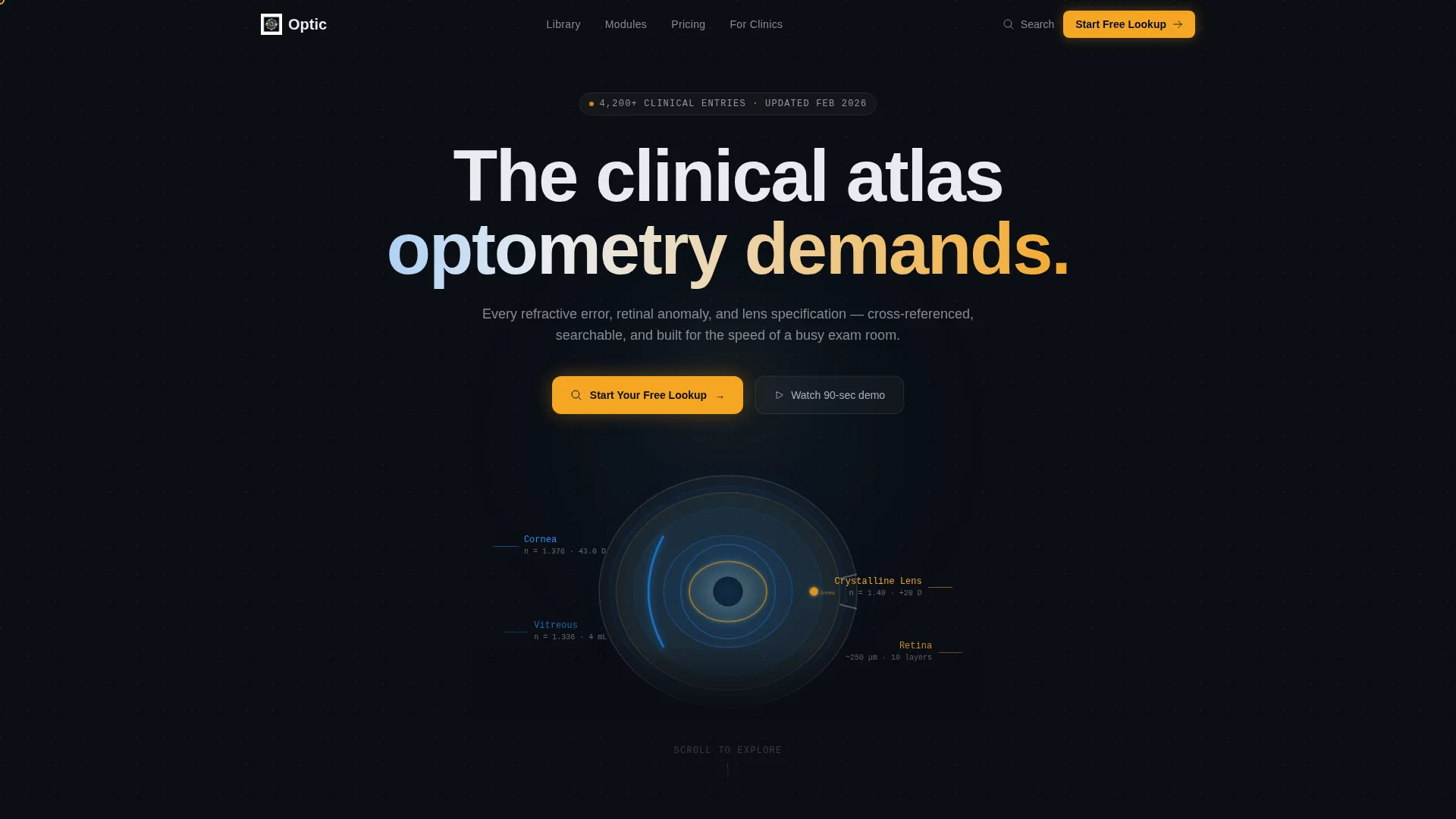
- A parallax hero section with an anatomically labeled, glassmorphic cross-section of the human eye, including data labels for refractive index values, tissue thickness, and wavelength absorption
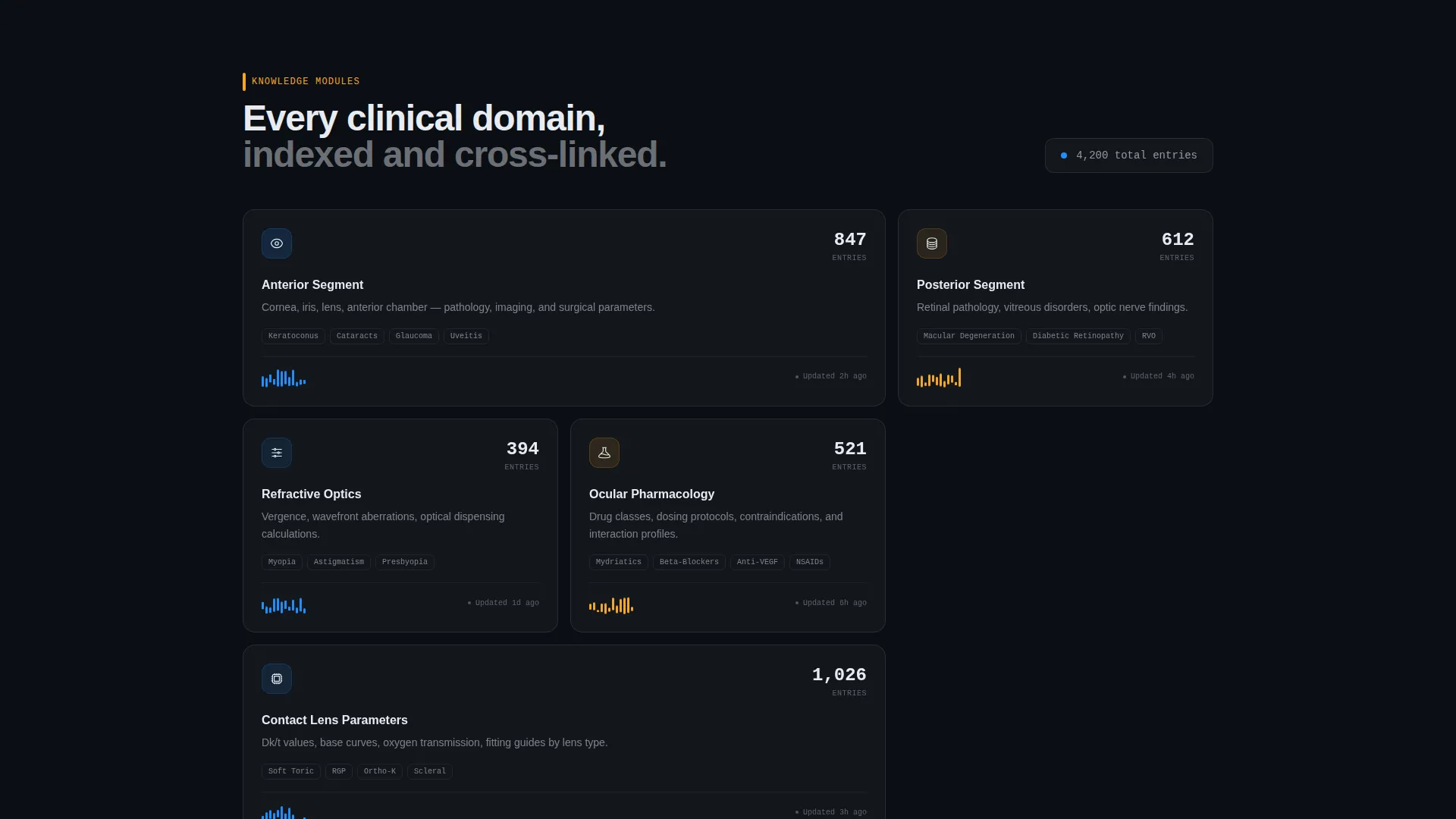
- A live-feeling dashboard grid of knowledge module cards covering Anterior Segment, Posterior Segment, Refractive Optics, Pharmacology, and Contact Lens Parameters, each with article counts, timestamps, and looping micro-animations
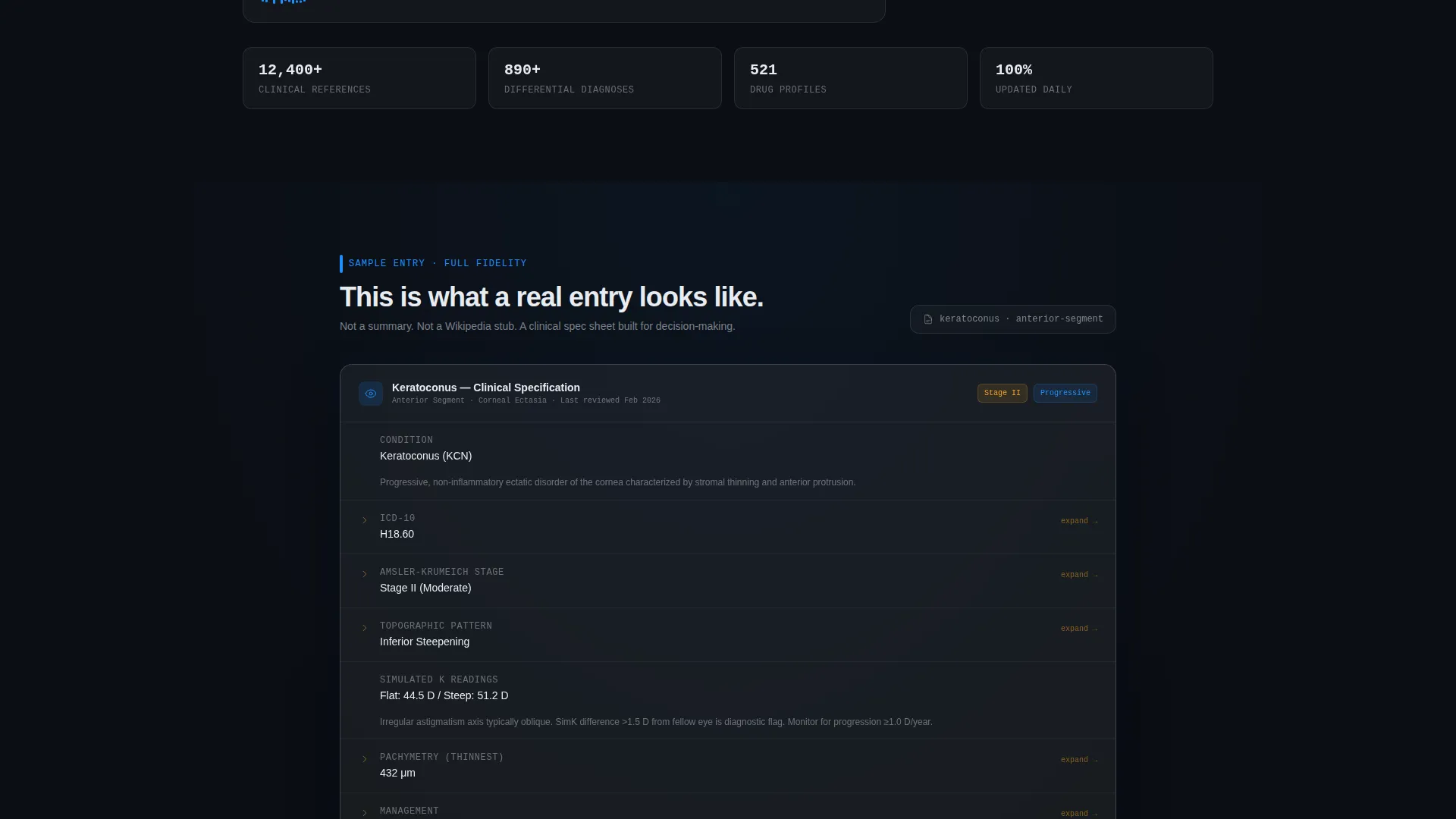
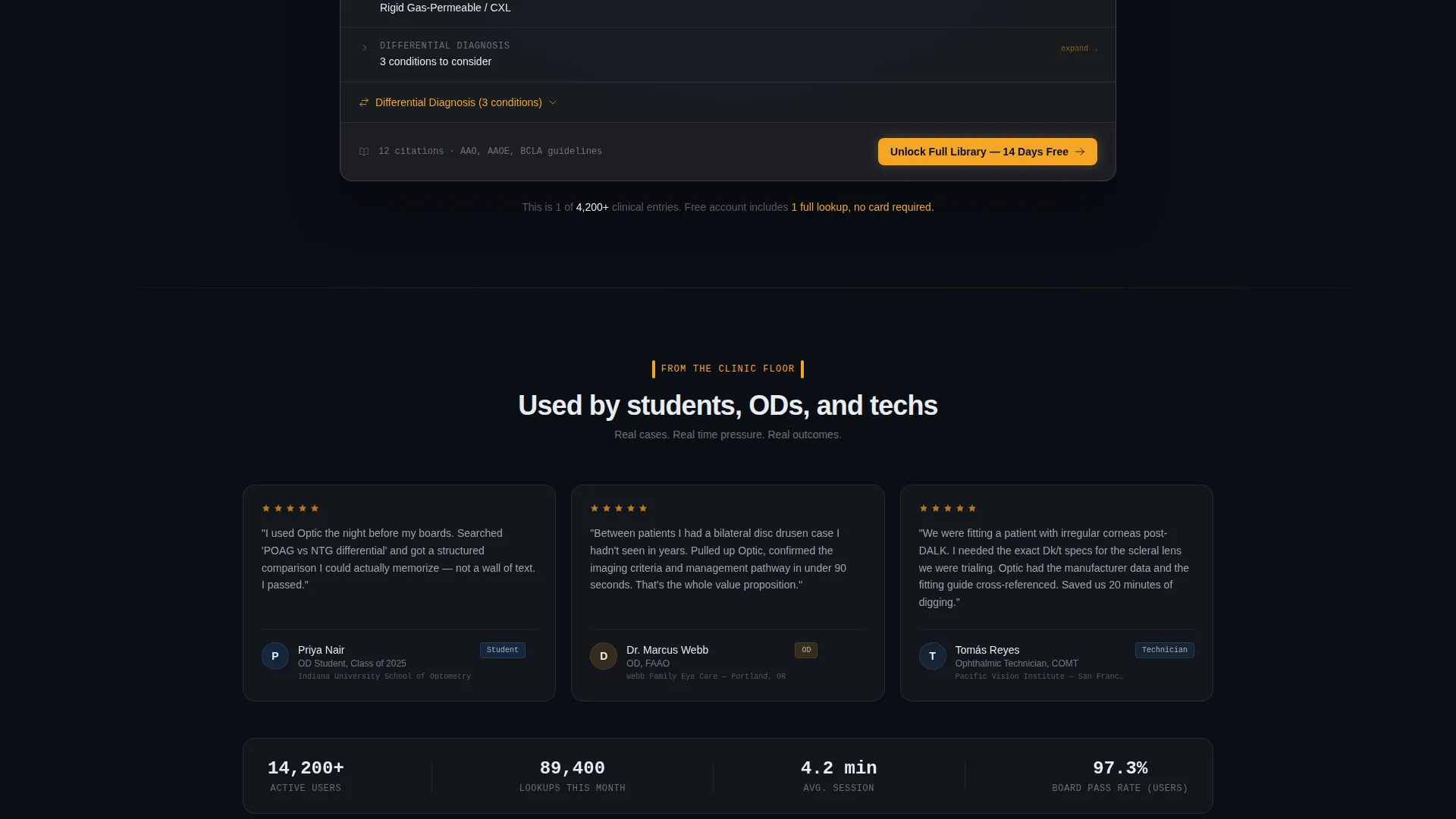
- A full-fidelity sample clinical spec sheet (keratoconus staging) with expandable data rows, differential diagnosis toggles, and citation links, plus a freemium conversion flow triggered by a single search bar overlay
Feature list
This template is built around a clear set of designed interactions and visual components drawn directly from the brief.
Parallax Eye-Anatomy Hero
The full-bleed header renders a diagrammatic cross-section of the human eye as layered, translucent glassmorphic shells. Each anatomical layer, including the cornea, aqueous humor, lens, vitreous, and retina, separates and glows independently as the visitor watches. Clinical data labels fade in beside each structure, turning the hero into a living specification sheet.
Glassmorphic Dashboard Knowledge Grid
Below the hero, the page snaps into a structured grid of frosted-glass cards. Each card represents a knowledge module, displays a live article count and last-updated timestamp, and contains a looping micro-animation of a relevant waveform or clinical diagram. Cards animate into the grid on scroll for a polished, dynamic feel.
Full-Fidelity Sample Spec Sheet
A complete clinical entry for keratoconus staging is rendered inline to demonstrate the platform's depth. It includes expandable data rows, differential diagnosis toggles, and citation links. This section proves the value of the knowledge base before the visitor is asked to create an account.
Freemium Search Conversion Flow
The primary call-to-action, "Start Your Free Lookup," appears in the hero and again after the sample spec sheet. Clicking opens a single-field search overlay. One full result is returned with no account required, followed by a soft interstitial offering a 14-day free trial with a role dropdown and institution toggle.
Amber Cursor-Tracking Focus System
Interactive elements use diagnostic amber (#F5A623) for hover states and focus rings. The amber highlight follows the cursor across the page like a tracking beam, reinforcing the slit-lamp visual metaphor and making all clickable elements immediately obvious.
Scroll-Triggered Motion System
Data counters tick upward as sections enter the viewport. Knowledge cards slide into the grid on scroll. Motion is constant but controlled, keeping the page alive without distracting from the clinical content it presents.
Page sections overview
| Section | Purpose |
|---|---|
| Hero Eye Anatomy | Draws attention with a parallax, labeled anatomical diagram and introduces the primary call-to-action |
| Knowledge Module Grid | Organizes clinical topics into frosted-glass cards with live counts and micro-animations |
| Sample Spec Sheet | Demonstrates full data depth with a keratoconus staging entry including expandable rows and citations |
| Free Lookup Trigger | Converts curiosity into action via a single-field search overlay with one free result |
| Trial Interstitial | Captures sign-ups with a 14-day free trial offer, role dropdown, and institution toggle |
Design & branding system
The visual identity is built around a Glassmorphic color system that evokes the atmosphere of a darkened exam room. Every design decision reinforces clinical precision and depth.
- Core palette: deep scleral black (#0B0E14) as the base, translucent iris blue (#1E90FF at 40% opacity) for frosted panels, crystalline lens white (#E8ECF1) for readable body text, and diagnostic amber (#F5A623) for all interactive highlights and hover states
- Glassmorphic card components use soft luminous borders and blur effects, giving each module the appearance of frosted glass floating over a depthless dark background
- Motion design follows a Dynamic Motion theme: parallax layering in the hero, scroll-triggered card animations, upward-ticking counters, and amber focus rings that track cursor movement across the grid
Mobile & speed optimization
The template is structured for responsive viewing across device sizes, keeping the dashboard grid and motion system functional on smaller screens.
- The frosted-glass card grid reflows cleanly for tablet and mobile viewports, maintaining the clinical data hierarchy without horizontal scrolling
- Scroll-triggered animations and the parallax hero are designed to degrade gracefully on lower-powered devices, preserving the core layout and content
How this template helps you convert
The conversion strategy is built into the page structure itself. Visitors experience the value of the knowledge base before any sign-up is requested.
- The "Start Your Free Lookup" call-to-action appears twice: first after the eye animation resolves in the hero, and again anchored at the bottom of the sample spec sheet, catching visitors at peak engagement
- The single-field search overlay delivers one full clinical result with no account required, removing the biggest point of friction and letting the depth of the knowledge base do the selling
- The soft interstitial after the first result offers a 14-day free trial with minimal fields, a role dropdown for personalization, and an institution-versus-individual toggle, making sign-up fast and relevant for every user type
Other information about this template
This template sits at the intersection of clinical reference design and high-fidelity motion landing pages. A few additional details are worth noting for teams evaluating it.
- The template style is classified as Dashboard and Data Grid, making it well suited for knowledge platforms that need to surface structured, categorized content in a scannable format
- The creative direction follows a Spec Sheet approach, meaning the layout prioritizes dense, accurate, structured data presentation over marketing-style storytelling
- The header concept uses a Dark Full-Bleed and Glow treatment, a pattern that works particularly well for science, health technology, and precision-data products where credibility and depth matter immediately
- The freemium and trial landing page direction is baked into the page architecture, not added as an afterthought, so the conversion path feels native to the experience rather than disruptive
Theme
Dynamic Motion
Creative direction
Spec Sheet
Color system
Glassmorphic
Style
Dashboard/Data Grid
Direction
Freemium/Trial
Page Sections
Parallax Eye-anatomy Hero
Glassmorphic Knowledge Card Grid
Sample Clinical Spec Sheet
Freemium Search Conversion Flow
Amber Cursor-tracking Highlights
Scroll-triggered Motion System
Related questions
Who is the Optic template designed for?
Can I customize the knowledge module categories in the dashboard grid?
Does the free lookup flow require a backend or database to work?
Is the keratoconus spec sheet a real data entry or a design placeholder?
Can this template be adapted for other medical or scientific knowledge bases?