AI for SaaS B2B Pricing Website Template
The Margin AI Revenue Lift Pricing Engine landing page template is a bento grid layout built for mid-market SaaS revenue teams. It features an interactive revenue gap calculator, spec-sheet versus cells, capability breakdowns, and a sticky call-to-action bar. The Carbon Fiber visual system delivers a high-voltage, data-driven aesthetic that turns pricing intelligence into a compelling conversion argument.
by Rocket studio
Quick summary
This is a single-page bento grid landing page template purpose-built for an AI-powered SaaS pricing engine. It opens with a live revenue gap calculator and flows through structured versus cells, capability cards, integration benchmarks, and social proof. Every section is designed to show prospects their own projected revenue lift before asking for a demo booking.
Who this template is for
This template is built for SaaS founders, revenue leaders, and go-to-market teams who need a landing page that does more than explain a product. It speaks directly to buyers who live inside pricing data every day and expect the page itself to prove its argument with numbers.
The target audience for this template includes:
- VP of Revenue and RevOps leads at mid-market SaaS companies managing 200 or more pricing tiers who need to replace slow, spreadsheet-based price-book updates
- CFOs and finance stakeholders who suspect seven-figure margin leakage from monthly pricing cycles in a market that moves hourly
- Growth marketers and demand-generation teams building high converting landing pages for an AI pricing engine and need a desktop-first, data-dense layout that converts paid traffic efficiently
What problem this template solves
Pricing pages for complex SaaS tools often fail because they describe features instead of demonstrating revenue impact. Visitors arrive skeptical and leave without engaging. The landing page copy never connects product capability to the buyer's specific financial situation.
This template solves that gap directly:
- It replaces passive feature lists with active versus proof, showing the gap between manual pricing processes and AI-powered repricing across response time, accuracy, and revenue recovery metrics
- It gives visitors a personalized revenue number through the interactive calculator before they scroll past the first section, making the case for engagement before a single feature is explained
- It structures the page so that conversion focused landing pages with heavy data density do not overwhelm visitors but instead build proof progressively, row by row, until the argument is self-evident
What you get with this template
This is a complete landing page built on a bento grid layout with five core section groups and a linear single-row footer. Every component is ready to customize and deploy as a professional looking landing page for an AI SaaS pricing engine.
Included in this template:
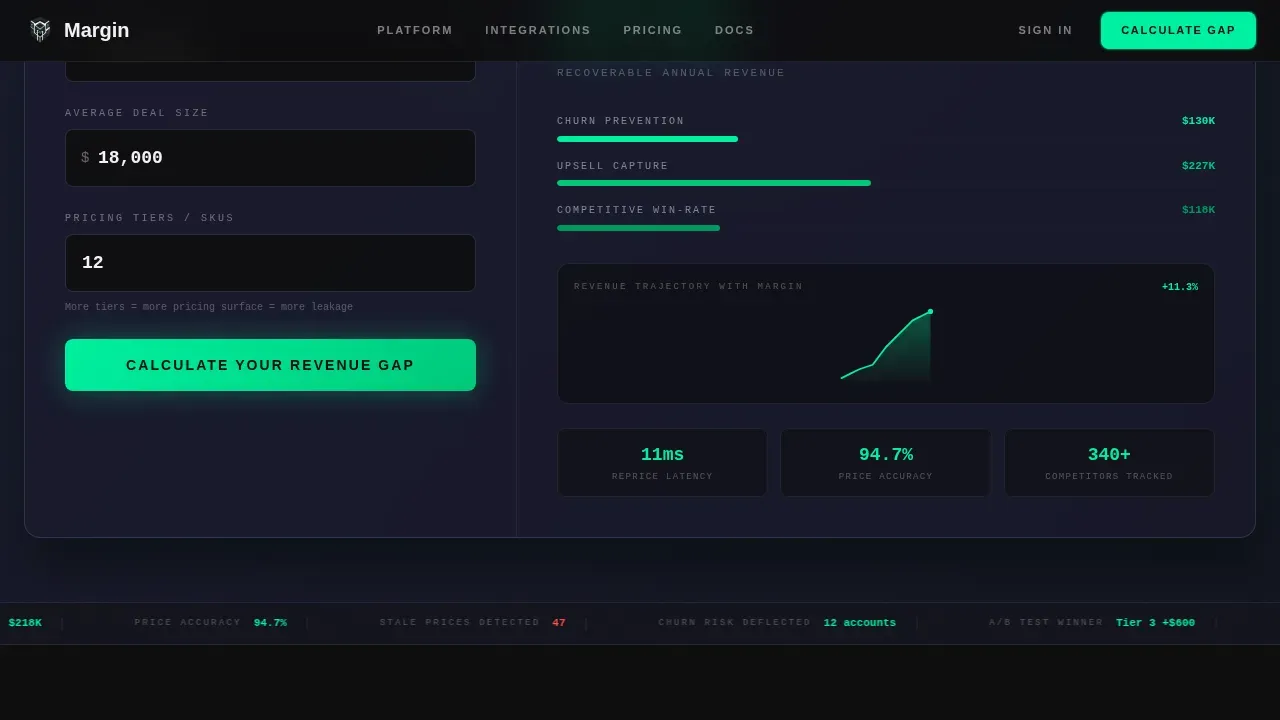
- A hero calculator bento cell occupying 60% of the viewport, styled as an interactive pricing simulator with animated counters and a miniature waterfall chart showing recovered margin sources
- A versus grid section with spec-sheet bento cells comparing manual processes against AI-powered repricing across specific metrics, capability cards for dynamic competitor tracking, elasticity modeling, segment-level A/B pricing, and CRM sync latency, plus integration logos, latency benchmarks, and audit-trail display cells
- A social proof section with testimonial blocks from named target personas, a sticky call-to-action bar that appears after the third bento row, and a secondary slide-out comparison matrix path
Feature list
This template ships with the following built-in capabilities, each tied directly to the conversion goal of booking a demo through demonstrated revenue impact.
Interactive Revenue Gap Calculator
The header cell dominates 60% of the viewport as a live pricing simulator. Visitors enter their current annual recurring revenue, average deal size, and number of pricing tiers. The engine instantly renders projected revenue lift as an animated counter. A miniature waterfall chart flanks the counter, breaking recovered margin into three sources: churn reduction, upsell capture, and competitive win-rate. This is the core landing page content that earns the scroll. An interactive ROI calculator like this helps users visualize the potential gains from using AI-based pricing tools before they read a single feature description. Strategically positioned call-to-action buttons inside the calculator align with where high-intent prospects are in their buying journey, which supports strong conversion rates from the first viewport.
Versus Spec-Sheet Bento Grid
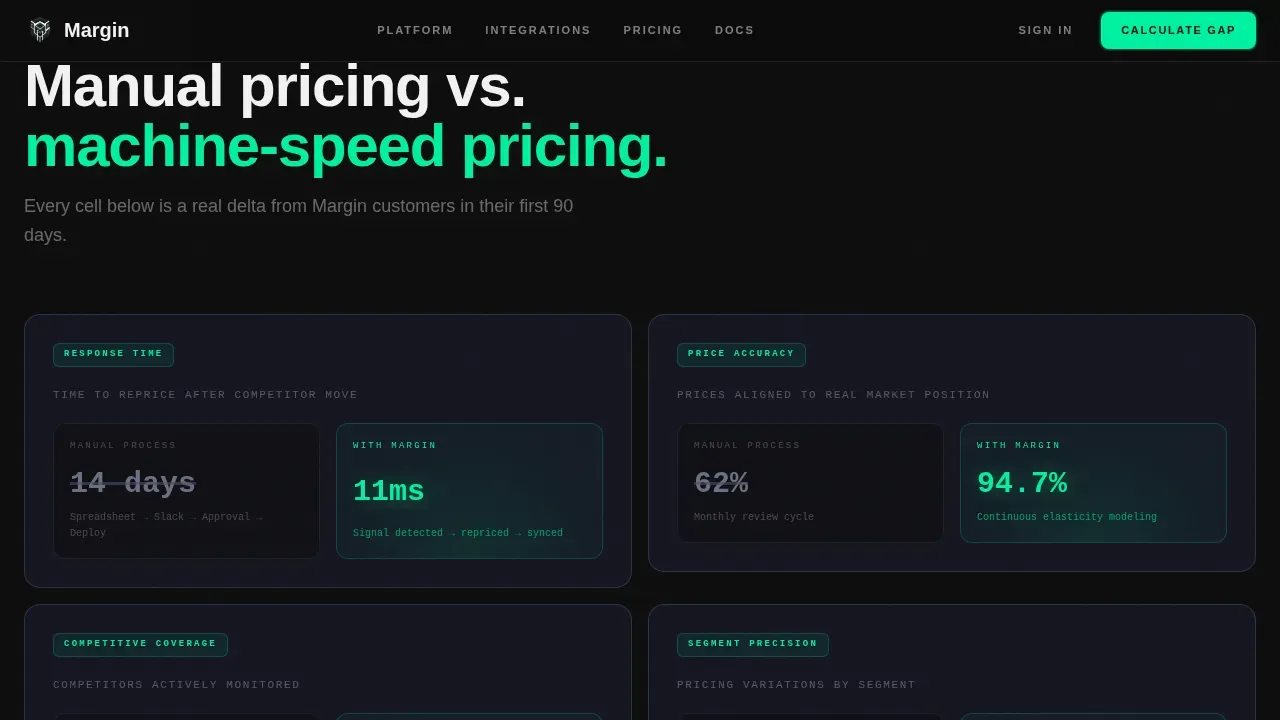
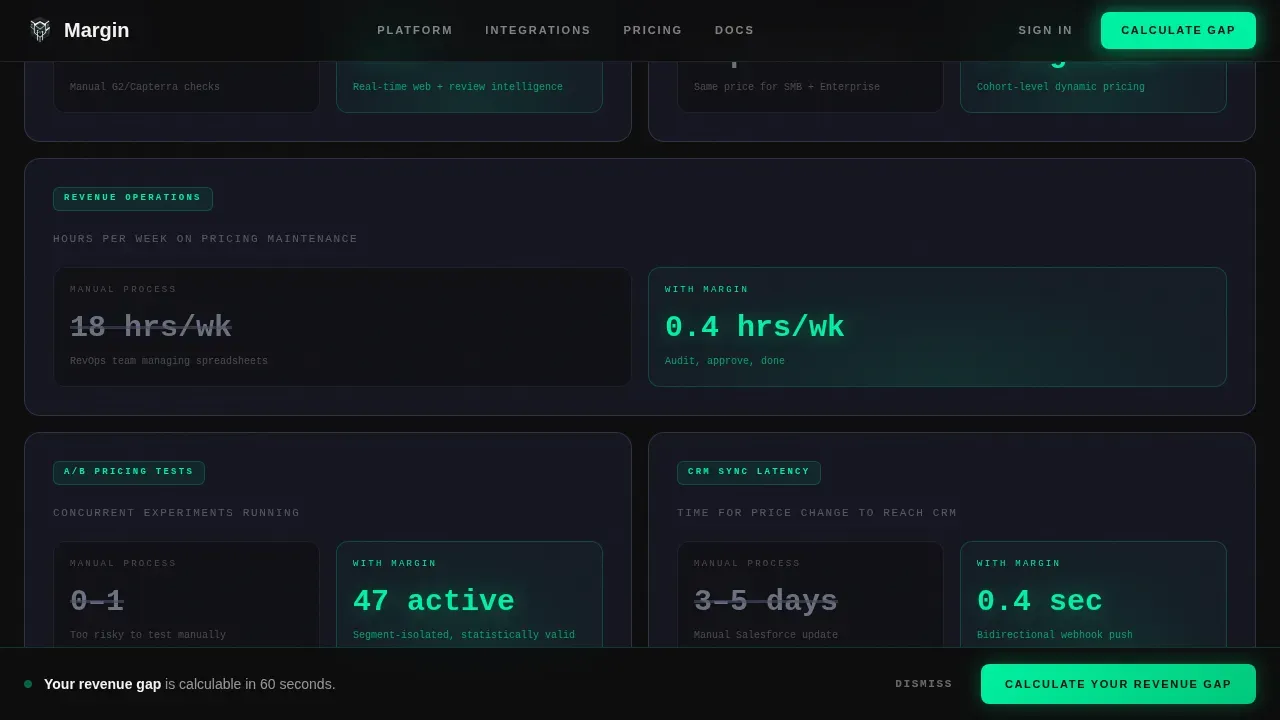
Below the calculator, the page flows through a systematic teardown of each capability. Each bento cell presents one capability as a versus card. Manual Process sits on the left in muted titanium. With Margin appears on the right in signal green with specific before-and-after metrics. Examples include response time dropping from 14 days to 11 milliseconds and price accuracy climbing from 62% to 94.7%. This structure supports data driven decision making at a glance. The grid densifies as the visitor scrolls, stacking proof until the data weight becomes its own argument. AI-driven tools can conduct multivariate tests to assess pricing strategies, and this section translates that capability into visible, scannable evidence for the buyer. This approach supports high performing landing pages by weaving concrete metrics and clear differentiation points directly into the landing page copy.
Capability Cells with Benchmark Proof
Four dedicated bento cells isolate individual product capabilities: dynamic competitor tracking, elasticity modeling, segment-level A/B pricing, and CRM sync latency. Each cell includes a latency benchmark, a visual data display styled as embedded telemetry, and integration logo rows. Elasticity modeling enables estimation of how demand changes in response to price shifts, providing an avenue for strategic price increases. This section converts technical depth into visual proof without requiring the visitor to read dense documentation. The AI engine analyzes inventory and traffic data to detect scenarios like low stock or high demand, and this template surfaces that intelligence in scannable bento cells that hold attention and build trust. Integrating machine learning into pricing strategies can lead to revenue growth of 5% to 15% and margin improvements of 5% to 10%, and those numbers are built directly into the benchmark display cells.
Sticky Call-to-Action Bar and Secondary Conversion Path
The primary call-to-action, labeled "Calculate Your Revenue Gap," anchors inside the hero calculator and reappears as a sticky bottom bar after the third bento row. This ensures that conversion optimization pressure follows the visitor through the entire page without interrupting the proof-building flow. A secondary path, "See How We Beat [Competitor]," opens a slide-out comparison matrix. This two-path structure supports both high-intent visitors ready to book a demo and mid-funnel visitors still evaluating options. Post click optimization begins the moment a visitor interacts with either path. Websites with 10 to 15 landing pages can generate 55% more leads than those with fewer pages, and this template is designed to serve as one high-impact node in a broader landing page strategy.
Carbon Fiber Visual System and Animation Layer
The template uses a full Carbon Fiber color system with deep cockpit black (#0D0D0D) backgrounds, woven graphite (#1A1A2E) bento cell surfaces, titanium hairline borders (#4A4E69), signal white (#F2F2F2) for text and data, and high-voltage green (#00F0A0) reserved exclusively for positive delta indicators, call-to-action elements, and upward-trending chart lines. Animations include counter animations, scroll reveals, glow effects, and bento card entrances. Typography uses DM Sans for headings and JetBrains Mono for data and numbers. This design quality creates the instrument-cluster aesthetic described in the brief: matte and recessed until the data lights up. Engaging visuals play a pivotal role in conveying your message, and this system ensures that 48% of visitors who would otherwise leave a page without engaging are pulled deeper by the visual momentum of live-data telemetry cells.
Page sections overview
| Section | Purpose |
|---|---|
| Hero Calculator Cell | Interactive revenue gap estimator with animated counter and waterfall chart |
| Versus Bento Grid | Manual versus. AI spec-sheet cards with before-and-after metrics |
| Capability Proof Cells | Dynamic tracking, elasticity, A/B pricing, CRM sync benchmarks |
| Integration and Benchmarks | Stack logos, latency proof, audit-trail display cells |
| Social Proof and call to action | Testimonial blocks, sticky call-to-action bar, secondary comparison path |
| Linear Footer | Single-row footer, Pattern 1 layout |
Design & branding system
The visual identity follows a Startup Velocity theme built on the Carbon Fiber color system. The palette is designed to feel like the interior of a performance vehicle at night: everything matte and recessed until the instrument cluster flares to life. Design quality is intentional at every level of the grid.
Key design decisions built into this template:
- Color system uses five values: deep cockpit black (#0D0D0D) for the background, woven graphite (#1A1A2E) for bento cell surfaces, titanium (#4A4E69) for hairline borders, signal white (#F2F2F2) for all text and data, and high-voltage green (#00F0A0) used exclusively for positive deltas, call-to-action buttons, and chart uptrends
- Typography pairs DM Sans for all headings with JetBrains Mono for every numeric and data element, reinforcing the instrument-panel aesthetic and making financial metrics instantly scannable
- Whitespace is treated as structural carbon: load-bearing, not decorative, so each bento cell has breathing room that increases visual weight as the grid densifies on scroll
Mobile & speed optimization
This template is specified as desktop-first, reflecting the reality that VP of Revenue and RevOps professionals work primarily on desktop dashboards. The layout is engineered for dense, data-rich viewing at full viewport width, where the bento grid can express its full visual hierarchy. Landing page performance is addressed through deliberate component architecture.
Performance decisions built into the template:
- Static sections use Server Components to minimize render blocking, while the live calculator and all animation layers run as Client Components, keeping the published page fast and the interactive elements fully responsive
- Animation priority is set to high, with counter animations, scroll reveals, glow effects, and bento card entrance sequences all scoped to Client Components so they do not impact the initial load of the static proof sections
- The sticky call-to-action bar is implemented as a lightweight Client Component that activates after the third bento row, ensuring conversion optimization pressure loads without affecting landing page performance of the earlier proof cells
How this template helps you convert
This template is built around a single conversion principle: show the visitor their own number first. Once a prospect sees their specific projected revenue lift inside the calculator, the cost of not booking a demo becomes real and personal. The page earns the click instead of asking for it.
Conversion mechanics built into this template:
- The hero calculator anchors conversion intent at the very first viewport. Visitors enter three data points and immediately see an animated revenue lift counter alongside a waterfall chart. This creates a live page moment where data becomes a personal financial argument. Social proof sections below the calculator reinforce that projection with named-persona testimonials and company-type results, adding the credibility that drives demo bookings.
- The versus grid turns every scroll into a proof-building event. Each bento cell quantifies the gap between traditional pricing processes and AI-powered repricing. The progressive densification of the grid means that by the time a visitor reaches the social proof section, they have seen enough conversion data to make a confident decision. The sticky call-to-action bar ensures that "Calculate Your Revenue Gap" is always one tap away, removing friction from the booking moment. AI-powered landing pages can increase conversions by up to 25% compared to traditional methods, and companies using AI-powered landing pages experience an average conversion rate lift of 22% compared to those using standard approaches.
Other information about this template
This template is part of a broader ecosystem of ai landing pages built on the platform. It is a strong reference for anyone exploring the best ai landing page approaches for high-stakes B2B SaaS products. Understanding how ai landing page builders and landing page builders in general handle conversion architecture helps contextualize what makes this template effective.
Here is additional context for buyers evaluating this template:
- AI landing page builders automate design, copywriting, testing, and mobile optimization processes that traditionally required weeks of development time. This template delivers that finished output in a single ready-to-deploy package. Free ai builders and free ai landing page tools can help teams get started, but they often carry limitations in advanced features, branding restrictions, and traffic caps on a free plan or free tier. This template removes those constraints without the steep learning curve of building from a blank page.
- Landing page creation with a good ai builder no longer requires a drag and drop editor or a drag and drop builder to produce professional results. This template ships as a complete, coded layout. Teams that want more control over copy and brand can edit the landing page copy, swap colors, and update the page structure without touching the core bento architecture. A free plan on most platforms lets teams explore templates before committing to a paid plan, and this template is available to preview before purchase.
- Ai landing page builder platforms and traditional landing page builders both address the challenge of creating landing pages quickly, but ai powered landing page generation goes further by embedding conversion psychology directly into the page. The use of artificial intelligence in marketing has increased by 190% in the past two years, with 61% of marketers believing that AI is crucial for their business success. This template reflects that shift. Machine learning algorithms power the pricing engine being marketed, and the page design mirrors that intelligence through its data-telemetry visual language.
- Key features for any ai powered landing page include b testing support, smart traffic routing, conversion optimization tools, seamless integration with CRM and marketing stacks, and the ability to publish to a custom domain. This template's architecture is compatible with platforms that offer those advanced features on a paid plan. Teams running paid traffic campaigns need optimized landing pages that convert visitors efficiently, and the sticky call-to-action bar plus the interactive calculator are specifically designed for that use case. The smart traffic feature on supported platforms can route visitors to multiple landing page variations for ongoing experimentation.
- Ai tools and ai powered tools for lead generation increasingly depend on the page itself to carry the conversion argument. This template supports that by making the landing page strategy visible in its structure. Simple landing pages work for low-stakes campaigns, but high performing landing pages for complex B2B SaaS require the depth this template delivers. Creating landing pages at this level of specificity, with build landing pages capability that covers both the visual system and the conversion logic, is what separates conversion focused landing pages from generic alternatives. Whether teams are looking to launch pages quickly or iterate toward high converting landing pages over time, this template provides a complete landing foundation that supports both goals.
- Ai optimization and post click optimization both depend on the quality of the original page. A high quality landing page reduces wasted spend on paid traffic and improves the efficiency of lead generation campaigns. This template provides that high quality landing foundation. Teams who want a dedicated account manager to guide deployment can explore platform support tiers where that option is available. The average conversion rate for a landing page across all industries sits around 6.6%, with top performers exceeding 11%. AI-driven landing page builders can increase conversion rates by up to 30% compared to traditional landing page builders. Personalization can drive a 10% to 15% revenue lift, and this template's calculator and versus-grid design directly support that personalization-first approach. Affordable pricing on the platform means teams can access the template on a free tier or upgrade to a paid plan for custom domain publishing and full advanced features access.
- Visitor behavior data consistently shows that essential features like a clear call-to-action, social proof, and quantified results are the primary drivers of conversion on B2B SaaS pages. This template builds all three into its core page structure. Free tools on the platform let teams preview and test before committing, and free builders give new users a starting point. This template sits above simple landing pages and traditional landing pages in its capability set, offering the depth needed for high-value B2B conversion campaigns. The landing page builders market is projected to grow from USD 715.5 million in 2025 to USD 2.72 billion by 2035, a 14.3% compound annual growth rate, reflecting how central ai landing and ai powered landing page generation is becoming to modern go-to-market execution. Build landing pages at this level and the gap between traditional landing and ai landing pages becomes immediately clear in conversion data.

Theme
Startup Velocity
Creative direction
Spec Sheet
Color system
Carbon Fiber
Style
Bento Grid
Direction
Comparison/Versus
Page Sections
Interactive Revenue Gap Calculator
Versus Spec-sheet Bento Cells
Capability Proof and Benchmark Cells
Sticky Call to Action Bar and Slide-out Comparison Matrix
Carbon Fiber Visual System with Animation Layer
Social Proof Section with Persona Testimonials
Related questions
Who is this landing page template designed for?
Can I edit the landing page copy and colors without breaking the layout?
Does this template include the interactive calculator functionality?
How does the versus grid section work?
Is this template compatible with ai landing page builder platforms?