Petition - Trusted Green Card Attorney Landing Page Template
Petition - Trusted Green Card Attorney Landing Page Template
The Petition template is a sidebar companion landing page built for green card immigration attorneys. It leads with a credential badge wall, scrolls through case-type cards and employer social proof, and keeps a sticky sidebar contact form in view at all times. The result is a high-trust, lead generation landing page designed to convert H-1B holders, HR directors, and families into consultation requests.
by Rocket studio
Loading preview…
Quick summary
The Petition template is a single-page, sidebar companion landing page purpose-built for green card immigration attorneys. It opens with a wall of professional credentials, moves through case-type cards with approval data, and closes the loop with a sticky eligibility form. Every scroll deepens trust. Every section moves the visitor closer to submitting their contact details.
Who this template is for
This landing page was designed for immigration law practices that handle employment-based and family-based green card matters. It fits attorneys who work across multiple practice areas but need one focused page that speaks directly to visa applicants and their sponsors.
Immigration attorneys and law firm partners who handle EB-1A, EB-2 NIW (National Interest Waiver), PERM labor certification, and family-based green card applications
Employer HR directors and in-house legal teams sponsoring key business talent on employment based visas
Solo practitioners and boutique immigration firms that want a professional, credentialed online presence without a full website redesign
What problem this template solves
Potential clients in immigration law carry real anxiety. They are watching visa bulletin dates shift. They are navigating forms they have never seen before. They need an immigration lawyer who communicates clearly and inspires confidence from the first scroll. Generic law firm pages fail here because they bury credentials and speak in vague legal language.
This landing page solves three core problems:
It removes doubt before the visitor reads a paragraph, by leading with a badge wall of credentials and approval statistics rather than a stock photo hero
It provides category-specific information through case-type cards, so a visitor filing an EB-2 NIW petition does not have to guess whether this attorney handles their situation
It keeps the conversion path permanently visible through a sticky sidebar, so the visitor never has to scroll back up to find the contact form or the attorney's contact details
What you get with this template
This template delivers a fully structured, section-led landing page layout. Every component is designed around legal authority, trust, and lead capture. There is no guesswork about what goes where.
Theme
Legal Shield
Creative direction
Logo Wall Authority
Color system
Navy Authority
Direction
Lead Generation
Page Sections
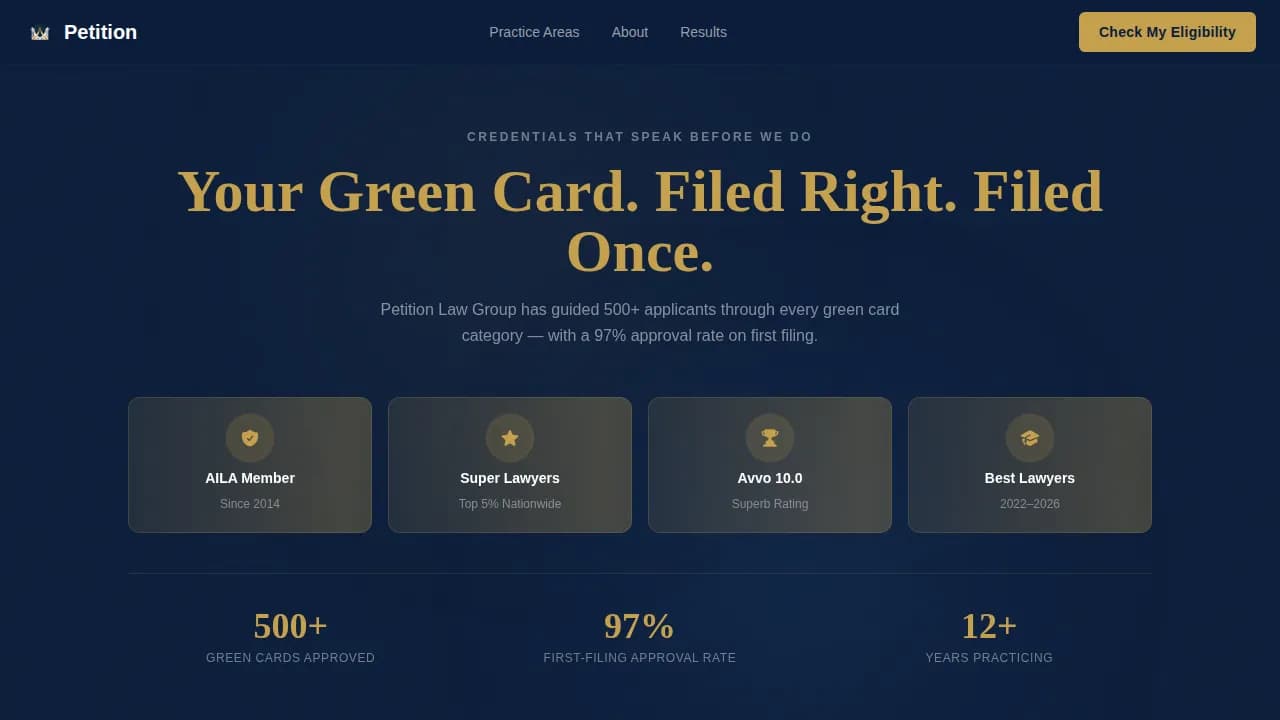
Award Badge Header Wall
Case-type Card Grid
Sticky Sidebar with Eligibility Form
Employer Logo Ticker
Secondary Lead Magnet Section
Layered Social Proof Architecture
Related questions
Who is the Petition template designed for?
Does the sticky sidebar work on phones and tablets?
Can I use this landing page for practice areas beyond immigration?
What forms does the template include?
How does the dual conversion path work?
A header badge wall in deep navy, a scrollable main content column with case-type cards and a grayscale employer logo ticker, a sticky sidebar with attorney profile and eligibility form, and a footer in a clean linear single-row pattern
Case-type cards for EB-1A, EB-2 NIW, PERM, and family-based categories, each carrying approval statistics, average processing timelines, and a paired client testimonial
A secondary lead magnet section offering a downloadable Green Card Timeline Calculator PDF gated behind an email address, capturing earlier-stage visitors who are not yet ready to call
Feature list
This landing page is built on six high-impact components drawn directly from the template brief. Each one does a specific job in the visitor journey.
Award Badge Header Wall
The header replaces a traditional hero image with a horizontal band of professional credential badges. Association seals, rating icons, and a 500-plus green card approvals counter are arranged like medals across a deep navy background. A judicial gold headline sits beneath them. This setup earns immediate trust before the visitor reads the first sentence of body copy.
Case-Type Card Grid
Four case-type cards cover the core immigration categories this firm handles: EB-1A, EB-2 NIW, PERM labor certification, and family-based immigration. Each card displays approval statistics, an average processing timeline, and a single client testimonial. Visitors can identify their visa category immediately and see real evidence of the attorney's track record in that specific area.
Sticky Sidebar With Eligibility Form
The sidebar follows the visitor as they scroll. It keeps the immigration attorney's face, bar admissions, and languages spoken in peripheral vision at all times. The embedded eligibility form asks for visa category, country of birth, a free-text situation description, and then name, email, and phone. This layout reduces bounce rate by keeping the conversion path continuously accessible without interrupting the main content flow.
Employer Logo Ticker
A grayscale scrolling ticker displays logos of Fortune 500 companies whose employees the firm has represented. The logos are rendered in muted tones so they feel authoritative without overshadowing the page's primary message. This component adds a layer of business immigration credibility that speaks directly to HR directors and corporate sponsors.
Secondary Lead Magnet Section
A dedicated section offers a downloadable Green Card Timeline Calculator PDF. Visitors provide only an email address to receive it. This secondary conversion path captures prospective clients who are researching their options and not yet ready to book a call, widening the top of the funnel without complicating the primary form.
Layered Social Proof Architecture
The page is structured so that social proof intensifies with each scroll. The badge wall establishes macro credibility. The employer ticker adds institutional weight. The case-type cards deliver category-specific success stories. Client testimonials with named outcomes anchor the emotional case. By the time a visitor reaches the eligibility form, trust is already built.
Page sections overview
Section
Purpose
Header Badge Wall
Front-loads credentials and removes doubt
Employer Logo Ticker
Adds business immigration social proof
Case Type Cards
Delivers category-specific approval data
Client Testimonials
Grounds emotional trust with real outcomes
Lead Magnet Call to Action
Captures earlier-stage visitors via PDF
Sticky Sidebar
Keeps attorney profile and form visible
Footer Pattern
Closes page with a clean linear layout
Design & branding system
The visual identity uses a Legal Shield theme built on a Navy Authority color system. The palette is sober, credentialed, and unmistakably official. It communicates the weight of a notarized document without a single word of explanation.
Deep briefcase navy (#0B1D3A) dominates the sidebar, header, and badge wall; judicial gold (#C5A04E) highlights badges, trust indicators, the eligibility form button, and hover states; polished marble gray (#D6D9DE) grounds section backgrounds; and brief-paper white (#F8F8F5) keeps body copy breathing
Typography uses Fraunces for serif headlines and DM Sans for body text, pairing authoritative warmth with clean readability across all section types
Animation is set to medium intensity with scroll reveals, counter animations on the approval stat badges, and a smooth logo ticker, giving the page motion without distraction
Mobile & speed optimization
The template is built desktop-first, with the sticky sidebar as the primary conversion mechanism on wider screens. Mobile users are not excluded; the layout adapts so the sidebar collapses and the eligibility form appears inline at the appropriate scroll point.
The sticky sidebar collapses gracefully on small screens, preventing layout overflow and keeping content readable on mobile devices without sacrificing the conversion path
Mobile optimization ensures the petition forms, case-type cards, and lead magnet call to action are fully readable and functional for most users arriving on phones and tablets
Page speed is supported through a server-component architecture for static sections, with client-side rendering reserved for the sidebar and interactive forms, keeping load times lean for mobile users navigating on slower connections
How this template helps you convert
This landing page is engineered around a single business goal: turning a first-time visitor into a qualified consultation lead. Every design and content decision serves that goal.
The credential badge wall front-loads trust so completely that by the first scroll, the visitor's question shifts from "Is this attorney qualified?" to "Does my case qualify?" This ordering mirrors how the best immigration lawyer pages earn commitment before asking for it.
The sticky sidebar keeps the attorney's contact details, bar admissions, and languages spoken in view throughout the entire reading experience, eliminating the friction of having to search for how to reach the firm.
The dual conversion path, a full eligibility form for ready visitors and a PDF lead magnet for researchers, means the page captures leads at two different stages of the decision journey, improving overall lead generation yield without adding clutter.
Other information about this template
This section covers additional context about how the Petition template fits into the broader landscape of legal landing page design, immigration attorney marketing, and related tools.
The petition trusted green card attorney landing page template is specifically designed for the green card immigration niche, not as a general legal template. Attorneys handling civil litigation, criminal defense, or criminal charges will find the credentialing architecture less relevant, though the sidebar companion structure and eligibility form logic can be adapted for other legal contexts.
Immigration attorneys who use this template can align it with broader digital marketing efforts. SEO for immigration attorneys helps improve online visibility and connect with clients during stressful moments. Creating visa-specific landing pages allows immigration attorneys to address unique client needs and improve user experience. Keyword targeting for immigration services should reflect real user intent, such as specific visa types or legal situations. Content marketing focused on immigration news and clear guidance helps keep the website relevant for returning users.
Schema markup for reviews and attorney profiles can enhance search visibility. Building backlinks from community organizations and cultural groups can improve SEO and demonstrate community involvement. Publishing client stories and case studies can enhance SEO and provide relatable content for those with ongoing immigration questions. Consistent optimization using performance data over time, including tools like Google Analytics, helps the firm stay responsive to changing visitor needs.
Attorneys can extend the page with blog content about priority date movement, documentary evidence requirements, or extraordinary ability criteria. Video content featuring the attorney explaining the green card process in plain language can increase engagement and reduce bounce rate. Adding content in additional languages, alongside a language toggle, makes the page culturally aware and accessible to non-English-speaking clients, which is critical given the internationally diverse nature of immigration applicants.
Scholarly articles, letters from international experts, and coverage in major trade publications or other major media are types of evidence that carry more weight in EB-1A and EB-2 NIW petitions. When attorneys present outstanding achievements, major significance of research contributions, or coverage in major media in a logically structured petition, approval chances improve. The green card petition process for extraordinary ability cases requires meeting at least three of ten specified criteria. Well-structured petitions present evidence clearly and minimize requests for additional documentation.
This template can also support a firm's social media platforms presence by serving as the dedicated landing destination for paid ad campaigns. The lead magnet section functions as a top-of-funnel entry point aligned with how most users discover immigration services, through search and social, before committing to a call. A distinguished reputation built through real case outcomes and client stories is the core asset the page amplifies.
The following additional points are worth noting for attorneys considering this template:
Incorporating social proof on landing pages can increase conversion rates by up to 34 percent, according to published landing page research, making the layered social proof architecture in this template a high-value structural choice
The average law firm landing page conversion rate is 5.81 percent, but well-targeted pages can reach 8.33 percent when message-to-audience fit is precise
A privacy policy link is recommended for legal compliance when collecting personal data through the eligibility and lead magnet forms
Multilingual support and a prominent language toggle assist non-native English speakers, which is essential given the diverse backgrounds of green card applicants
Tools such as NIWKit are used by some attorneys as online systems for gathering and preparing large NIW petition packages, and this template's case-type card structure pairs naturally with that kind of document workflow
The Formsite platform offers a petition with signatures template for easy, secure, mobile-friendly form completion, which is one reference point for how petition forms should behave on small screens
Attorney profiles with photos, bar admission details, and languages spoken are essential trust signals for a high-conversion green card attorney landing page, and this template builds all three into the sticky sidebar
The green card lawyer handling complex employment-based or family cases needs a landing page that communicates a personalized approach, and this template delivers that through case-type specificity and a free-text form field where visitors describe their situation
AI assistance tools can support attorneys in drafting initial case summaries or eligibility assessments, though the template's form is designed to capture that human narrative directly from the client