Statute - Authoritative Federal Employee Defense Landing Page Template
Statute - Authoritative Federal Employee Defense Landing Page Template
The Statute template is a split-screen landing page built for federal employee defense law firms. It pairs a stark editorial aesthetic with a multi-step case assessment quiz to convert anxious federal workers into qualified leads. Every section is structured to meet the gravitas of Merit Systems Protection Board appeals, security clearance revocations, and whistleblower retaliation cases.
by Rocket studio
Loading preview…
Quick summary
Statute is a single-page landing page template designed for law firms that defend federal employees against adverse agency actions. The layout uses a strict 50/50 split screen, an editorial black-and-white visual identity, and a scroll-linked process timeline that guides visitors through each phase of legal representation before inviting them to assess their own situation privately through a built-in quiz.
Who this template is for
This template is built for federal employment law firms that handle a high volume of serious, complex cases. It speaks directly to the attorneys and practice managers responsible for intake, positioning, and public-facing communications in this specialized area of law.
Law firms representing federal employees facing proposed removal, suspension, or clearance revocation
Practices focused on Merit Systems Protection Board appeals, whistleblower retaliation defense, and Inspector General investigation responses
Solo practitioners or boutique offices that want an authoritative public presence without a heavy design budget
What problem this template solves
Federal employees who receive a proposed removal notice on a Tuesday morning are frightened, confused, and often unsure where to search for help. They do not want to call a law office cold. They want to understand their situation first. Most law firm pages fail to meet that need. They list practice areas without explaining the process, they request a phone call before the visitor is ready, and they give no signal of how prepared or capable the firm actually is.
Visitors leave before converting because no page section earns their trust or explains what happens next
The firm captures low-quality inquiries because visitors cannot self-identify their situation before reaching out
The page state feels generic, with no signal that the attorney understands the specific statute, forms, and federal policy landscape the client is already living inside
What you get with this template
This template delivers a fully structured, ready-to-customize landing page with every section pre-built and purposefully ordered. The layout, copy scaffolding, and interactive elements are all included in one cohesive file. No placeholder assumptions are added beyond what the source design specifies.
Theme
Editorial Magazine
Creative direction
Transparent Process
Color system
Arctic White
Direction
Quiz/Assessment
Page Sections
Split-screen Hero with Editorial Photography
Scroll-linked Process Timeline
Multi-step Case Assessment Quiz
Practice Areas Section
Social Proof with Outcome Markers
Arctic White Editorial Design System
Related questions
Who is the primary audience for this template?
Does the quiz modal require a phone number from the visitor?
Can I customize the practice area sections and document artifacts?
What federal law context does this template address?
Is this template suitable for a firm that handles cases in multiple locations?
A 50/50 split-screen hero with a black-and-white federal corridor photograph on the left and a serif headline with call-to-action on the right
A scroll-linked process timeline that reveals five phases of representation with redacted document artifact panels alongside each phase
A multi-step case assessment quiz modal that collects grade, agency, action type, and deadline information before asking for a name and secure email
Feature list
This template was built around a specific set of functional and visual capabilities drawn directly from the design brief. Each feature serves the conversion goal of turning an anxious federal employee into a qualified intake.
Split-Screen Hero with Editorial Photography
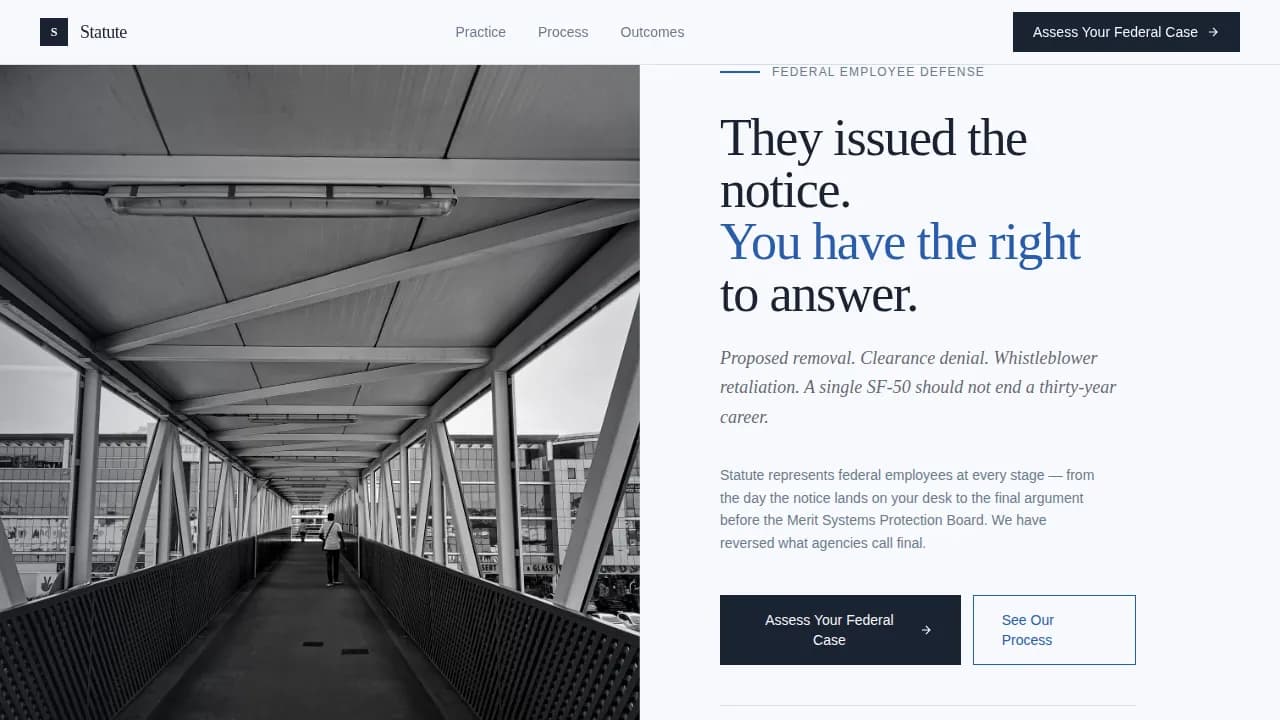
The hero section divides the viewport into two equal panels. The left panel holds a tightly cropped, editorially lit black-and-white photograph of a federal building corridor, with overhead lights receding to a vanishing point and a single figure mid-stride. The right panel presents a large serif headline, a charcoal italic subline naming the stakes, and a quiet call-to-action prompt. The layout signals authority before a single word is read.
Scroll-Linked Process Timeline
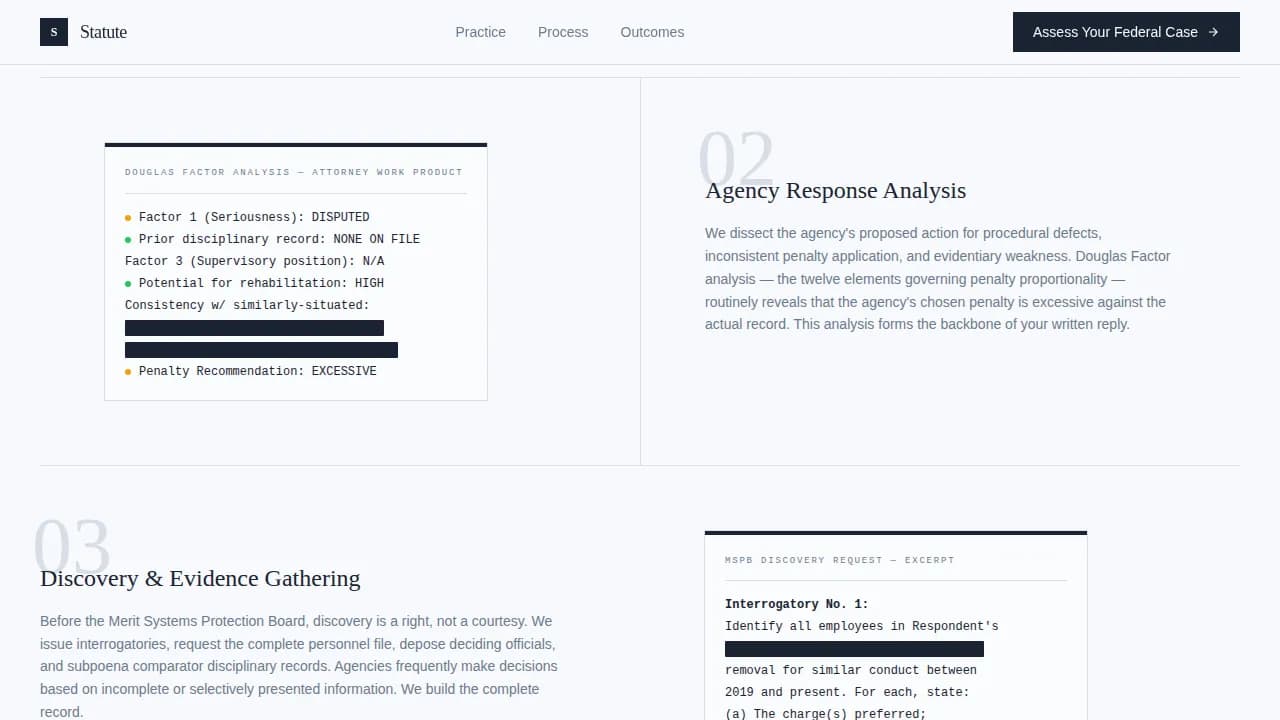
Scrolling past the hero reveals a case timeline with five distinct phases: initial rights assessment, agency response analysis, discovery and evidence gathering, hearing preparation, and Merit Systems Protection Board or federal court argument. Each phase is explained in plain language on the left panel. The right panel shows a corresponding redacted document artifact, such as a proposed removal letter or a final decision stamped with the word REVERSED. The scroll structure removes the fog that makes federal workers feel powerless by showing exactly what happens and in what order.
Multi-Step Case Assessment Quiz
The primary conversion tool is a modal quiz that opens from the "Assess Your Federal Case" call-to-action. It begins with the least intimidating question first, asking for the visitor's current federal pay grade. It then progresses through agency name, type of action received, and whether a reply deadline has already been set. The final screen requests a name and a secure email address. No phone number is required at any point. This approach reduces the emotional barrier of contacting a law office while delivering a fully qualified intake to the firm before the first conversation.
Practice Areas Section
A dedicated section covers the three core areas of law this template is designed to represent: Merit Systems Protection Board appeals, security clearance revocations, and whistleblower retaliation cases. Each practice area is presented with enough context to help the visitor recognize their own situation and confirm they have found the right office.
Social Proof with Outcome Markers
The template includes a social proof section displaying anonymized client outcome statistics and reversed-decision stamps. These elements are positioned to reinforce the firm's record and meet the visitor's need for evidence of competence before they commit to requesting a consultation.
Editorial Arctic White Design System
The visual identity uses a law review aesthetic built on four values: glacial white (#F7F9FC) as the base, federal charcoal (#1B2332) for body text, silver sidebar rule (#C5CCD6) for dividers, and congressional blue (#2A5CAA) reserved exclusively for links, pull quotes, and interactive elements. Fraunces serif is used for headlines. DM Sans handles all body copy. The combined effect is immaculate, authoritative, and deliberately free of decorative noise.
Page sections overview
Section
Purpose
Split-Screen Hero
Opens with authority; presents headline, stakes subline, and primary call-to-action
Process Timeline
Reveals five representation phases with scroll-linked document artifact panels
Practice Areas
Identifies MSPB appeals, clearance revocations, and whistleblower cases as service categories
Social Proof
Displays anonymized outcome statistics and reversed-decision markers
Case Assessment Quiz
Multi-step modal intake that qualifies the visitor before the first conversation
Footer Row
Single linear row with firm contact and navigation links
Design & branding system
The entire template is built on an Editorial Magazine theme. The restraint is intentional. Authority in this context is earned through negative space, not decoration. Every typographic and color decision reinforces the idea that the firm is meticulous, prepared, and serious.
Color system: glacial white (#F7F9FC) base, federal charcoal (#1B2332) text, silver rule (#C5CCD6) dividers, congressional blue (#2A5CAA) for interactive elements and pull quotes only
Typography: Fraunces serif for all headlines and section titles, DM Sans for all body copy and form labels
Animation: low-to-medium intensity scroll reveals and document stamp animations; no heavy motion that would distract from the editorial tone
Mobile & speed optimization
The template is designed desktop-first, reflecting that the primary audience is a federal employee reading at a work desk during business hours. The layout remains fully responsive so that mobile visitors who search after hours or on personal devices can still access the information and complete the quiz without friction.
Desktop-first grid with a responsive reflow that stacks the split-screen panels vertically on smaller viewports
Static server components power all non-interactive sections; only the quiz modal loads as a client component, keeping the initial page render light
Scroll-reveal animations are set to low-to-medium intensity to avoid layout shift or visual distraction on slower connections
How this template helps you convert
The entire page is structured as a progressive trust-building sequence. Each section earns the visitor's confidence before asking for anything in return. The conversion architecture is deliberate and sequential.
The hero section creates immediate recognition. The headline "They issued the notice. You have the right to answer." meets the visitor exactly at the emotional state they are already in, naming removal, suspension, and clearance denial before they have to explain anything.
The process timeline builds credibility through transparency. Showing each phase of representation in order, alongside real-looking redacted document artifacts, signals that the firm has done this many times before and knows exactly what to do. Visitors who reach the end of the timeline are significantly more prepared to request an assessment.
The quiz modal converts anxiety into action. By starting with a low-stakes question about pay grade rather than asking the visitor to sign anything or call anyone, the form meets them where they are comfortable and gathers enough information for the firm to enter the first conversation fully prepared.
Other information about this template
This template sits at the intersection of legal practice management and digital public communication for federal employment law. It incorporates a number of contextual layers that practitioners and template buyers should understand before customizing and publishing the page.
Understanding federal statutes is crucial for navigating employee rights and obligations. The United States Code, organized by subject matter into 54 titles and five appendices, is the official codification of all general and permanent laws of the united states government. The Office of the Law Revision Counsel is responsible for maintaining and publishing these titles. Annotated editions include further historical commentary and cross-references, and the code is updated annually with cumulative print supplements.
Federal statutes can amend or repeal earlier laws or create new ones. Slip laws are the first official publication of a public or private law. Positive law codification improves the usefulness of the code over time.
The Westfall Act, formally known as the Federal Employees Liability Reform and Tort Compensation Act of 1988, governs defenses and immunity for federal employees sued for actions taken within the scope of their employment. Under this law, the United States is substituted as the defendant in cases involving negligent acts committed by a federal employee while working. The protections of the Westfall Act generally do not extend to criminal proceedings, and its immunity does not apply to suits alleging violations of the U.S. Constitution or federal statutes.
The definition of scope of employment is critical for determining immunity under the Westfall Act. It applies to actions within the outer perimeter of an employee's duties. Common law torts covered under this law include negligence, defamation, and misrepresentation. If the Attorney General refuses to certify a federal employee for immunity, that employee can petition the court to review the decision. The Westfall Act also authorizes the Attorney General to remove cases from state court to federal district court.
Guidance documents from the Department of Defense come in a variety of formats including memoranda, statements of policy, and bulletins. Such documents lack the force and effect of law unless expressly authorized by statute or incorporated into a contract. The Department of Defense may not cite, use, or rely on any guidance that is not posted on its official website. Any person may petition the department to withdraw or modify a particular guidance document. When developing a significant guidance document, the department publishes a notice in the Federal Register announcing the availability of the draft. The public can submit comments on draft guidance documents by following instructions in the Federal Register publication.
The Popular Names Table lists statutes alphabetically by their colloquial names, which can be useful when searching for protections by the name most people use. The Classification Tables aid researchers by indicating where enacted laws appear in the U.S. Code and which sections of that code those laws amended. The General Index is a comprehensive directory organized alphabetically by subject with the corresponding title and section listed.
Federal agencies operate under a web of regulations, policy directives, and published rules. Many of these rules are found in the Federal Register, which serves as the daily journal of the united states government and covers several states, territories, and the District of Columbia. Any change to federal employment policy, including rules that affect procurement, funds management, or official conduct standards, is typically published there first.
This template is built to support the specific compliance and communication needs of law offices that work within this regulatory environment. It is particularly suited to practices with a history of representing persons at GS-7 through Senior Executive Service levels, where a single adverse action can force a career change with immediate effect.
Rocket.new is an AI-powered platform that lets users build full, production-ready apps and websites from natural-language prompts. Rocket.new handles backend work, deployment, and code generation so that non-technical users can go from idea to a live page without traditional programming. This template is available on that platform.