Photonic Computing Open Source Landing Page Template
Photon is a bento grid landing page template built for an open-source photonic computing framework. It combines a dark electric indigo color system with a structured feature matrix layout to communicate deep technical capability. The template targets quantum optics researchers, machine learning infrastructure engineers, and photonics startup leaders who need to present a serious, vendor-neutral silicon photonic stack to partners and collaborators.
by Rocket studio
Quick summary
Photon is a single-page bento grid landing page for an open-source photonic computing framework. It routes computation through silicon photonic waveguides instead of copper interconnects. The design blends a deep void black and electric indigo palette with a structured feature matrix, a contributor logo bar, and a lead generation form targeting early-access enterprise and research partnerships.
Who this template is for
This template is built for technically credible open-source projects that need to attract serious collaborators fast. The audience is not general consumers. It speaks directly to the people who understand why replacing electrons with photons matters.
- Quantum optics postdocs building custom interferometer meshes who need to present their project credibly
- Machine learning infrastructure engineers tired of waiting on GPU cluster allocations and looking for a faster path
- Photonics startup CTOs who need a vendor-neutral stack before taping out their first silicon chip
What problem this template solves
Most open-source project pages either look like a README file or a generic SaaS homepage. Neither works when your audience is a semiconductor engineer or a deep-tech investor who will dismiss anything that feels unfinished. This template solves the credibility gap.
- It structures complex architecture into scannable bento grid clusters so visitors understand the stack before they reach the call to action
- It presents contributor and integrator logos prominently so the project does not look like a solo weekend build
- It combines a low-commitment GitHub star path with a high-intent compiler access form to capture both early followers and enterprise partners
What you get with this template
The template delivers a complete single-page layout with every section pre-built and connected into a coherent visual and narrative flow. You get a bento grid structure where each cell is a self-contained unit that can be updated independently.
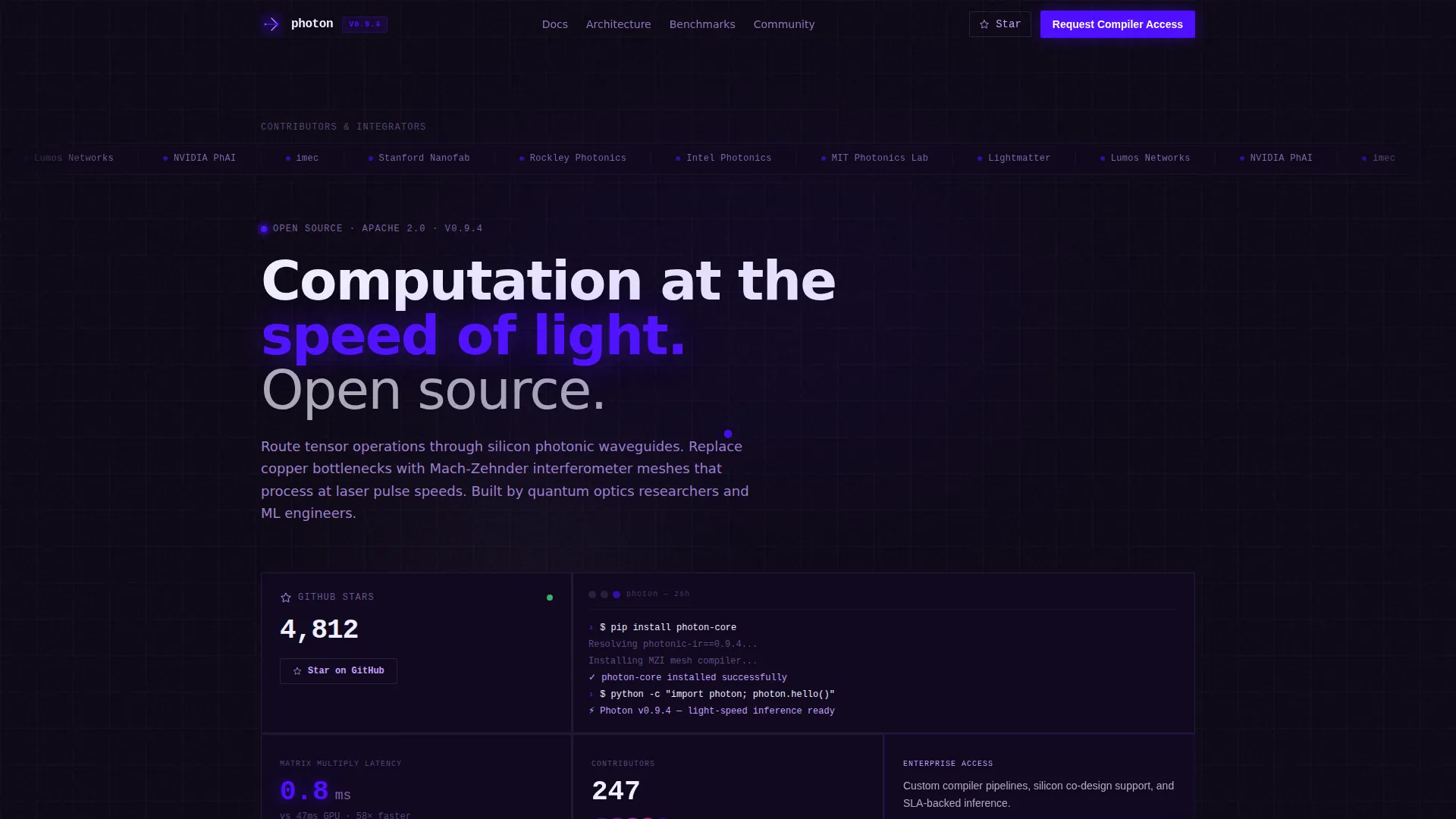
- A scrolling logo bar, a live GitHub star counter cell, and a pip install terminal block in the header area
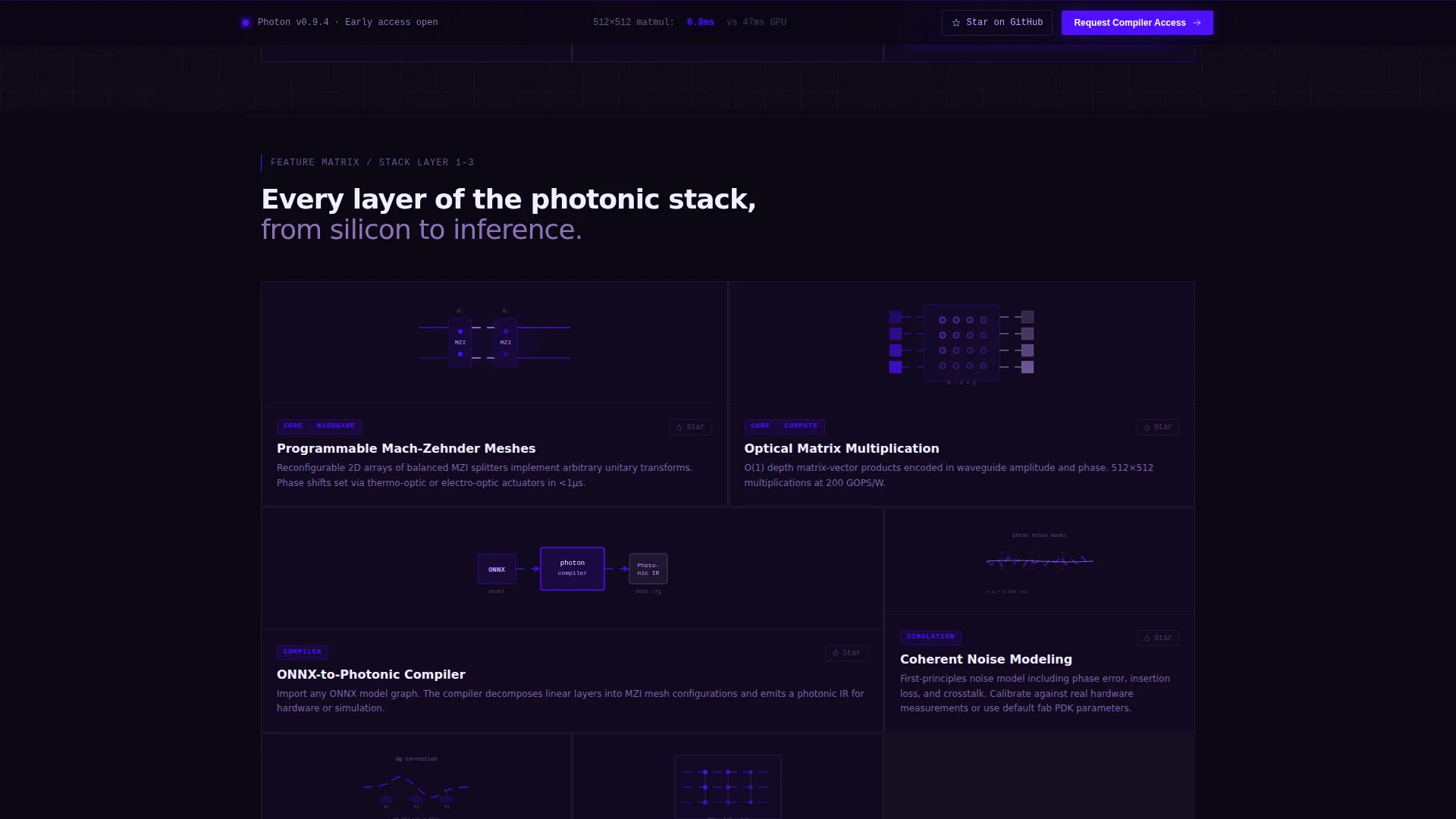
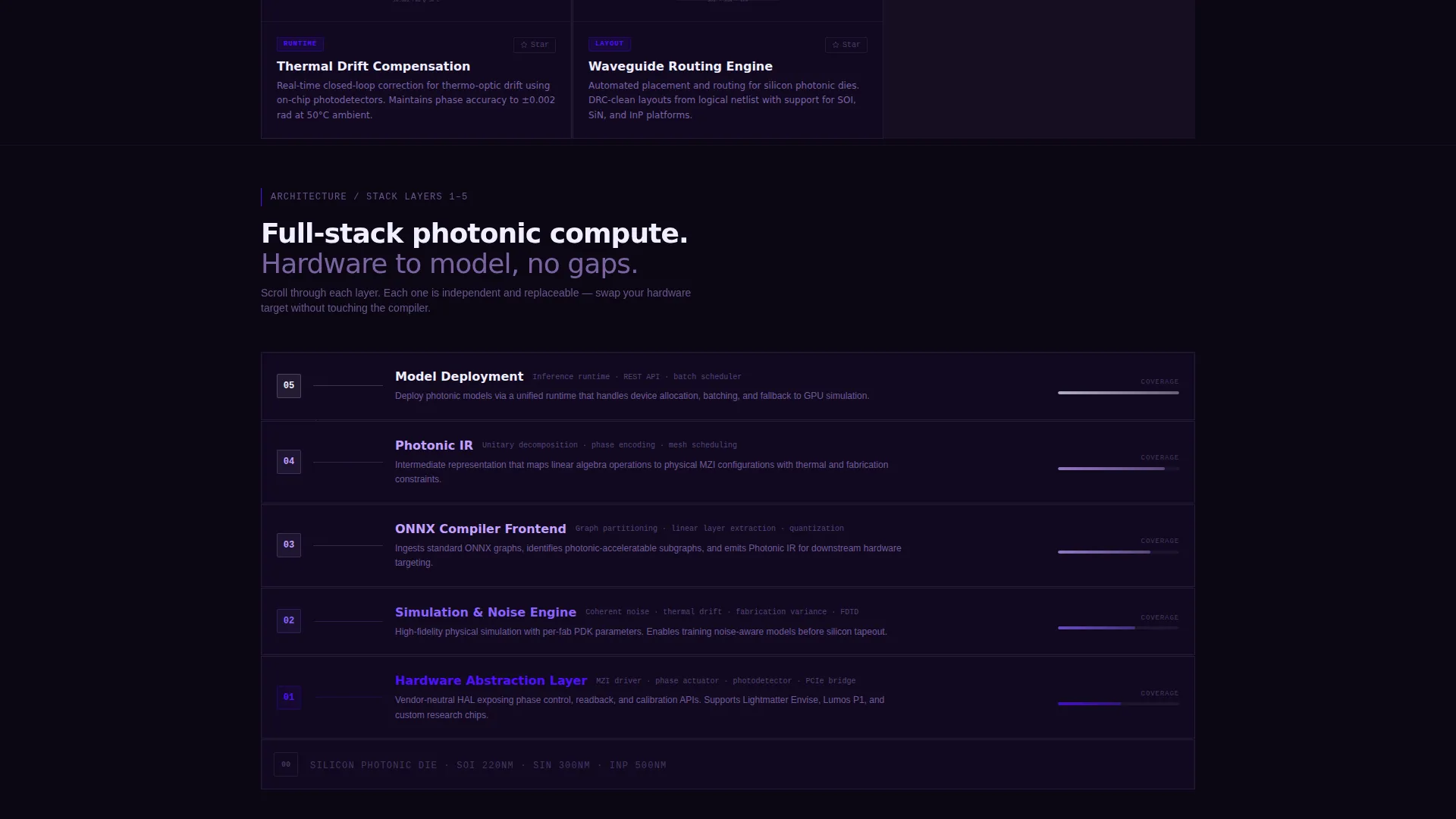
- A feature matrix with variable cell sizes showing optical matrix multiplication, programmable Mach-Zehnder meshes, coherent noise modeling, ONNX-to-photonic compilation, and thermal drift compensation
- A three-field lead generation form with a work email input, organization name field, and a radio selector for interest type, plus a sticky bottom bar call to action that appears after the second grid cluster
Feature list
This template packages every visual and structural component the Photon framework needs to earn trust and drive action on a single page.
Scrolling Contributor Logo Bar
A horizontal strip of institutional and corporate logos scrolls at a slow, confident pace beneath the primary headline. The strip signals project legitimacy without a single line of marketing copy. Contributors and integrators are displayed as logos, not testimonials.
Bento Grid Feature Matrix
The feature matrix arranges capability cards into a structured bento grid where core compute features occupy larger blocks and utility features use compact cells. Each card contains a small animated diagram showing the operation visually. The grid reveals in clusters, each cluster representing one logical layer of the stack from hardware abstraction to model deployment.
Variable Cell Sizing System
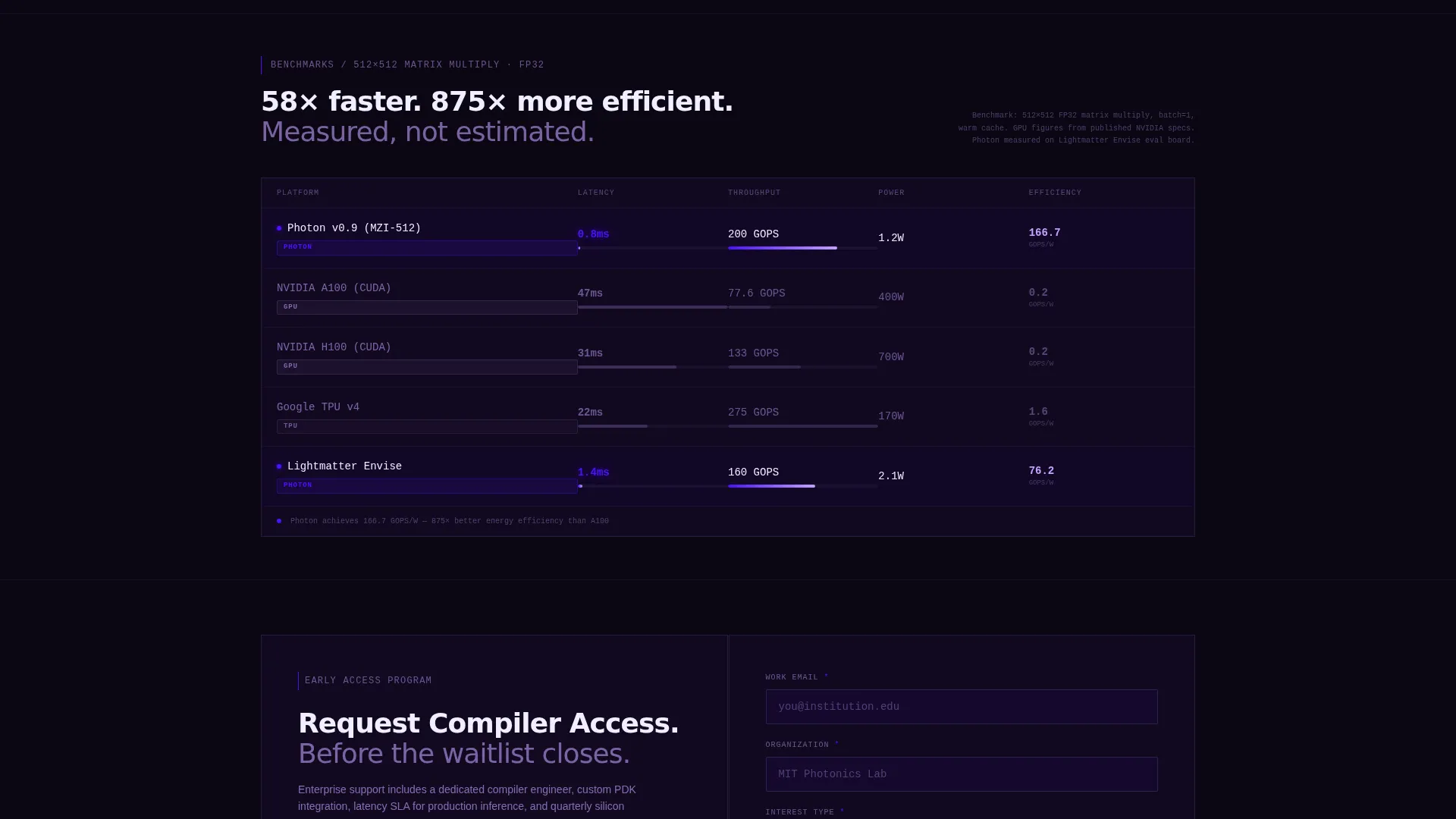
Core compute features such as optical matrix multiplication and Mach-Zehnder mesh programming occupy full two-by-two blocks. Supporting utilities sit in compact one-by-one cells. A full-width cell near the bottom holds a benchmark comparison table showing latency numbers against GPU and TPU baselines.
Dual Call-to-Action Architecture
The primary call to action, "Request Compiler Access", appears in the top-right corner of the header and again as a sticky bottom bar that activates after the second grid cluster scrolls into view. A secondary "Star on GitHub" action anchors the bottom-right corner of every feature cell for lower-commitment engagement.
Lead Generation Form
A three-field form captures work email, organization name, and a radio selector for interest type. The interest selector covers research collaboration, commercial integration, and silicon co-design. The form is positioned to appear only after technical depth has been demonstrated through the feature matrix and benchmark table.
Terminal and Live Signal Block
A dark bento cell below the logo bar displays a live GitHub star count alongside a blinking terminal cursor running the pip install command. This block communicates project momentum and installation simplicity at a glance.
Page sections overview
| Section | Purpose |
|---|---|
| Header Logo Bar | Displays contributor and integrator logos with scrolling animation |
| Headline Block | Anchors the monospaced primary headline and primary call to action button |
| GitHub Signal Cell | Shows live star count and pip install terminal block |
| Feature Matrix Grid | Presents capability cards in variable bento cell sizes |
| Benchmark Comparison Cell | Full-width table comparing latency against GPU and TPU baselines |
| Lead Generation Form | Captures email, organization, and interest type for partnership access |
| Sticky Bottom Bar | Persistent call to action bar activating after second grid cluster scroll |
Design & branding system
The visual identity channels a cleanroom aesthetic where every color feels emitted rather than reflected. The palette creates the sensation of ultraviolet lasers tracing paths across a silicon wafer in a dark environment. Typography uses monospaced fonts to reinforce the engineering context.
- Background panels use deep void black (#0B0614) set edge-to-edge with no gutters, and each bento cell glows faintly at its border to suggest active photonic channels
- Electric indigo (#4F0FFF) drives interactive elements, code highlights, hover states, active tabs, and feature matrix cell borders, with phosphor lilac (#C4A1FF) used for secondary text and diagram labels
- Body copy renders in hard white (#F0EEFF) with a faint violet cast, keeping text readable against the deep black without breaking the emitted-light visual language
Mobile & speed optimization
The bento grid layout is designed to reflow logically on smaller screens without losing the cluster-based architecture narrative. Each cell remains readable and self-contained at any viewport width.
- Variable cell sizes adapt to single-column stacking on mobile while preserving the visual hierarchy of core versus utility features
- The sticky bottom bar call to action remains functional on touch devices, appearing at the appropriate scroll depth after the second grid cluster
How this template helps you convert
The conversion strategy is built on a principle of earned trust. No one fills out a photonics partnership form unless they already believe the project is technically real. The template sequences trust signals before asks.
- The contributor logo bar and GitHub signal cell establish credibility in the first viewport, so visitors stay long enough to engage with the feature matrix
- The benchmark comparison table and architecture-layered grid clusters deliver enough technical depth that the "Request Compiler Access" form feels like a logical next step rather than a cold ask
Other information about this template
This template was designed specifically for the photonic computing open-source niche where technical audiences are skeptical of polish without substance. The layout reflects the Startup Velocity theme, balancing raw engineering credibility with a refined visual system.
- The Electric Indigo color system and bento grid template style are pre-configured, so teams can adapt the layout to their own photonic computing project without rebuilding from scratch
- The template supports the full lead generation flow from first impression through form submission, covering both research collaboration and commercial integration interest types
- Contributor logos shown in the brief include institutions and companies active in the photonic computing space such as MIT Photonics Lab, Lightmatter, Lumos, NVIDIA PhAI, and imec, and the logo bar layout can accommodate similar partner sets
Theme
Startup Velocity
Creative direction
Feature Matrix
Color system
Electric Indigo
Style
Bento Grid
Direction
Lead Generation
Page Sections
Scrolling Contributor Logo Bar
Bento Grid Feature Matrix
Dual Call-to-action System
Three-field Lead Generation Form
Benchmark Comparison Table Cell
Terminal and Github Signal Cell
Related questions
Who is this landing page template designed for?
Can I update the feature cards with my own project capabilities?
How does the lead generation form work?
What does the benchmark comparison cell include?
Is the GitHub star counter connected to a live data source?