Incident Cost Estimator RCA Landing Page Template
This postmortem incident cost estimator RCA landing page template gives SRE teams, engineering managers, and platform leads a structured, single-page hub for incident review. It converts chaotic outage threads into publishable post mortem reports with root cause timelines, severity matrices, and blameless action items. Built in a bold brutalist dark-mode style with glassmorphic panels and live cost estimator interactivity.
by Rocket studio
Quick summary
This postmortem incident cost estimator RCA landing page template is designed for engineering teams who need to move fast after an incident. It turns scattered Slack threads and raw on-call notes into a structured, publishable post mortem document. The hub-and-spoke layout guides readers through five spec-sheet sections, each covering a distinct stage of the postmortem process, from root cause identification to stakeholder export.
Who this template is for
This template is built for teams where incident management is a daily reality. It speaks the language of engineers who have been paged at 3 AM and managers who need clean answers before the morning stand-up.
- On-call engineers and Site Reliability Engineers (SREs) who need a fast, structured format to capture what happened while the details are still fresh
- Engineering managers and team leads writing stakeholder updates that prove process improvements are in motion
- Platform leads and VP-level stakeholders who need evidence that similar incidents will not repeat
What problem this template solves
Effective incident postmortems do not happen by default. Without a structured format, incident post mortem documentation becomes a patchwork of Slack exports, shared Google Docs, and incomplete timelines. Every hour of disorganization after an incident is an hour of compounding cost.
- The postmortem process breaks down when there is no consistent format, leading to repeated incidents and missed lessons learned
- Teams waste engineering hours on duplicated investigations, reformatting notes, and chasing down key details instead of preventing future incidents
- Without a blameless culture and clear corrective actions, the same root cause resurfaces across other incidents, eroding trust and reliability
What you get with this template
You get a fully designed, single-page landing page built around a hub-and-spoke anchor navigation system. Each spoke links to a spec-sheet panel covering one feature of the postmortem tool. The page is ready to customize and deploy.
- An interactive incident cost estimator in the header that calculates the annual cost of unstructured post mortem practices using team size, salary, and mean time to resolution inputs
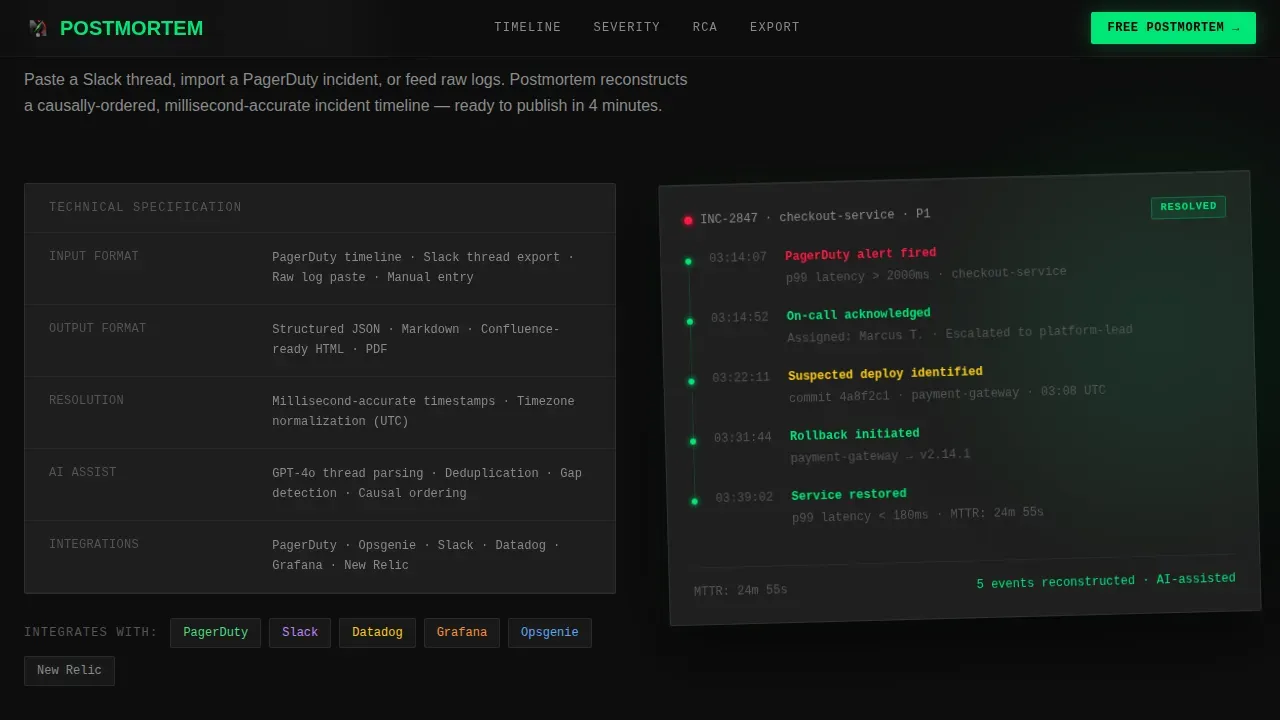
- Five anchor-navigated feature spec sections covering Timeline Builder, Severity Classification, Contributing Factors, Action Item Tracker, and Stakeholder Export
- High-contrast call-to-action buttons using status-green on black, with a freemium conversion path and a one-click PagerDuty OAuth import flow
Feature list
This template ships with purpose-built components that reflect real incident management workflows. Each section is designed to build conviction through completeness, the way an on call engineer trusts thoroughness over enthusiasm.
Interactive Incident Cost Estimator
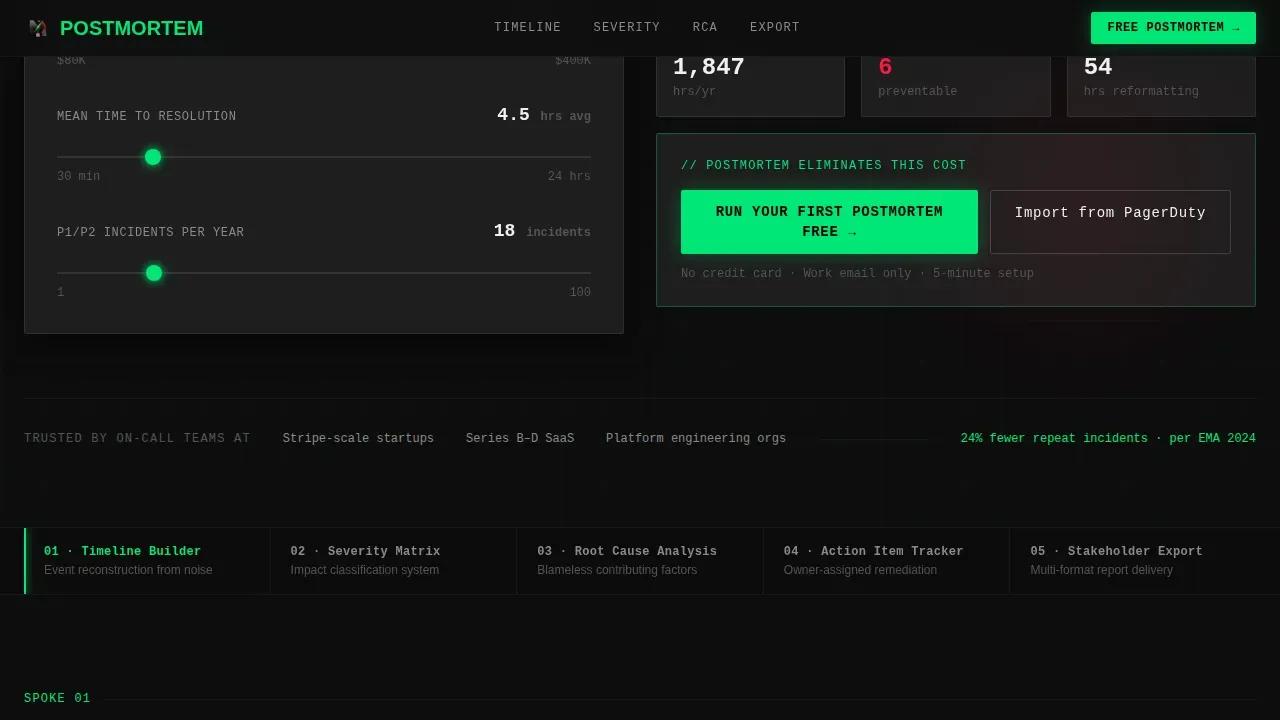
The header hosts a live cost estimator with draggable sliders for team size, average engineer salary, and mean time to resolution (MTTR). As values change, the tool calculates the annual cost of unstructured incident postmortems in real time. Costs are rendered in large monospaced type, ticking upward like a damage counter. This makes the financial case immediately visible, shifting the conversation from "what happened" to "what did this cost us." The estimator breaks down direct costs such as SLA penalties and engineering hours, and indirect costs such as revenue loss and customer impact.
Hub and Spoke Anchor Navigation
A sticky anchor navigation bar acts as the hub. Each link smooth-scrolls to a spoke section below. The five spokes are Timeline Builder, Severity Classification, Contributing Factors, Action Item Tracker, and Stakeholder Export. Each spoke reads like a technical specification: input format, output format, and integration points are documented clearly. Clicking a spoke feels like opening a man page, not a sales brochure.
Root Cause Analysis Spec Panels
Each spec panel presents its feature as technical documentation. The root cause analysis section explains input format and output format for the five whys technique, causal chain mapping, and contributing factors. Detection details clarify how and when an issue was first identified, whether through automated alerts or a monitoring system alert. Primary root cause fields are separated from secondary contributing factors, keeping the incident summary clean and precise.
Blameless Action Item Tracker
The Action Item Tracker section displays corrective actions as assigned tasks with owners, due dates, and status fields. The design enforces a blameless culture by focusing on system failures rather than individuals. You will not assign blame to a person here. Actionable follow up items are structured so that any team lead or service owner can pick them up immediately after the incident review meeting. This tracker supports the feedback loop from incident to improvement.
Stakeholder Export Panel
The Stakeholder Export spoke specifies output formats for sharing postmortem reports externally. It documents how an incident post becomes a public post or internal communication, including formatting options for affected users, customer impact summaries, and incident overview sections. The export flow is designed to reduce the time between resolution and communication, which matters when major incidents have left stakeholders waiting for answers.
Page sections overview
| Section | Purpose |
|---|---|
| Hero Cost Estimator | Live slider tool showing annual cost of unstructured post mortem reviews |
| Hub Anchor Nav | Smooth-scroll navigation linking all five spoke sections |
| Timeline Builder | Spec panel for building a detailed timeline of incident key events |
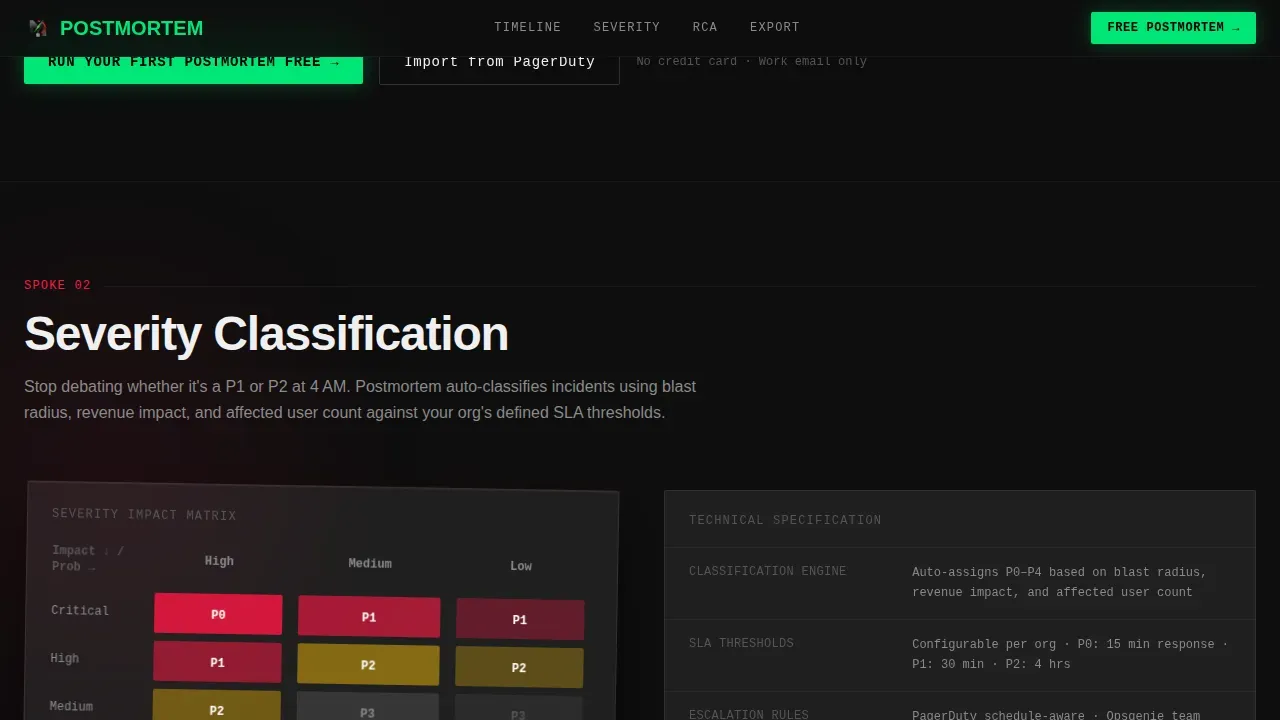
| Severity Classification | Matrix panel for classifying incident severity and customer impact |
| Contributing Factors | Spec panel for root cause analysis and causal chain documentation |
| Action Item Tracker | Blameless corrective actions panel with owner and due date fields |
| Stakeholder Export | Output formats panel for incident postmortem reports and public posts |
| Final Call to Action | Primary conversion section with freemium signup and OAuth import |
| Footer | Minimal developer-style footer with links and integration references |
Design & branding system
The visual language is Bold Brutalist filtered through a glassmorphic color system. Every design decision earns its place against a deep terminal black background. Frosted glass panels float over the black with blurred backdrops, giving brutalist typography room to breathe and punch without adding decorative noise. The result feels like a dark-mode incident dashboard at 4 AM.
- Color system: deep terminal black (#0D0D0D) as the base, frosted glass white at 12% opacity (#FFFFFF1F) for panels, status-green (#00E676) for resolved states and interactive accents, and severity-red (#FF1744) reserved exclusively for critical-path highlights and error states
- Typography: JetBrains Mono is used for all monospaced data, code, and cost counter output; Manrope is used for headings and body text, keeping the layout readable without sacrificing technical credibility
- Animation and interactivity: live counter animation on the cost estimator, slider reactivity, scroll-reveal effects on spoke panels, and floating glass panels at slight angles for depth
Mobile & speed optimization
This template is desktop-first by design. SRE tooling and war-room monitors are the primary environment. The layout is built for large screens where the cost estimator, anchor nav, and spec panels can display at full fidelity. Mobile support is included to ensure the incident post mortem content remains accessible from any device.
- CSS smooth scroll and native scroll behavior handle anchor navigation without heavy JavaScript dependencies
- Intersection Observer drives scroll-reveal animations on spoke panels, keeping transitions lightweight and performant on desktop monitors
- Frosted glass panels and glassmorphic layers use backdrop-filter for visual depth without loading additional image assets
How this template helps you convert
The conversion path is engineered to reduce friction at every step. Visitors arrive, see the financial cost of disorganization immediately, and then scroll through technical specification panels that build trust through depth. By the time they reach the bottom call to action, the decision to sign up feels like the obvious engineering choice.
- The interactive cost estimator at the top quantifies the annual cost of unstructured post mortem reviews before a visitor reads a single feature description. Seeing a real number tied to their own team size and incident frequency makes the value proposition concrete and personal.
- Each spoke section in the anchor nav builds conviction through specification-level detail. Reading how the root cause analysis, contributing factors, and corrective actions sections work feels like evaluating a tool, not reading a pitch. The primary call to action repeats after every spoke, so conversion is always one click away.
Other information about this template
This template is positioned at the intersection of documentation, reliability engineering, and incident management tooling. It is suited for B2B SaaS products targeting SRE and platform engineering teams. Below are additional details relevant to teams evaluating this template for their postmortem documentation workflows.
- The postmortem template format supports both minor incidents requiring a basic incident post mortem review and complex outages requiring a detailed incident postmortem example with full causal chain analysis, making it adaptable for mature teams and teams new to structured review
- Incident handling workflows can connect to tools such as PagerDuty and Jira through the OAuth import flow described in the template, allowing incident responders to pre-populate fields from their most recent P1 without manual re-entry
- The cost estimator on the landing page covers direct costs (SLA penalties, engineering remediation hours), indirect costs (revenue loss, customer churn), and coordination tax, which is the time lost to finding on call engineer availability and creating incident bridges, typically 10 to 15 minutes per incident
- Load testing and integration tests are referenced as examples of preventive measures that corrective actions may surface after root cause identification, giving service owners concrete next steps rather than vague recommendations
- The incident channel field in the postmortem template captures where the incident was first reported, whether a Slack channel, a monitoring system alert, or an automated pager, ensuring postmortem documentation is anchored to a real sequence of events
- A well-run incident review meeting held within 24 to 72 hours after resolution ensures that every call engineer and service owner can shed light on key events while memory is still accurate; this template is designed to be the clean document waiting when that meeting starts
- Near misses and past incidents that did not escalate to major outages are also valid candidates for the post mortem process; treating near misses as learning opportunities supports a blameless culture and continuous improvement over time
- The five whys technique is supported structurally within the Contributing Factors spoke, where each level of the causal chain can be documented with the primary root cause clearly separated from secondary issues such as a configuration error or an exhausted connection pool
- Routine deployment events that triggered an outage, such as a connection pool misconfiguration introduced in a routine deployment, can be traced through the detailed timeline and incident timeline sections, giving the team a precise sequence of events to reference
- The incident started field, the log line reference, and the incident detected timestamp together anchor the incident overview to factual data, reducing ambiguity during the incident review and supporting psychological safety by replacing memory-based debate with documented evidence
- Psychological safety is reinforced throughout the template's copy and structure by keeping language system-focused rather than person-focused, which is essential for effective incident postmortems and for ensuring that affected users and stakeholders receive honest, complete communication
- The postmortem report output can serve as both an internal post mortem document and a public post for customer-facing communication, depending on the export format chosen in the Stakeholder Export section

Theme
Bold Brutalist
Creative direction
Spec Sheet
Color system
Glassmorphic
Style
Hub & Spoke (Anchor Nav)
Direction
Freemium/Trial
Page Sections
Live Incident Cost Estimator
Hub and Spoke Anchor Navigation
Root Cause Analysis Spec Panel
Blameless Action Item Tracker
Stakeholder Export Panel
Freemium Conversion Path with Oauth Import
Related questions
What is included in this post mortem landing page template?
Who is this template designed for?
Does this template support a blameless culture in postmortem reviews?
Can this template handle both minor incidents and major incidents?
How does the cost estimator on the landing page work?