Sociology Education Professional Website Template
Praxis is a sociology tutoring landing page template built for solo tutors who teach through story, not just syllabus. It features a Persona Selector header, Hero's Journey zigzag layout, interactive theory toggles, and a friction-low revision kit download form. The design uses a Dopamine Pop colour system to make every scroll feel energising and every concept feel within reach.
by Rocket studio
Quick summary
Praxis is a single-page sociology tutoring template designed around one idea: teach before you ask. The alternating zigzag layout guides visitors from crisis to clarity through interactive panels, persona-driven content, and a free revision kit offer. Built for UK students and solo sociology tutors, it turns a landing page into a genuine learning moment.
Who this template is for
This template suits solo sociology tutors who want to demonstrate their teaching quality before asking for a sign-up. It is built for the UK education market and speaks directly to students who are struggling rather than simply browsing.
- Second-year undergraduates facing essay deadlines on functionalism or conflict theory
- A-Level students preparing for AQA, OCR, or Edexcel sociology examinations
- Mature learners and career-switchers returning to academic study
What problem this template solves
Most tutoring pages list qualifications and expect the visitor to take that on faith. Students in academic distress do not have time for trust-building credentials. They need to feel understood immediately, and they need evidence that the tutor actually knows how to explain things.
- Generic tutoring pages fail to speak to different student situations with one static message
- Students abandon pages that ask for contact details before showing any teaching value
- A-Level and undergraduate sociology content is rarely explained in plain, relatable language
What you get with this template
You get a fully structured, section-led landing page that moves visitors through a deliberate narrative arc. Every section either gives something away or raises a question the next section resolves. The template is ready to populate with your own story, student quotes, and resource offer.
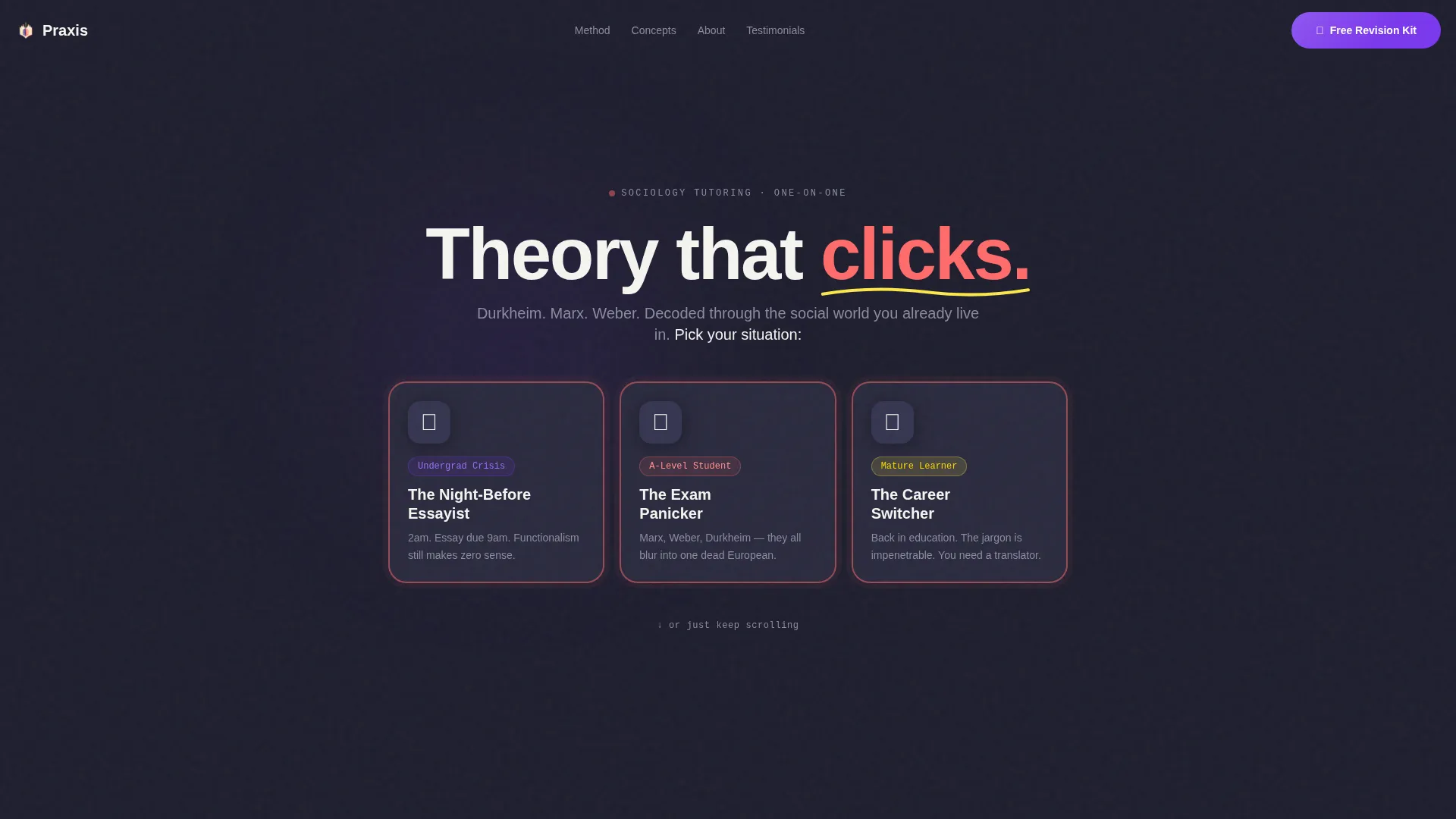
- A three-card Persona Selector header that reshuffles page content by student type
- A zigzag alternating layout with five distinct content sections built in sequence
- A dual conversion path: a three-field revision kit form and a video gate secondary call to action
Feature list
A paragraph overview: the features below reflect what is built into the Praxis template as described in the source brief. Each one serves the core goal of demonstrating teaching quality and earning the visitor's trust before asking for anything in return.
Persona Selector Header
Three illustrated student archetype cards sit against a deep charcoal background. Clicking a card triggers a step-forward micro-animation, dims the others, and reshuffles the page language, testimonials, and resource recommendations to match that student's situation.
Hero's Journey Zigzag Layout
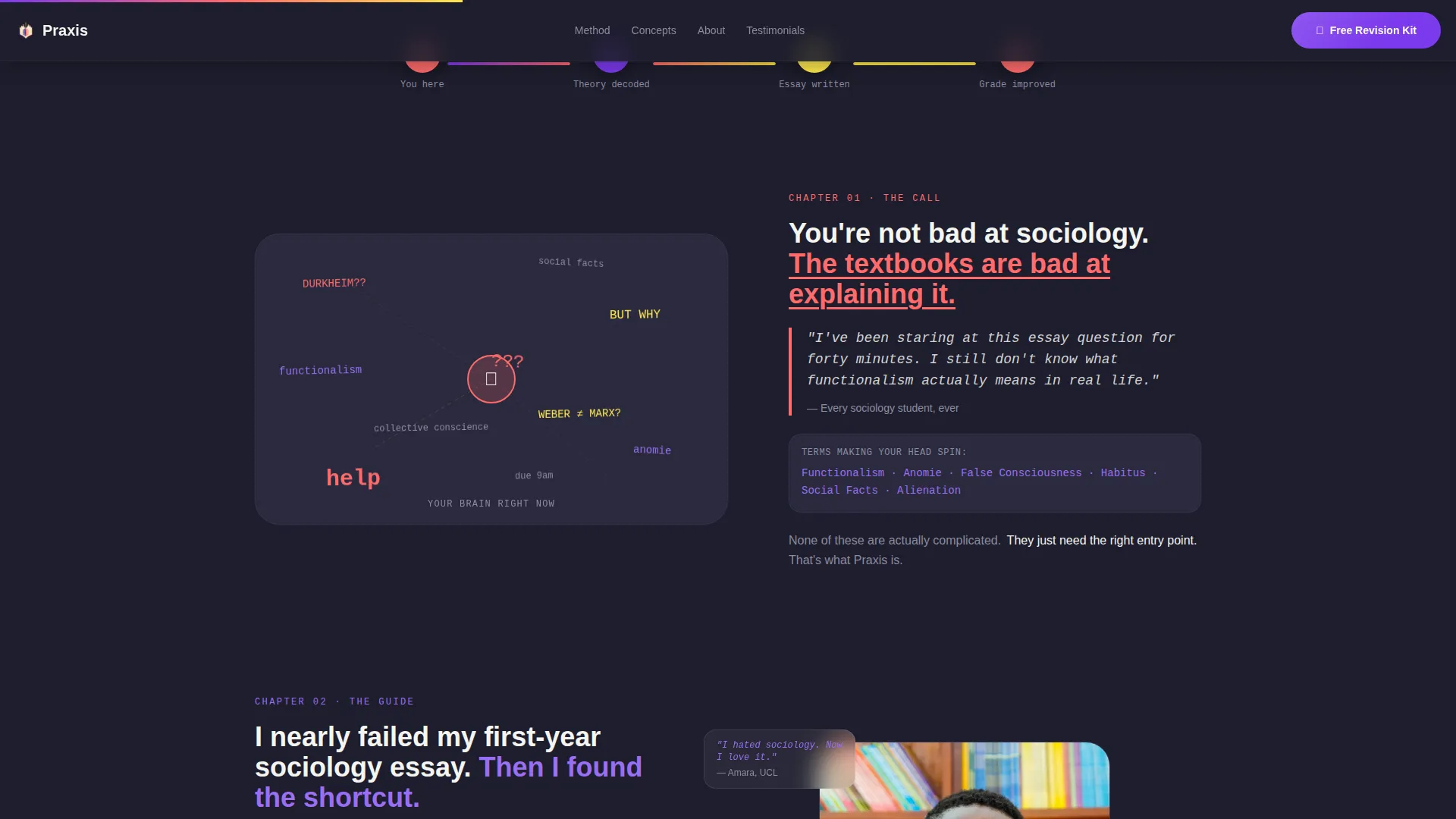
The page scrolls through a tension-and-release rhythm across five alternating panels. Each left-right section raises a student pain point, then resolves it with a teaching moment, a tutor story, or an interactive example.
Interactive Theory Toggle
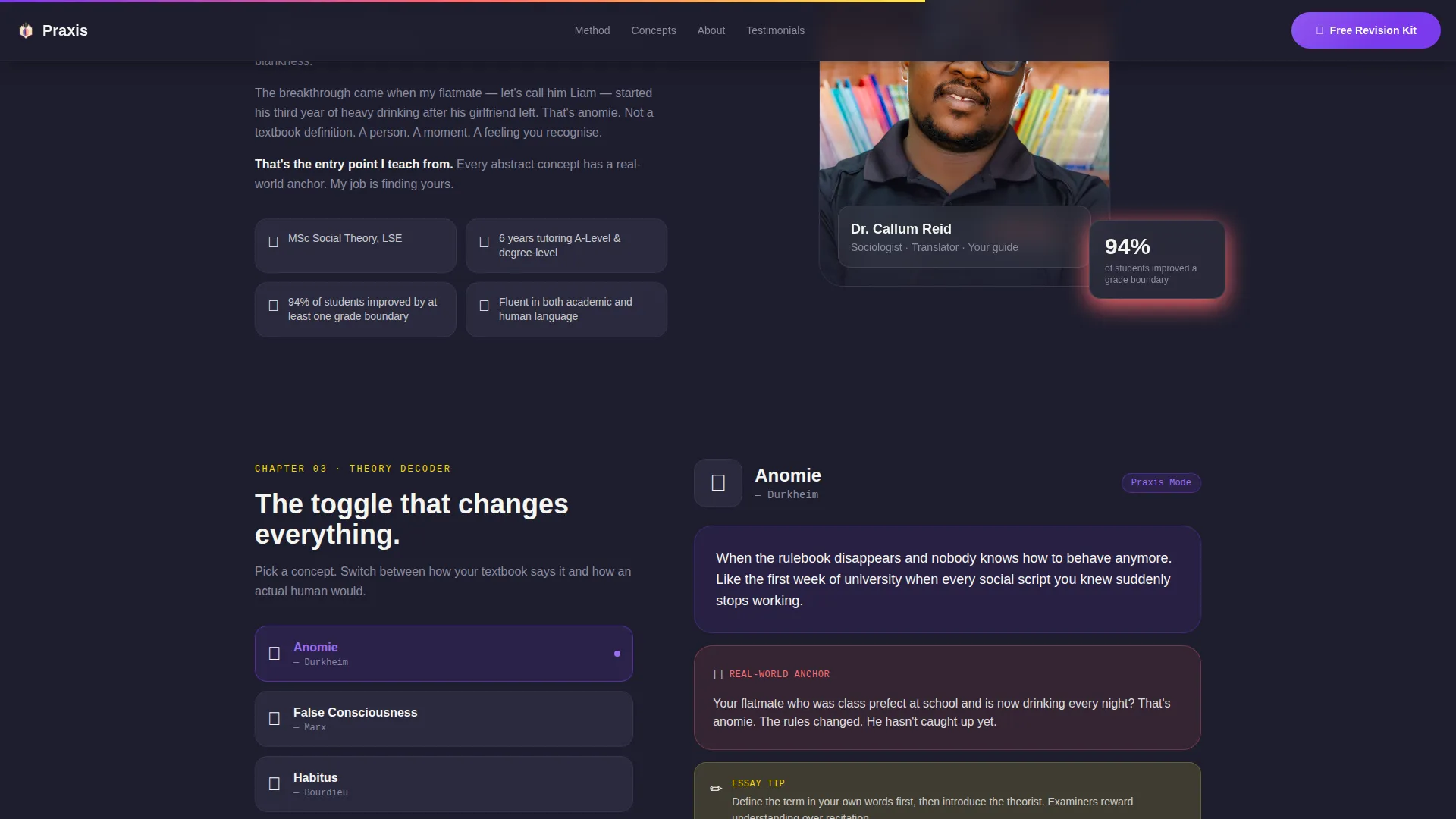
A dedicated zigzag panel lets visitors flip between academic language and plain English versions of the same sociological concept. This toggle demonstrates the tutor's ability to translate theory before any session is booked.
Scroll-Linked Progress Bar
A progress indicator fills visually as the visitor scrolls down the page. The behaviour mimics the dopamine loop of actual learning, rewarding continued reading with visible forward movement.
Friction-Low Conversion Form
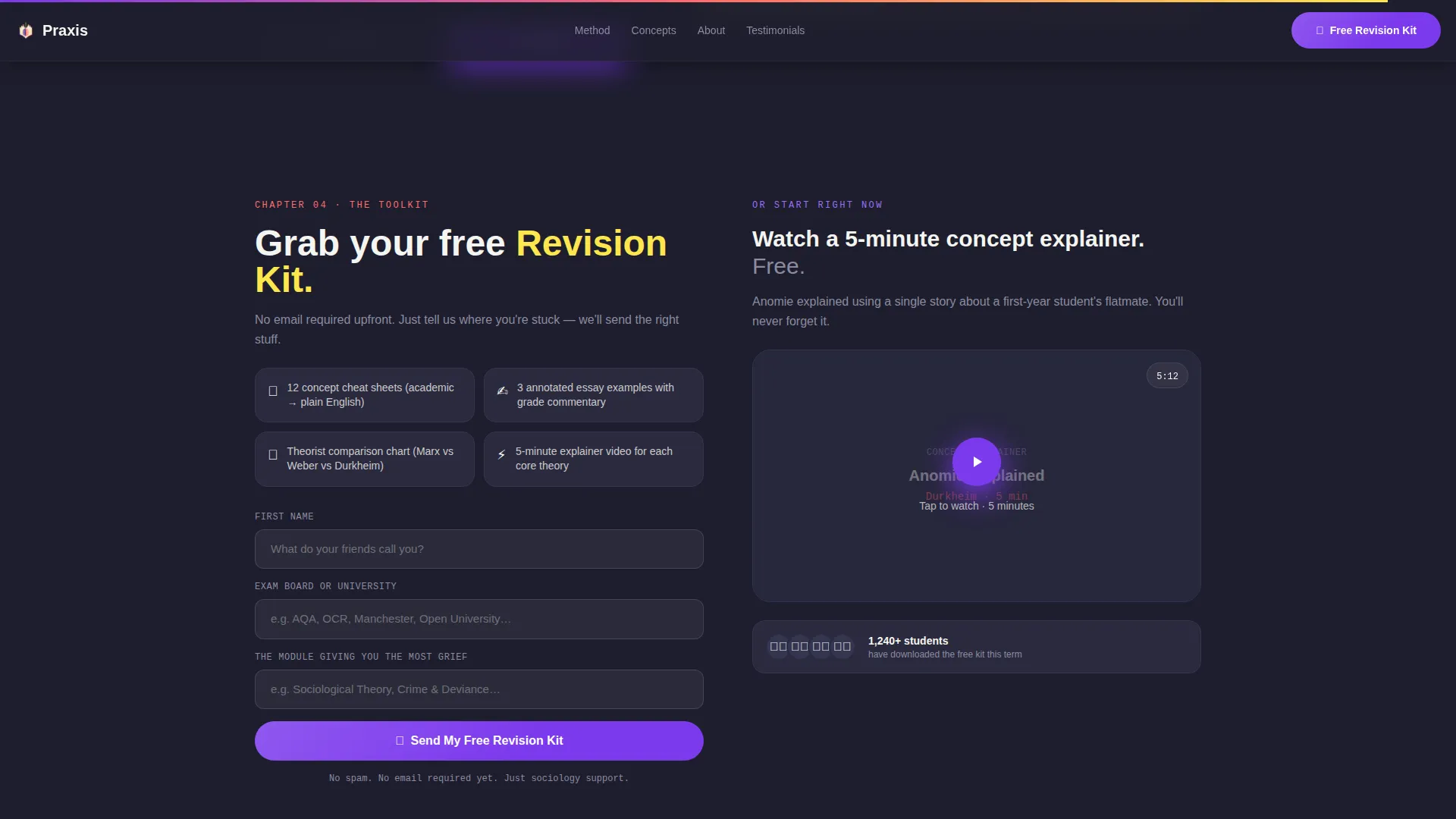
The primary call to action form asks for only three fields: first name, exam board or university, and the module causing the most difficulty. No email address is required at this stage, keeping the barrier to entry as low as possible.
Video Gate Secondary Path
A secondary conversion option offers a five-minute concept explainer video. The email field appears only after the visitor hits play, reducing friction to near zero and capturing intent at the moment of highest engagement.
Page sections overview
| Section | Purpose |
|---|---|
| Hero Persona Selector | Identifies student type and personalises the page content |
| The Call Zigzag | Mirrors student pain with a real quote and a chaotic mind-map visual |
| The Guide Zigzag | Introduces the tutor through origin story, not a list of credentials |
| Theory Decoder Panel | Lets visitors toggle between academic and plain-English theory explanations |
| Revision Kit Call to Action | Collects three fields and offers a free resource to confirm teaching value |
Design & branding system
The Dopamine Pop colour system gives this template a feel that is energising rather than clinical. The palette is deliberately bold, rewarding, and notebook-fresh, chosen to match the emotional register of a student who finally understands something.
- Electric violet (#7C3AED) drives headings, interactive states, and primary call to action buttons
- Serotonin coral (#FF6B6B) marks key concepts, pull-quotes, and the pulsing persona card outlines
- Highlighter yellow (#FDE74C) fires on hover states and the scroll-linked progress indicator
- Deep chalkboard charcoal (#1E1E2E) anchors background fields across long-read sections
- Typography uses DM Sans for bold headings, Manrope for body copy, and IBM Plex Mono for academic quotes
Mobile & speed optimization
The template is built with a mobile-first priority because, as the brief puts it, two-in-the-morning essay panic happens on phones. Layout decisions, tap targets, and content hierarchy are all designed for small-screen reading first.
- Smooth scroll behaviour and Intersection Observer-triggered reveals keep animations lightweight on mobile
- Staggered entrance animations are timed to feel rewarding without slowing content delivery
- The persona selector and theory toggle are designed to work cleanly on touch screens
How this template helps you convert
The conversion strategy is built on a simple sequence: demonstrate value first, then ask. Every section gives something away before requesting anything in return, so by the time a visitor reaches the form, downloading the kit feels like the natural next step.
- The Persona Selector personalises the page immediately, making visitors feel seen before they have read a single paragraph
- The Theory Decoder and before-and-after essay panel prove teaching quality through interactive examples, building trust without a sales pitch
- The three-field form and video gate offer two low-friction paths to conversion, meeting visitors at different levels of readiness
Other information about this template
This template is designed specifically for the UK sociology education market. Localisation details are built into the brief, including references to UK exam boards, university terminology, and British English copy conventions.
- Currency references use the pound sterling (£) and the template assumes a UK undergraduate and A-Level audience
- Social proof elements include per-persona student quotes, essay before-and-after annotations with tracked changes, and a grade improvement statistic placeholder
- The footer follows a Vercel Horizontal Flow pattern and is included as the final section of the single-page layout
- This template suits EdTech and solo tutoring service contexts where a single tutor wants to compete on teaching quality rather than brand recognition
Theme
Educational Guide
Creative direction
Hero's Journey
Color system
Dopamine Pop
Style
Zigzag/Alternating
Direction
Content/Resource
Page Sections
Persona Selector with Micro-animations
Hero's Journey Zigzag Structure
Interactive Theory Toggle Panel
Scroll-linked Progress Indicator
Dual Low-friction Conversion Paths
Dopamine Pop Colour and Typography System
Related questions
Can I change the three student personas to match my own audience?
Does the template work for subjects other than sociology?
What does no email required upfront mean for the conversion form?
How many conversion paths does this template include?
Is this template designed specifically for the UK education market?