Boutique Hotel Privacy Policy & Guest Data Website Template
Comply is a split-screen privacy policy landing page template built for boutique hotels and resort compliance teams. It pairs an interactive Privacy Exposure Calculator with side-by-side plain-language and legal-clause panels, making personal data disclosures readable and trustworthy. The design uses a high-contrast Acid Digital palette to signal transparency before a guest ever clicks "Accept All."
by Rocket studio
Quick summary
Comply is a single-page, split-screen template designed for hospitality compliance teams who need privacy policies that guests actually read. It translates complex data collection disclosures, cookie tracking, keycard logs, spa bookings, minibar histories, into clear, scannable content. The layout pairs every legal clause with a plain-language equivalent, so the page works as both a legal document and a genuine communication tool.
Who this template is for
Comply is built for two audiences who rarely share the same page. The first is the compliance officer at a boutique resort chain who needs one template that satisfies multiple overlapping privacy laws simultaneously. The second is the hotel guest who actually pauses before clicking "Accept All" and wants to understand exactly what personal information the property holds.
- Compliance officers at boutique resort chains managing multi-jurisdiction privacy obligations
- Hotel guests who read privacy policies before consenting to data collection
- Website owners in hospitality who need a legally structured, guest-friendly privacy page
What problem this template solves
Privacy policies are a legal document type that most hospitality websites bury, rush, or write in language that no guest will read. That creates two simultaneous problems: guests distrust the policy, and compliance officers cannot be confident it meets applicable laws across jurisdictions. Comply was designed to close both gaps at once.
- Legal prose written for attorneys, not travelers, reduces guest comprehension and trust
- Generic privacy pages fail to cover the layered data collection that happens across a resort stay, from booking cookies to keycard swipes
- A single template that satisfies the General Data Protection Regulation, the California Consumer Privacy Act, and Brazil's Lei Geral de Proteção de Dados (LGPD) simultaneously is hard to build from scratch
What you get with this template
This template gives compliance teams and website owners a ready-to-customize, single-page layout that is structured for transparency from the first scroll to the footer. Every section has a defined purpose, and the design system enforces readability without sacrificing the authority a legal document requires.
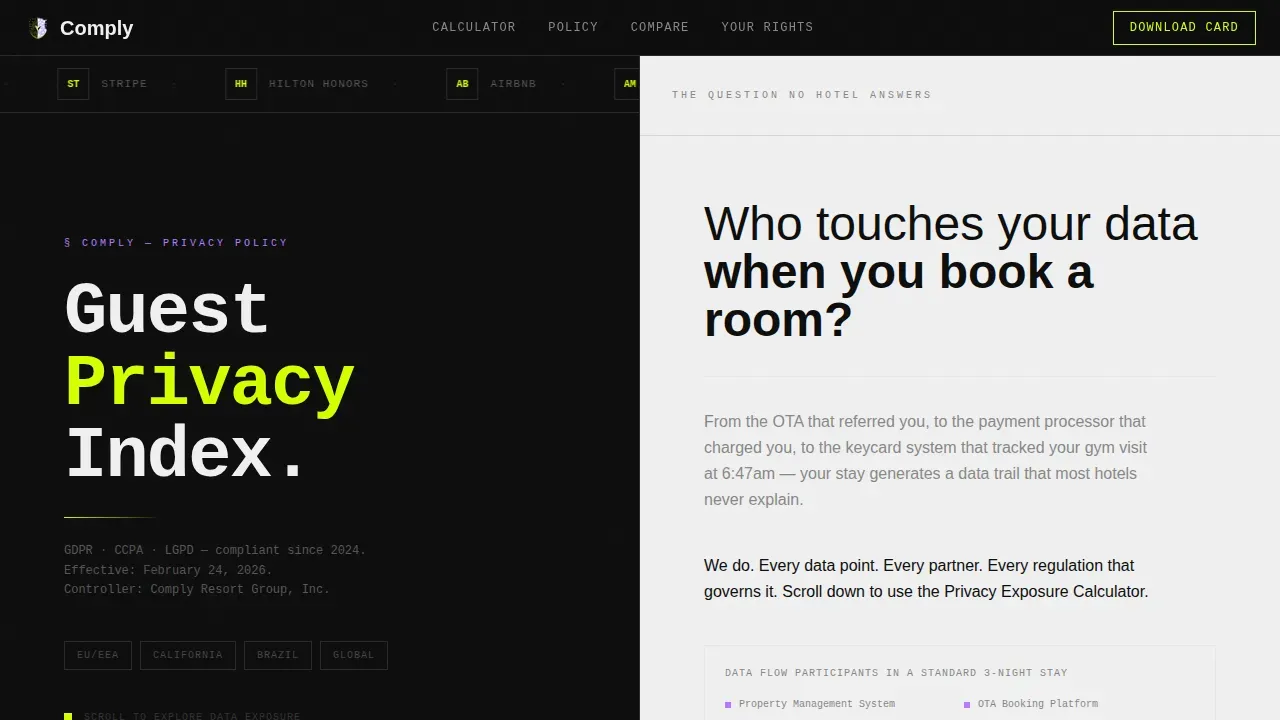
- A 50/50 split-screen layout with terminal black on the left for legal clauses and clinical white on the right for plain-language explanations
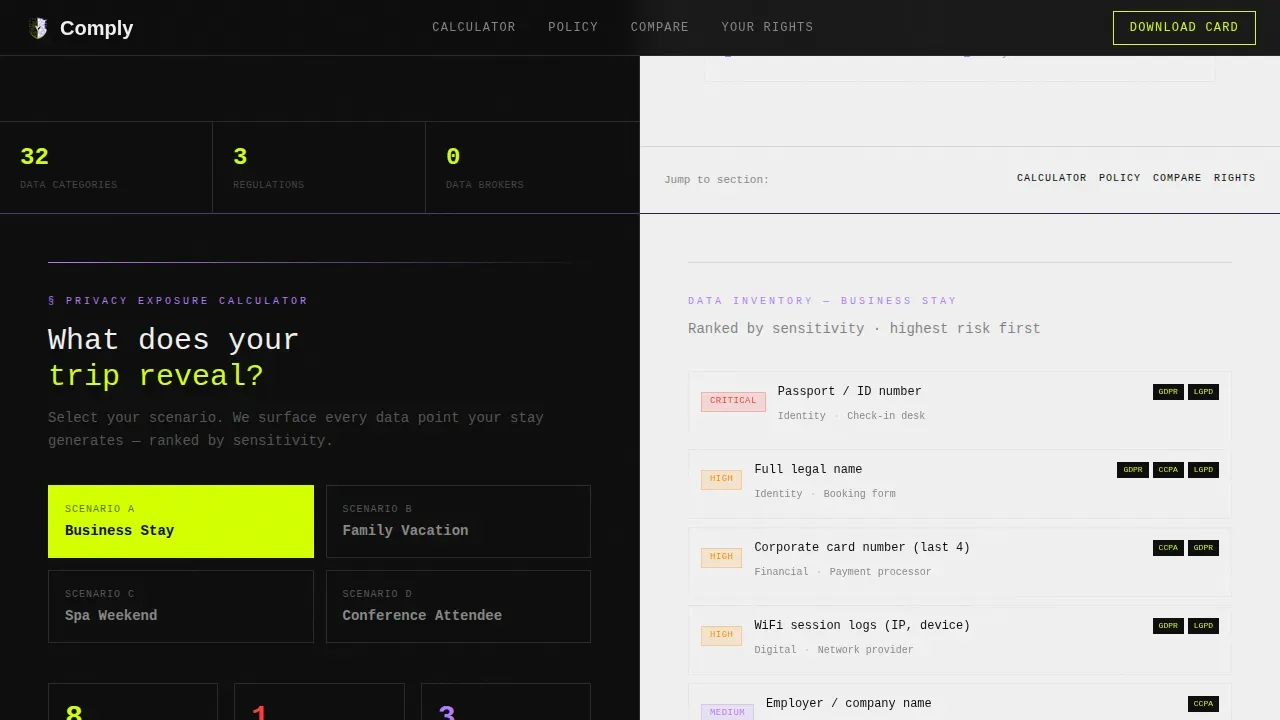
- An interactive Privacy Exposure Calculator that shows guests exactly what personal information their trip scenario generates, ranked by sensitivity
- A policy comparison panel, a data rights summary, and a downloadable guest data card as primary and secondary calls to action
Feature list
The following built-in components are included in the Comply template. Each one reflects a deliberate design decision to make privacy policies readable, trustworthy, and multi-jurisdiction ready.
Interactive Privacy Exposure Calculator
The left panel of the calculator section displays a scenario selector: business stay, family vacation, spa weekend, or conference attendee. When a guest selects a scenario, the right panel populates instantly with every personal data point that specific trip generates, names, card numbers, dietary restrictions, pool towel swipes, ranked by sensitivity. This tool makes the concept of data collection concrete before a single line of legal text appears.
Side-by-Side Policy Clause Viewer
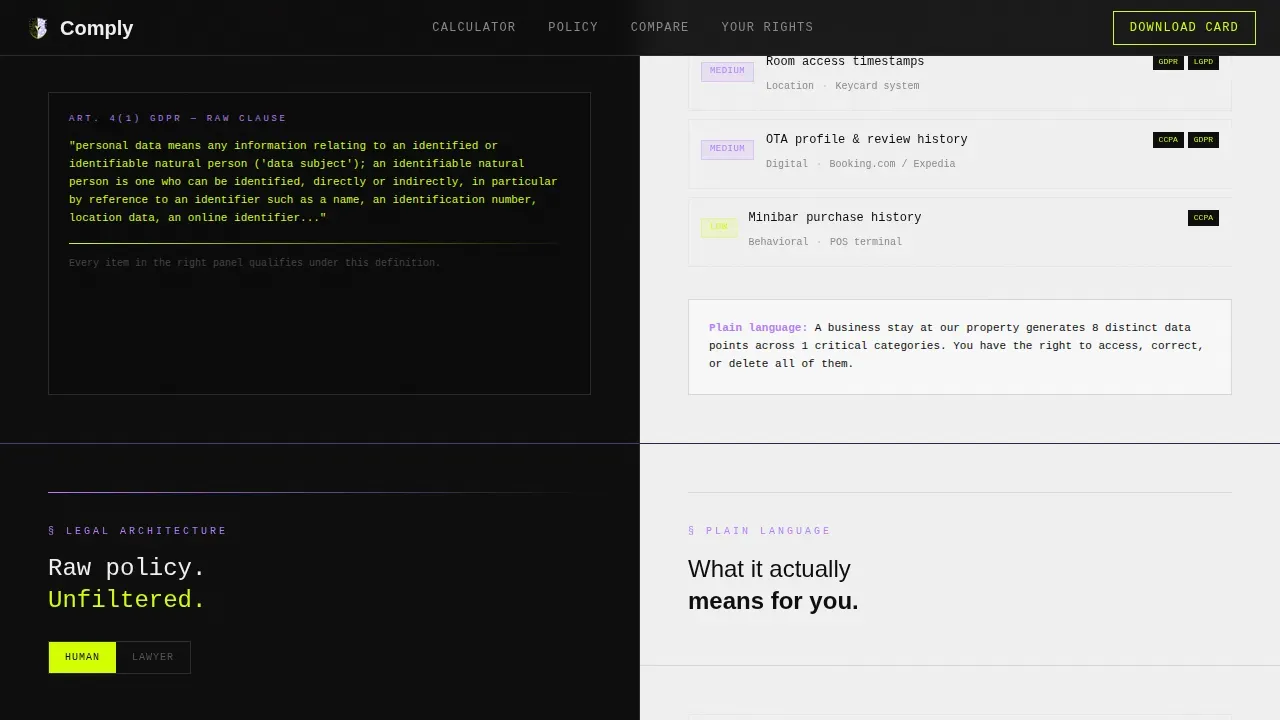
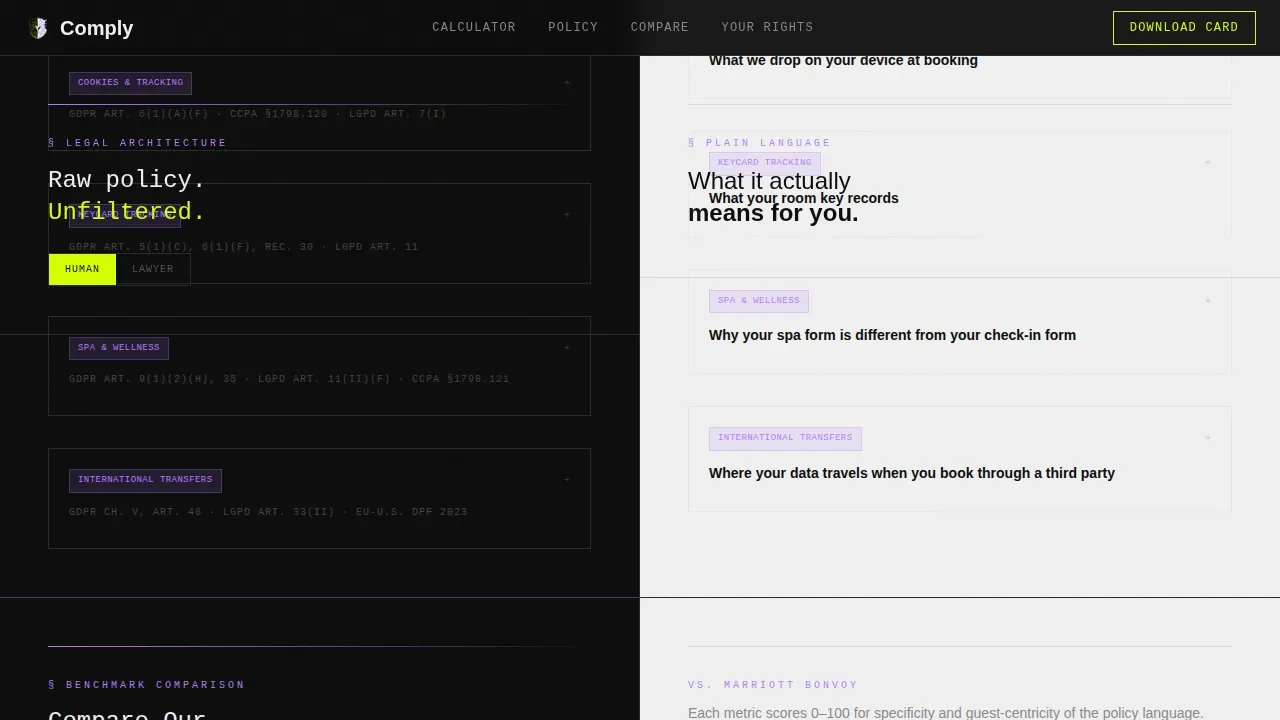
Each policy section pairs the raw legal clause on the left panel, rendered in JetBrains Mono typeface in electric chartreuse type on terminal black, against a plain-language explanation on the right panel in DM Sans. Guests can toggle between the human version and the lawyer version within the same scroll. This dual-track structure uses clear and plain language throughout, making it easier for guests to understand exactly what information is collected and why.
Logo Bar Header with Data-Flow Context
The header features a horizontal ticker of hospitality-brand logos, property flags, online travel agency partners, payment processors, and loyalty platforms, scrolling slowly across the black left panel. These logos are not decorative. Each one reappears later in the page as a data-flow node, so the ticker functions as a cast list for the policy. This approach shows guests upfront which third party services touch their personal data before the body of the policy explains how.
Policy Benchmark Comparison Panel
The primary call to action is "Compare Our Policy," accompanied by a dropdown that benchmarks the property's privacy practices against major chain standards. This positions transparency as a competitive advantage rather than a burden. The comparison panel informs users how the property's data practices measure up, which builds confidence and reduces abandonment at the consent stage.
Download Guest Data Card
A secondary call to action generates a one-page portable document format (PDF) file that summarizes exactly what personal information this property collects, how it is used, and who can access it. The card gives guests a tangible, offline reference. It also functions as a practical tool for data subject requests, since guests can reference the card when exercising their user rights under applicable laws.
Data Rights Panel
The data rights section summarizes guest entitlements under the General Data Protection Regulation, the California Consumer Privacy Act, and Brazil's LGPD in one consolidated view. It covers access, rectification, deletion, and data portability. Regulatory compliance badges appear alongside the summary to signal that the property has met legal requirements under each framework.
Page sections overview
| Section | Purpose |
|---|---|
| Logo Bar Header | Introduces data partners as a visual cast list |
| Privacy Exposure Calculator | Shows personal data generated per trip type |
| Policy Clause Viewer | Pairs legal text with plain-language explanation |
| Benchmark Comparison Panel | Compares data practices against major chain standards |
| Data Rights Summary | Lists guest rights under GDPR, CCPA, and LGPD |
| Linear Footer Row | Links policy, contact details, and mailing address |
Design & branding system
The visual identity follows a Directory and Discovery theme expressed through an Acid Digital color system. The palette is deliberately confrontational in the hospitality context, synthetic neon hues against clinical white and terminal black, because that contrast signals honesty rather than polish. Privacy policies should feel like they have nothing to hide, and this design system makes that visible before anyone reads a word.
- Terminal black (#0D0D0D) dominates the left split for all legal clause panels; clinical white (#F0F0F0) dominates the right split for all plain-language body text panels
- Electric chartreuse (#D4FF00) is applied to every interactive element and hyperlink; UV lilac (#B57BFF) marks section dividers and cookie-category tags
- JetBrains Mono is used for all legal clause text; DM Sans is used for all body and plain-language copy
Mobile & speed optimization
The template is desktop-first by design, because compliance officers typically review privacy documentation on a workstation. However, the layout is fully responsive so that hotel guests can read the same policy comfortably on a mobile device. The split-screen structure stacks gracefully into a single-column flow on smaller viewports.
- The split-screen 50/50 layout converts to a stacked single-column view on mobile, keeping legal and plain-language content in the correct reading order
- The Privacy Exposure Calculator and benchmark comparison panel remain functional on touch screens without horizontal scrolling
- The website footer, including contact details, physical address, and policy links, remains accessible and readable at all viewport sizes
How this template helps you convert
A privacy policy page is more than just a legal requirement, it is an active trust signal. Comply is structured so that each scroll interaction builds guest confidence rather than creating friction at the consent moment.
- The Privacy Exposure Calculator makes data collection concrete and honest before guests encounter any legal prose, so the page earns attention rather than demanding it.
- The benchmark comparison panel reframes the policy as a competitive asset, giving compliance teams a clear reason to promote the page rather than hide it in the website footer.
- The downloadable guest data card provides a tangible take-away that guests associate with the property's transparency, reducing objections at the point of explicit consent.
Other information about this template
Comply sits at a specific intersection of hospitality branding and legal technology. The following details help website owners understand the broader context of what this template covers and how it handles common privacy policy requirements across different frameworks.
- A privacy policy is a legal document that informs users about how a business collects and handles their personal data, and businesses that collect personal information are legally required to post one
- The comply transparent guest data privacy policy landing page template covers layered data collection that occurs across a full resort stay, from booking-stage cookies to post-checkout loyalty data
- Many third party services require website and app owners to post a complete privacy policy agreement as a condition of using their platforms, this template is structured to satisfy those requirements
- The template accommodates references to cookies and other tracking technologies, including those used by tools such as Google Analytics and social media platforms, within its policy clause panels
- A sample privacy policy template like Comply can help website owners jump-start the process of building a compliant legal document without starting from scratch; it functions as a free privacy policy template starting point that teams can adapt to their specific data processing activities
- The California Privacy Rights Act (which supplements the California Consumer Privacy Act) requires specific disclosures for california residents, including the right to know, the right to delete, and the right to opt out of the sale of consumers personal information, the data rights panel in this template is structured to surface these disclosures clearly
- The template provides space to include a data protection officer contact, a physical address, and a mailing address so guests and regulators can reach the appropriate person with questions
- Personally identifiable information categories that a typical resort business collects, including payment card numbers, but not fields like a social security number, which a hotel does not collect, can be listed explicitly in the calculator and clause sections
- The page is structured to keep the policy up to date: sections are modular so that when data processing activities change, teams can update individual clause panels without rebuilding the entire page
- The website footer area includes space for the website's privacy policy link, making it easy for users to locate the document from any page of the property's web app or main site
- Sensitive personal information, including dietary restrictions, accessibility needs, and spa treatment records, is surfaced explicitly in the calculator output, so guests understand which sensitive data the property handles and under what legal basis
- The template supports language around how the property will transfer data across borders and what legal obligations apply when personal data moves between jurisdictions
- Third party service providers, including payment processors, booking engines, and loyalty platforms, are named visually in the logo bar and contextually in the clause panels, so the policy discloses data sharing in a way guests can actually follow
- The benchmark comparison panel encourages properties to view their privacy posture as a differentiator, not just a statutory or contractual requirement imposed by regulators
- Even properties that choose not to sell personal information can use the template's rights panel to state that fact clearly, which itself builds trust with guests who users expect to be informed
- The policy structure follows the principle that a privacy policy should use clear and plain language throughout, written for the guest first and the regulator second
Theme
Directory & Discovery
Creative direction
Calculator/Tool First
Color system
Acid Digital
Style
Split Screen (50/50)
Direction
Comparison/Versus
Page Sections
Interactive Privacy Exposure Calculator
Dual-track Policy Clause Viewer
Logo Bar with Data-flow Context
Benchmark Comparison and Download Panel
Consolidated Data Rights Section
Acid Digital Visual Identity System
Related questions
Does this template cover GDPR, CCPA, and LGPD in one layout?
Can I use this as a sample privacy policy template and adapt it for my property?
Who should review the final policy before publishing?
Is the Privacy Exposure Calculator usable on mobile devices?
How do I keep the policy up to date when data practices change?