Precision Math Study Guide Landing Page Template
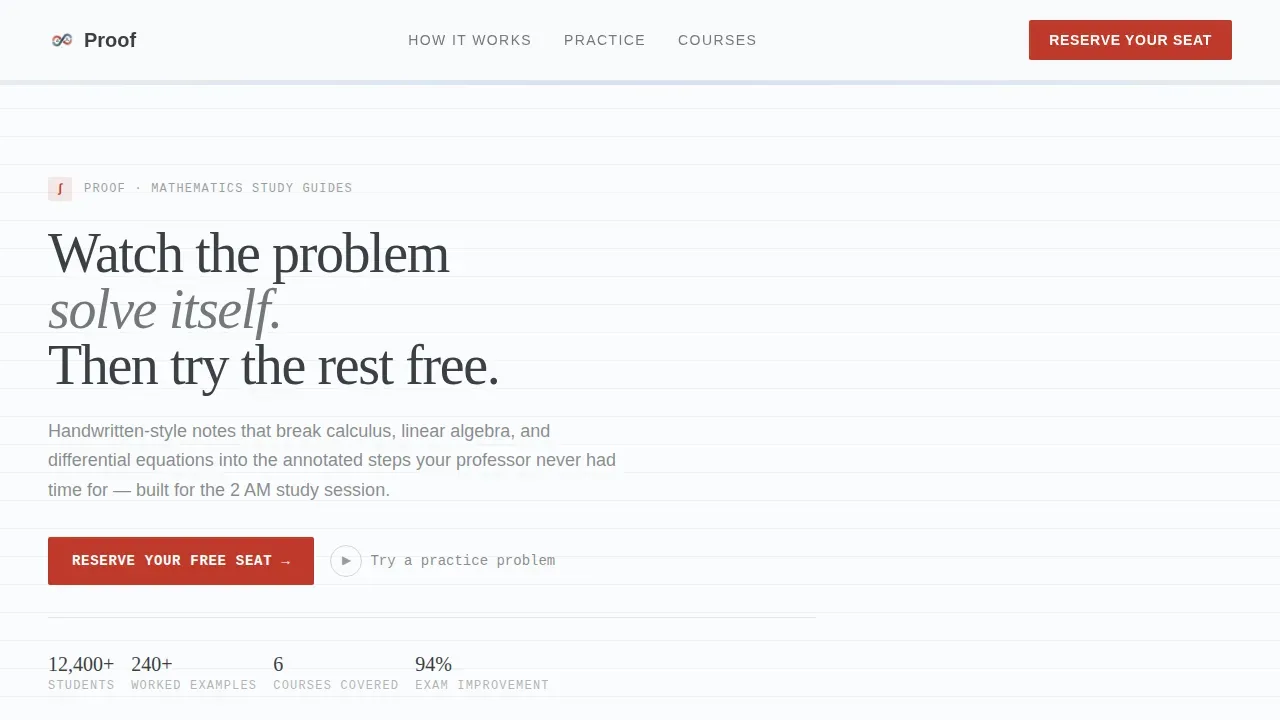
Proof is a precision math study guide landing page template built for EdTech platforms serving engineering students, pre-med learners, and bootcamp career-switchers. It pairs an animated integration-by-parts hero with four zigzag lesson sections that escalate from passive reading to active problem solving, then closes with a workshop registration form and a free chapter download path.
by Rocket studio
Quick summary
Proof is a single-page landing page template for a mathematics study guide platform. It opens with a live animated proof demo, walks visitors through four escalating lesson stages, and converts them through a workshop seat form or a free chapter email capture. The design follows a Corporate Precision aesthetic: clinical, legible, and quietly urgent.
Who this template is for
This template is built for EdTech founders, mathematics course creators, and independent educators who want a high-converting landing page. It speaks directly to students who need structured proof-based support and to teachers who want a compelling resource to share with their class.
- Engineering and pre-med students facing calculus, linear algebra, or differential equations finals
- Career-switchers in data science bootcamps who need a strong foundation rebuilt from scratch
- Mathematics educators and teachers looking for an engaging online resource to recommend
What problem this template solves
Many students struggle when proof-based mathematics moves from mechanical solving to formal logic and structured argument. Lectures move fast, textbooks are dense, and the gap between a professor's explanation and a student's understanding can feel impossible to close at 2 AM before a final. This template gives that audience a page that earns trust before asking for a click.
- Students need worked examples that finish the thought, not just state the solution
- Visitors bouncing from a generic landing page miss the moment when confidence is highest
- A one-size-fits-all registration form ignores the specific math course a student is struggling with
What you get with this template
You get a complete, ready-to-customize landing page with six clearly defined sections, two conversion paths, and a design system built entirely around mathematics comprehension. Every visual element reinforces the logic and precision of the content itself.
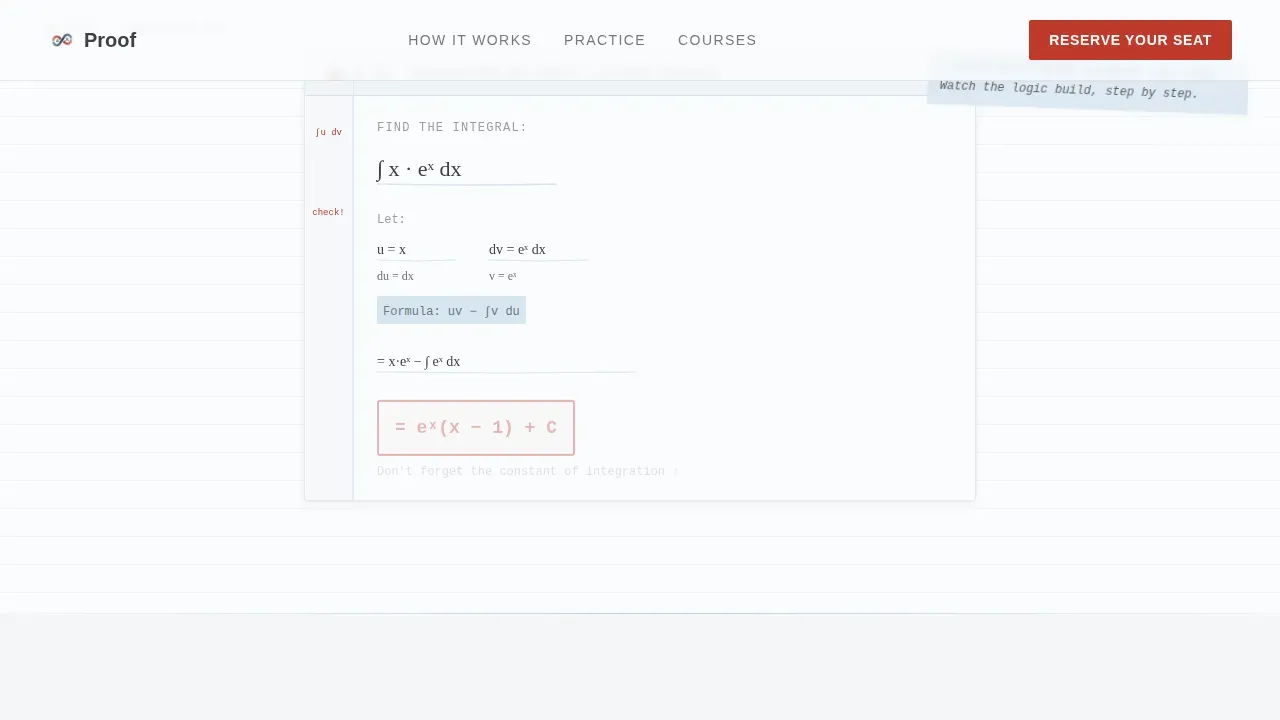
- An animated hero that demonstrates a live integration-by-parts proof with sequential pencil strokes
- Four zigzag lesson sections that guide visitors from recognizing gaps in understanding to proving mastery
- A dual-conversion footer: a workshop seat registration form and a free chapter email capture
Feature list
This template includes the following built-in features drawn directly from the design brief.
Animated Integration-by-Parts Hero
The header renders a complete, handwritten-style proof of integration by parts mid-viewport. Pencil strokes animate at natural writing speed, margin notes fade in with pale chalk blue highlights, and the final boxed answer pulses once in theorem-red. Visitors experience the product working before they read a single word of copy.
Zigzag Step-by-Step Lesson Sections
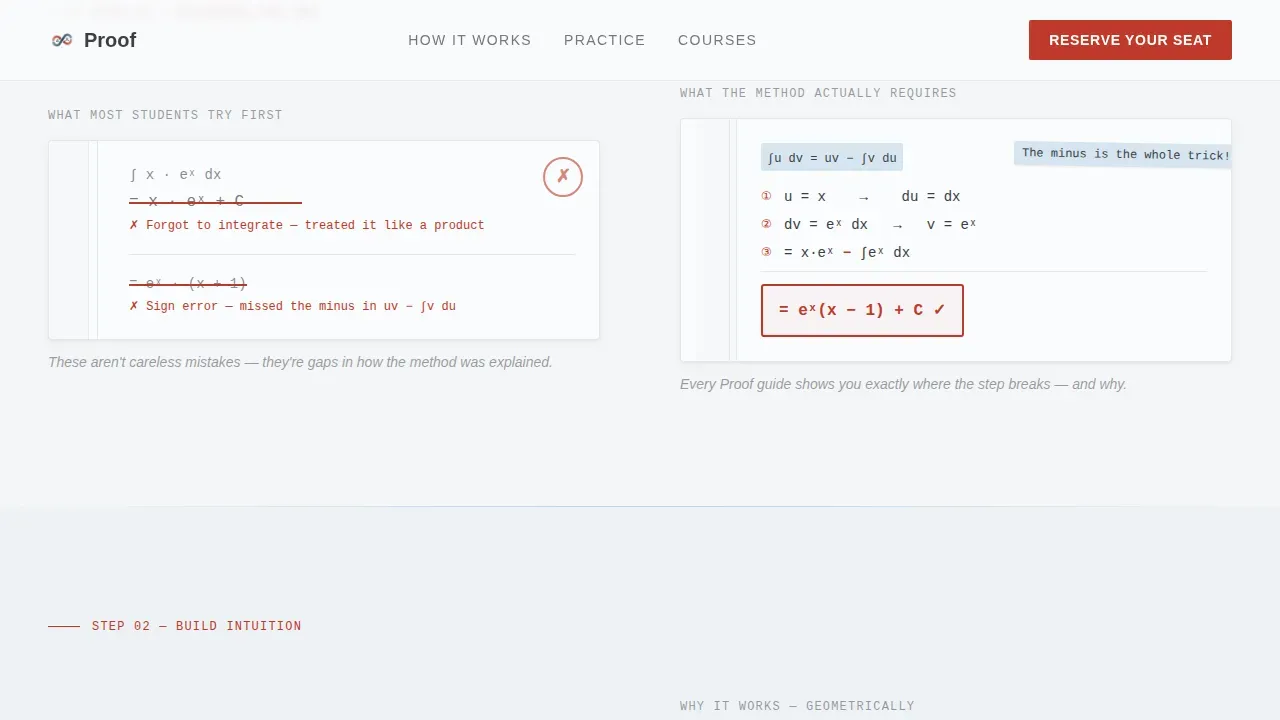
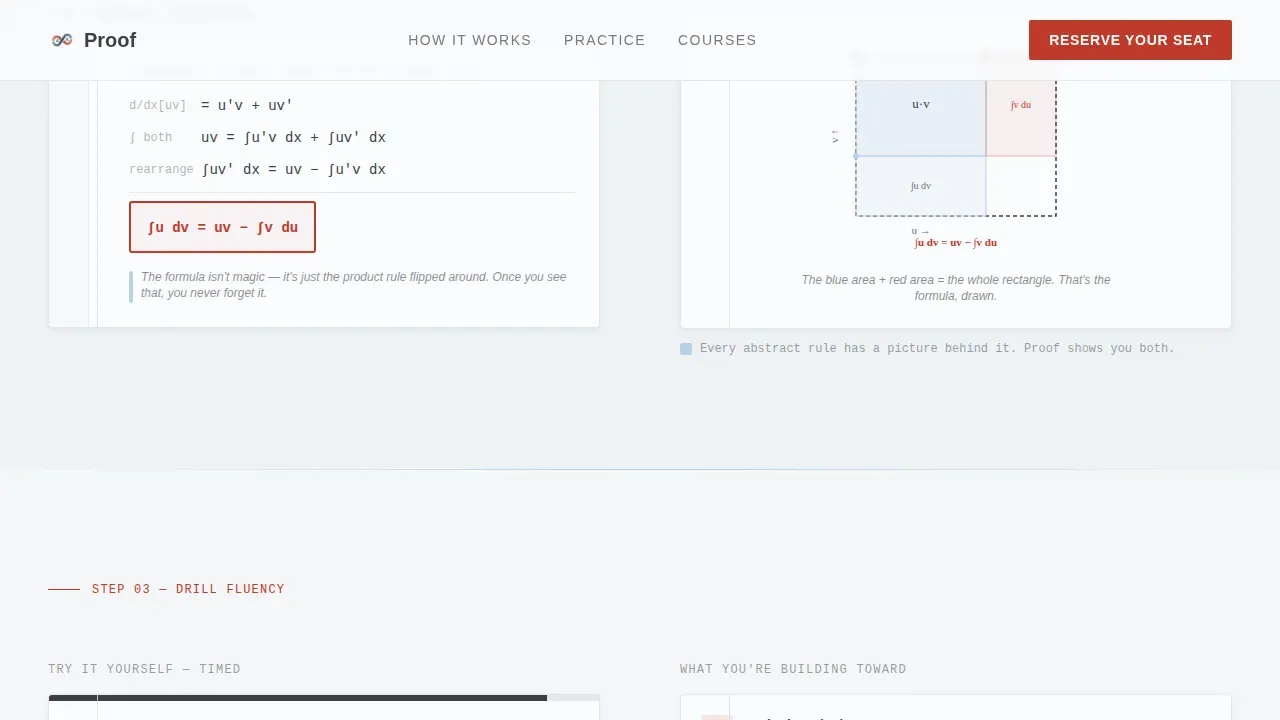
Four alternating sections walk visitors through a student's full learning journey. The first shows a crossed-out wrong approach beside the corrected method, making it easy to identify common errors. The second pairs a geometric intuition visual with its algebraic proof twin. The third offers a tappable timed practice problem widget. The fourth presents a mock exam score breakdown with percentile context so visitors can evaluate where they stand.
Tappable Practice Problem Widget
The third zigzag section includes an interactive widget visitors can tap through directly on the page. This active learning moment lets students engage with a real math problem before any registration is requested. It is one of the most engaging elements on the page and a key driver of conversion confidence.
Dual Conversion Path
After the practice widget, a theorem-red "Reserve Your Seat" call to action anchors the workshop registration form. The form collects first name, university or program, and the specific math course the visitor is struggling with via a dropdown covering Calculus I through III, Linear Algebra, Differential Equations, Discrete Math, Statistics, and Other. A secondary path offers a free chapter download for visitors who prefer to explore before committing.
Theorem-Red and Soft Mist Design System
Color is used with clinical precision throughout. The theorem-red (#C0392B) appears only on key formulas, call-to-action buttons, and interactive hotspots. Pale chalk blue (#D6E4F0) marks section dividers and highlight boxes. Graphite pencil (#3B3F45) carries all body writing and ruled-line accents on a cool fog white (#F4F6F8) background. Every color stroke signals something meaningful.
Corporate Precision Typography Stack
Headlines use DM Serif Display for authoritative, notebook-style impact. Math expressions and code-style content render in IBM Plex Mono to reinforce precision and legibility. Body copy uses DM Sans, keeping paragraph text clean and readable across all section sizes.
Page sections overview
| Section | Purpose |
|---|---|
| Animated Hero | Demonstrate live proof with sequential pencil-stroke animation |
| Zigzag One | Show wrong approach crossed out beside the correct solution |
| Zigzag Two | Pair geometric intuition visual with algebraic proof |
| Zigzag Three | Tappable timed practice problem widget for active engagement |
| Zigzag Four | Mock exam score breakdown with percentile context |
| Conversion Footer | Workshop registration form and free chapter email capture |
Design & branding system
The visual identity follows a Corporate Precision theme expressed through the Soft Mist color system. Every design decision is grounded in legibility and urgency, the way a freshly printed exam paper feels on a cold desk: clinical, organized, and serious.
- Colors: cool fog white (#F4F6F8) background, graphite pencil (#3B3F45) for text and ruled-line accents, pale chalk blue (#D6E4F0) for dividers and highlight boxes, theorem-red (#C0392B) reserved for key formulas, call-to-action buttons, and interactive hotspots
- Typography: DM Serif Display for headlines, IBM Plex Mono for mathematics expressions, DM Sans for body text
- Visual style: handwritten-style annotated notes aesthetic, scroll-triggered reveals, sequential fade-ins, and SVG pencil stroke animation
Mobile & speed optimization
The template is designed desktop-first, reflecting the primary context of students studying at a desk. The layout remains fully responsive for mobile visitors who review notes or register on the go.
- Server Components handle all static content sections for reliable rendering, while Client Components power the animated hero demo and the interactive practice widget
- Scroll-triggered section reveals and sequential fade-ins are managed to load progressively, keeping the interactive experience smooth as visitors move down the page
- The zigzag layout adapts fluidly across screen sizes, maintaining readability of mathematics notation and lesson content on smaller viewports
How this template helps you convert
This template is structured so that the visitor earns trust in the product through direct experience before any ask is made. The conversion flow is deliberate and staged.
- The animated proof hero immediately demonstrates value: visitors watch a complete lesson unfold in real time, building confidence in the platform before reading further
- The practice widget in the third zigzag section is the confidence peak: visitors have already solved a real math problem themselves, so the "Reserve Your Seat" call to action that follows feels like a logical next step rather than an interruption
- The dual-path conclusion captures two distinct visitor types: those ready to commit to a live workshop and those who prefer to review a free chapter first, ensuring no interested visitor leaves without a conversion opportunity
Other information about this template
This template is well-suited for educators and course creators who want to introduce students to proof-based mathematics through a structured digital experience. It draws on established principles from mathematics pedagogy: logic in mathematics forms the foundation of all mathematical proofs, and understanding logical principles helps students follow arguments carefully and identify mistakes. The page is designed to demonstrate, not just describe.
The study guide content model behind this template reflects best practices for a proof-based math course resource. A strong study guide should include step-by-step proof walkthroughs, detailed examples of different proof techniques, a theorem and definition bank, common logical fallacy alerts, and an active review checklist that lets students track their mastery of concepts. Visual aids such as diagrams and flowcharts illustrate relationships between mathematical concepts and help students learn by seeing logic in action. Interactive self-check quizzes and sections for exercises with step-by-step solutions support self-evaluation. Clear learning objectives and a searchable section for key terms, theorems, and lemmas complete the structure.
The template supports a broad range of mathematics topics. Students learn across subjects including probability, algebra, quadratic equations, and discrete math. The course dropdown in the registration form reflects the full range of challenges students face, from introductory calculus through differential equations and statistics.
- Teachers and instructors can use this template to establish an online presence for a mathematics study resource and drive workshop attendance
- The page layout can help organize a proof-based math course offering, with each zigzag section mapping to a lesson stage in the curriculum plan
- The Proof precision math study guide landing page template is designed to be editable and customizable, allowing course creators to tailor the outline, course dropdown options, and section content to fit individual learning needs
- Sections of this template can support a journal-style note format, with margin annotations and worked examples that demonstrate mathematical behavior and help students establish mathematical reasoning skills
- The template's structure reflects the idea that success in proof-based mathematics does not hinge solely on generating correct statements, but on giving students the space to explore, challenge, and refine their own reasoning
Theme
Corporate Precision
Creative direction
Step-by-Step Guide
Color system
Soft Mist
Style
Zigzag/Alternating
Direction
Event Registration
Page Sections
Animated Integration-by-parts Hero
Four Zigzag Lesson Sections
Tappable Practice Problem Widget
Dual Conversion Path Design
Theorem-red and Soft Mist Color System
Corporate Precision Typography Stack
Related questions
Who is this landing page template designed for?
What conversion paths does the template include?
Can the course dropdown in the registration form be customized?
Does the template include the animated proof demo?
Is this template suitable for teachers to share with students?