Rapid Prototype Development Landing Page Template
The LaunchSDK Ship Faster Startup Mobile App Landing Page Template is a dark, spec-sheet-style comparison landing page built for solo founders and small teams. It consolidates your pitch into one focused scroll: a floating iPhone mockup hero image, a three-column capability comparison table, expandable spec cards, social proof strips, and a frictionless inline signup. Ship faster. Waste less runway.
by Rocket studio
Quick summary
This template gives technical founders a single, high-converting landing page to present their mobile app SDK to the world. The page opens with a product screenshot hero, drops into a spec-sheet comparison table, and closes with an inline free-tier signup. No credit card required. No bloated multi-page site. Just what fast-moving startups need to win their first customers.
Who this template is for
This template is the perfect solution for builders who think in pull requests, not pitch decks. It speaks directly to the people shipping mobile apps under real time pressure.
- Technical co-founders and indie developers who are building at odd hours and need a landing page that earns trust from other developers on first scroll.
- Accelerator cohort members with a few weeks left before demo day, who need a site that converts visitors without demanding days of design effort.
- Indie makers and side-project builders who want a polished app landing page without the extra work of building one from scratch.
What problem this template solves
Most startups waste money and weeks assembling a fragmented tech stack. They also waste time building a landing page that never quite justifies the old way. This template solves both problems at once.
- Stack complexity on display: The comparison table makes the bloated multi-tool setup look exactly as heavy as it is, row by row, feature by feature.
- Slow time to a live site: Pre-built sections eliminate the need to build from scratch, so founders can publish a professional app landing in record time rather than spending a week on web design.
- Poor conversion on technical pages: Most generic templates do not speak to developers. This one does, with code snippets, latency benchmarks, and lines-of-code counts that make the consolidation argument land.
What you get with this template
You get a complete, ready-to-customize landing page laid out specifically for a mobile app SDK platform. Every section is built and sequenced to move a skeptical technical visitor toward a free signup.
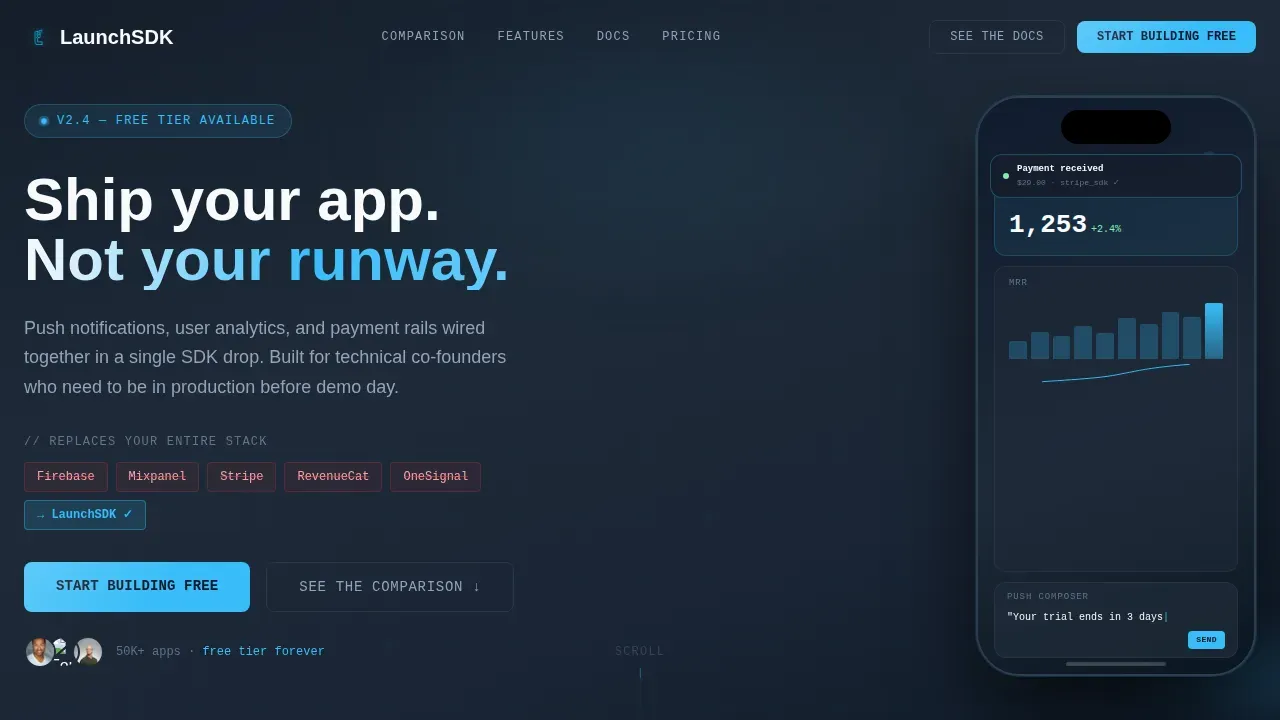
- Hero section with floating iPhone 15 mockup: A pixel-perfect product screenshot with a live-dashboard screen, real-time user count, push-notification composer, and a revenue graph, all set against the deep slate background with a sky-blue glow beneath the device.
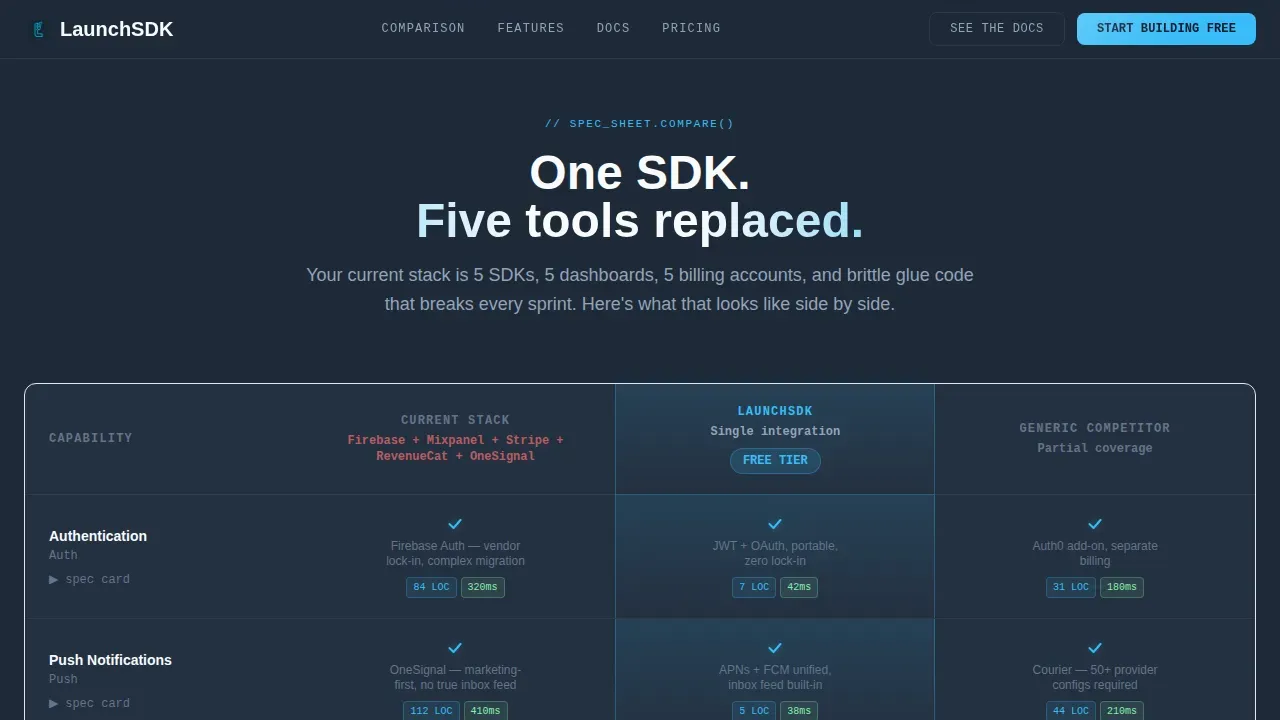
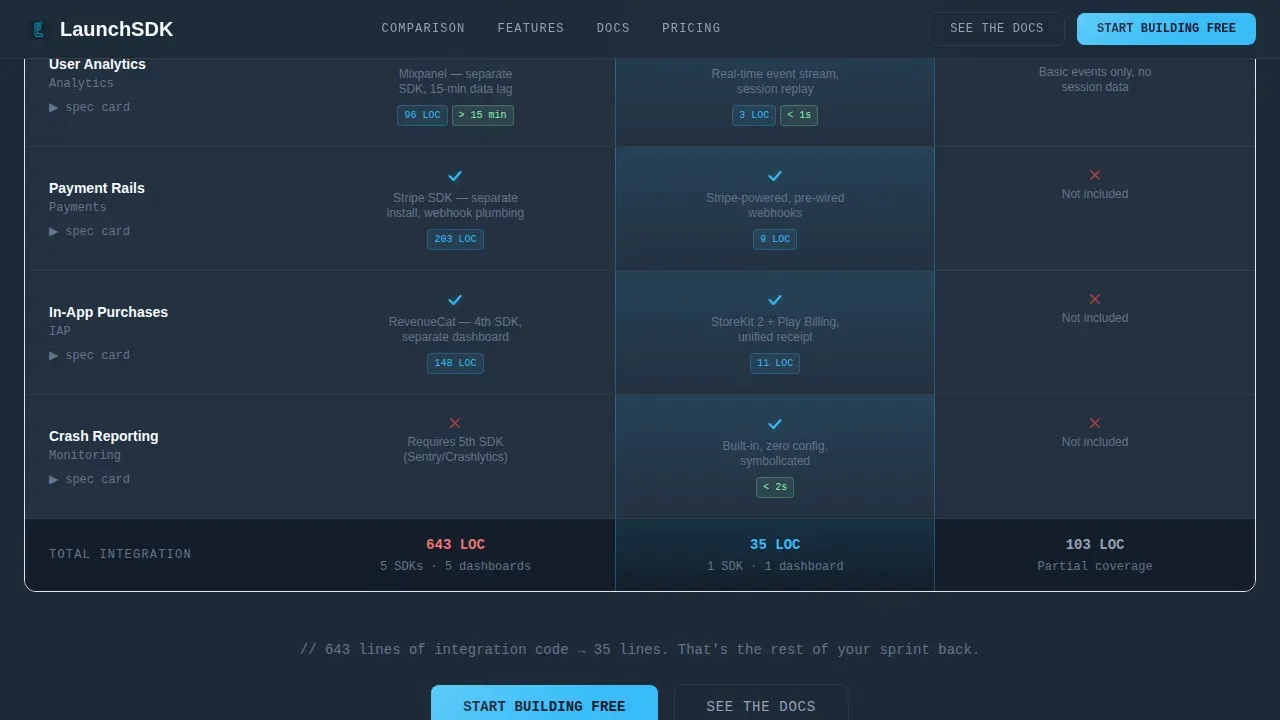
- Three-column comparison table: Rows cover auth, analytics, payments, push notifications, and in-app purchases, with checkmarks, latency benchmarks, and lines-of-code-to-implement counts across your current stack, this platform, and a generic competitor.
- Expandable spec cards, social proof strip, and inline signup: Each feature row expands into a mini spec card with code snippets. A founder testimonial marquee and metrics strip build trust. The call-to-action opens an inline form: GitHub OAuth or email, then a platform dropdown for iOS, Android, or both.
Feature list
This template is built around a focused set of capabilities that move a technical audience from curiosity to free account activation.
Three-Column Comparison Table
The core of the landing page is a scrollable comparison table. It places your current fragmented stack next to a single-SDK alternative, row by row. Each row covers a key capability: authentication, analytics, payments, push notifications, and in-app purchases. Checkmarks, latency benchmarks, and lines-of-code counts make the case without a single word of hype.
Expandable Feature Spec Cards
Below the comparison table, each feature row expands into a detailed spec card. Cards include code snippets, SDK size impact figures, and cold-start performance numbers. This gives developers the real data they need to evaluate before they commit. A "See the Docs" link sits beside every snippet for visitors who want to inspect the full documentation before signing up.
Product Screenshot Hero Section
The hero image is a crisp iPhone 15 frame floating on the dark slate background. The screen shows a live dashboard with a ticking user count, a push-notification composer in progress, and a revenue graph with a clear upward curve. Scroll-triggered animations and a subtle sky-blue glow beneath the device create the electric, focused atmosphere that resonates with late-night builders.
Inline Freemium Signup Flow
The primary call-to-action, "Start Building Free," is pinned to the top navigation and repeated after the comparison table and at the page bottom. Clicking opens an inline signup form directly on the landing page. Visitors choose GitHub OAuth or email, then select their platform from a dropdown. No credit card. No friction. This process is designed to convert visitors at the moment their confidence peaks.
Social Proof and Metrics Strip
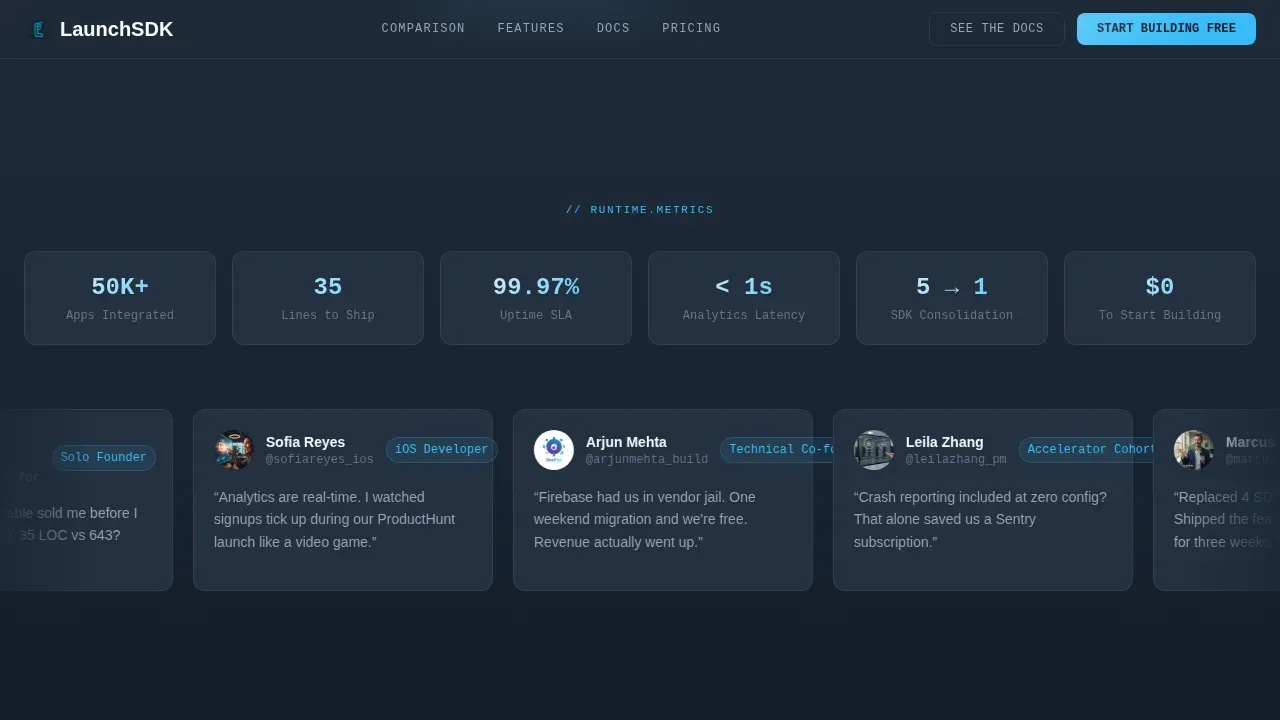
A pill-style founder testimonial marquee and a metrics strip anchor the page before the final call-to-action. Displaying real traction data and founder quotes helps customers trust the platform before they create an account. Social proof at this position catches visitors who scroll past the comparison table but have not yet clicked sign up.
Dark Code-Editor Visual System
The entire landing page uses a dark, focused visual language. JetBrains Mono handles code labels and technical detail. DM Sans carries body text and headings. The Slate and Sky color palette, deep graphite, mid-tone steel, open-sky blue, and cloud white, creates the feel of a code editor at dawn. user interface components are styled to feel native to the tools developers already live in.
Page sections overview
| Section | Purpose |
|---|---|
| Hero Product Screenshot | Introduce the app with a floating iPhone mockup and headline |
| Comparison Table | Show stack consolidation across three columns with benchmarks |
| Spec Card Expansion | Provide per-feature deep-dives with code snippets and metrics |
| Social Proof Strip | Build trust with founder testimonials and traction numbers |
| Inline Signup Form | Convert visitors with a frictionless free-tier account flow |
| Sticky Navigation Bar | Keep the primary call-to-action accessible throughout the scroll |
Design & branding system
The design language is built around one idea: precision under pressure. Every visual choice reinforces the idea that this platform is built by people who take performance seriously. The palette and typography make the page feel like a tool, not a brochure.
- Color system: Deep graphite slate (#1E2A38) for primary backgrounds, mid-tone steel (#4A5568) for secondary surfaces, open-sky blue (#38BDF8) as the action accent on buttons and highlighted table cells, and cloud white (#F8FAFC) for text and breathing room.
- Typography: JetBrains Mono for code blocks, labels, and benchmark figures; DM Sans for body paragraphs and section headings. The pairing hits the right balance between technical credibility and readable copy.
- Animation and interactivity: Scroll-triggered section reveals, a ticking real-time user counter in the hero, table-row stagger animations, expandable spec cards with tab switching, and a glow pulse beneath the iPhone mockup, all powered by static-first CSS animations and Intersection Observer for speed.
Mobile & speed optimization
Even though this landing page is desktop-first for the technical audience evaluating on a laptop, it is built to load fast and render cleanly on any screen size.
- Static-first delivery: CSS animations and Intersection Observer handle all scroll reveals without heavy JavaScript frameworks, keeping the site fast and reducing bounce rates for impatient visitors.
- Responsive layout: The comparison table, spec cards, and hero section reflow cleanly on smaller screens. Customers who land on the page from a shared link on mobile get a properly formatted experience without broken components.
How this template helps you convert
A landing page only earns its keep if it moves people to act. This template is engineered, section by section, to build conviction and reduce hesitation for a technical audience.
- The comparison table does the selling: By the time a visitor has read five rows of consolidated tooling, the free tier feels like an obvious choice. The table is not decorative; it is the core conversion engine of the landing page, and it earns the click through accumulated, specific evidence.
- The inline signup removes the drop-off point: Instead of redirecting visitors to a separate signup page, the form opens inline on the same landing page. GitHub OAuth means developers can create an account in under a minute. The platform dropdown for iOS, Android, or both keeps the flow relevant and focused.
Other information about this template
This section covers additional practical details for founders and developers evaluating the template before they start customizing it.
- The template is structured with a clean file structure, making it straightforward for developers to customize colors, swap copy, and update benchmark figures without hunting through disorganized folders.
- Developers who prefer to build unique layouts can use ai tools such as v0.dev to generate Tailwind or React code that slots into the existing component structure.
- The shipfast boilerplate approach is built into this template's philosophy: pre-built ui components and a logical file structure mean you skip the blank-canvas problem and go straight to shipping.
- Like scalable Bootstrap templates and Flutter single-codebase patterns, this template is designed to grow with your project. You can add pages or extend the web app presence without redesigning from scratch.
- The template's documentation covers each section in detail, including how to update the comparison table rows, swap the hero image, and connect the inline signup form to your preferred backend or auth provider.
- Setting up continuous integration and continuous deployment (CI/CD) from day one can dramatically reduce the time taken to push updates. This template's static-first architecture pairs well with that approach.
- For teams who want to watch how the template performs before committing, the "See the Docs" links beside each code snippet in the spec cards point visitors toward full technical documentation. You can also record quick walkthrough videos or link to a YouTube demo to support the page with video social proof.
- The metadata output means your landing page looks sharp and professional when shared on social platforms, which matters when founders are posting to developer communities to gather early user feedback.
- Pre-built sections save an estimated 30 to 50 hours per project compared to building from scratch. For startups counting every dollar, that time is money you keep.
- The template supports two weeks of focused customization time or less. Most founders report being able to ship a polished, live landing page site in record time, often within a single week.
Theme
Startup Velocity
Creative direction
Spec Sheet
Color system
Slate & Sky
Style
Comparison Table
Direction
Freemium/Trial
Page Sections
Three-column Comparison Table with Benchmarks
Expandable Spec Cards with Code Snippets
Floating Iphone 15 Hero Section
Inline Freemium Signup with No Credit Card
Social Proof Strip and Founder Testimonials
Dark Code-editor Visual Language and Animations
Related questions
Do I need to write code to customize this landing page template?
Is this template suitable for a new app with no existing users?
Can this landing page work for both iOS and Android apps?
Does the template include documentation for customization?
Can I add video demos to the hero section instead of a static mockup?