Provenance - Precision Artwork Landing Page Template
Provenance is a split-screen landing page template built for high-value artwork and antiques reverse logistics operations. It pairs a technical Spec Sheet layout with a Data Command visual identity, guiding auction house operations managers, gallery directors, and estate executors through every stage of a return case, from pickup and condition documentation to crating, transit monitoring, customs, and final delivery sign-off.
by Rocket studio
Quick summary
Provenance is a 50/50 split-screen landing page template for fine art and antiques reverse logistics. It combines an isometric header illustration, scroll-triggered spec sheet sections, and a right-panel lead capture form into one cohesive, conversion-ready page. The design speaks directly to operations professionals who need to see domain fluency before they hand over a case.
Who this template is for
This template is built for service providers operating in the high-value art and antiques reverse logistics space. It is designed to resonate with operationally minded buyers who evaluate vendors on process rigor, not on price lists alone.
- Auction house operations managers reconciling post-sale returns and damaged-in-transit claims
- Gallery directors and estate executors managing multi-object collections across international borders
- White-glove logistics firms that need a lead generation page signaling museum-grade handling standards
What problem this template solves
High-value artwork logistics is a domain where the vendor's credibility must be visible before the first conversation. A generic logistics page will not earn the trust of an operations manager who signs off on a seven-figure Rothko return. This template closes that credibility gap by structuring the page like a professional manifest.
- There is no clear way to communicate condition reporting, crating engineering, and chain-of-custody rigor on a standard service page
- Prospective clients cannot visualize the full reverse logistics chain, leaving them uncertain about handoff protocols and monitoring standards
- Lead capture forms feel transactional; this template makes form submission feel like handing a case to a trusted colleague
What you get with this template
The template delivers a fully structured single-page layout with every section mapped to a stage in the reverse logistics process. Each scroll section splits the screen between a technical specification panel and a human-readable narrative panel.
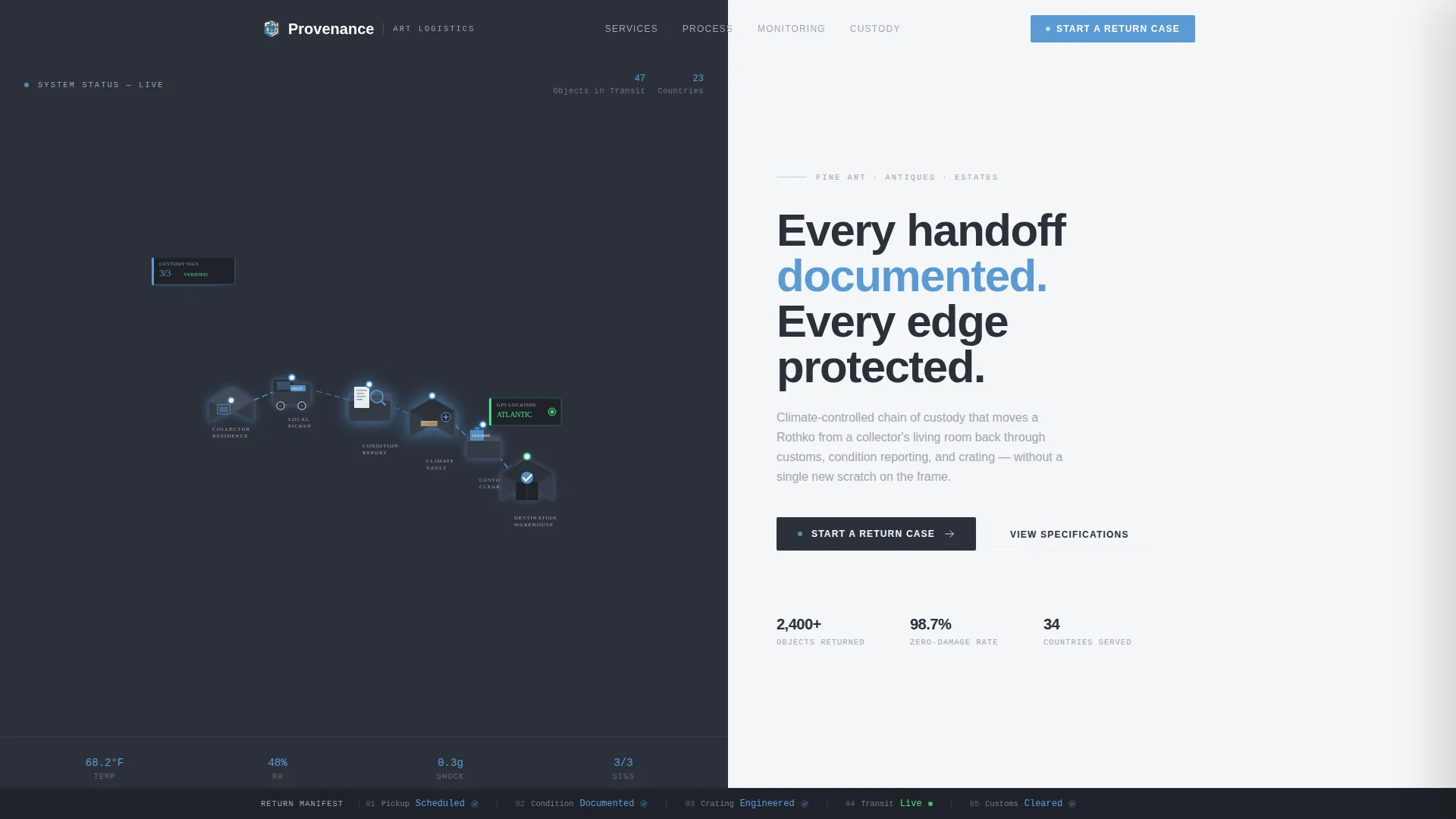
- An isometric SVG header cutaway illustrating the full logistics chain with live-data callout nodes showing temperature, humidity, shock readings, and custody signatures
- Five scroll sections covering pickup protocols, condition documentation, crating engineering, transit monitoring, and customs plus final delivery
- A scroll-triggered running manifest bar that stacks at the bottom of the viewport and builds a complete return summary as the visitor scrolls
- A right-panel slide form triggered by the primary call to action, collecting object type, estimated value, origin and destination countries, and special handling notes
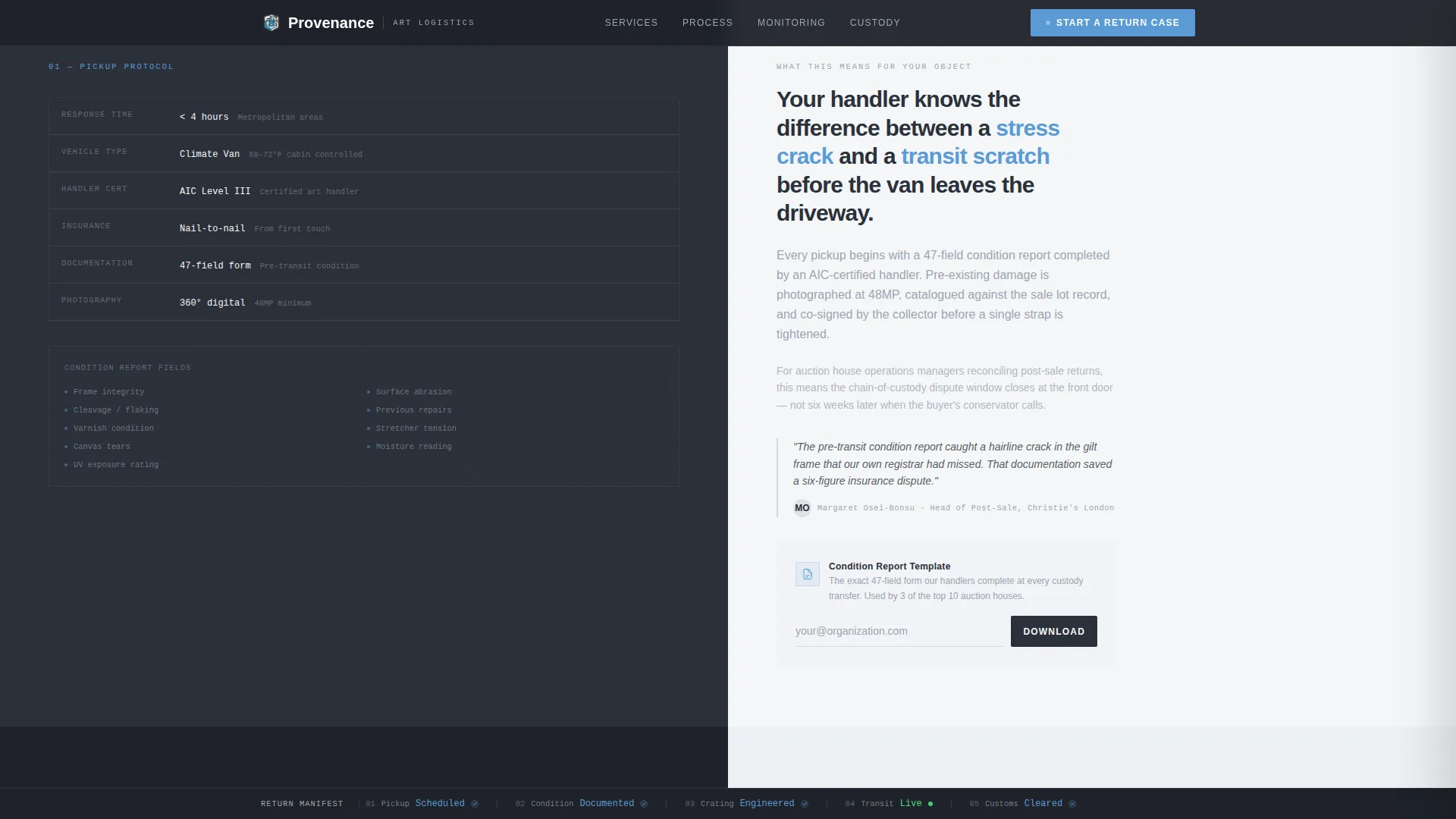
- A secondary email-gated download path offering a condition report template to qualify operations-focused leads
Feature list
This section covers the core built-in capabilities delivered by the Provenance template.
Isometric SVG Header Illustration
The header is a fully illustrated axonometric cutaway of the reverse logistics chain. It shows a crated painting moving backward through six labeled nodes: collector residence, local pickup van, condition-report station, climate-controlled vault, customs clearance desk, and destination warehouse. Each node includes a live-data callout displaying temperature, relative humidity, shock sensor readings, and chain-of-custody signature counts. The illustration replaces photography entirely and functions as a proof-of-competence system diagram.
Spec Sheet Split-Screen Layout
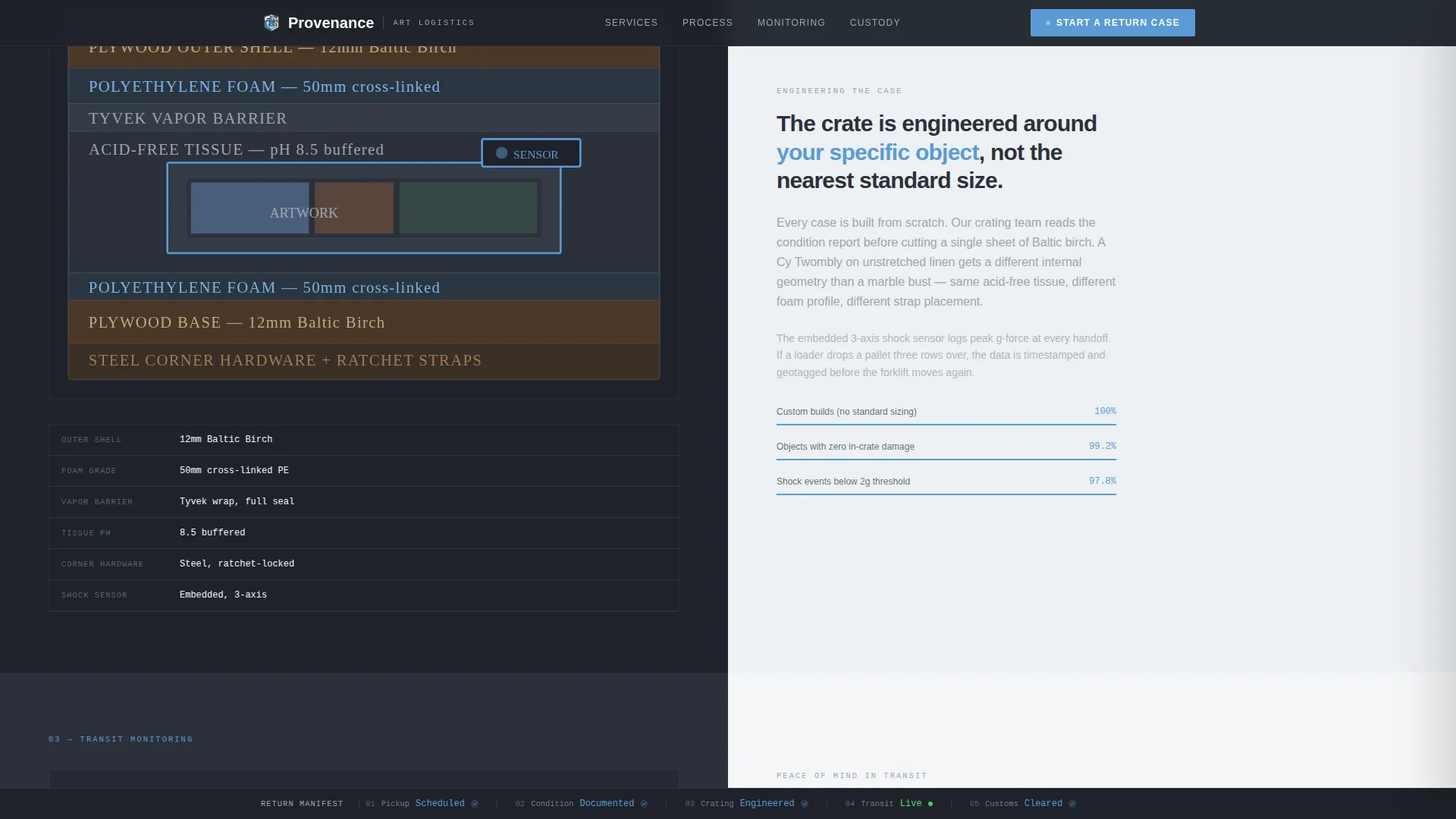
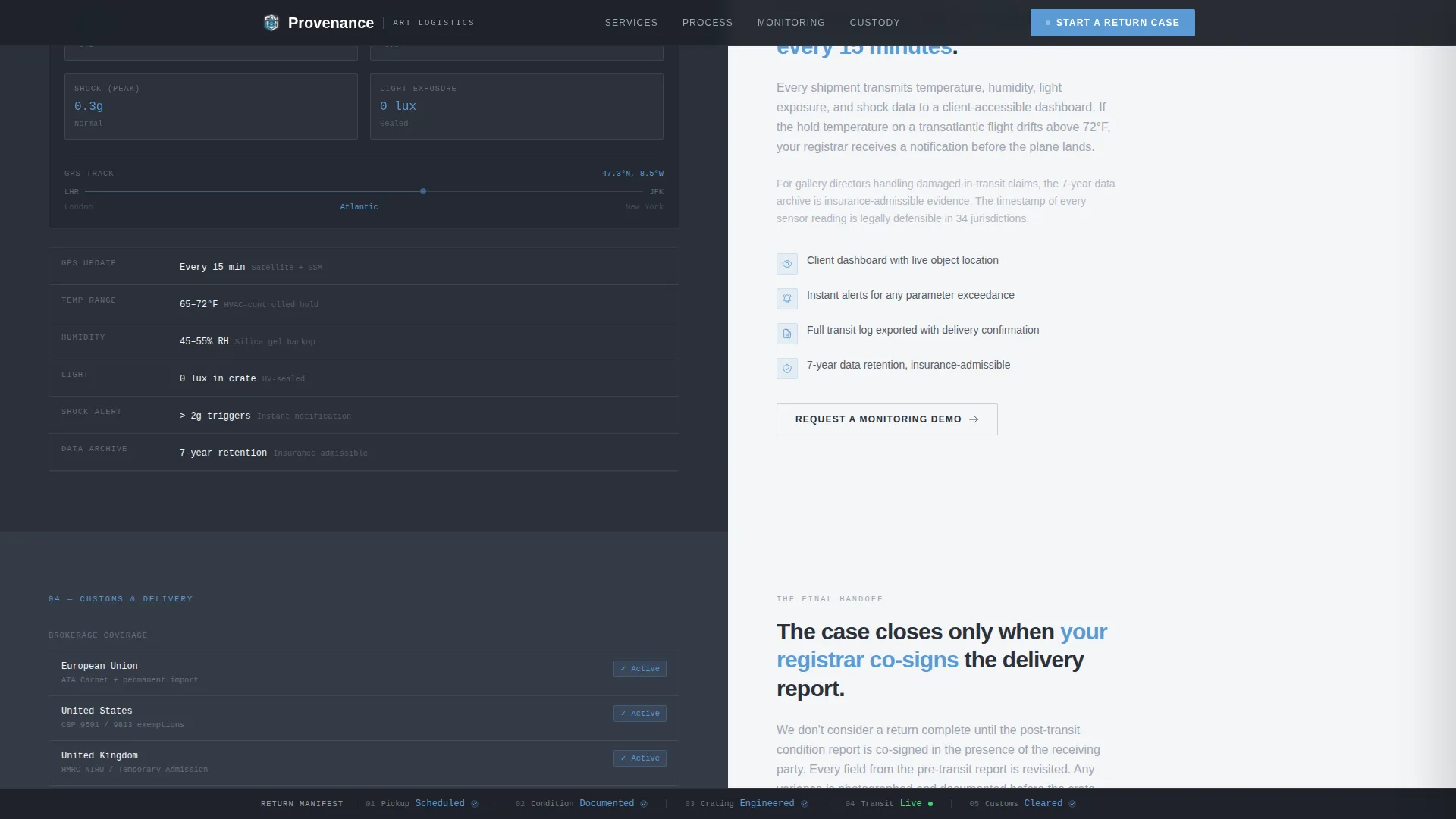
Every scroll section divides the viewport into two equal halves. The left panel carries technical specification content, including condition report fields, insurance coverage tiers, transit time benchmarks, and crating material cross-sections. The right panel holds a plain-language narrative explaining what each spec means for the client's object. This structure speaks fluently to operations professionals who read manifests daily.
Scroll-Triggered Manifest Bar
A running return summary bar sits fixed at the bottom of the viewport. Each time the visitor scrolls into a new section, that section's service line item is added to the bar. By the time the visitor reaches the final call to action, the bar reads as a complete logistics document, reinforcing the comprehensiveness of the service.
Right-Panel Lead Capture Form
The primary call to action, labeled "Start a Return Case," opens a slide panel anchored to the right side of the viewport. The form collects object type via a selection input, estimated value range via a dropdown, origin and destination countries, and a free-text field for special handling notes. The form is positioned after the visitor has seen the full spec sequence, so submission feels informed rather than premature.
Email-Gated Condition Report Download
A secondary conversion path offers a downloadable condition report template gated behind email capture. This gives operations managers an immediate practical tool and qualifies them as leads before they are ready to start a return case. It extends the page's utility beyond a single call to action.
Inline Social Proof Metrics
The template includes designated placements for inline performance metrics, such as condition reports filed, objects successfully returned, and countries served. Domain-specific testimonials from operations managers are also built into the layout, reinforcing credibility within the spec-sheet scroll flow rather than isolating social proof in a separate section.
Page sections overview
| Section | Purpose |
|---|---|
| Hero Split Screen | Isometric illustration, live-data callouts, primary call to action |
| Pickup and Condition | Condition report spec left, pickup narrative right |
| Crating Engineering | Material cross-section spec left, protection narrative right |
| Transit Monitoring | Telemetry dashboard spec left, monitoring narrative right |
| Customs and Delivery | Brokerage spec left, sign-off narrative and final call to action right |
| Footer | Linear single-row footer with supporting links |
Design & branding system
The visual identity follows a Data Command theme, styled to resemble a museum's back-of-house monitoring station. Every color choice reinforces the idea of precision, archival care, and controlled environments.
- Deep archival charcoal (#2B303A) anchors the left data panels; brushed aluminum gray (#9EA4B0) covers secondary surfaces; open-sky blue (#5B9BD5) fires on status indicators and interactive elements; conservation white (#F4F6F8) holds the right-side narrative panels
- Typography pairs Plus Jakarta Sans for body text and interface labels with DM Mono for all data readouts, specification values, and manifest line items
- Animation is high-intensity: SVG nodes pulse on the isometric header, the manifest bar reveals with GSAP ScrollTrigger, and the form panel slides in from the right on call-to-action click
Mobile & speed optimization
The template is desktop-first by design. Auction house operations managers and estate executors typically review detailed manifests on large monitors, so the split-screen layout prioritizes that experience. Mobile layout adaptations are built in for accessibility across devices.
- Static sections use Server Components to keep initial load weight low; interactive elements including the manifest bar and form panel use Client Components
- The split-screen columns reflow gracefully on smaller viewports so spec content and narrative panels remain readable without horizontal scrolling
- Animation intensity scales down on mobile to preserve readability and reduce motion overhead on smaller screens
How this template helps you convert
Provenance earns the conversion before the call to action appears. The page is structured so that every scroll section adds proof of domain fluency, making the lead form feel like a natural next step rather than a cold ask.
- The isometric header illustration front-loads credibility by showing the entire logistics chain as a visual system diagram, so the visitor understands the operation's scope within the first few seconds
- The spec sheet scroll sequence layers granular technical detail section by section, matching the mental model of operations managers who think in manifests and condition reports
- The scroll-triggered manifest bar creates a concrete summary of the full service scope by the time the visitor reaches the "Start a Return Case" call to action, reducing hesitation at the conversion point
Other information about this template
The Provenance template sits within the Logistics and Supply Chain category, specifically under the Artwork and Antiques Logistics subcategory. It is purpose-built for the artwork and antiques reverse logistics and returns niche, with an intersection match score indicating strong category alignment.
- The page is localized for English-language audiences with support for both USD and GBP value references and international country inputs in the lead form
- The Intersection Match Score for this template is 13, reflecting strong alignment between the template style, creative direction, header concept, and niche use case
- The template style is Split Screen (50/50), the creative direction is Spec Sheet, the color system is Slate and Sky, and the header concept is Isometric, all drawn from the matched intersection context
- The lead generation flow includes two distinct conversion paths: the primary "Start a Return Case" form and the secondary email-gated condition report download, giving the page two qualification opportunities
Theme
Data Command
Creative direction
Spec Sheet
Color system
Slate & Sky
Style
Split Screen (50/50)
Direction
Lead Generation
Page Sections
Isometric SVG Header with Live-data Callouts
Spec Sheet Split-screen Scroll Sections
Scroll-triggered Running Manifest Bar
Right-panel Slide Lead Capture Form
Email-gated Condition Report Download
Inline Social Proof and Metrics Placements
Related questions
Who is this landing page template designed for?
What does the Start a Return Case form collect?
What is the scroll-triggered manifest bar?
Does this template include a secondary lead capture path?
Is the header a photograph or a custom illustration?