Healthcare Sentiment Tracking Landing Page Template
The Pulse Live Healthcare Sentiment Tracking Landing Page Template is a dark, dashboard-driven single-page design built for healthcare SaaS platforms that convert patient feedback into real-time operational signals. It combines a mission-control visual style with a feature matrix layout, progressive lead capture, and animated data dashboards, purpose-built for hospital COOs, clinic network operators, and digital health founders.
by Rocket studio
Quick summary
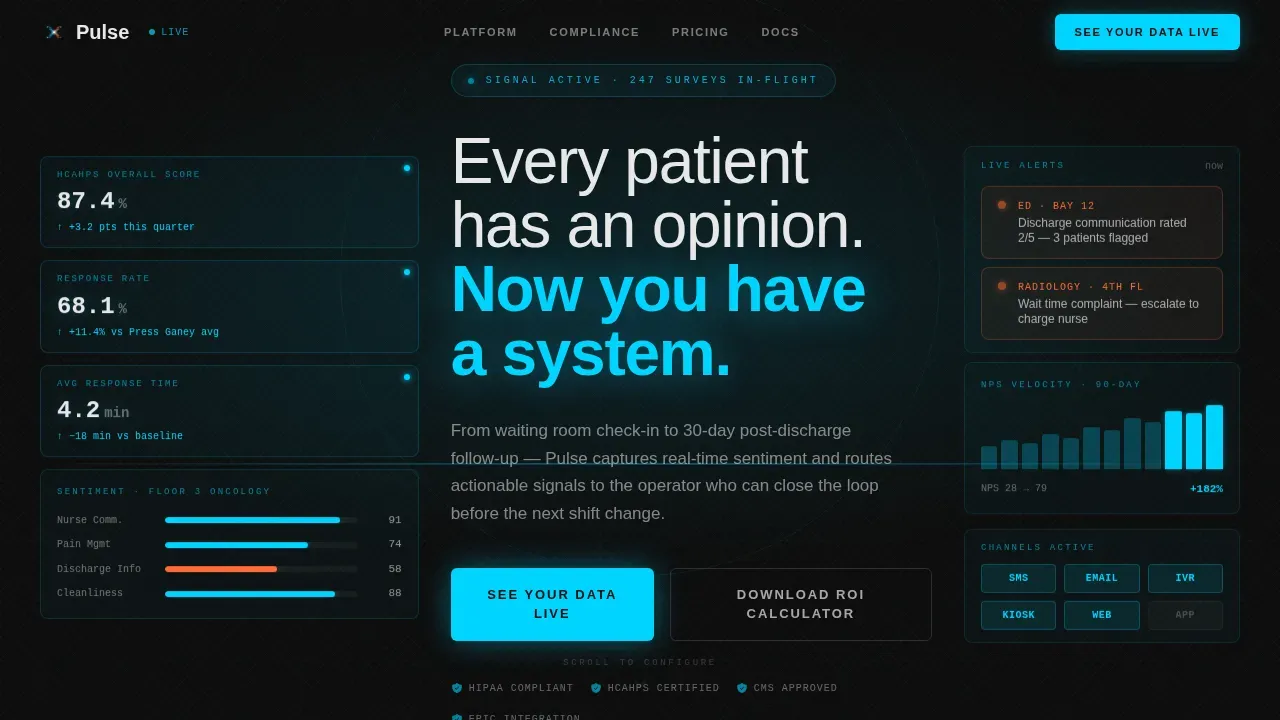
This template delivers a high-impact, single-page experience for healthcare feedback and patient sentiment platforms. The design channels a fighter jet HUD aesthetic, dark matte surfaces, electric blue data glows, and animated dashboards that behave like the product itself. It is built for lead generation, with a progressive two-step form and a secondary call to action for a gated ROI calculator.
Who this template is for
Healthcare SaaS founders and product marketing teams will find this template immediately relevant. It speaks directly to operators who need to demonstrate real-time data value to enterprise buyers, without relying on generic stock photography or vague wellness messaging.
- Hospital system COOs and VP Patient Experience leaders managing HCAHPS compliance and Medicare Value-Based Purchasing exposure
- Clinic network operators running thirty or more locations who need consistent, comparable patient experience data across sites
- Digital health startup founders who need to show Net Promoter Score (NPS) velocity and feedback infrastructure to close institutional funding rounds
What problem this template solves
Healthcare organizations collect patient feedback but struggle to act on it fast enough. Slow reporting cycles, disconnected survey platforms, and fragmented data make it harder to identify service failures before they compound. This template is designed to communicate the value of a platform that closes that gap, turning passive responses into live operational signals.
- Teams spend hours each week manually compiling survey data across departments, which makes manual work a constant drain on analyst resources
- HCAHPS dashboards often reflect the past, not the present, leaving health systems reacting to problems that are already worse than the data shows
- Clinic networks with high location volume lack a unified view of patient sentiment, making it difficult to measure quality and identify patterns across sites
What you get with this template
This page is built around six structured sections, each doing specific conversion work. The layout prioritizes scannability, visitors typically spend less than 47 seconds on a healthcare landing page, so every section earns its place. You get a fully coded, single-page template with high animation fidelity and a progressive form system ready to deploy.
- A hero section with animated dark dashboard, bloom lighting effect, and headline copy framework targeting operational buyers
- A feature matrix grid with animated data cells, hover states, and a spec-sheet scroll flow that mirrors the product experience
- A progressive two-step lead capture form plus a secondary gated PDF call to action for pipeline nurturing at every funnel stage
Feature list
This template packages a precise set of built-in components. Each one serves the strategy of helping enterprise healthcare buyers understand the platform's value before the demo call.
Animated Mission Control Hero
The hero section opens on a pure black viewport with a faint carbon weave texture. An electric blue bloom radiates outward from center as a live dashboard materializes, satisfaction scores ticking upward, response rate percentages climbing, and a sentiment heatmap rendering across a hospital floor plan. This opening communicates the product's core promise in the first three seconds, without a single stock photograph.
Feature Matrix Data Grid
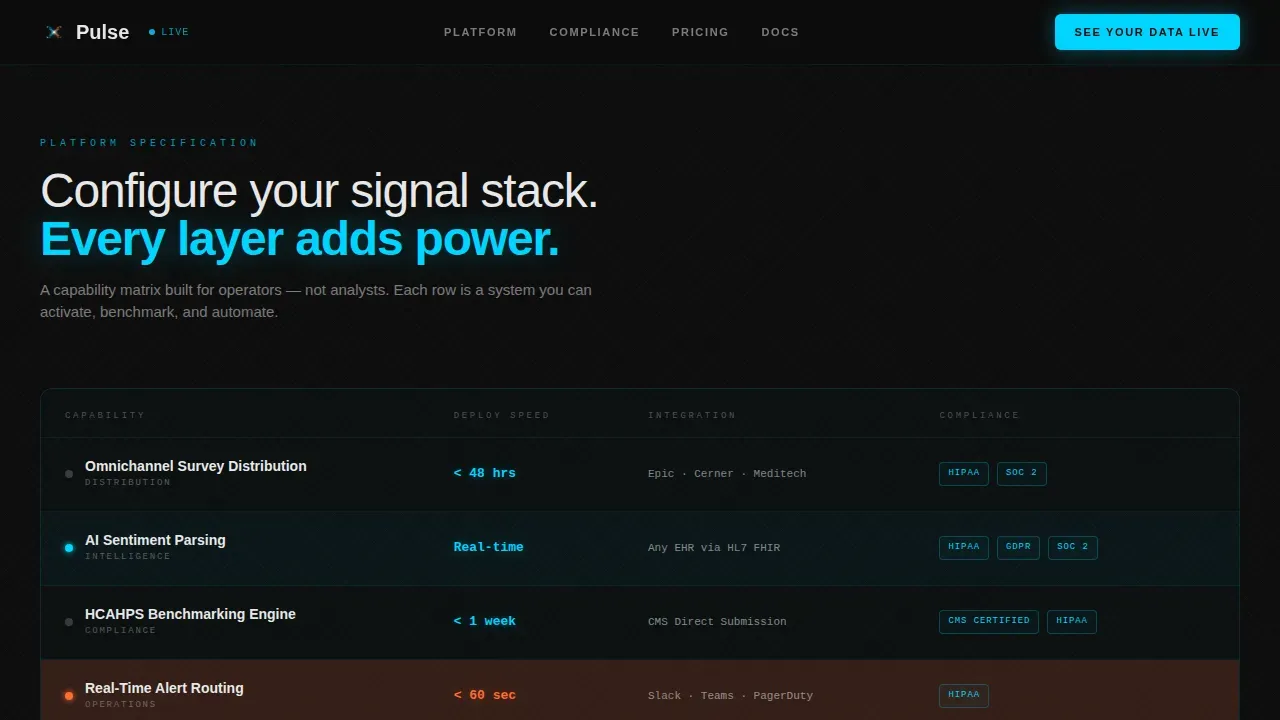
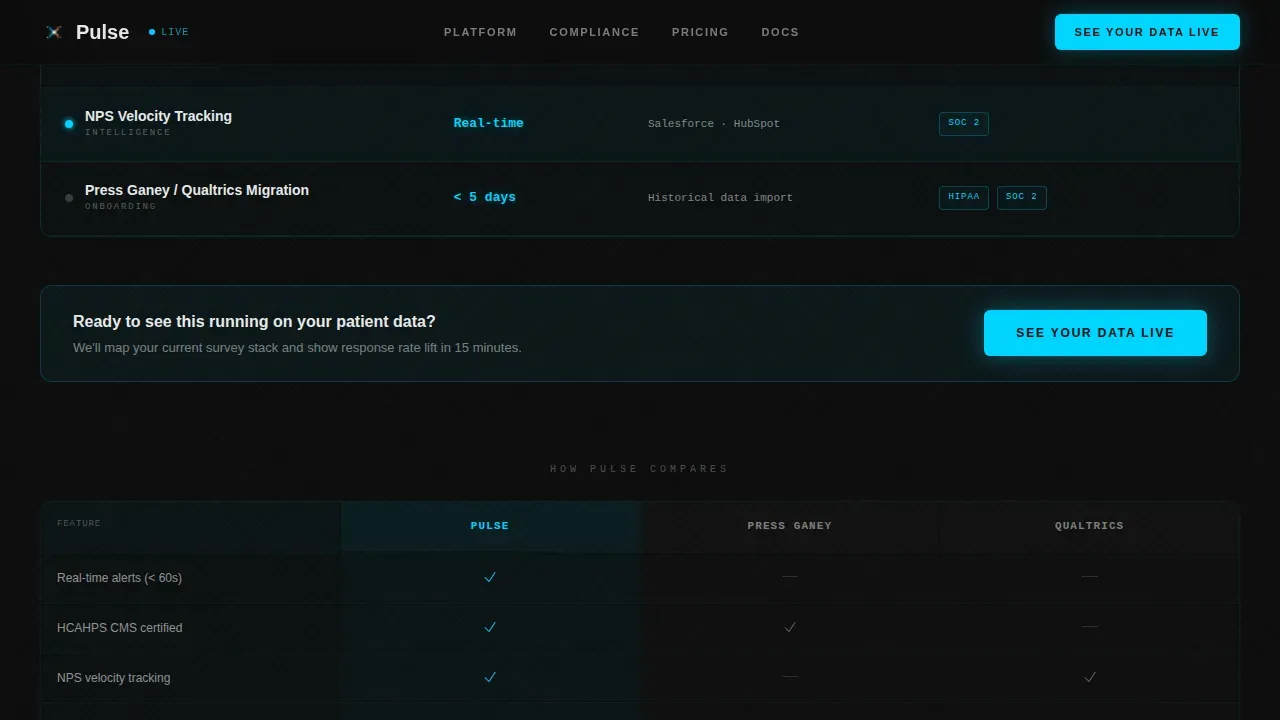
The feature matrix drives the scroll like a capability spec sheet. Each grid row presents a platform feature, omnichannel distribution, AI sentiment parsing, HCAHPS benchmarking, and real-time alert routing. Columns show deployment speed, integration depth, and compliance coverage. Micro-animations fire as data cells populate and comparison checkmarks snap into place, so the page itself behaves like the product being described. This approach helps visitors evaluate the platform's depth without reading dense copy blocks.
Progressive Two-Step Lead Form
The lead capture form is designed to reduce friction and increase form completion. Step one captures a work email only. Step two asks for organization size via a dropdown, single clinic, multi-site, or health system, and the visitor's current survey tool, with autocomplete suggestions. This staged approach lets the sales team qualify leads by context before the first conversation, making outreach smarter and more relevant.
Gated ROI Calculator Secondary call to action
A secondary call to action offers a downloadable ROI calculator PDF for visitors who are not yet ready to request a demo. This path captures the lead while delivering immediate value, keeping prospects engaged at an earlier stage of their decision workflow. It also extends the page's usefulness to visitors who are researching platforms and need a business case to take internally.
Social Proof and Scale Wall
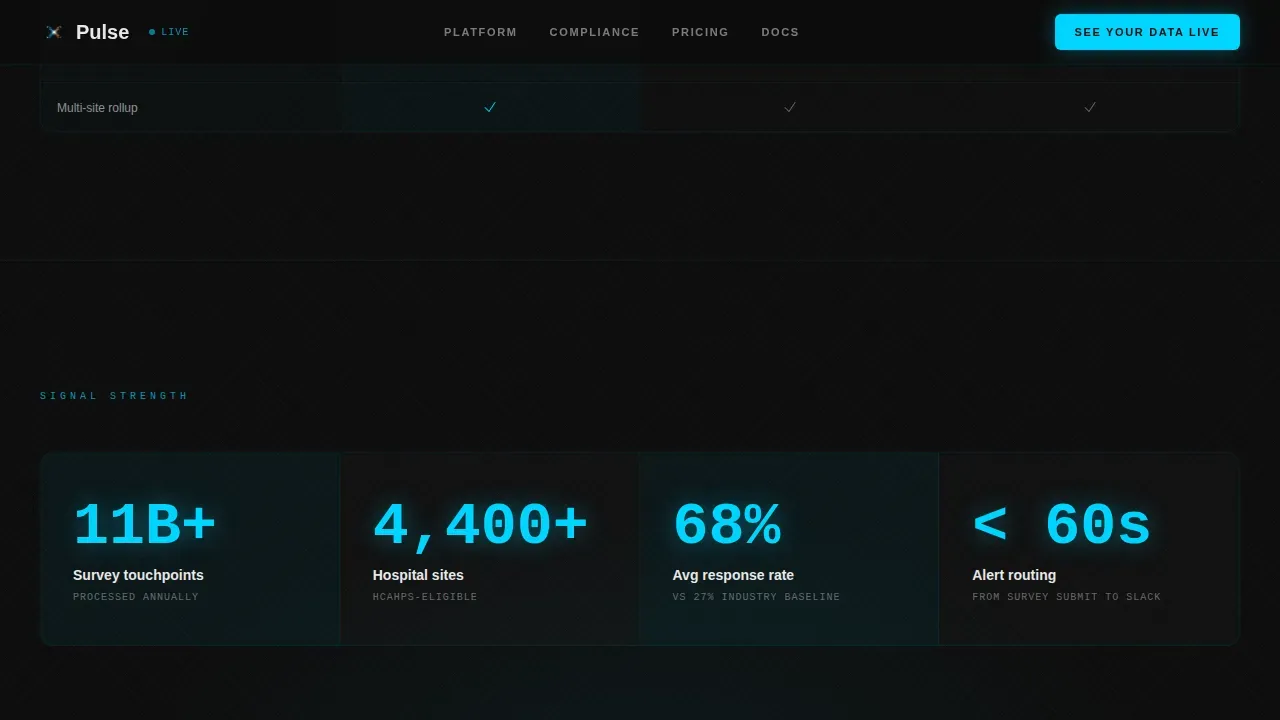
The template includes a dedicated social proof section with a stats wall, client logo strip, and testimonial blocks. Testimonials and case studies build credibility for healthcare services and help buyers trust the platform's claims before speaking to sales. Named role testimonials and specific performance metrics, such as HCAHPS lift percentages and response rates, are built into the layout framework.
Use Case ICP Cards
Three Ideal Customer Profile (ICP) cards present tailored messaging for each target audience: health systems, clinic networks, and digital health startups. Each card surfaces the specific challenge that audience faces and frames the platform as the direct solution. This segmentation helps every visitor quickly find the version of the story that is most relevant to their situation.
Page sections overview
| Section | Purpose |
|---|---|
| Hero Dashboard | Launch platform story with animated real-time data bloom |
| Feature Matrix Grid | Demonstrate platform capabilities via animated spec-sheet scroll |
| Social Proof Wall | Build credibility with stats, logos, and named testimonials |
| Use Case Cards | Segment messaging for three distinct healthcare buyer personas |
| Lead Capture Form | Convert visitors with progressive two-step form and email capture |
| ROI Calculator call to action | Engage early-stage visitors with a gated PDF secondary path |
| Footer | Minimal developer-style footer with navigation and compliance context |
Design & branding system
The visual identity is built on the Carbon Fiber color system, which creates a dark cockpit environment where every glow is functional and nothing is decorative. Typography combines Plus Jakarta Sans for headings with JetBrains Mono for data and numbers, a pairing that reinforces the platform's precision and technical reliability.
- Color palette: cockpit black (#0D0D0D) as the base, woven carbon gray (#1A1A2E) for surface layers, electric pulse blue (#00D4FF) for live data accents, clinical white (#E8E8E8) for body type, and warning amber (#FF6B35) for alerts and critical response flags
- Animation system: bloom effect on hero entry, counter animations on stats, staggered grid reveals on the feature matrix, and pulse ring effects on live data indicators, all built to mirror the product's real-time behavior
- Typography hierarchy: Plus Jakarta Sans headings give the page authority and clarity, while JetBrains Mono on data cells and metrics reinforces the sense that every number shown is live and exact
Mobile & speed optimization
The template is built desktop-first to match the workstation habits of its primary audience, COOs and clinic network operators who evaluate enterprise tools on large screens. Mobile responsiveness is included as a fallback layer, which matters because over 70% of health-related searches originate from mobile devices. The page architecture uses server components for static sections and client components for the animated dashboard and form, keeping the interactive experience performant.
- Desktop-first layout prioritizes the feature matrix and dashboard hero, which read best on wide viewports at full data density
- Mobile-responsive fallback ensures the page remains functional and scannable on smaller screens without breaking the dashboard animations
- The template is structured to support fast load behavior, as landing pages in healthcare should target load times under two seconds to minimize bounce rates and maintain user engagement
How this template helps you convert
Healthcare landing pages succeed when they help visitors understand their options quickly and clearly. This template is designed around that principle, using every section to reduce doubt and increase the confidence of an enterprise buyer who may be evaluating multiple feedback platforms at once.
- The hero dashboard creates immediate context, visitors see the platform working before reading a single feature description, which accelerates understanding and anchors the value proposition visually
- The progressive form reduces friction at the most critical conversion point, capturing the lead in step one and gathering qualification data in step two, so no visitor leaves without being counted in the pipeline
- The ROI calculator secondary path ensures that even visitors who are not ready to book a demo contribute a lead, extending the page's conversion reach across multiple buyer stages and timeline contexts
Other information about this template
This template is one of the more technically detailed landing pages available in the healthcare software category. It is designed for teams building or marketing B2B healthcare SaaS platforms where the sales cycle is long and the buyer needs substantial evidence before engaging with sales. The following notes cover additional context for teams evaluating this template.
- Landing page tracking for telehealth and healthcare platforms should remain intentionally broad to avoid compliance issues. Good analytics, including tools like Google Analytics, enables multiple definitions of success based on the page's role in the funnel. Effective tracking focuses on a small set of signals that consistently correlate with downstream outcomes, rather than over-indexing on granular behavioral data that can introduce legal and operational risk.
- The template's feature matrix and use case cards are structured to support A/B testing of different headlines, messaging, and call-to-action placements. Teams can swap copy blocks, reorder grid rows, or test call to action button labels without restructuring the underlying layout.
- Automated systems built into the lead form can generate a target list of qualified leads segmented by organization size and current survey tool, giving the sales team a smarter starting point for outreach. Automation tools in healthcare marketing help tailor follow-up communication based on the data collected at the form stage.
- Healthcare marketing automation simplifies complex marketing workflows. Automated workflows save the team hours of manual work each week and support scalable content plans as the platform grows. Content automation helps maintain consistent messaging across all channels, including blogs, ad campaigns, and digital content published alongside the landing page.
- Search visibility for healthcare SaaS platforms depends on landing pages that are structured clearly and load quickly. The template's clean section hierarchy supports search visibility by making it easier for crawlers to understand the page structure. Teams running paid ad campaigns can use this template as a dedicated post-click landing page to improve relevance scores.
- The platform context referenced in this template includes HIPAA compliance requirements for handling sensitive patient data. Companies ensure this by separating personally identifiable information from feedback analytics. The template is designed to reflect that regulatory context visually and in its messaging, helping healthcare brands ensure compliance is part of the story they tell to buyers.
- Natural language processing (NLP) interprets emotional cues in patient feedback. The template's feature matrix section is structured to communicate NLP-driven capabilities clearly to a non-technical executive audience. Custom sentiment categories improve the accuracy of analysis by focusing on feedback areas most relevant to each health system's priorities.
- For teams using Google Analytics or similar analytics platforms, the page's section structure makes it straightforward to set up scroll-depth tracking and event goals aligned with each conversion path, demo request form, ROI calculator download, and exit intent.
- The pulse live healthcare sentiment tracking landing page template is the full design system described throughout this page, available as a ready-to-deploy starting point for healthcare feedback platforms building their marketing presence.
Theme
Startup Velocity
Creative direction
Feature Matrix
Color system
Carbon Fiber
Style
Dashboard/Data Grid
Direction
Lead Generation
Page Sections
Animated Mission Control Hero Section
Feature Matrix Capability Grid
Progressive Two-step Lead Form
Gated ROI Calculator Secondary Path
Social Proof and ICP Use Case Sections
Related questions
Who is this template designed for?
Can I customize the feature matrix content?
Does the template include the lead capture form logic?
How does the ROI calculator secondary call to action work?
Is the dark dashboard hero animation fully coded?