R Programming Course Landing Page Template
Quantile is a modular card-grid landing page built for an R programming and statistics online course. It uses a warm, grounded visual identity and a persona-selector header to greet each type of learner personally. The layout blends instructor stories, curriculum cards, and a lead-generation form flow that feels like a natural next step, not a sales pitch.
by Rocket studio
Quick summary
Quantile is a single-page template designed for an R programming and statistics online course aimed at busy working professionals. The layout opens with a persona selector, moves through instructor and curriculum cards, and closes with a focused lead-capture flow. Every section earns attention before asking for anything in return.
Who this template is for
This template speaks directly to learners who have real lives outside their screens. It was built for people who want to learn R programming on their own schedule, without the pressure of a traditional classroom.
- Mid-career analysts who rely on spreadsheets today and want to write their own R scripts tomorrow
- PhD candidates and academic researchers who need to run regression models or survival analyses for a dissertation or publication
- Healthcare and science professionals who learned their field first and now need statistical programming to move forward
What problem this template solves
Many online course pages feel cold and generic. They list modules, post a price, and ask for a sign-up before the visitor feels understood. That approach loses the learners who need the most reassurance.
- Visitors leave before converting because the page never speaks to their specific situation or constraints
- Course creators struggle to communicate value to audiences with very different backgrounds and goals
- The gap between "I need to learn R" and "I'm ready to enroll" stays wide when the page offers no personal connection
What you get with this template
This template gives course creators a complete, modular landing page that guides each visitor from recognition to action. Every section is purposeful and laid out in a clear grid structure.
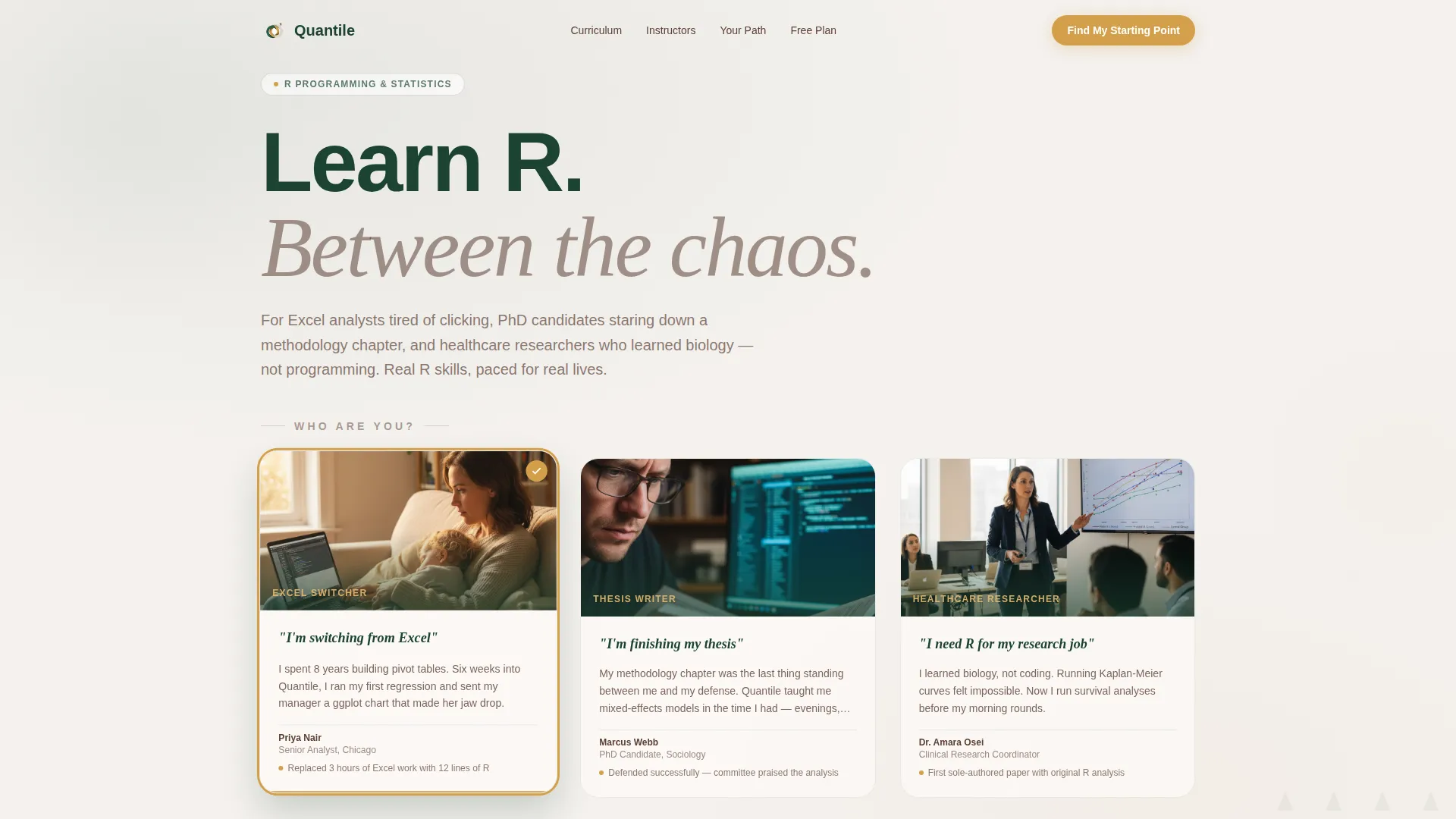
- A persona-selector header with three illustrated learner cards that reshape the page experience based on who is visiting
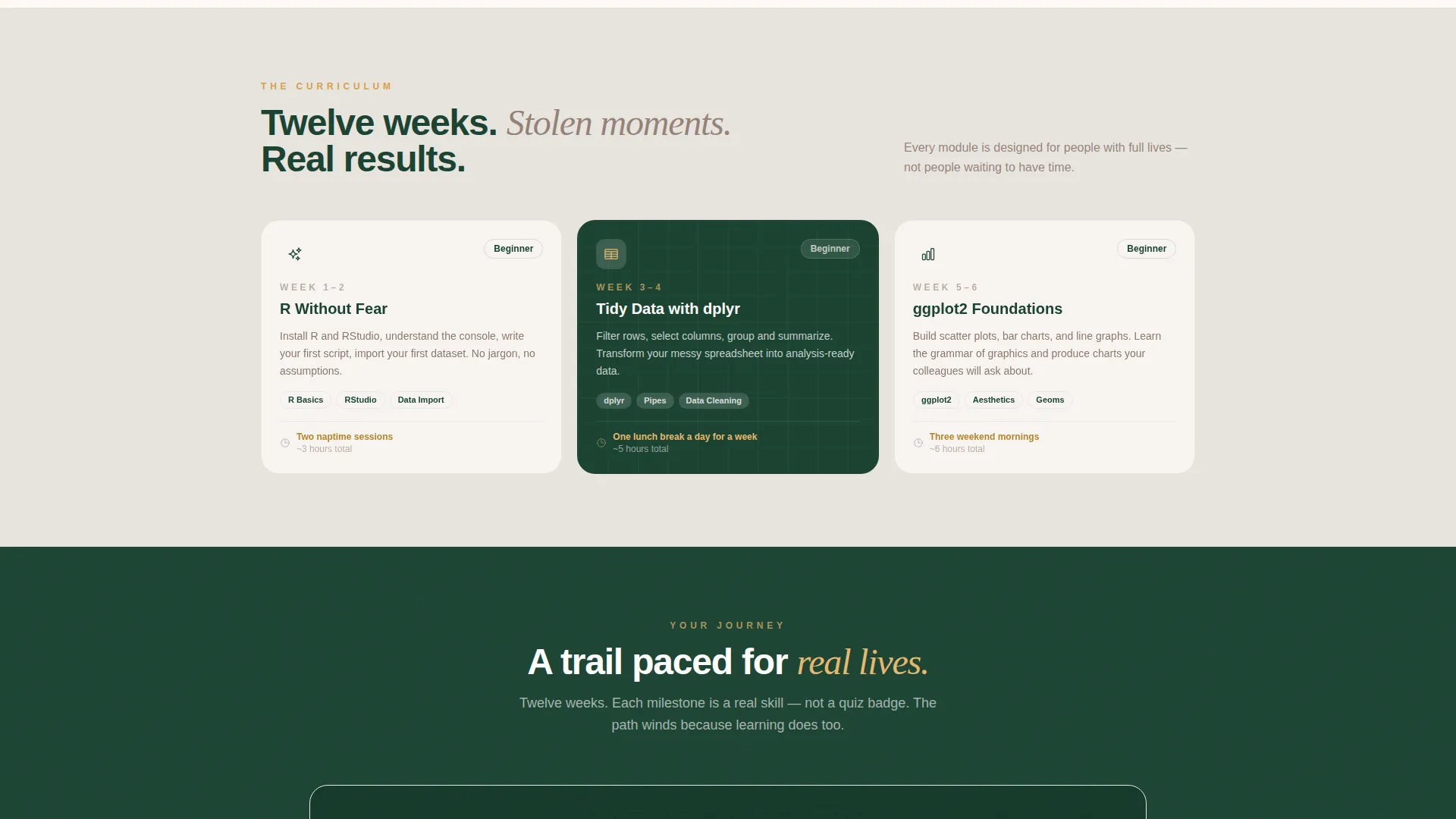
- A curriculum section built from responsive card grids showing lesson titles, honest time estimates, and skill badges
- A three-step lead-generation form and a secondary free-resource download path for visitors who are not yet ready to commit
Feature list
This template includes six purpose-built components drawn directly from the brief. Each one serves a specific moment in the learner's journey from curious visitor to enrolled student.
Persona Selector Header
Three illustrated cards open the page, each representing a real learner moment. Clicking a card reshuffles testimonials, curriculum modules, and outcomes to match that learner's story. The interaction feels personal and sets the tone for everything that follows.
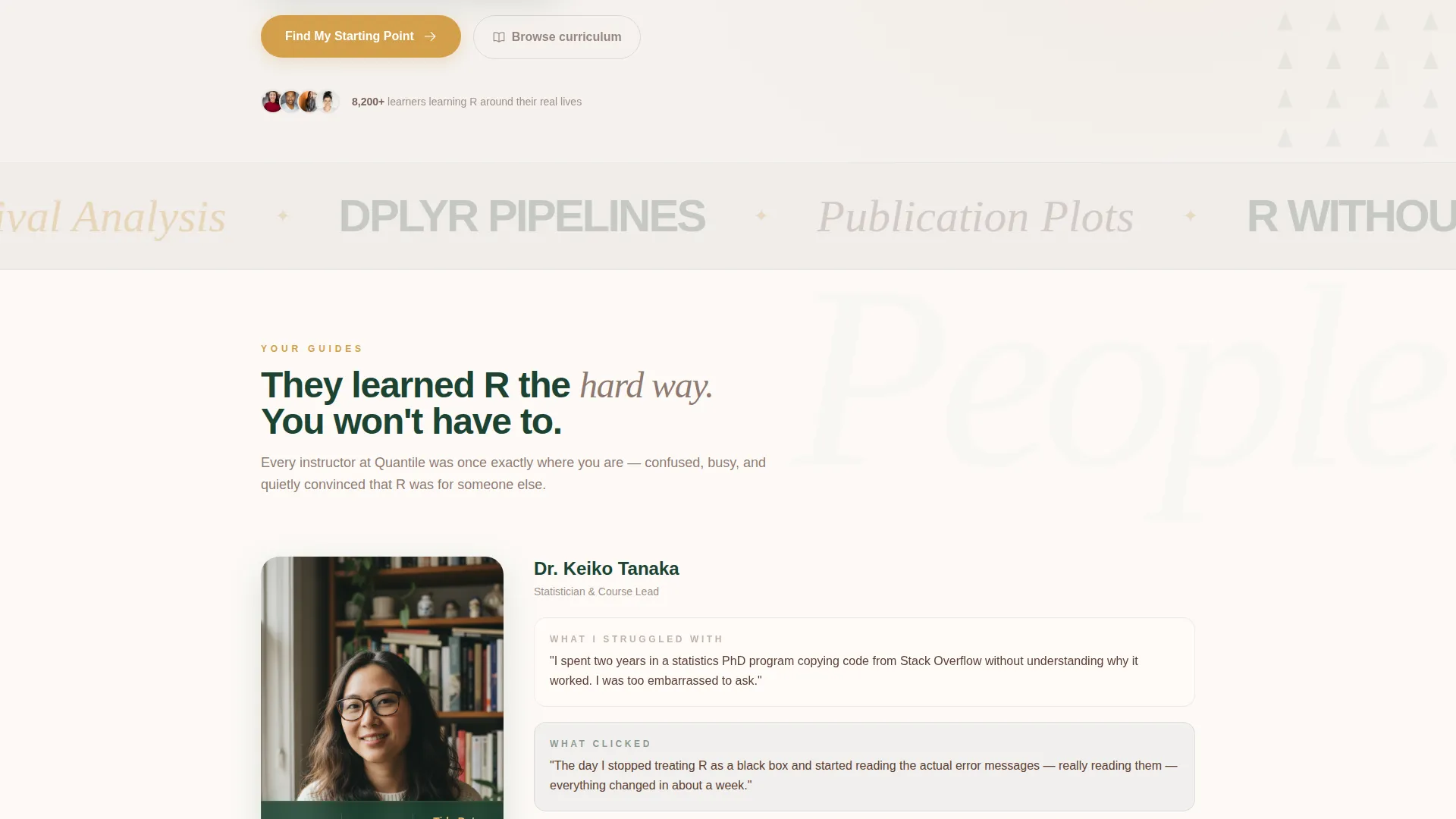
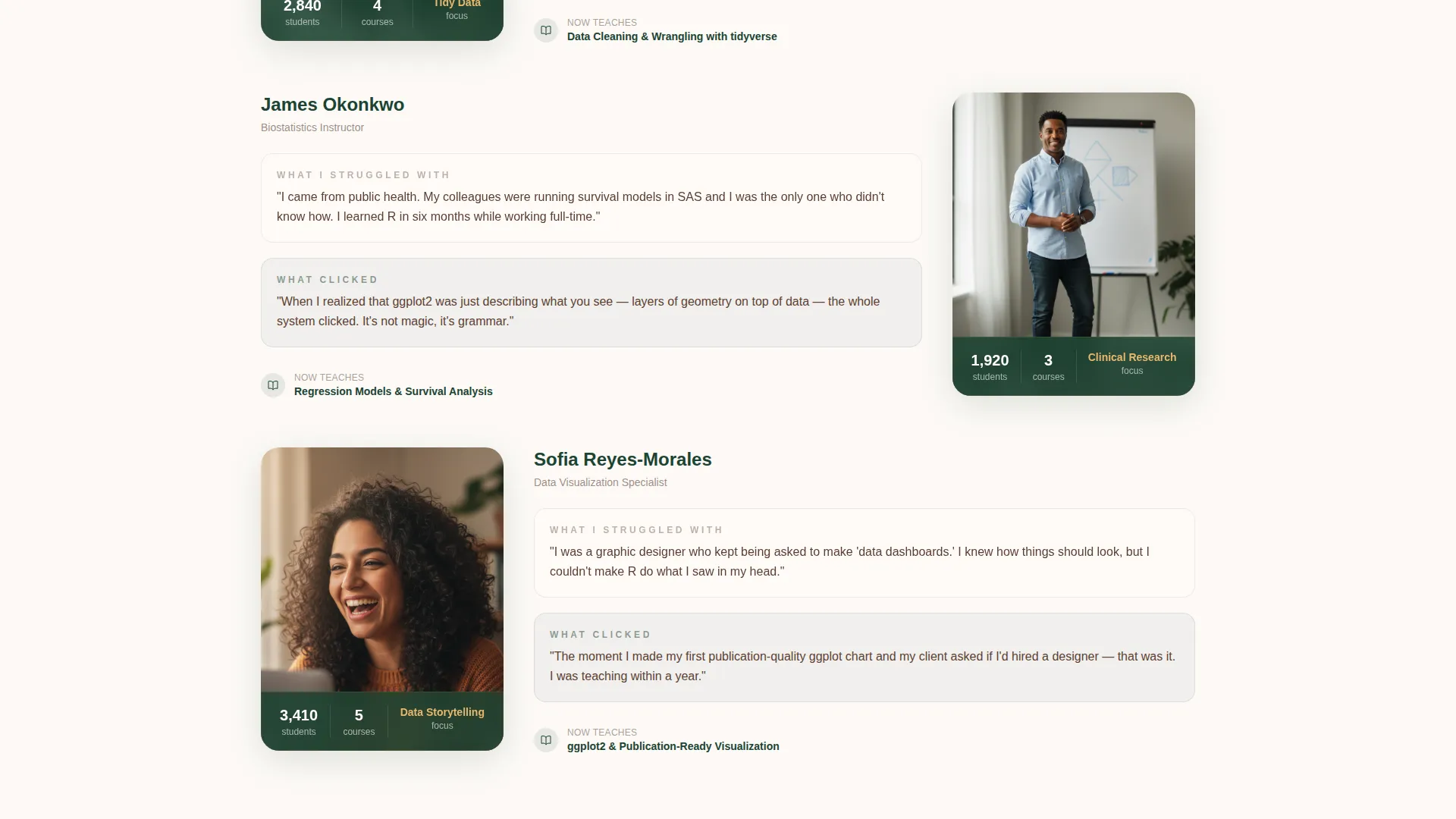
Instructor Story Cards
Each instructor is introduced through a modular card pairing a candid photo with a short personal narrative. The card shares what they struggled with before R, what finally clicked, and what they teach now. This keeps the page from feeling like a catalog.
Curriculum Module Grid
Lesson cards tile in a responsive grid with honest time labels such as "one lunch break a day for a week." Each card also displays skill badges earned upon completion, giving learners a clear picture of what they will walk away with.
Progress Path Illustration
A mid-page card shows the full curriculum as a winding trail through a forest illustration. Each node marks a milestone. The visual reinforces that this course is paced for people with full lives outside of learning.
Primary Lead-Generation Form
The "Find My Starting Point" call to action opens a lightweight three-step form. Learners select their background, choose their goal, and enter their email to receive a personalized curriculum map. The flow is short and low-friction.
Free Resource Download Gate
A secondary conversion path offers a downloadable PDF called "The Family-Friendly R Study Plan." It is gated behind an email address only, capturing leads who trust the page but are not ready to commit to full enrollment.
Page sections overview
| Section | Purpose |
|---|---|
| Persona Selector Header | Match visitors to their learner identity immediately |
| Instructor Story Cards | Build trust through real human narratives |
| Curriculum Module Grid | Show course content with honest time labels |
| Progress Path Card | Visualize the full learning journey as a trail |
| Sticky call to action Button | Keep the primary action visible during scroll |
| Lead-Generation Form | Collect background, goal, and email in three steps |
| Free PDF Download | Capture undecided leads with a low-commitment offer |
Design & branding system
The Forest Trust color system gives this template its calm, grounded personality. Every color choice reinforces the feeling of learning in a safe, unhurried environment.
- Deep evergreen (#1B4332) anchors headers and navigation; warm bark brown (#5C4033) carries body text; soft morning fog (#E8E4DF) fills card backgrounds and open space
- Gentle amber (#D4A04A) is reserved strictly for buttons, progress indicators, and interactive card hover states, so the eye is drawn only where action is needed
Mobile & speed optimization
The card-grid layout is built on a responsive modular structure. Sections stack cleanly as screen size reduces, keeping the persona cards, curriculum tiles, and form steps readable on any device.
- The modular grid reflows naturally from multi-column desktop layouts to single-column mobile views without losing hierarchy
- Honest time labels and short card copy keep each section lightweight and easy to scan on a small screen
How this template helps you convert
Quantile earns the conversion before it asks for one. The page is structured so that trust is built in layers, and the form only appears after the visitor has already seen themselves in the content.
- The persona selector creates an immediate sense of recognition, making visitors feel the page was built for them specifically before they read a single lesson description.
- The "Find My Starting Point" call to action appears first inside the persona selector and repeats as a sticky amber button after the curriculum trail, keeping the next step visible without being intrusive.
Other information about this template
This template is a strong fit for independent course creators, academic departments, and training platforms in the data science and statistics education space. It is built with the Family First theme in mind, meaning the design respects learners who are balancing education with parenting, caregiving, or demanding careers.
- The template style is Card Grid (Modular), making it straightforward to rearrange or expand individual sections as a course grows
- The lead-generation direction supports two distinct conversion paths: full enrollment intent and lower-commitment resource downloads
- The Forest Trust color palette and illustrated assets are designed to feel warm and human rather than corporate or technical
Theme
Family First
Creative direction
Team & People
Color system
Forest Trust
Style
Card Grid (Modular)
Direction
Lead Generation
Page Sections
Persona Selector with Dynamic Content
Instructor Story Card Grid
Curriculum Cards with Honest Time Labels
Forest Trail Progress Illustration
Three-step Lead Capture Form
Free PDF Secondary Conversion Path
Related questions
Who is this landing page template designed for?
How does the persona selector work?
What are the two conversion paths on this page?
Can the curriculum cards be updated as the course grows?
Does this template support multiple instructor profiles?