Cutting-Edge Computing Insight Landing Page Template
Photon is a scroll-reveal landing page template built for a photonic computing newsletter and community. It opens above the fold with an interactive link-budget calculator, then progressively discloses recent issue headlines, a live patent-and-funding timeline, and community proof from named organizations. The Carbon Fiber visual system and GSAP animations deliver cleanroom-grade precision that earns trust before a single line of copy is read.
by Rocket studio
Quick summary
Photon is a single-page, scroll-reveal landing page template purpose-built for a deep-tech photonics newsletter targeting engineers, PhD candidates, and venture investors. The above-the-fold experience leads with a fully functional photonic link-budget calculator rather than a hero image, proving technical credibility instantly. Each section materializes on scroll, mimicking the way light propagates through sequential photonic components. The Carbon Fiber color system and GSAP-driven animations make every surface feel engineered, not decorated.
Who this template is for
This template serves founders, editors, and developer-designers who are launching or relaunching a high-credibility photonics newsletter or community platform. It is especially effective when the audience demands proof of technical depth before subscribing, and when authority and community validation are critical differentiators in a deep-tech field.
- Photonics PhD candidates and systems architects who need fabrication yield data, optical interconnect benchmarks, and chip-level performance analysis in one weekly digest
- Venture partners and hyperscaler evaluators sizing the optical compute market, tracking funding rounds, and comparing photonic accelerator proposals
- Newsletter operators and developer-designers building a conversion-optimized entry point for a photonic computing research community
What problem this template solves
Deep-tech newsletters face a specific trust gap. Potential subscribers need to see evidence of content quality before committing, because the subject matter, covering photonic systems, silicon photonics earnings, quantum photonics developments, and optical interconnect benchmarks, is highly specialized. A generic hero image and a tagline do not close that gap. A live, working tool does.
This template removes that barrier by making the calculator the first impression. It also solves structural conversion problems that plague technical newsletter pages:
- The above-the-fold area must capture interest within seconds; the calculator delivers immediate, tangible value so visitors are already engaged before they encounter a single call-to-action
- Authority signals, including named organization logotypes, a visible subscriber count of 4,200-plus members, and analyst-note-style recent issue headlines, build trust progressively as the reader scrolls, rather than front-loading unsubstantiated claims
What you get with this template
You get a complete, single-page landing page layout structured to convert technically sophisticated visitors into newsletter subscribers and community members. Every section is pre-built and ready to populate with your content.
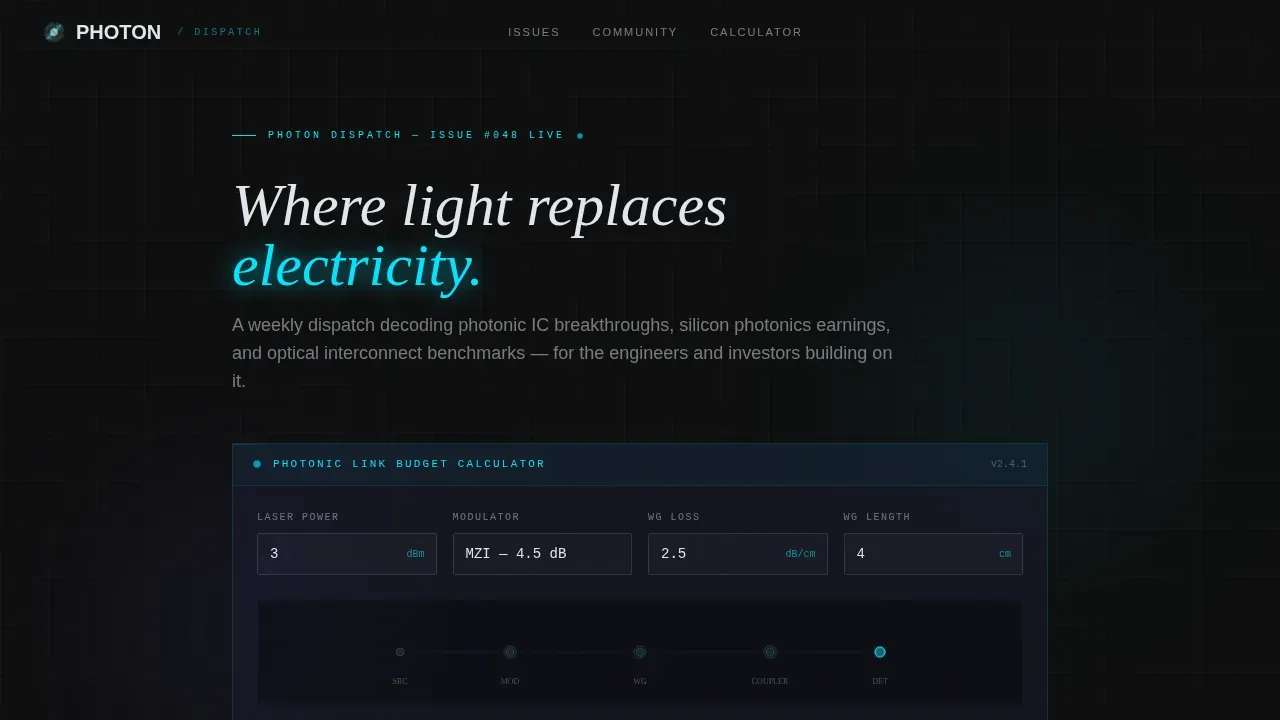
- A fully functional photonic link-budget calculator embedded above the fold, complete with modulator type selection, waveguide loss input, and an animated light-path SVG diagram tracing the signal from source to detector
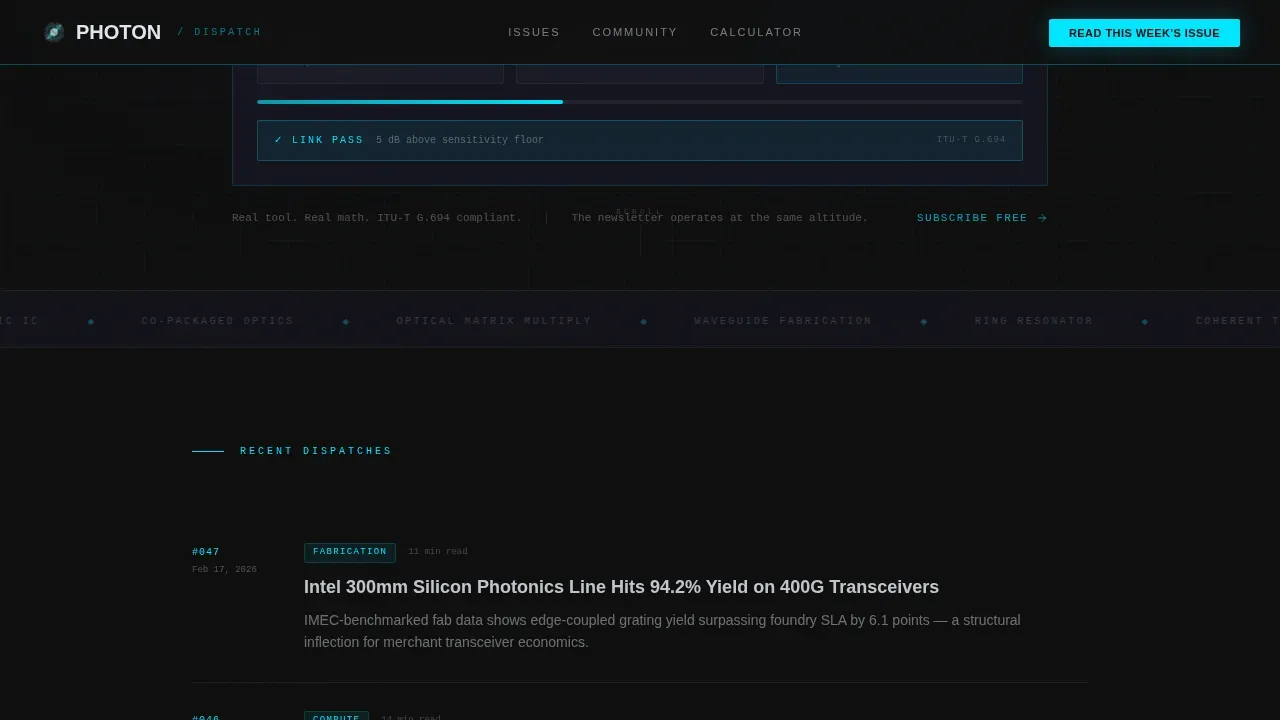
- Five distinct scroll-reveal content sections: the calculator hero, recent issue headlines, a live patent and funding timeline, a community proof block with named organization logotypes, and a full-width call-to-action break with an email subscribe form
- A pinned navigation call-to-action that appears after scroll begins, a secondary email subscribe field requiring only one input, and a linear single-row footer layout
Feature list
This template is built around a specific set of prompt-backed capabilities. Each feature below is present in the template as described in the source brief.
Interactive Photonic Link-Budget Calculator
The calculator is the hero of this landing page. Visitors enter laser power in decibels relative to one milliwatt (dBm), select a modulator type from Mach-Zehnder interferometer (MZI), ring modulator, or electro-absorption modulator (EAM), and set waveguide loss per centimeter. The tool instantly renders insertion loss, receiver sensitivity margin, and a pass/fail verdict. An animated SVG light-path diagram traces the signal from the laser source through the waveguide to the detector in real time, giving the visitor an immediate experience of the newsletter's technical precision. This component is built as a Client Component to keep interactivity sharp inside the browser without blocking static section rendering.
GSAP ScrollTrigger Scroll-Reveal Animation System
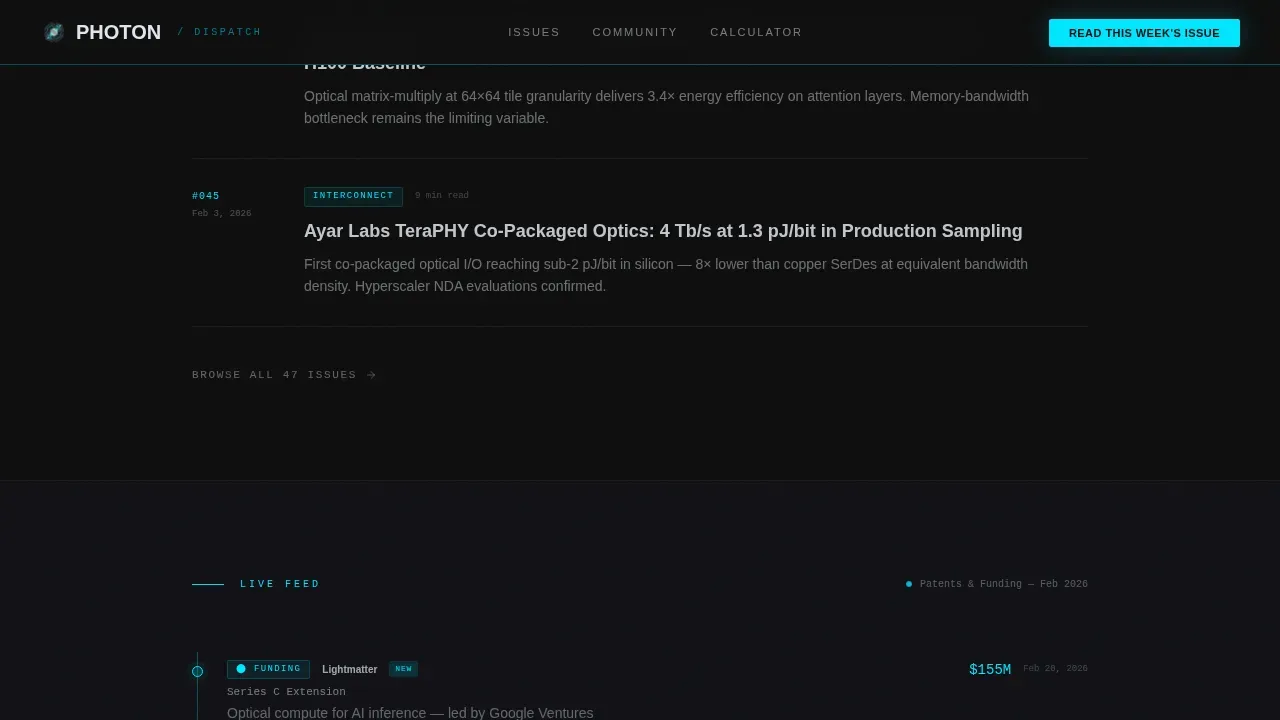
Every section below the calculator activates only when the visitor's scroll position reaches it, mimicking the way photons propagate through sequential photonic components. Recent issue headlines fade up as analyst-note cards. The patent and funding timeline materializes as a minimal, chronological feed. The community proof block assembles its logotype rows only when the signal, the visitor's attention, arrives. This scroll-reveal system is powered by GSAP ScrollTrigger, with a cursor-reactive light pulse layered on top for additional depth of interaction.
Live Patent and Funding Timeline Feed
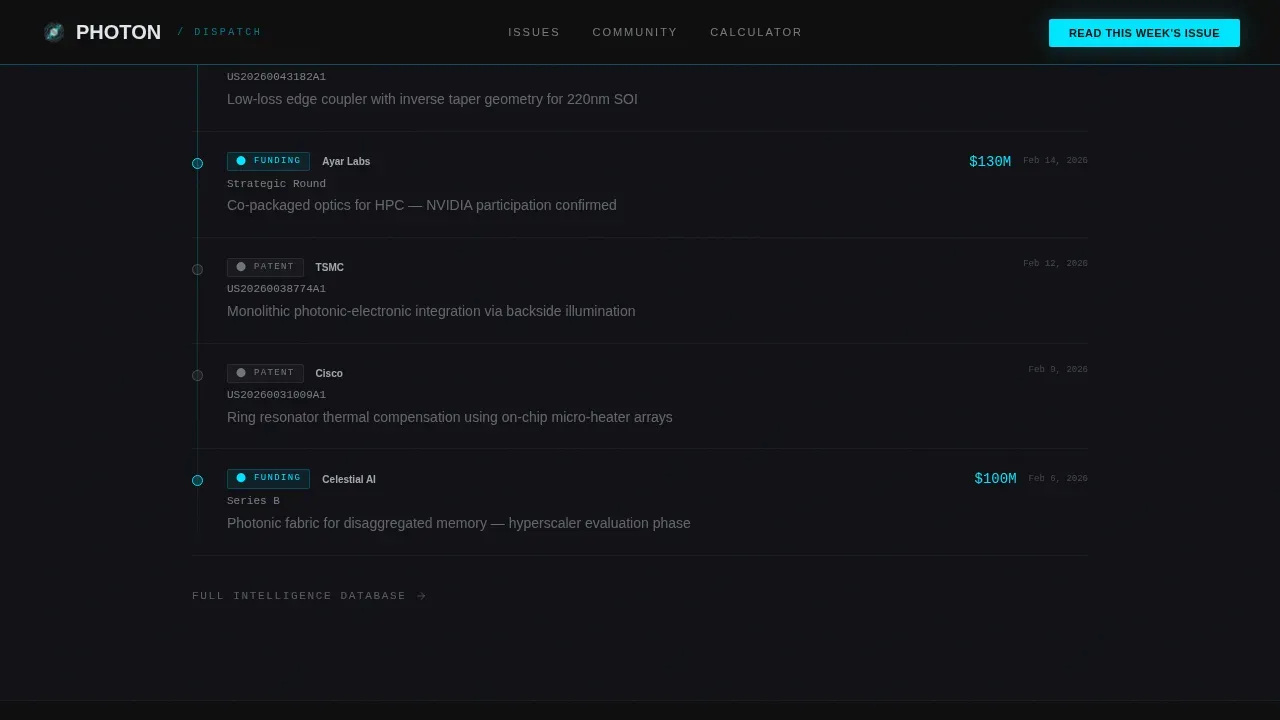
Below the recent issues section, a minimal timeline renders real-time photonic computing patent filings and funding rounds. Each entry appears as a compact, timestamped line item. The feed design mirrors the aesthetic of a cleanroom data display: high information density, zero decorative noise. This section communicates that the newsletter tracks the market in motion, not just established research, reinforcing its value for venture partners and systems architects evaluating photonic accelerators.
Community Proof Block with Named Organization Logotypes
The community proof section displays member counts tied to named organizations in quiet logotype rows. This is not a generic testimonial block. Specific institutional affiliations are displayed alongside aggregate and organization-level member numbers, providing authority validation that resonates with technically sophisticated visitors. Authority and community validation are critical in deep-tech fields, and this block is designed to deliver both without resorting to generic social proof patterns.
Dual Call-to-Action Architecture
The primary call-to-action, "Read This Week's Issue," appears twice: once as a pinned element in the top navigation after scroll begins, and once as a full-width section break after the community proof block. The secondary path, "Join 4,200+ Photonic Engineers," presents a single email field for instant subscribe. This dual structure captures both high-intent visitors who are ready to read immediately and exploratory visitors who want to commit to the community first.
Carbon Fiber Visual System with Laser Cyan Accents
The visual identity uses a precisely defined four-color palette applied with surgical consistency. Deep carbon black forms the base. Woven graphite provides surface layering. Optical-grade glass white is used for typography and readable content areas. Laser-line cyan is reserved exclusively for interactive edges, hover states, and data accents. Typography combines DM Sans for interface and body copy with Fraunces for editorial serif accents, creating a tone that feels simultaneously like a cleanroom readout and a high-quality research publication.
Page sections overview
| Section | Purpose |
|---|---|
| Link-Budget Calculator | Proves technical depth above the fold with an interactive optical tool |
| Recent Issue Headlines | Displays three analyst-note-style summaries as scroll-reveal cards |
| Patent & Funding Timeline | Shows a live-updating minimal timeline of market activity |
| Community Proof Block | Presents named organization logotypes and member count data |
| Call-to-Action Break | Full-width section with primary and secondary subscribe paths |
| Pinned Nav call to action | Persistent "Read This Week's Issue" button appearing after scroll begins |
| Single-Row Footer | Linear footer pattern with minimal link and legal structure |
Design & branding system
The visual system is built on a Tech Glass aesthetic executed through a Carbon Fiber color palette. The overall effect feels like holding a photonic chip under cleanroom lighting: matte darkness interrupted by impossibly precise lines of luminous blue, every surface engineered rather than decorated. This is not a template that relies on photography or illustration; the tools, data, and logotypes carry the visual weight.
- Color palette: deep carbon black (#0D0D0D) as the base, woven graphite (#1A1A2E) for layered surfaces, optical-grade glass (#E0E7EE) for readable content areas, and laser-line cyan (#00E5FF) reserved strictly for interactive edges, hover states, and data accents
- Typography: DM Sans handles all body copy and user interface elements for maximum legibility at small sizes; Fraunces provides editorial serif accents in headlines and section labels, adding depth and a sense of authored intelligence to the layout
Mobile & speed optimization
The template is designed desktop-first, reflecting the reality that photonics engineers and systems architects primarily work at workstations where they can interact fully with the calculator, the timeline feed, and the animated diagrams. Responsive behavior is included so that visitors arriving via mobile, including those who encounter the newsletter on social media, can still read recent issue summaries, view the community proof block, and access the subscribe form without friction.
- Static sections including the recent issue headlines, community proof block, and call-to-action break are built as Server Components, keeping those elements fast to render without client-side JavaScript overhead
- The link-budget calculator is isolated as a Client Component inside the browser, so its interactivity loads independently without delaying the static content that surrounds it
How this template helps you convert
The conversion architecture of this landing page is deliberate. Every element exists to move a technically skeptical visitor closer to subscribing, using demonstration rather than persuasion as the primary mechanism.
- The calculator delivers immediate, tangible value before any copy is read. Visitors who have used a real tool in the browser trust that the newsletter behind it operates at the same technical altitude. This is the core conversion engine of the template.
- The scroll-reveal sequence builds progressive commitment. Each section that materializes, from analyst-note headlines to the funding timeline to the community proof block, adds another layer of credibility. By the time the visitor reaches the full-width call-to-action break, they have already experienced the newsletter's value three times in different forms.
Other information about this template
This section covers additional context about the template's scope, technical foundation, and the broader photonics landscape it is designed to serve.
Photonics is revolutionizing how we transmit, process, and sense information. Photonics leverages light to enable significantly faster speeds, greater bandwidth, and lower energy consumption compared to electronics. As the limits of Moore's Law approach and electronic systems face power and speed constraints, photonics is gaining momentum in cutting-edge domains including AI accelerators and quantum photonics. Photonics is becoming vital to the future of technology, powering ultra-fast internet and enabling breakthroughs in quantum computing and autonomous vehicles. Photonics technologies are being integrated into various industries, including telecommunications, biomedical devices, and advanced manufacturing.
Quantum photonics is transforming the way information is processed, transmitted, and measured. Quantum photonics is uniquely suited for quantum technologies because light travels at the speed of light, enabling extremely fast information processing and transmission with minimal latency. In photonic quantum computing, photons act as qubits, carrying and processing quantum information. Quantum communication leverages the properties of light to transmit information securely, ensuring that eavesdropping is detectable. Quantum sensors exploit the extreme sensitivity of quantum states to measure physical phenomena with unprecedented precision.
High-quality optical lenses and precision beam shaping enhance the interaction between photons and the measured system, allowing ultra-accurate timing, frequency, and spatial measurements. Quantum photonics holds the key to breakthroughs in computing, communications, and sensing, and its success depends on absolute control of light. Quantum technologies are revolutionizing industries by leveraging the unparalleled precision and computational power of quantum mechanics. High-precision optics enable the manipulation of photon paths and interference patterns necessary for quantum logic operations. Photonics supports both free-space configurations and integrated photonic platforms, providing flexibility for a wide range of quantum applications.
The design of photonic systems presents unique challenges that require specialized software capable of simulating optical behavior. Quantum communication leverages the properties of light to transmit information securely by encoding encryption keys in the quantum states of photons. Quantum sensors exploit the extreme sensitivity of quantum states to measure physical phenomena with unprecedented precision. Photonics is essential for applications in navigation, spectroscopy, and fundamental physics research due to its precision capabilities.
Photonic materials are essential for enhancing the performance and efficiency of display technologies. Advancements in photonic materials have enabled the transition from bulky, low-resolution displays to ultra-thin, high-contrast screens. The demand for flexible, energy-efficient displays is driving innovations in photonic materials. Photonic materials play a crucial role in real-time optical computing and faster image processing. The integration of photonic materials is key to the development of advanced imaging and display technologies.
The integration of photonics in AI and machine learning can enhance the speed and efficiency of data processing and transmission. Photonics is gaining momentum in cutting-edge domains like AI accelerators and quantum photonics as the limits of Moore's Law approach. The newsletter this template supports covers photonic IC breakthroughs, silicon photonics earnings, and optical interconnect benchmarks at engineer-grade depth, with tools, not just words.
From a template deployment perspective, the following practical details apply:
- The photon precision photonic computing newsletter landing page template is a single-page layout with no multi-page routing required
- The template uses GSAP ScrollTrigger for all reveal animations, a cursor-reactive light pulse overlay, and an animated SVG light-path diagram inside the calculator component
- Modulator options in the calculator include MZI (Mach-Zehnder interferometer), ring modulator, and EAM (electro-absorption modulator), covering the primary modulator architectures used in integrated photonics today
- The footer follows Pattern 1: a linear single-row layout with minimal links and legal text, keeping the exit experience as clean as the entry
- The sign-up form requires only a single email field, reducing friction for visitors who decide to subscribe after exploring the calculator and recent issue previews
- Desktop-first layout is the design priority, with responsive breakpoints included for mobile visitors arriving via social media referrals
- The page does not include navigation links that would direct visitors away from the conversion path, supporting focused attention on the subscribe and read actions
Additional photonics context relevant to the newsletter's subject matter includes the following. Fiber optics and fiber amplifiers are core infrastructure topics covered in the dispatch. Waveguides, resonators, and optical modulators are covered as integrated photonics components across issues. Entangled photon pairs, quantum optics, and quantum mechanics topics appear in coverage of quantum computing applications. Laser beams, laser power budgets, wavelengths, polarization, coherence, and noise characteristics are core to the link-budget tool embedded in the page. Nonlinear crystals, beam shaping optics, and parasitic reflections are advanced topics addressed in the newsletter's fabrication yield and experimental coverage. Free space optical interconnects, fiber transmission systems, and fiber optics deployment data are covered in the optical interconnect benchmarks section of each issue. Other light sources beyond lasers, such as LED-based and broadband sources used in photonics experiments, appear in comparative research coverage. Photons as qubits, entangled photon pairs, and quantum optics experiments are discussed in the quantum computing application columns. The newsletter also covers photonic systems used in imaging, sensing, and display technology contexts, including the role of photonic materials in advancing imaging resolution and display efficiency. Fiber amplifiers such as erbium-doped fiber amplifiers (EDFAs) are discussed in the context of long-haul optical transmission system performance. The newsletter's live patent feed tracks advances in chip-scale photonic integration, compact modulator designs, and bandwidth-scaling innovations. Exceptional accuracy in fabrication yield reporting and benchmark measurement methodology is a stated editorial standard of the dispatch. Building blocks of integrated photonics, including modulators, resonators, amplifiers, waveguides, and detectors, are covered systematically across issues. The best solution for any given optical compute architecture is analyzed with data, not opinion, in each weekly edition.
Theme
Tech Glass
Creative direction
Calculator/Tool First
Color system
Carbon Fiber
Style
Scroll Reveal (Progressive)
Direction
Click-Through
Page Sections
Interactive Photonic Link-budget Calculator
GSAP Scrolltrigger Reveal Animations
Live Patent and Funding Timeline Feed
Community Proof Block with Named Org Logotypes
Dual Call-to-action Architecture
Carbon Fiber Visual System and Tech Glass Theme
Related questions
Who is this landing page template designed for?
What makes the calculator section different from a standard hero image?
Can I customize the modulator types and calculator parameters?
How does the scroll-reveal animation system work?
Is this template suitable for mobile visitors?