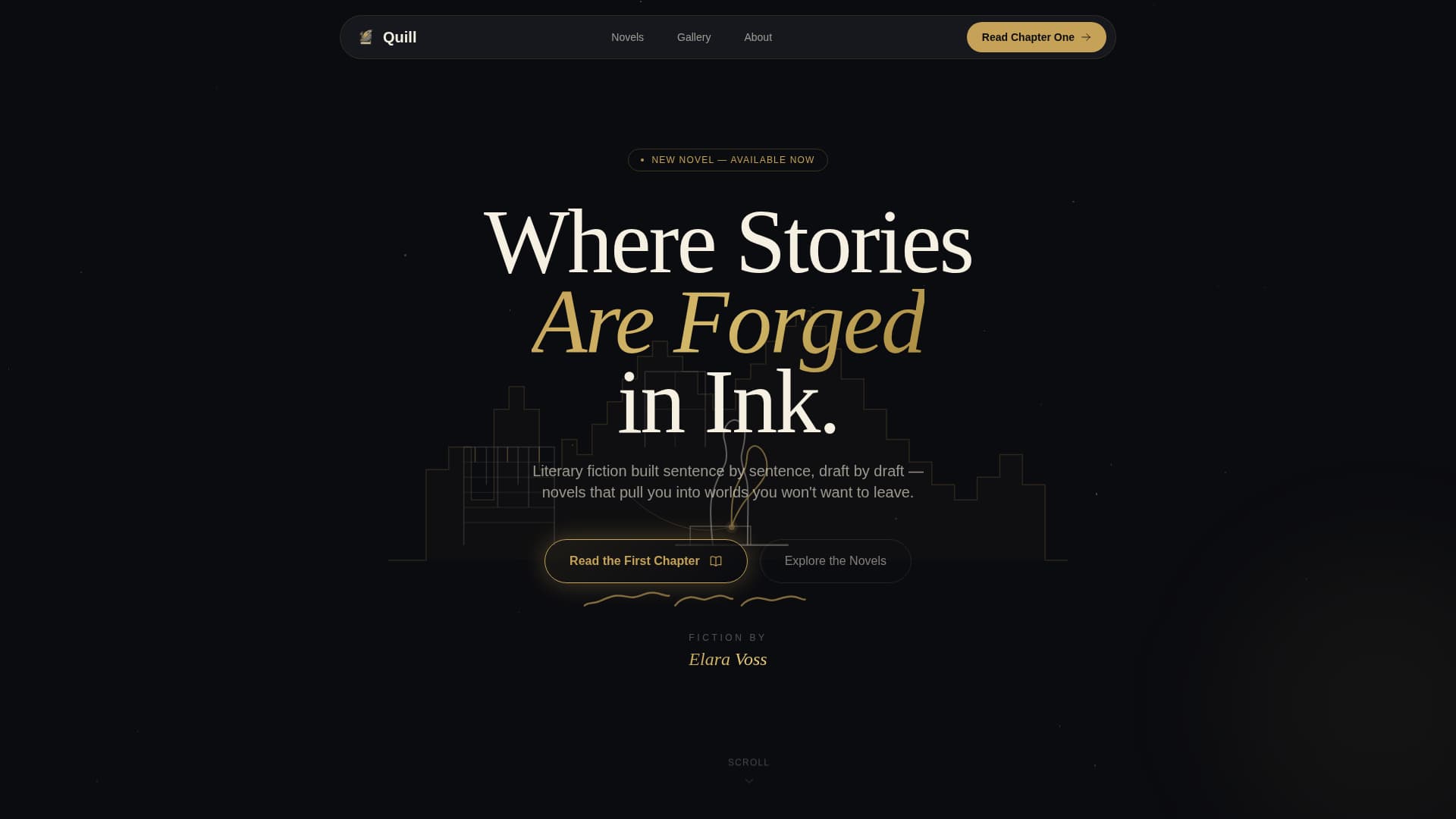
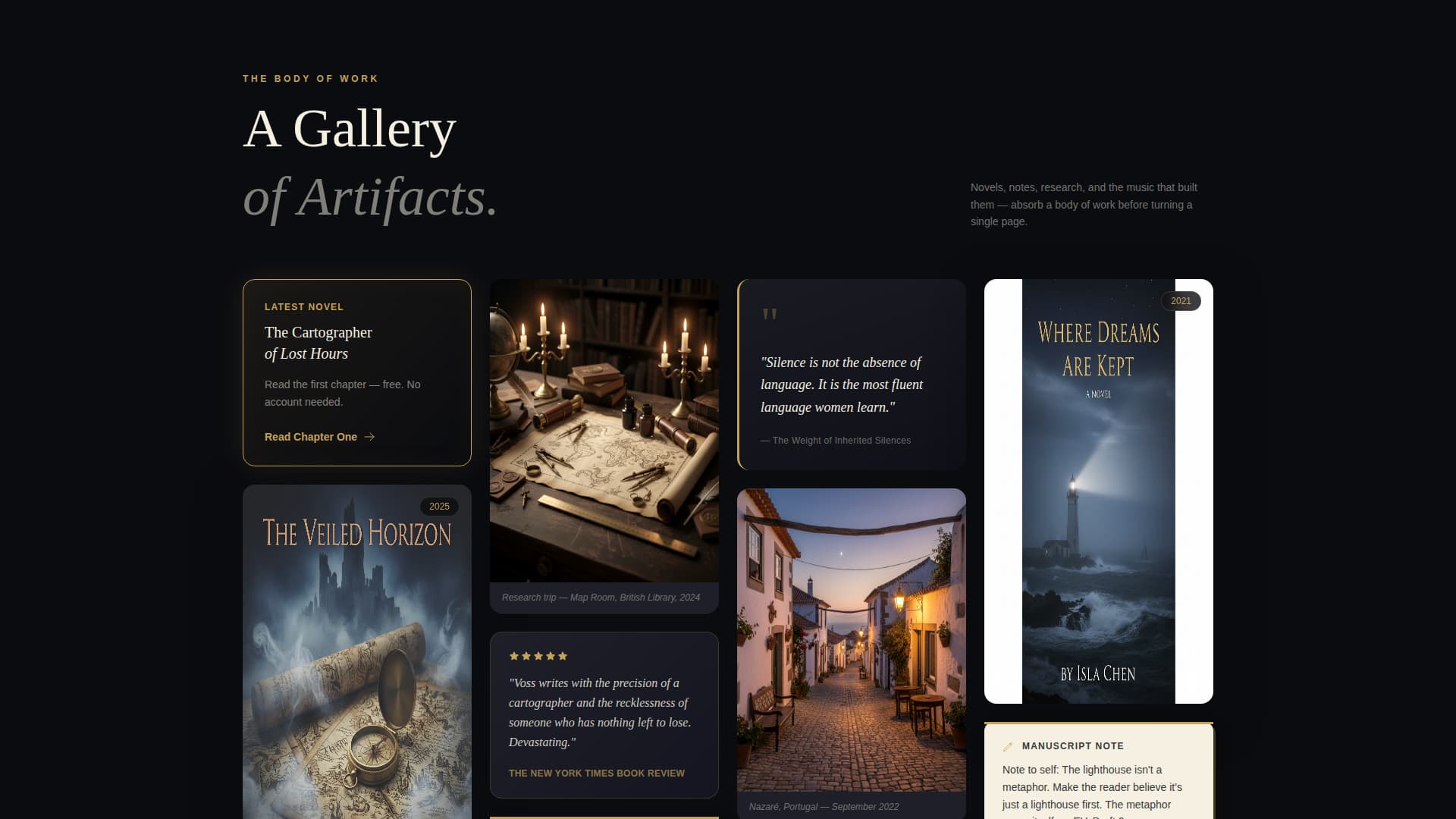
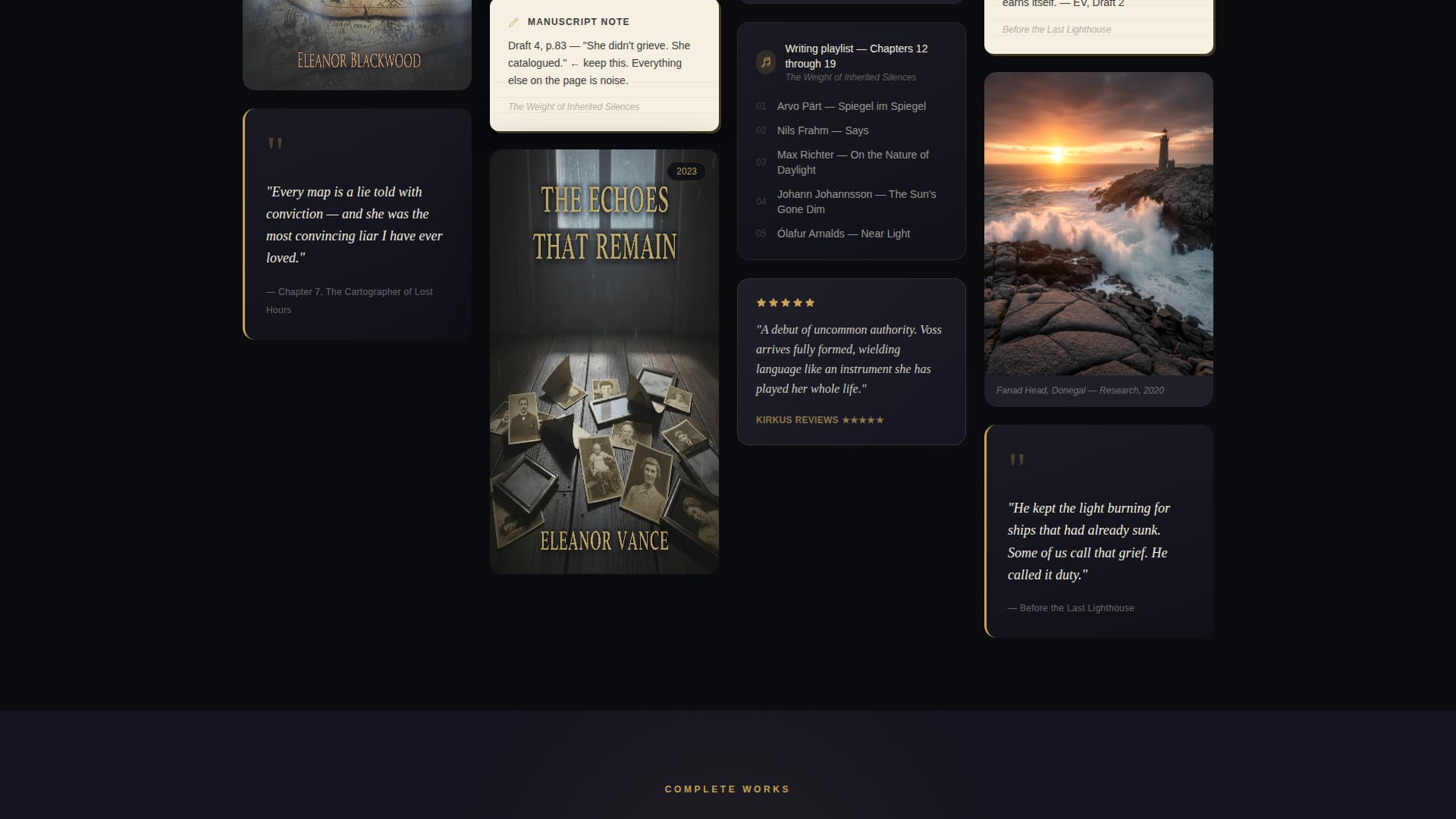
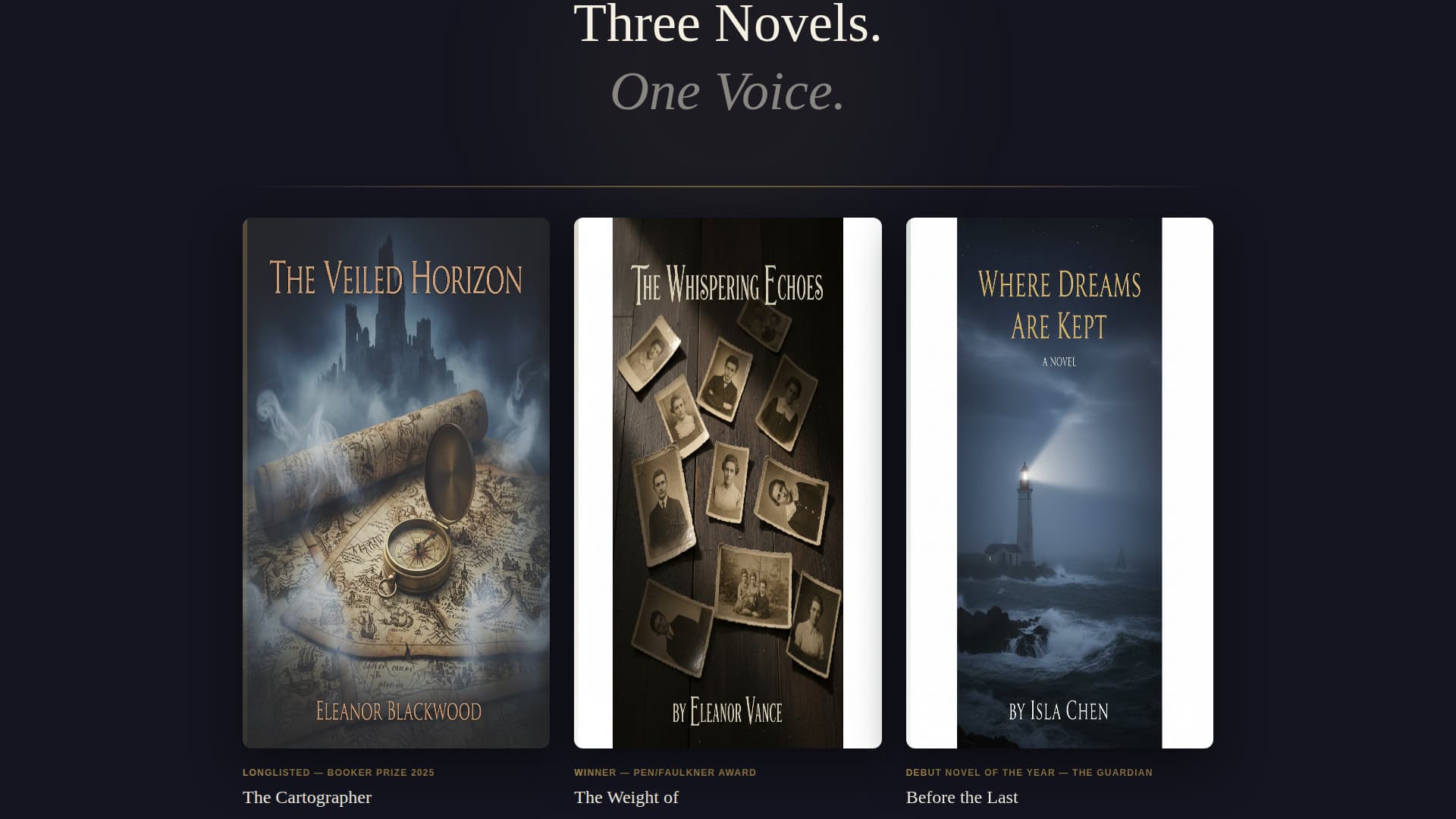
Quill is a masonry-style landing page template built for fiction authors who want their web presence to feel as compelling as their prose. With an animated ink-drawing header, a gallery-style scroll of literary artifacts, and a gold-accented Obsidian and Gold color system, Quill turns a single page into an immersive author experience that moves visitors toward reading the first chapter.
by Rocket studio
Loading preview…
Quick summary
Quill is a single-page fiction author landing page template built around a masonry gallery layout. It opens with a hand-drawn animated illustration, then guides visitors through a curated scroll of book covers, pull quotes, research photographs, and reviews. The design uses deep obsidian, warm parchment cream, and burnished gold to evoke a leather-bound first edition.
Who this template is for
Quill is made for literary fiction authors who want a web presence that reflects the depth and craft of their writing. It works equally well for debut novelists building their first online home and established authors refreshing an outdated site.
Fiction authors who want readers to feel the author's voice before opening the book
Book club organizers and indie bookstore curators looking to share author resources
Writers whose audience discovers them through social reading communities and word-of-mouth recommendations
What problem this template solves
Most author websites present a flat biography and a list of titles. That structure asks visitors to work hard for a reason to care. Quill reverses the dynamic entirely.
Visitors absorb a body of work through visual artifacts instead of reading a formal bio
The masonry gallery format removes the sterile, linear feel of traditional author pages
A clear path from sample chapter to purchase eliminates the friction that kills conversion
What you get with this template
Quill delivers a fully designed, single-page layout that functions as a literary exhibition space. Every visual element is intentional and connected to a specific moment in the author's creative world.
An animated ink-illustration header that builds itself over four seconds as the page loads
A masonry gallery grid where each card represents a different literary artifact tied to a novel
A pinned "Read the First Chapter" call-to-action card and a floating button that reappears after three scroll clusters
Theme
Atelier Studio
Creative direction
Gallery Walk
Color system
Obsidian & Gold
Style
Masonry/Pinterest
Direction
Click-Through
Page Sections
Animated Ink-drawing Header
Masonry Gallery Grid
Pinned Chapter Call to Action Card
Floating Scroll-triggered Call to Action Button
Sample Chapter Page and Retailer Modal
Obsidian and Gold Color System
Related questions
Who is Quill designed for?
Does Quill require visitors to fill out a form or create an account?
What types of content can the masonry gallery display?
What purchase options does the retailer modal support?
Can the animated header reflect different novel settings?
Feature list
This template packages several carefully considered components into one cohesive landing page experience. Each feature serves the page's core purpose: making a visitor feel they already know the author before they buy the book.
Animated Ink-Drawing Header
A hand-drawn illustration builds itself in real time as the page loads. A quill touches paper, ink spreads outward into a setting drawn from the latest novel, character silhouettes emerge within the linework, and the author's name writes itself in fluid script. The four-second sequence ends with the full scene rendered and breathing with subtle cursor-driven parallax.
Masonry Gallery Grid
The scroll is structured as a literary exhibition. Cards load in staggered clusters, each cluster anchored to one novel. Each card type represents a different artifact: a tilting book cover that reveals its synopsis on hover, a broadside-style pull quote, a research trip photograph, a handwritten revision note, a starred review fragment, or a listening playlist.
Pinned Chapter call to action Card
A gold-bordered "Read the First Chapter" card sits pinned at the top of the masonry grid. It is the first interactive prompt the visitor encounters and sets the conversion intent for the entire page without interrupting the gallery experience.
Floating Scroll-Triggered Button
After the visitor scrolls past three gallery clusters, a floating "Read the First Chapter" button appears. This reinforces the primary call to action at the precise moment engagement is highest, without requiring the visitor to scroll back to the top.
Sample Chapter Page with Retailer Modal
Clicking the chapter call to action opens a beautifully typeset dedicated page. A secondary "Order Your Copy" call to action on that page triggers a retailer selection modal offering indie bookstore, hardcover, ebook, and audiobook options. The flow requires no form and no account creation.
Obsidian and Gold Color System
The palette applies deep obsidian black to backgrounds, warm parchment cream to cards and text blocks, and burnished manuscript gold exclusively to hover states, pull quotes, and book cover spine accents. Gold appears rarely enough to feel earned rather than decorative.
Page sections overview
Section
Purpose
Animated Header Illustration
Opens the page with a four-second ink-drawing sequence that introduces the author's name and latest novel's world
Pinned call to action Card
Anchors the primary "Read the First Chapter" call to action at the top of the masonry grid
Novel Cluster One
First gallery cluster grouping artifacts tied to a specific novel
Novel Cluster Two
Second gallery cluster continuing the exhibition with a new novel's artifacts
Novel Cluster Three
Third gallery cluster completing the core scroll before the floating button activates
Floating call to action Button
Persistent button that appears after three clusters to re-surface the chapter reading prompt
Sample Chapter Page
Dedicated typeset page reached by clicking the chapter call to action
Retailer Selection Modal
Overlay presenting indie bookstore, hardcover, ebook, and audiobook purchase options
Design & branding system
The visual identity follows an Atelier Studio theme. Every design choice reinforces the feeling of a leather-bound first edition with gilded page edges. The overall impression is a private study at golden hour: warmly lit, deliberately arranged, and unmistakably literary.
Color palette: deep obsidian black (#0B0C10) for backgrounds, warm parchment cream (#F5F0E1) for cards and text blocks, burnished manuscript gold (#C5A258) for hover states and pull quotes, and muted charcoal (#3A3A3A) for body text
Gold is applied sparingly, only on hover states, pull quotes, and book cover spine accents, so each appearance feels intentional
Typography and card layout are styled to evoke a broadside poster for pull quotes and a gallery exhibition card for artifact entries
Mobile & speed optimization
The masonry layout adapts naturally to smaller screens, preserving the gallery feel without sacrificing readability. Cards reflow to single or double columns on mobile so the staggered cluster structure remains intact.
Staggered card loading keeps the gallery entrance effect visible on mobile without requiring simultaneous asset loads
The floating call-to-action button is positioned to remain accessible on touch screens without blocking card content
The sample chapter page and retailer modal are designed for comfortable reading and tapping on any screen size
How this template helps you convert
Quill is built around a single conversion goal: getting the visitor to read the first chapter and then order the book. Every structural decision supports that path.
The masonry gallery builds familiarity and trust before any purchase prompt appears, so the visitor arrives at the call to action already engaged with the author's voice and world.
The pinned call to action card and floating button place the "Read the First Chapter" prompt at two strategic moments in the scroll, making it easy to act without interrupting the browsing experience.
The retailer modal at the end of the sample chapter page removes all friction by presenting indie bookstore, hardcover, ebook, and audiobook options in one place, with no form to fill out.
Other information about this template
Quill fits naturally into the broader landscape of author website templates and personal portfolio pages designed for creative professionals. It is a strong choice for anyone building a fiction author website within the Personal and Resume category.
The template style is Masonry and Pinterest-inspired, making it visually distinct from standard list-based or column-grid author pages
The Atelier Studio theme and Obsidian and Gold color system are specifically matched to literary fiction aesthetics, not generic personal branding
Quill is categorized under Author and Writer templates, making it easy to find alongside other creative professional page designs