Military UAV & Drone Manufacturer Landing Page Template
Recon is a single-column landing page template built for military drone and unmanned aerial system manufacturers. It combines an Engineering Blueprint visual theme with a Case Study Narrative structure to guide procurement officers, program managers, and field commanders from technical proof to a qualified lead form. Every section earns trust before asking for action.
by Rocket studio
Quick summary
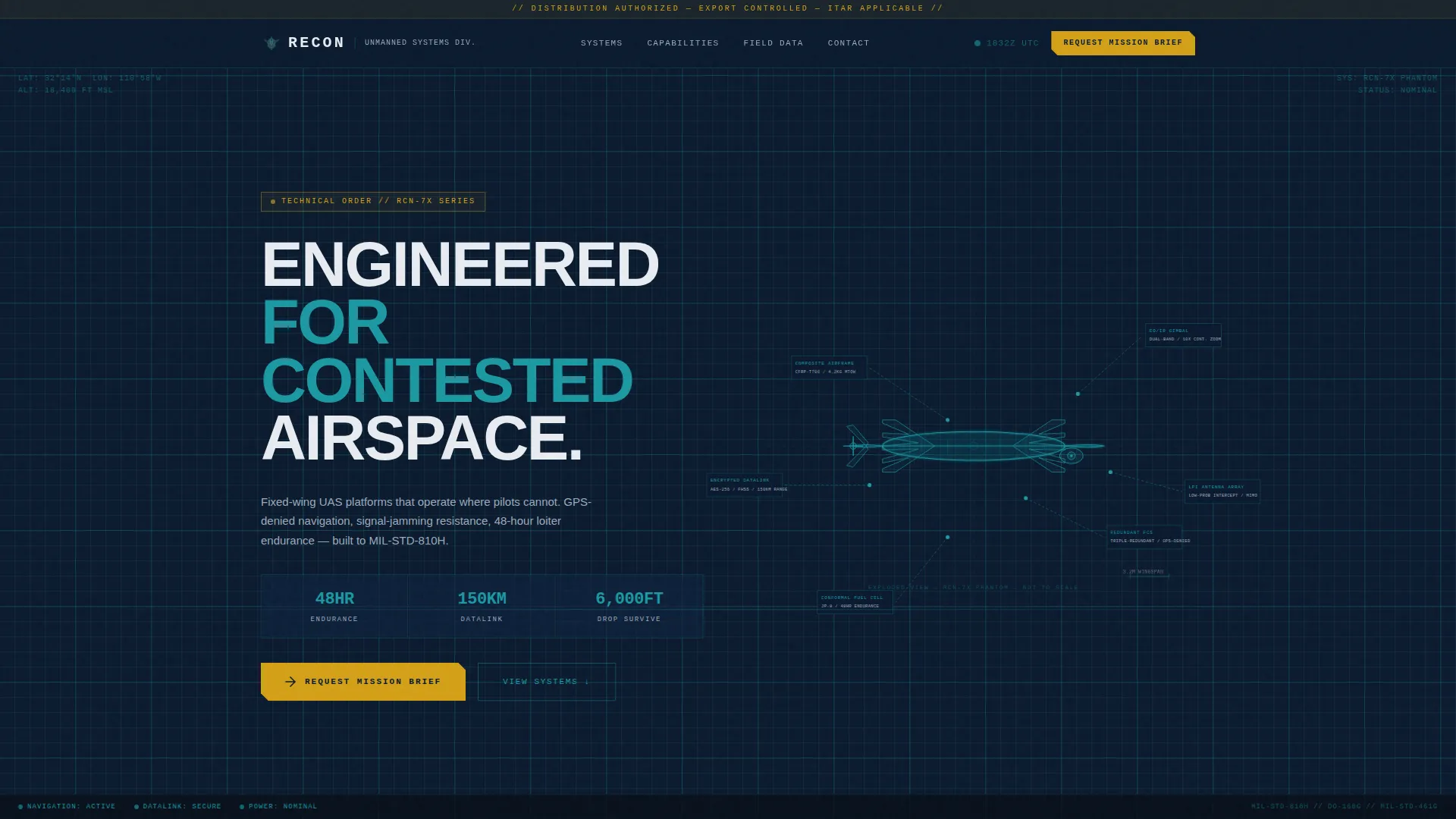
Recon is a lead generation landing page template designed for defense engineering firms in the unmanned aerial systems space. It opens with an animated exploded-view schematic of a fixed-wing UAV, then walks visitors through operational case studies with annotated cross-sections, thermal field footage, and hard performance data before presenting a gated contact form.
Who this template is for
This template is built for organizations that sell or procure unmanned aerial systems at a professional defense level. The intended audience operates in a high-scrutiny, budget-conscious environment where engineering credibility must be established before any sales conversation begins.
- Defense contractors and UAV manufacturers presenting capabilities to government buyers
- Procurement officers, program managers, and contracting officers evaluating unmanned aerial systems
- Field commands and engineering liaisons who need persistent intelligence, surveillance, and reconnaissance without risking a pilot
What problem this template solves
Defense-sector buyers do not respond to generic marketing. They need to see the engineering, the operational record, and the performance numbers before they will engage. Most templates cannot carry that level of technical authority. Recon is built specifically for this gap.
- Standard templates lack the visual language and structural depth that defense procurement audiences expect
- Firms lose qualified leads when their page cannot convey system survivability, field-tested performance, or mission-specific capability
- There is no clear low-friction path for buyers who are not yet ready to commit to a full briefing request
What you get with this template
Recon delivers a complete single-column landing page structured as a progressive technical briefing. Every section is designed to deepen reader engagement before surfacing a call to action.
- An animated exploded-view header with cyan leader lines, MIL-SPEC component labels, and a subtle assembly sequence
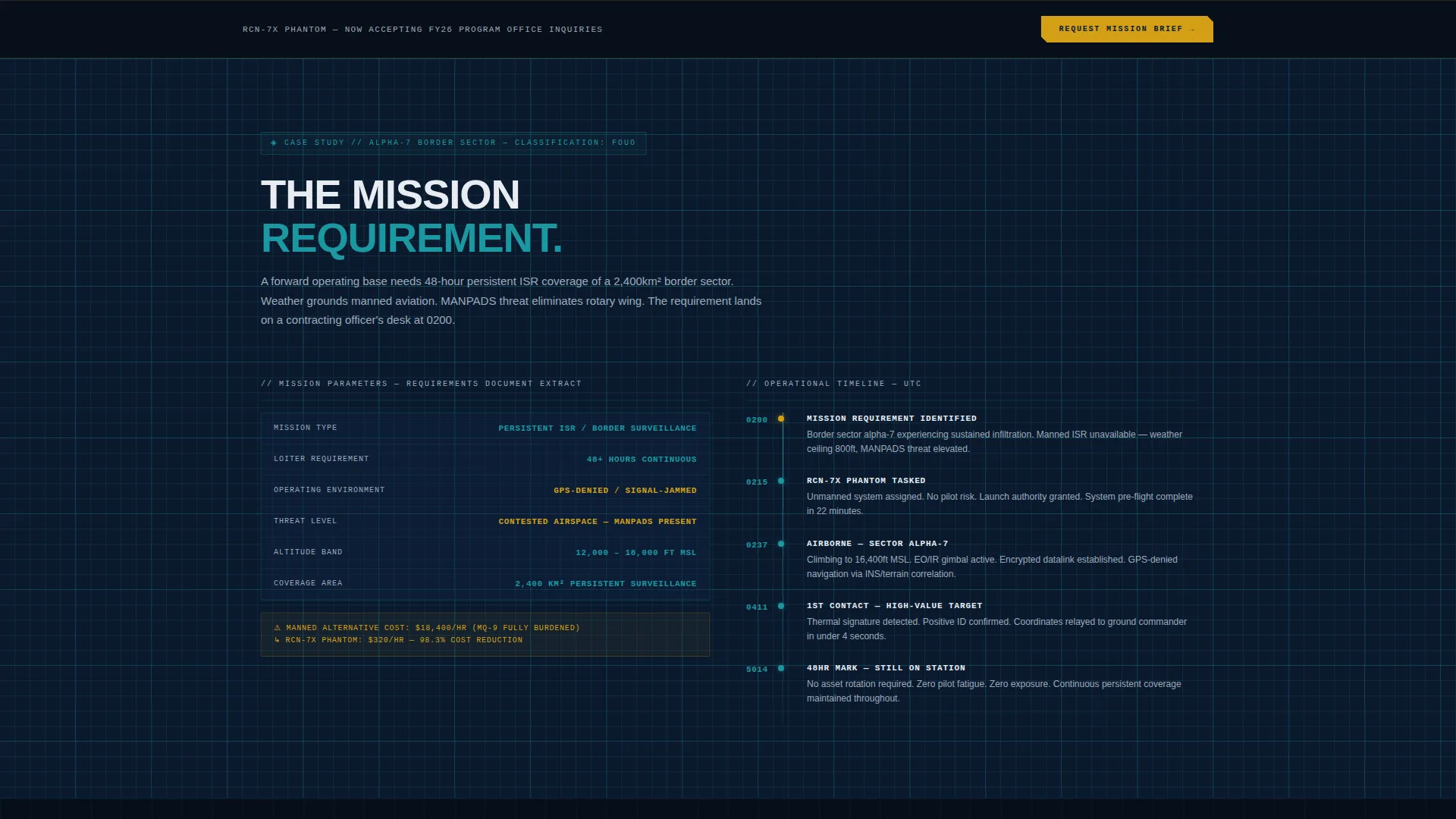
- Scrolling case study sections covering mission requirement, engineering response, field deployment footage, and measurable outcome data cards
- Two lead capture paths: a detailed mission brief request form and a lighter-commitment capability sheet download gated behind email and organization
Feature list
The template includes the following purpose-built capabilities drawn directly from the design and functional brief.
Exploded View Assembly Header
The header renders an isometric breakdown of a fixed-wing UAV against a deep navy background. Each subsystem, including composite airframe, electro-optical and infrared gimbal, encrypted datalink module, redundant flight controller, and conformal fuel cell, floats in position with thin cyan leader lines and MIL-SPEC nomenclature. A subtle assembly animation pulls every component into flight configuration on page load.
Operational Case Study Flow
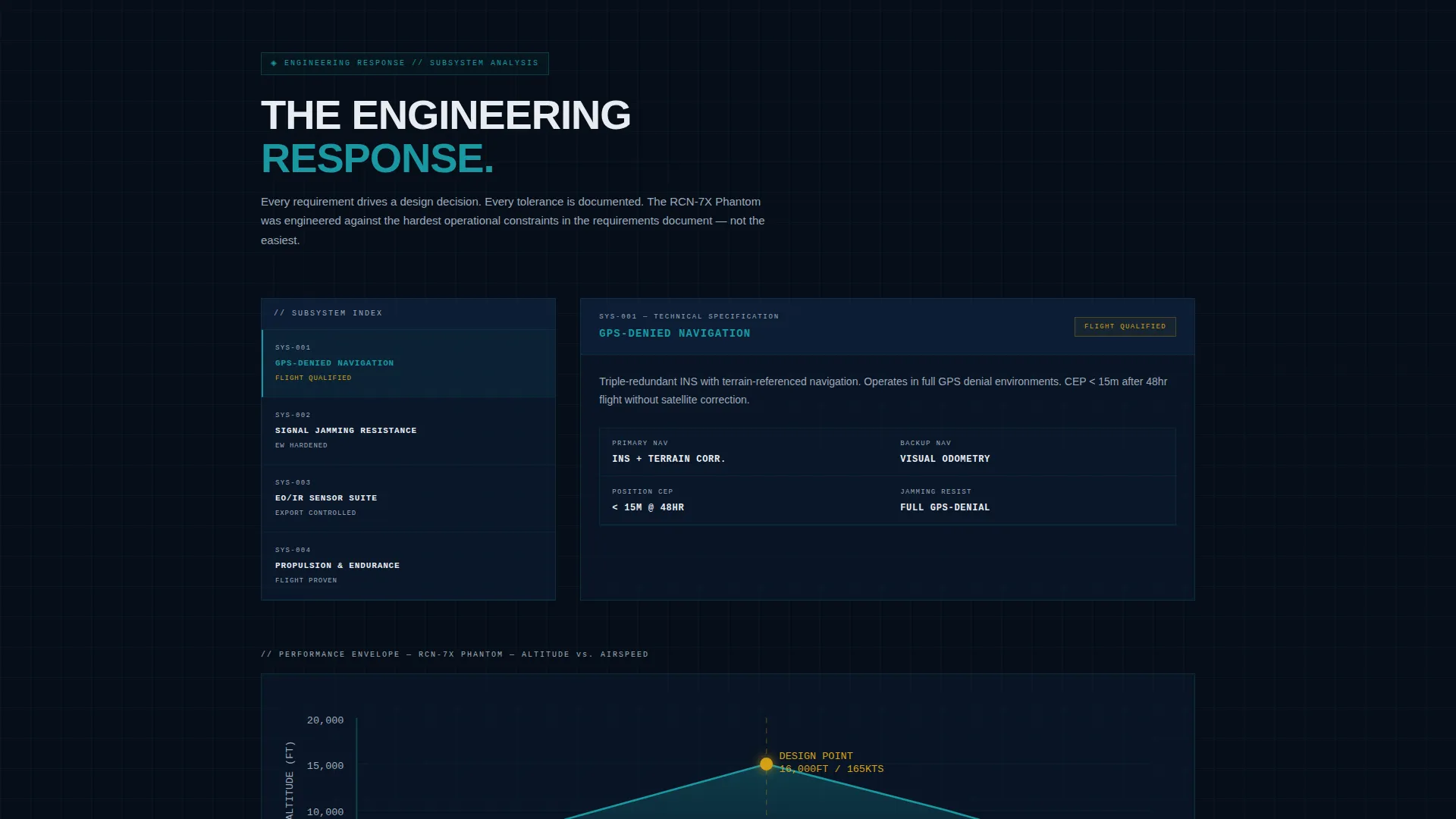
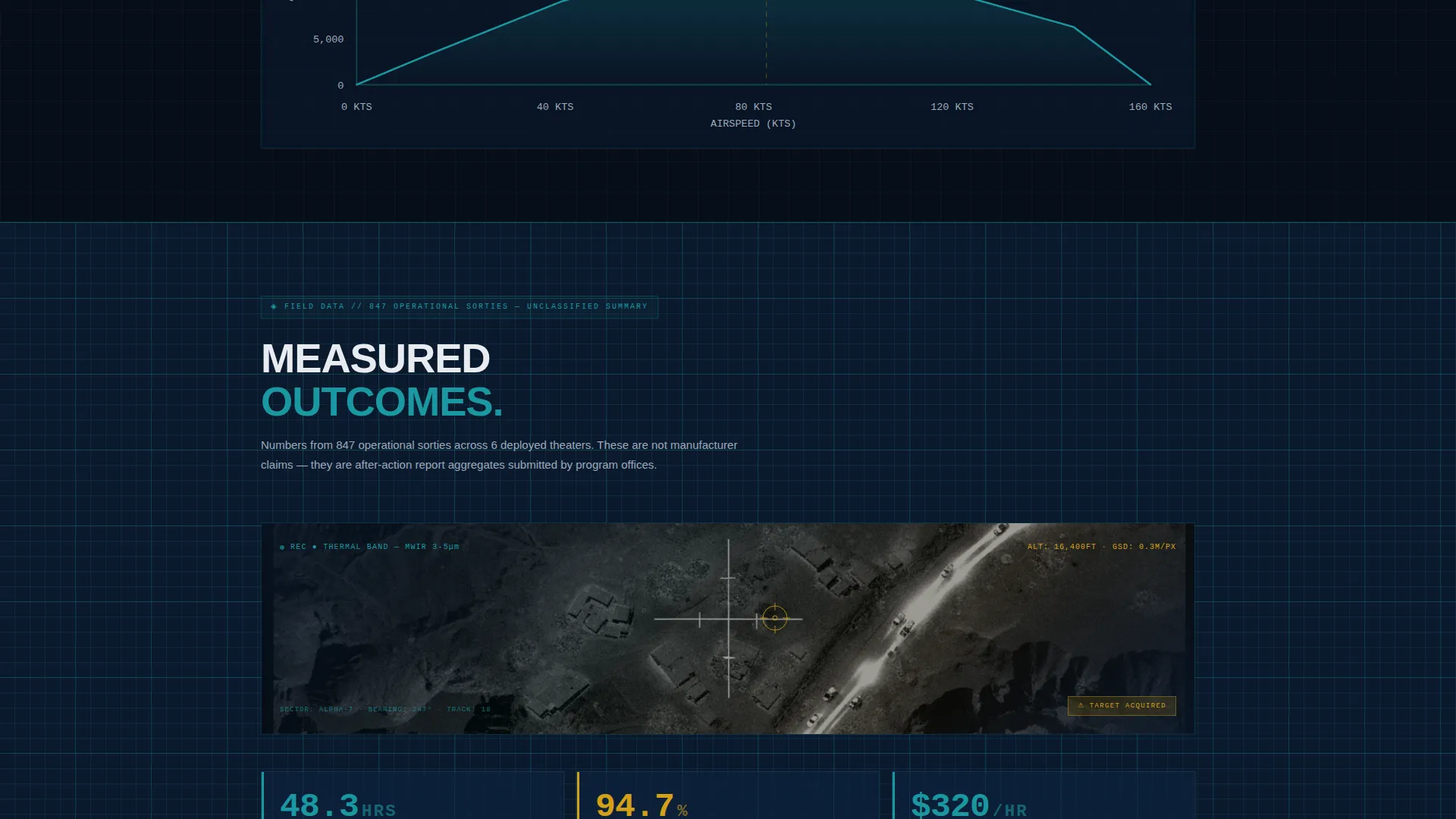
After the header assembles, the page drops the visitor into a real mission scenario. Each case study moves through four stages: the mission requirement, the engineering response with annotated cross-sections and performance envelopes, grainy thermal field deployment footage, and stark data cards showing measurable outcomes such as hours on station, detection rate, and cost-per-flight-hour versus manned alternatives.
Dual Lead Capture System
The primary call to action, labeled "Request Mission Brief" in warning amber, appears after the header and repeats after each case study. A secondary path offers a "Download Capability Sheet" gated behind email and organization only, providing a lower-commitment entry point that feeds the same lead pipeline.
Navy Authority Color System
The palette uses deep command navy for all backgrounds, technical grid cyan for linework and interactive highlights, spec-sheet white for body text and data labels, and warning amber reserved exclusively for calls to action and critical callouts. No lifestyle imagery is used anywhere on the page.
Structured Lead Capture Form
The mission brief request form collects name, organization, role via dropdown (Program Manager, Contracting Officer, End User, Engineering Liaison), mission type via dropdown (Intelligence Surveillance Reconnaissance, Strike, Logistics, Counter-Unmanned Aerial Systems), and a free-text field labeled "Operational Requirement." This structure pre-qualifies every inbound lead before the first conversation.
Escalating Clearance Narrative
Each successive case study increases in operational complexity and classification level. This escalating structure creates a briefing-style reading experience that pulls technically sophisticated buyers deeper into the page, building credibility progressively rather than front-loading claims.
Page sections overview
| Section | Purpose |
|---|---|
| Exploded View Header | Introduces UAV system with animated assembly and MIL-SPEC component labels |
| Primary call to action Block | First "Request Mission Brief" prompt in amber after header assembly |
| Mission Requirement | Opens first case study with operational scenario and surveillance parameters |
| Engineering Response | Annotated cross-sections and performance envelopes for the stated requirement |
| Field Deployment Footage | Grainy thermal real-world footage establishing field-tested credibility |
| Outcome Data Cards | Hard metrics: hours on station, detection rate, cost-per-flight-hour comparisons |
| Case Study call to action | Repeating amber call to action after each case study conclusion |
| Capability Sheet Gate | Secondary download path gated by email and organization only |
| Mission Brief Form | Full lead capture form with role and mission type dropdowns |
Design & branding system
The visual identity follows an Engineering Blueprint theme with a Navy Authority color system. Every design decision reinforces the impression of a classified technical order displayed on a mission planning terminal.
- Deep command navy (#0B1A2E) dominates all backgrounds; technical grid cyan (#1B98A2) traces linework and interactive highlights; spec-sheet white (#E8ECF1) carries all body text and data labels
- Warning amber (#D4A017) is used exclusively for calls to action and critical callouts, giving it maximum visual urgency against the navy field
- No lifestyle imagery or decorative elements appear anywhere; the engineering schematics, annotated cross-sections, and thermal field footage serve as the sole visual content
Mobile & speed optimization
The single-column flow structure adapts naturally to smaller screens without requiring layout restructuring. The deliberate, content-led design keeps the page focused and load-efficient.
- Single-column layout means no complex grid reflow on mobile devices; content stacks cleanly at every viewport width
- The page avoids decorative imagery and stock photography, keeping asset weight low and load time manageable
- Amber call to action buttons remain visually prominent on dark navy at all screen sizes, maintaining conversion clarity on mobile
How this template helps you convert
The Recon template is built around the principle that technical buyers must be convinced before they are asked to act. Every structural decision supports this sequence.
- The exploded-view assembly and case study narrative build engineering credibility progressively, so by the time a call to action appears, the reader already trusts the capability being offered.
- Two lead capture options reduce friction: the full mission brief form captures highly qualified buyers, while the capability sheet download captures earlier-stage prospects with minimal commitment, keeping both segments in the pipeline.
Other information about this template
Recon is a purpose-built template for the military drone and unmanned aerial systems market. It is well-suited for defense contractors, unmanned aerial vehicle program offices, and aerospace and defense firms entering new procurement cycles.
- The template is designed for the Aerospace and Defense category, specifically the Defense Contractor and Military subcategory, with a niche focus on military drone and UAV manufacturers
- The single-column flow and case study narrative structure make it appropriate for any unmanned aerial system capability page, whether for fixed-wing UAVs, multi-rotor platforms, or counter-unmanned aerial systems programs
- The template style, Engineering Blueprint, and the Navy Authority color system are designed to communicate authority and precision to technically sophisticated government and defense buyers
Theme
Engineering Blueprint
Creative direction
Case Study Narrative
Color system
Navy Authority
Style
Single Column Flow
Direction
Lead Generation
Page Sections
Animated Exploded View Header
Four-stage Case Study Sections
Escalating Narrative Structure
Structured Mission Brief Form
Low-friction Capability Sheet Download
Navy Authority Color System
Related questions
Who is the Recon template designed for?
What lead capture options does the template include?
Can the case study sections be adapted for different mission types?
Does the template use any stock photography or lifestyle imagery?
What makes the color system appropriate for defense procurement audiences?