Complete Directory & Marketplace Platforms Appointment Booking Website Template
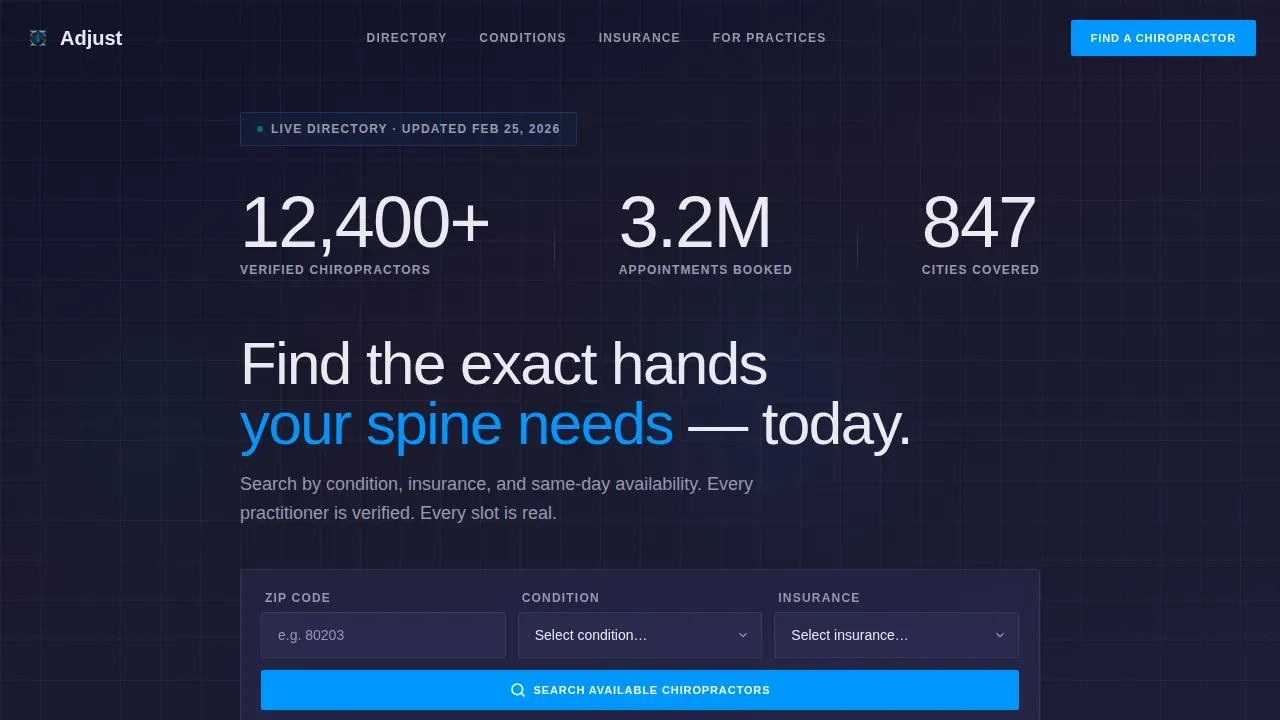
Adjust is a modular card-grid landing page built for chiropractic directories. It pairs a live-counter stats wall with a three-field search bar, then surfaces results as compact spec cards showing technique tags, star ratings, insurance badges, and next available slots. The dark Carbon Fiber palette signals clinical precision, while every design decision moves visitors toward booking the right chiropractor faster.
by Rocket studio
Quick summary
Adjust is a single-page chiropractic directory template built around searchability and speed. It opens with a stats wall of animated counters, drops immediately into a three-field search experience, and organizes results in a modular card grid. Each card reads like a precision spec sheet: technique tags, distance, availability, and insurance badges all visible at a glance.
Who this template is for
This template is built for founders, developers, and product teams launching a health services directory in the chiropractic space. It is equally useful for a chiropractic clinic network wanting to showcase multiple practitioners under one roof.
- Teams building a B2C chiropractic directory that needs to connect chiropractic patients with verified local providers quickly
- Developers or agencies creating a high converting chiropractic website for a multi-practitioner practice or regional clinic group
- Marketers who want a visually credible chiropractic website design that supports strong patient acquisition without starting from scratch
What problem this template solves
Patients search for chiropractic care in urgent, location-driven moments. An office worker with sudden neck pain or a weekend athlete dealing with a sports injury does not have patience for cluttered layouts or hidden phone numbers. Patients rarely search past the first result, and a slow or confusing page loses them before the first scroll. This template solves the core disconnect between urgent need and friction-heavy discovery.
- People looking for a back pain chiropractor or an auto accident chiropractor need availability and proximity surfaced immediately, not buried three clicks deep
- Existing directory templates ignore technique differentiation, leaving chiropractic patients unable to tell a Gonstead specialist from a general wellness provider
- Most chiropractic website design options lack the clinical authority signals that healthcare providers need to earn trust before a booking decision
What you get with this template
You get a fully structured, single-page layout with five distinct content zones, each engineered for a specific conversion role. The visual system, typography, and component logic are production-ready from the first load.
- A hero section with three animated stat counters, a three-field search bar (zip code, condition, insurance), and an SVG grid background
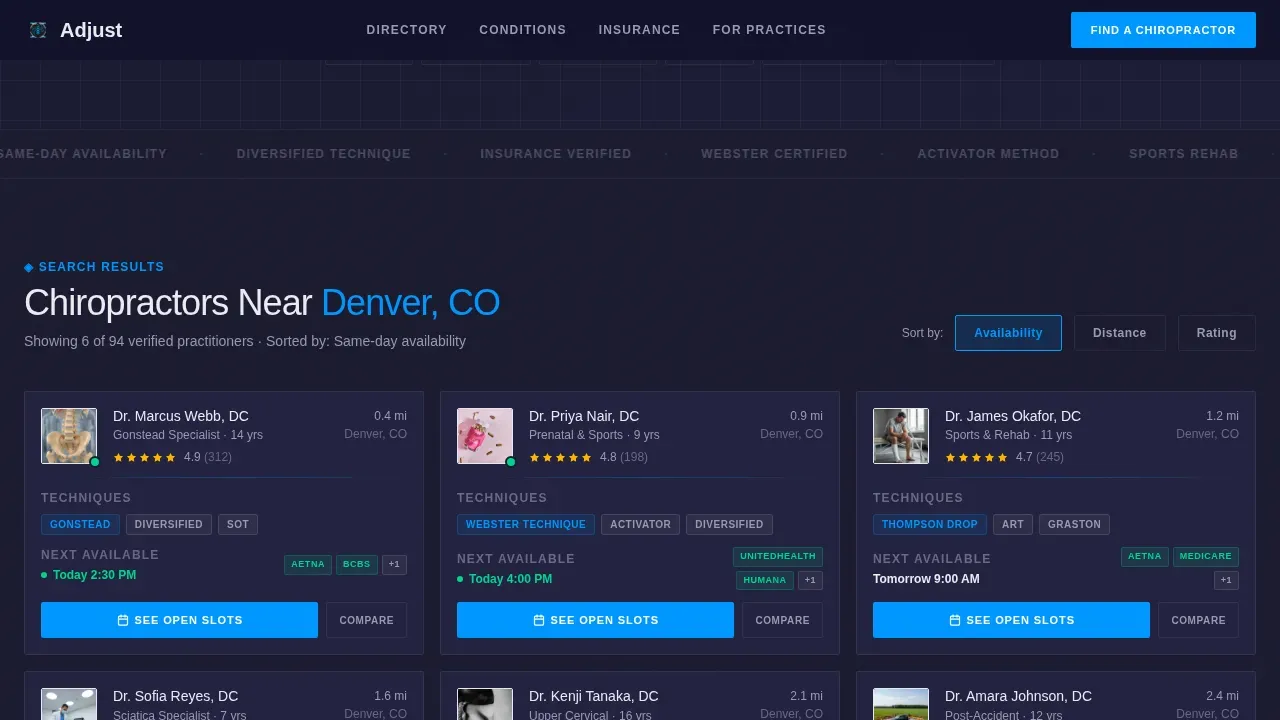
- A modular results grid of chiropractor spec cards, each carrying technique tags, star ratings, distance, next available slot, and insurance badge indicators
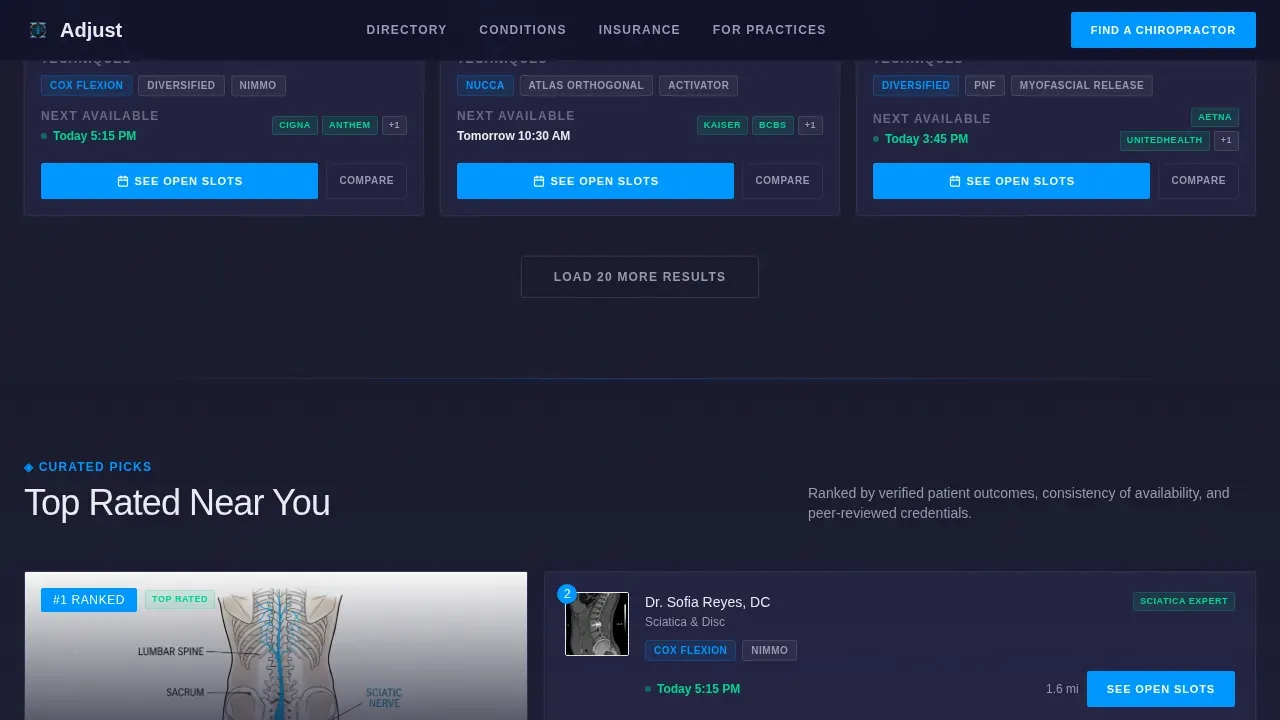
- Curated upper sections including a "Top Rated Near You" block with a compare toggle, condition-specific collection modules, and a vetting process trust panel
Feature list
This template is built around five tightly scoped feature sets. Each one maps directly to a real moment in the visitor's decision journey.
Animated Stats Wall with Three-Field Search
The hero opens with three oversized count-up counters set against cockpit black: verified provider numbers, total appointments booked, and cities covered. Directly below, a prominent search bar sits above the fold with fields for zip code, condition dropdown, and insurance provider. Positioning the search bar in the hero section gives patients immediate access to the tool they came for, reducing the steps between arrival and action.
Chiropractor Spec Card Grid
Each card in the results grid is structured like a compact dossier. It shows a headshot, a star rating, technique tags (Gonstead, Diversified, Activator, Thompson Drop), distance from the user, the next available appointment slot, and insurance badge indicators. The layout draws from a Spec Sheet creative direction, so scrolling feels like paging through precision-cut parts catalog entries rather than a generic list of names and phone numbers. This structure helps chiropractic patients compare providers on the details that actually matter for their condition.
Compare Toggle for Side-by-Side Practitioner Review
A secondary interaction path lets visitors select two or three practitioners and stack them side by side. The compare view surfaces technique, star rating, and wait time in a parallel layout. This feature directly supports the visitor who is choosing between a sports injury chiropractor and a neck pain treatment specialist and needs a fast, rational way to decide without leaving the directory.
Condition-Specific Collection Modules
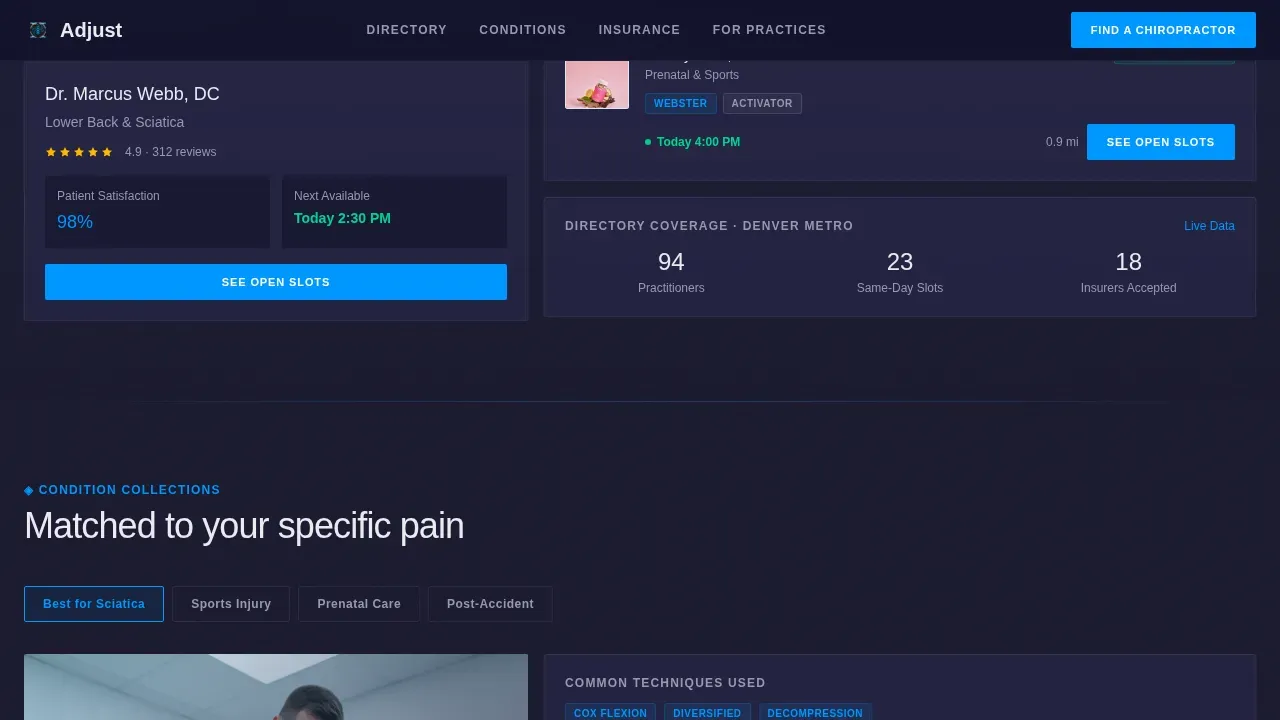
Below the main results grid, the template organizes curated groupings by condition type: sciatica, sports injury, prenatal care, and post-accident recovery. Each collection acts as a focused service section, helping patients whose search intent is condition-specific land on a pre-filtered view without re-typing. These modules reinforce that the directory has done the vetting, not just the listing.
Vetting Process Trust Panel
A dedicated section explains how each listed practitioner has been reviewed and verified. This panel uses a process spec sheet layout rather than stock imagery, leaning on structured information to build credibility. Displaying certifications, verification steps, and board signals here aligns with best practice for healthcare websites that need to earn trust before asking for a booking commitment.
Page sections overview
| Section | Purpose |
|---|---|
| Hero Stats Wall | Display animated counters and three-field search bar |
| Results Card Grid | Show chiropractor spec cards with technique and availability |
| Top Rated Nearby | Curated top picks with compare toggle functionality |
| Condition Collections | Condition-grouped modules for sciatica, sports, prenatal, post-accident |
| Vetting Trust Panel | Explain practitioner verification process and credibility signals |
| Footer Single Row | Provide navigation links in a minimal linear layout |
Design & branding system
The visual identity follows a Carbon Fiber color system built to feel like the interface of a high-end diagnostic console. It is clinical without being cold, and technical enough to signal that the directory treats spinal health with serious intent.
- Core palette: cockpit black (#1A1A2E) for backgrounds, titanium panel gray (#30305A) for card surfaces, diagnostic white (#EAEAF0) for body text and labels, and activation blue (#0096FF) for hover states, search fields, and call to action pulses
- Typography: Manrope in bold weights for headings and counters, DM Sans for body text, card tags, and badge labels, creating a clear visual hierarchy between information layers
- No stock photography of generic smiling subjects; the stat counters and spec card data carry the credibility weight, keeping clinic interior and provider imagery purposeful rather than decorative
Mobile & speed optimization
Over 60% of healthcare searches occur on mobile devices, and approximately 70% of chiropractic searches specifically happen on smartphones. This template is built mobile-first, with layout decisions driven by thumb reach and small-screen legibility.
- Search filters, card call to action buttons, and compare toggles are sized for thumb-friendly tapping, meeting the recommended minimum of 44 to 48 pixels in height for interactive elements on mobile devices
- The card grid reflows cleanly from a multi-column desktop layout to a single-column stacked view on smaller screens, keeping the spec card dossier format intact and readable for mobile users
- Server Components handle static sections like the stats wall and trust panel, while Client Components manage interactive search fields, count-up animations, card hover states, and the compare toggle, keeping the interactive layer responsive without bloating the initial load
How this template helps you convert
Every layout decision in this template is oriented around reducing the distance between "I have back pain" and "I booked an appointment." The design treats conversion as a sequence of small, confident steps rather than a single high-pressure ask.
- The stats wall at the top of the page functions as instant social proof before the visitor has read a single word of copy. Live counters showing verified providers, booked appointments, and cities covered answer the trust question immediately, so the three-field search bar below it becomes an invitation rather than a gamble. A clear call to action on every card reading "See Open Slots" routes visitors directly to a booking profile without dead ends.
- The card grid frontloads the four pieces of patient information that drive decisions: availability, proximity, technique specialization, and insurance acceptance. When patients search and see a result that matches their insurance plan and shows a same-day slot, the friction to book drops significantly. The compare toggle adds a rational second path for visitors who are deciding between two strong matches rather than picking blindly.
- The condition collection modules act as pre-filtered entry points, so a visitor who lands thinking "I need a neck pain treatment specialist" does not have to re-search. They scroll to the relevant collection, scan the curated cards, and find a match without cognitive overload. This approach mirrors how a high converting chiropractic website should behave: it does the sorting work so the visitor can focus on the decision.
Other information about this template
This template is designed to support a broad set of chiropractic practice growth strategies beyond the directory itself. The layout structure anticipates that the teams using it will want to connect the directory to wider digital marketing and local visibility efforts.
- Chiropractic SEO and chiropractor seo efforts benefit from a structured landing page because search engines can crawl condition-specific sections and index them as targeted treatment pages. Using LocalBusiness schema markup alongside the template helps search engines understand location, services, and operating hours. Implementing Medical schema markup further signals the clinical context of the content to search engines, improving chiropractic seo outcomes.
- The template structure supports local SEO by giving each condition collection module its own scoped content block, which teams can extend into individual landing pages for different cities. Creating location-specific service pages is one of the most reliable chiropractors local seo tactics for improving local search rankings and appearing in local search results for queries like "chiropractor near me." Local SEO focuses on geographic relevance, and this template's zip code search field directly mirrors how patients search locally.
- For chiropractic website owners already investing in local SEO efforts, aligning the Name, Address, and Phone number (NAP) data displayed in the directory with what appears on a Google Business Profile is critical. Inconsistencies in NAP data harm local seo efforts and reduce search visibility. Your Google Business Profile is your most important local SEO asset, and Google rewards complete profiles with better placement in local search results.
- Google Maps integration is a natural extension of this template's zip code and distance features. When a chiropractor's card shows distance from the user, that data can be tied to Google Maps to give patients a visual reference. Google Maps also surfaces practitioner pins in local search results, reinforcing the directory's local relevance for each listed provider. Optimizing a Google Business Profile to appear on Google Maps increases the chances of appearing when patients search via Google search or on mobile devices.
- The Google search console can help teams monitor which condition-specific pages are generating organic traffic and which treatment pages need additional content depth. Tracking local search behavior through Google search console data helps prioritize where to invest in service pages and educational content. Implementing well-crafted page titles and a focused meta description for each treatment section improves page seo and increases click-through from search results.
- Patient testimonials and video testimonials are trust accelerators for any chiropractic practice. Displaying patient success stories alongside verified star ratings mirrors the review signals that prospective patients check before choosing a healthcare provider. Research shows that 90% of consumers read reviews before selecting from healthcare providers, and chiropractors with strong positive reviews can rank up to 25% higher in local search results.
- Local link building between the directory and chiropractic associations, local businesses, and community health organizations strengthens the domain authority behind the chiropractic site. Partnerships with local businesses can generate backlinks from other websites, improving the directory's standing with search engines over time. Local link building combined with a well-maintained Google Business Profile represents one of the most cost-effective seo strategies available to a chiropractic clinic.
- Localized content marketing supports both patient engagement and search visibility. Creating educational content that answers community-specific questions about chiropractic care, such as "how to fix a herniated disc without surgery," attracts patients ready for treatment. This kind of content targets long-tail queries that patients search for in high-intent moments, and it complements the directory by driving organic traffic to condition treatment pages.
- The Carbon Fiber design system avoids the visual clichés common in the medical industry. Rather than relying on professional photography of treatment rooms or clinic interior shots as the primary trust mechanism, it uses structured data, live counters, and spec card layouts to signal authority. When professional photography is used, it is purposeful: headshots on each practitioner card, not generic stock imagery.
- This template works well alongside paid advertising campaigns that drive traffic to specific condition collection sections. Running paid ads to a sciatica collection or sports injury module delivers visitors who arrive already filtered by intent, reducing wasted spend. Paid advertising combined with strong local SEO gives a chiropractic practice two complementary channels for patient acquisition.
- The adjust searchable spinal care directory landing page template is built on a component architecture that supports content management systems for teams that need to update practitioner listings, condition tags, or insurance badge data without rebuilding the layout. Patient portals can be linked from individual booking profile pages that each card's call to action routes to, creating a seamless handoff from the directory into the clinic's scheduling system.
- The chiropractic site structure keeps service pages scoped and skimmable, which matters when mobile users are searching in pain and need answers fast. Patients rarely search for general wellness options when they are in acute discomfort. They search for a specific pain chiropractor, a back pain chiropractor, or an auto accident chiropractor who can see them today. This template is designed around that urgency.
- Chiropractic associations and regional health networks can use this template to consolidate local search behavior data and surface the right healthcare providers in the right geographic areas. Building local relevance into each section of the directory strengthens the connection between the chiropractic care offered and the communities that need it most. Strong local relevance also improves how search engines score the directory against broader medical website competitors.
- For teams tracking website traffic across multiple channels, the template's clean URL structure and distinct section anchors make it straightforward to assign UTM parameters to different entry points. Whether visitors arrive via google search, paid advertising, or referral links from other websites, each section can serve as a scoped landing target that is easy to track and optimize.
- Chiropractic treatment information displayed in the spec cards, such as technique tags and condition specializations, functions as patient information that reduces the research burden. When chiropractic patients arrive on this page, they do not need to visit multiple other websites to understand the difference between Gonstead and Activator methods. That compression of the research journey is what separates a purposeful directory from a generic list.
- Neck pain, chronic back pain, sports injury, prenatal discomfort, and post-accident pain each represent distinct patient journeys. The condition collection modules in this template acknowledge that back pain relief means something different to a weekend runner than it does to a new mother. Organizing the directory around those distinctions improves local search behavior matching and keeps chiropractic care feeling personal rather than transactional.
Theme
Directory & Discovery
Creative direction
Spec Sheet
Color system
Carbon Fiber
Style
Card Grid (Modular)
Direction
Click-Through
Page Sections
Animated Stats Wall and Search Bar
Chiropractor Spec Card Grid
Compare Toggle for Practitioner Side-by-side View
Condition-specific Collection Modules
Vetting Process Trust Panel
Related questions
Can I customize the condition dropdown and technique tags on the cards?
Does this template work for a single clinic as well as a large directory?
How does the compare toggle help visitors decide between practitioners?
Is this template suited for mobile users searching in an urgent moment?
What trust signals does the template include for prospective patients?