Optometry Software Appointment Booking Website Template
Claimscycle is an AI-driven optometry revenue recovery landing page template built for claims management professionals who are tired of watching insurance claims stall in denial queues. It combines a modular card grid layout, animated performance metrics, and a lead-capture system designed to turn rejected remits into booked consultations and actual revenue recovered.
by Rocket studio
Quick summary
Claimscycle is a modular, card-grid landing page template purpose-built for optometry revenue cycle professionals. It opens with three animated counter stats, unfolds into a clickable feature matrix of six claims management capabilities, and closes with a dual-path lead capture system. Every section is designed to move billing managers and practice owners toward one clear action: booking an accounts receivable audit.
Who this template is for
This template was designed for a specific slice of the healthcare system: people whose days are defined by rejected insurance claims, aging accounts receivable buckets, and the quiet dread of write-off deadlines approaching. It speaks their language without softening the problem.
- Independent optometry practice owners managing one to three providers who are drowning in denied remits from vision payers and struggling to stabilize cash flow.
- Billing managers at multi-location optical chains who toggle between multiple payer portals daily and need a claims processing solution that matches the complexity of their workload.
- Finance and operations directors at private-equity roll-ups normalizing revenue cycle management metrics across dozens of acquired practices simultaneously.
What problem this template solves
Most denials are predictable outcomes of unstable workflows rather than one-off billing mistakes. Yet healthcare providers keep losing the same revenue to the same payer rules, month after month, because the right tools are never surfaced clearly enough to reach decision-makers. This template fixes the presentation problem. It gives an AI-driven optometry revenue recovery service a landing page experience that matches the precision of the product itself.
- Practices lose meaningful lost revenue to claim denials that go unworked past appeal windows, and no existing page design communicates the urgency or the solution side-by-side effectively.
- Healthcare organizations serving optometry clients need a digital entry point that builds credibility fast, presents capabilities as a diagnostic tool, and captures leads before visitors bounce to a competitor.
- The financial impact of uncollected claims compounds over time, potentially leading to reduced cash flow, strained labor costs, and difficulty sustaining patient care operations across growing practice networks.
What you get with this template
This template delivers a fully structured, data-forward landing page built around six core capability cards, three conversion touchpoints, and a visual identity calibrated to feel clinical without feeling cold. Everything below is included in the template as delivered.
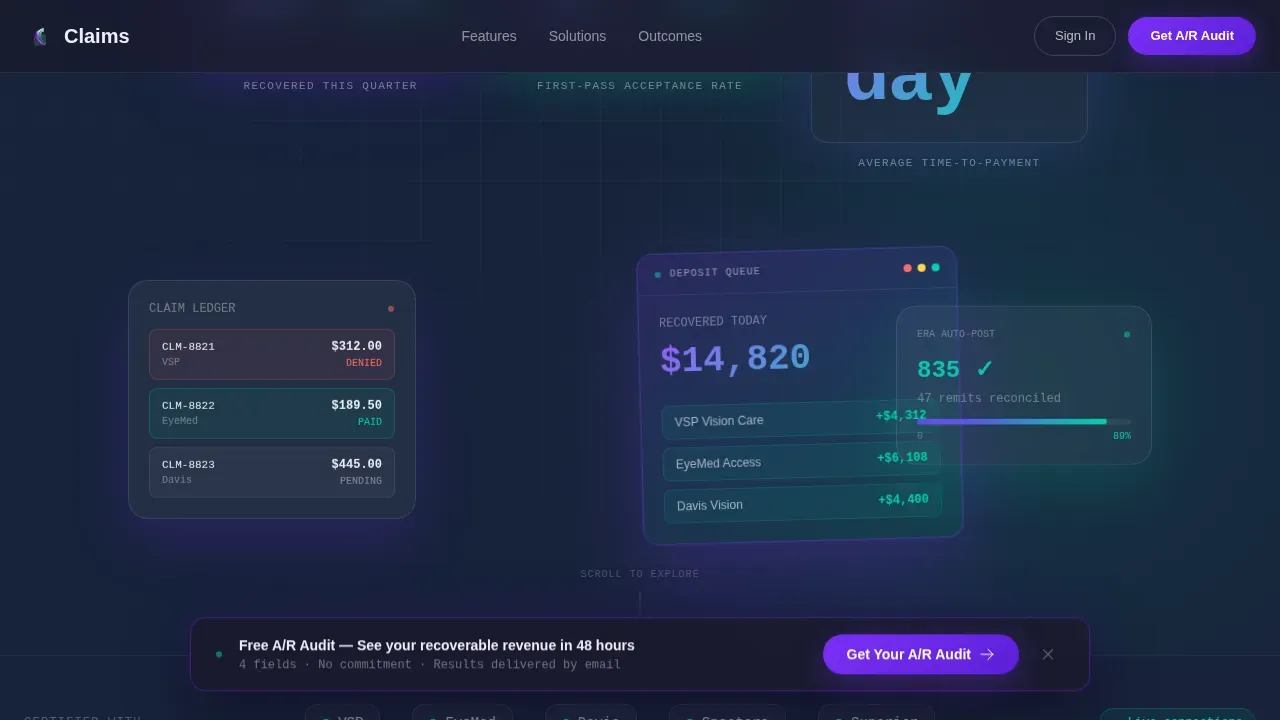
- An animated hero section with three real-time counter stats, a floating claim-card interface element, and a single-line proof statement that anchors visitor trust before a single scroll occurs.
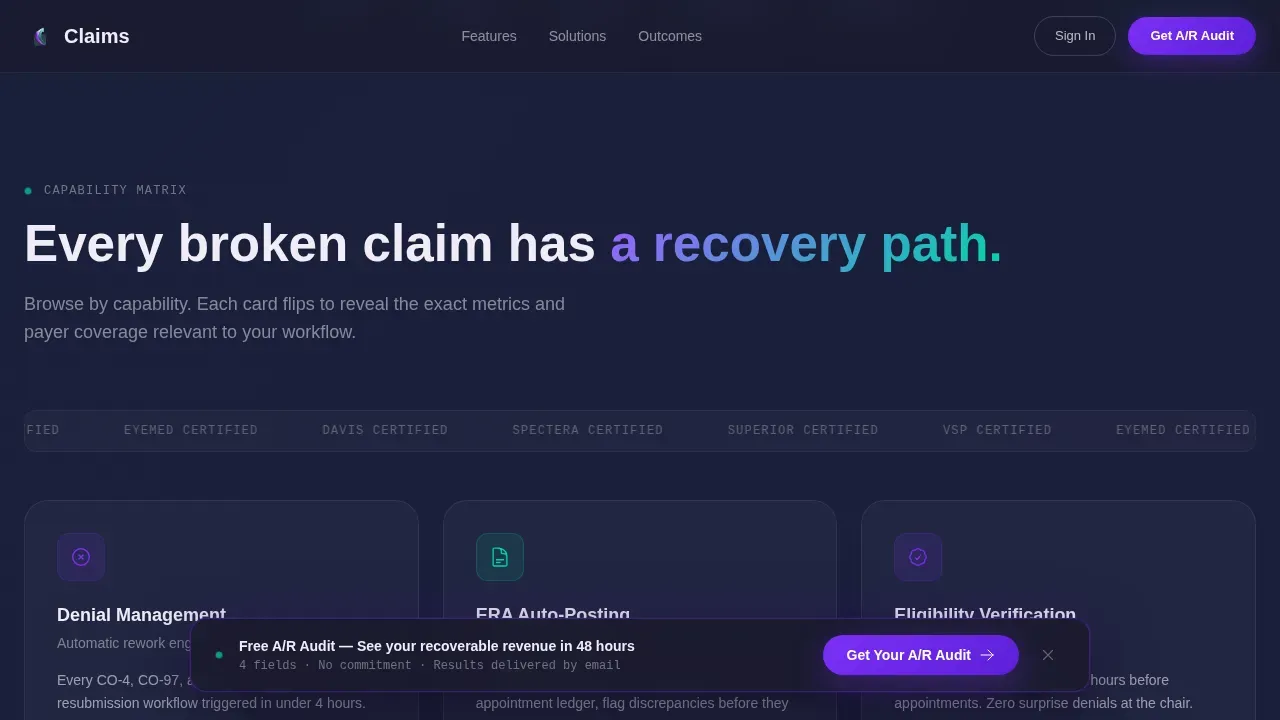
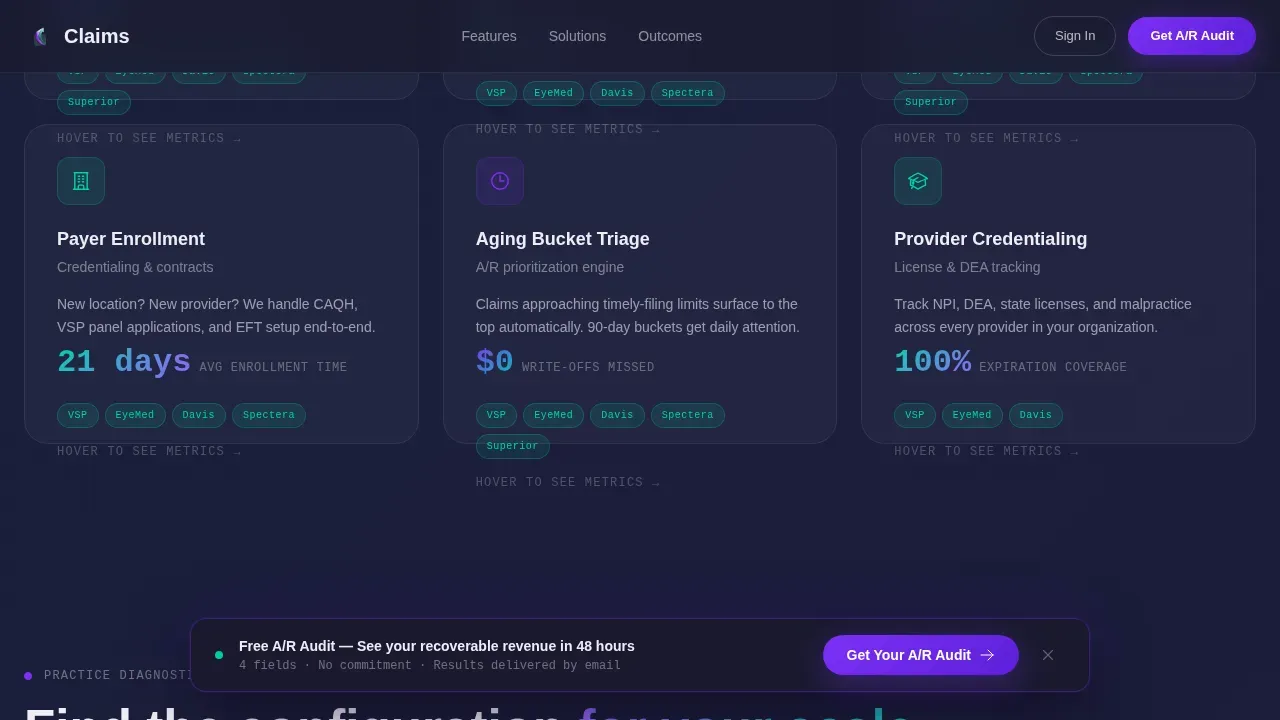
- A six-card feature matrix with hover-flip interactions, payer compatibility icons, and a practice-size tier comparison column set that turns feature browsing into a self-diagnostic experience.
- A dual-path lead capture system featuring a floating accounts receivable audit call-to-action bar and an email-gated denial code resource download for visitors who are not yet ready to talk.
Feature list
This template is built around six core capability representations, each rendered as an interactive card inside the feature matrix. The feature set below reflects what the template presents and supports as a claims management service.
Denial Management Card Module
The denial management card surfaces the core value proposition of the service. It presents the ai-driven workflow that tracks rejected insurance claims, flags documentation gaps, and routes each denial back through the appropriate payer rules for resubmission. The card expands on hover to show payer-specific metrics and compatibility icons, giving visitors immediate proof that the system understands their specific claims data environment.
ERA Auto-Posting and Reconciliation
This card covers electronic remittance advice auto-posting, showing visitors how the service reconciles ERA files against appointment ledgers without manual data entry. The template presents this as a direct answer to the revenue leakage that occurs when billing staff spend hours manually matching payments to claims. Data analytics tools embedded in the service identify patterns across reconciliation records to flag discrepancies before they become write-offs.
Patient Eligibility Verification Engine
Before a claim ever reaches submission, eligibility verification determines whether the encounter will pay. This card presents the ai-driven eligibility verification workflow that checks patient eligibility against active payer policies before the appointment is finalized. Automating routine tasks at this stage of the patient journey reduces coding errors and billing accuracy failures downstream, supporting cleaner claim submission rates and faster reimbursement timelines.
Aging Accounts Receivable Triage
The aging bucket triage card shows how the service prioritizes accounts receivable using intelligent worklists that focus on recoverable dollars first. Rather than relying solely on manual follow up queued by a billing coordinator, ai systems rank outstanding insurance claims by collection likelihood and deadline proximity. This approach supports measurable outcomes in cash flow recovery and reduces the labor costs of working low-probability accounts.
Payer Enrollment and Credentialing
This card addresses the upstream revenue cycle problem that most denial management tools ignore. Payer enrollment errors and credentialing gaps are a frequent source of claim denials that affect the entire revenue cycle. The template presents this capability as a structured, trackable process with audit trails that healthcare providers can reference during payer disputes or compliance reviews.
Prior Authorization Workflow Tracking
Prior authorization failures are one of the most preventable sources of claim denials in the healthcare system. This card shows how the service tracks authorization status across active claims, alerts billing staff before services are rendered without confirmed approval, and uses ai-supported workflows to reduce the risk of missed authorizations. Automating the prior authorization process leads to higher first-pass acceptance rates and fewer downstream appeals.
Page sections overview
| Section | Purpose |
|---|---|
| Hero Stats Dashboard | Animates three performance metrics to establish credibility immediately |
| Feature Matrix Grid | Presents six capability cards with hover-flip interaction and payer icons |
| Practice Size Tiers | Compares service fit across solo, multi-location, and roll-up practice types |
| Outcomes and Testimonials | Displays asymmetric results cards with named practice types and recovered amounts |
| Floating Audit Bar | Pins a four-field lead form above the fold after the first card row |
| Email-Gated Download | Captures early-stage visitors with a denial code resource behind email entry |
| Single-Row Footer | Closes the page with a clean linear footer following Pattern 1 layout |
Design & branding system
The visual identity uses an AI Iridescent color system that feels like light refracting through a server room. It is precise and data-forward without feeling sterile. The palette creates contrast that draws the eye to performance metrics, interactive states, and successful outcome signals simultaneously.
- Deep graphite (#1A1A2E) anchors all background fields and dense claims data displays; holographic violet (#7B2FF7) marks every interactive state, primary call-to-action button, and hover trigger across the card grid.
- Refracted teal (#00D4AA) signals positive outcomes, successful claim submission confirmations, and recovered revenue figures throughout the metrics dashboard and card flip states.
- Pearl white (#F0EDF6) surfaces each modular card to give the grid visual breathing room; JetBrains Mono handles all number and data typography while DM Sans carries the body copy with clarity.
Mobile & speed optimization
The template is built desktop-first, reflecting the real-world context of billing managers who work at workstations with multiple monitors. However, the layout adapts responsively so that practice owners reviewing the page on a mobile device can still navigate the card grid, read the counter stats, and submit the lead form without friction.
- Card grid columns reflow into a single-column stacked layout on smaller screens, and the floating audit call-to-action bar repositions to remain accessible without covering key content.
- Counter animations, card hover-flip interactions, gradient halos, and scroll reveals are built as client-side components, keeping static content sections rendered efficiently for faster initial load.
How this template helps you convert
The conversion architecture in this template is designed around two truths: some visitors are ready to talk and some are not. Both groups are captured. The page does not force a single conversion path, which reduces bounce pressure and improves the overall lead quality coming through the form.
- The floating accounts receivable audit bar appears after the first card row with a four-field form asking for practice name, provider count, primary vision payer, and estimated monthly claim volume. Each field is sequenced from easiest to most committed, reducing drop-off as visitors move through the form.
- Visitors who are still researching can download the denial code cheat sheet for optometry by submitting only their email address, creating a low-friction secondary conversion path that keeps the practice in the pipeline while trust continues to build.
Other information about this template
The Claimscycle AI Powered Optometry Revenue Recovery Landing Page Template sits at the intersection of healthcare revenue cycle management and B2B software marketing. Understanding the broader context of the space helps clarify why specific design and content decisions were made for this template.
- Healthcare organizations are increasingly investing in managed revenue cycle services to address staffing shortages, complex payer policies, and rising costs that strain internal billing teams.
- Practices using ai revenue activation platforms report revenue improvements of 20 to 30 percent within the first quarter, with some recovering between $250,000 and $350,000 in annual revenue through automation.
- Ai-driven analytics help healthcare organizations identify patterns across historical claims data, generate reports on claims denial rates, and flag documentation gaps before they become write-offs.
- Advanced analytics and machine learning algorithms enable ai models to process vast amounts of claims data, minimize errors caused by manual tasks, and support faster decision-making across the revenue cycle.
- Optical character recognition tools are used within some ai systems to extract healthcare data from remittance documents, reducing dependence on manual data entry and improving billing accuracy.
- Data analytics platforms give healthcare providers the ability to measure success across performance metrics tied to claim submission accuracy, reimbursement rates, and prior authorization tracking.
- Analyzing historical claims data allows the service to identify patterns that predict future denials, supporting denial prevention before claims are submitted rather than after they are rejected.
- Automating routine tasks across the revenue cycle reduces administrative costs, lowers labor costs for billing teams, and supports financial stability across practices of all sizes.
- The template includes ongoing support pathways built into the conversion architecture, giving new leads a clear next step whether they are ready for a full audit consultation or prefer to start with a downloadable resource.
- Cost savings from reduced manual follow up and eliminated coding errors can significantly boost a practice's actual revenue relative to relying solely on reactive denial management approaches.
- Revenue generation improves when ai systems enforce structural reliability across the claims lifecycle, catching documentation gaps, flagging payer rules mismatches, and routing prior authorization flags before encounters are completed.
- Healthcare providers benefit from automated solutions that address the financial impact of claim denials on patient access, patient data accuracy, and patient experience quality throughout the billing lifecycle.
- The template's step by step guide to the lead capture form reflects industry standards for reducing friction in healthcare B2B sign-up flows, sequencing fields from least to most sensitive commitment.
- Ai-driven tools evolving across the healthcare system are moving from providing insights toward providing actionable guidance, a shift this template reflects in its feature card content and conversion copy.

Theme
Directory & Discovery
Creative direction
Feature Matrix
Color system
AI Iridescent
Direction
Lead Generation
Page Sections
Animated Hero Stats Dashboard
Six-card Interactive Feature Matrix
Dual-path Lead Capture System
Practice Size Tier Comparison
Outcomes and Results Display
Floating Audit Call-to-action Bar
Related questions
Who is this landing page template built for?
What capabilities does the feature matrix section present?
How does the dual lead capture system work?
Does the template address different practice sizes?
Can the card grid and animated stats be customized?