Intelligent Customer Reactivation Landing Page Template
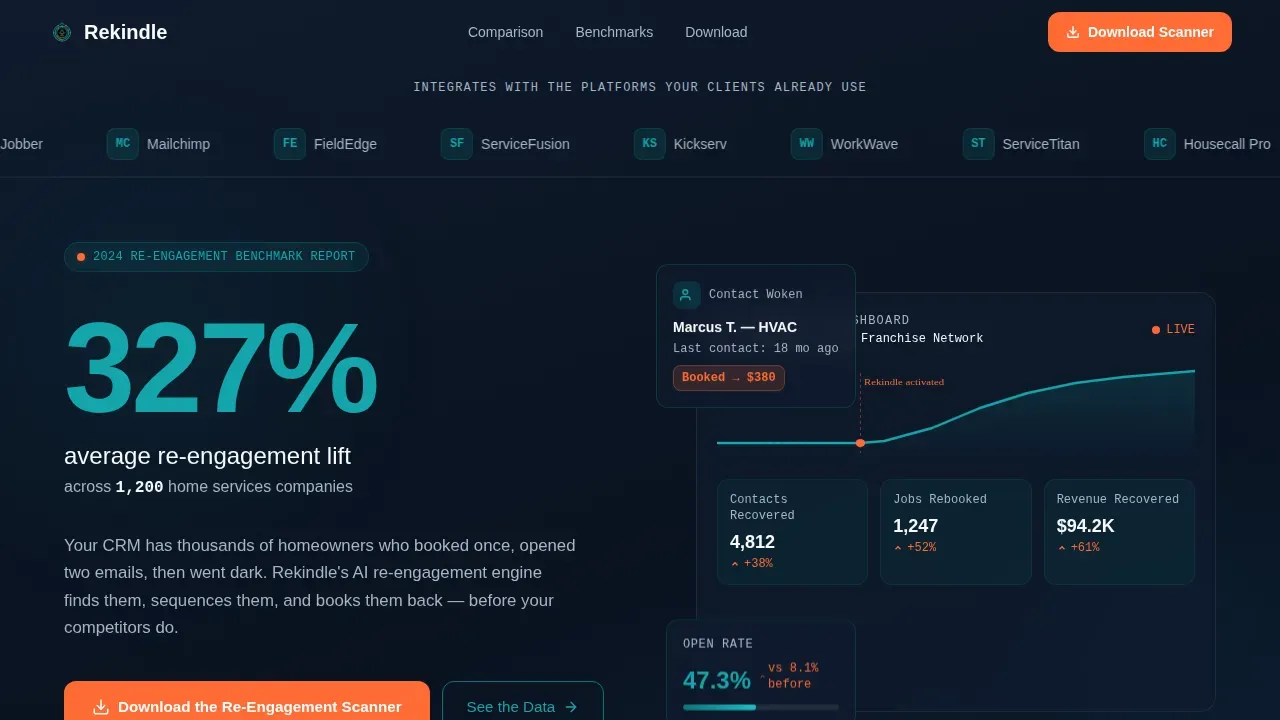
The Rekindle AI-Powered Re-Engagement Dashboard Pro landing page template is built for home services operators sitting on aging CRM lists. It presents a confrontational comparison table, trade-vertical benchmarking data, and a control-room visual identity to drive app downloads and PDF lead capture. Every section is designed to make the revenue cost of dormant customers impossible to ignore.
by Rocket studio
Quick summary
Rekindle is a single-page landing page template engineered for home services re-engagement marketing. It opens with an oversized benchmark stat and a scrolling logo trust bar, then walks operators through a three-way comparison table and trade-vertical decay data before pushing them toward an app download or a gated PDF. The visual identity reads like a live control room: deep teal, midnight panels, and one pulsing orange alert.
Who this template is for
This template is designed for marketers and operators running re-engagement campaigns in the home services industry. The pages it produces speak directly to the people responsible for booking rates, technician utilization, and CRM health.
- HVAC franchise operators managing 40,000 or more cold contacts with decaying open rates
- Plumbing network managers and multi-trade operators watching idle technician days accumulate
- Marketing directors at home services groups who need to engage a dormant audience and recover revenue from existing customers
What problem this template solves
Home services companies build large contact lists, then watch them go quiet. Re-engagement strategies are often manual, inconsistent, and impossible to scale across thousands of contacts. This landing page template makes the cost of inaction visible and gives operators a clear next step.
- Dormant CRM lists bleed revenue quietly over a specific period, and most operators have no dashboard to quantify the loss
- Manual re-engagement sequences decay quarter over quarter, leaving technicians idle and customers uncontacted
- Without a structured re-engagement platform, reminding customers to rebook requires effort that most teams cannot sustain consistently
What you get with this template
This template delivers a fully structured, single-page layout built around data persuasion and a clear app download call to action. Every section is pre-designed to move an operator from awareness of the problem to action.
- A hero logo bar with a scrolling trust ribbon and one oversized benchmark stat in teal type
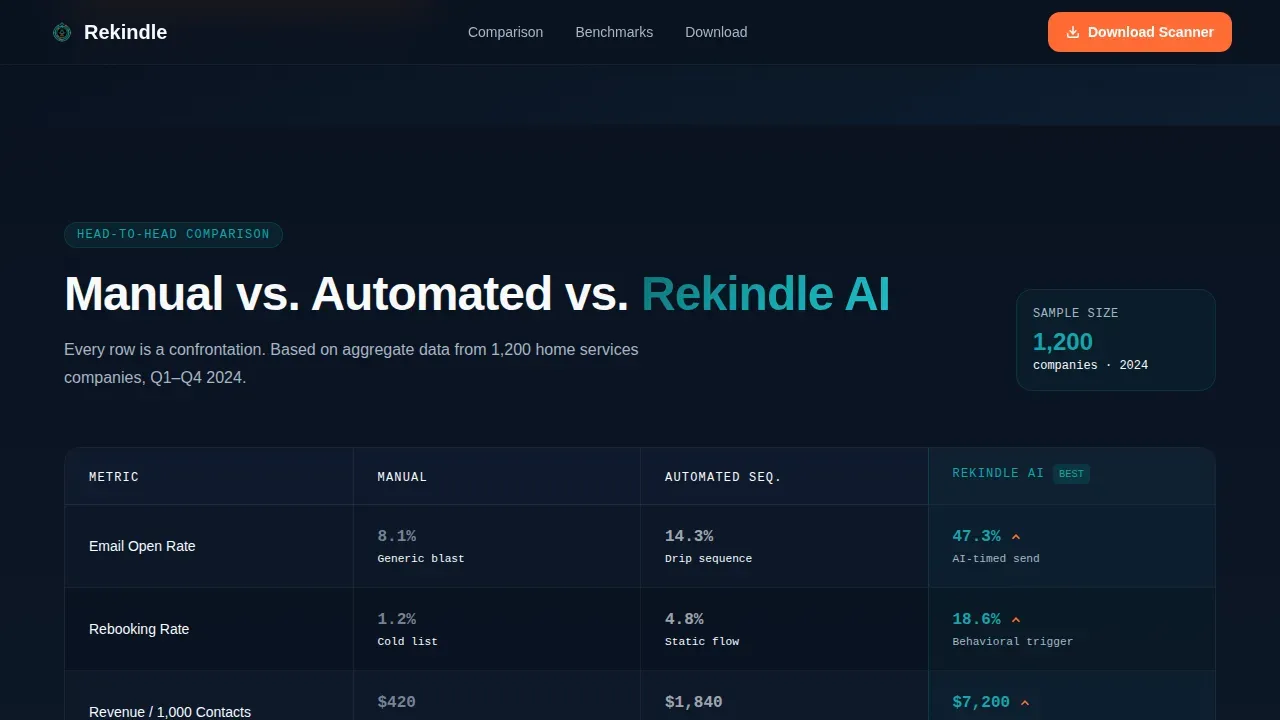
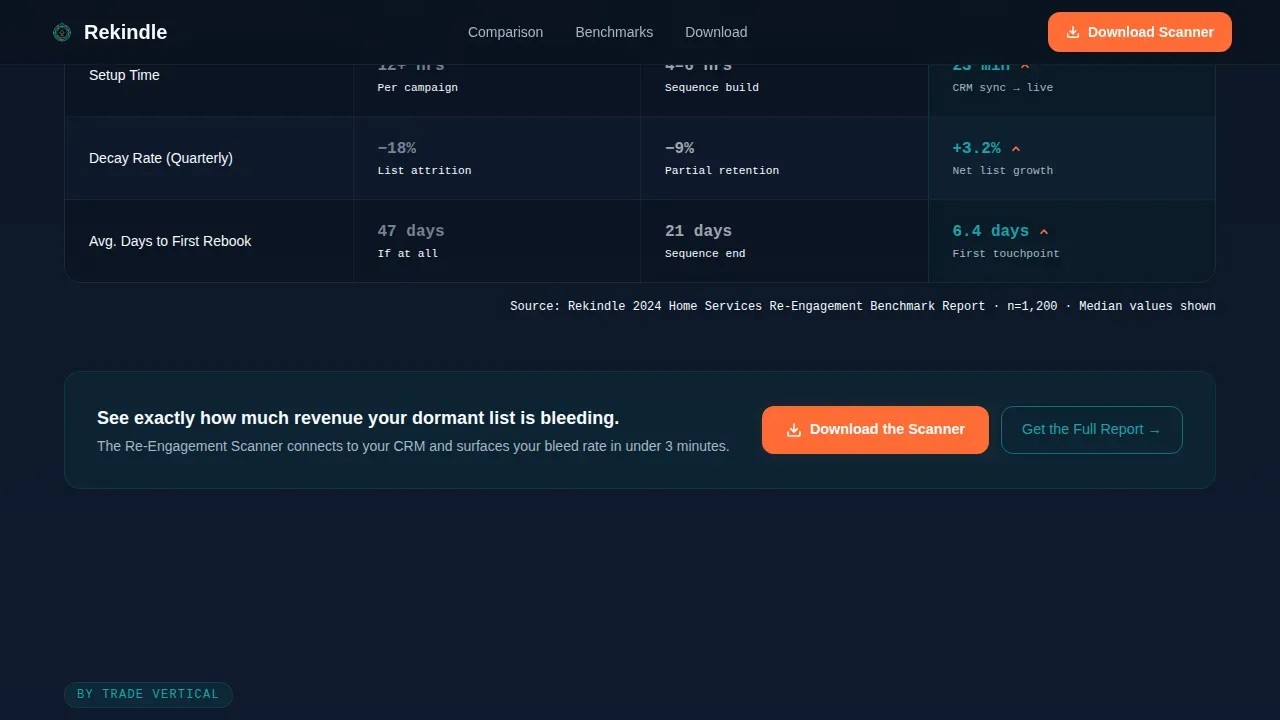
- A three-column comparison table covering manual, automated, and AI-driven re-engagement approaches, with rows for open rates, rebooking rates, revenue recovered per 1,000 contacts, and setup time
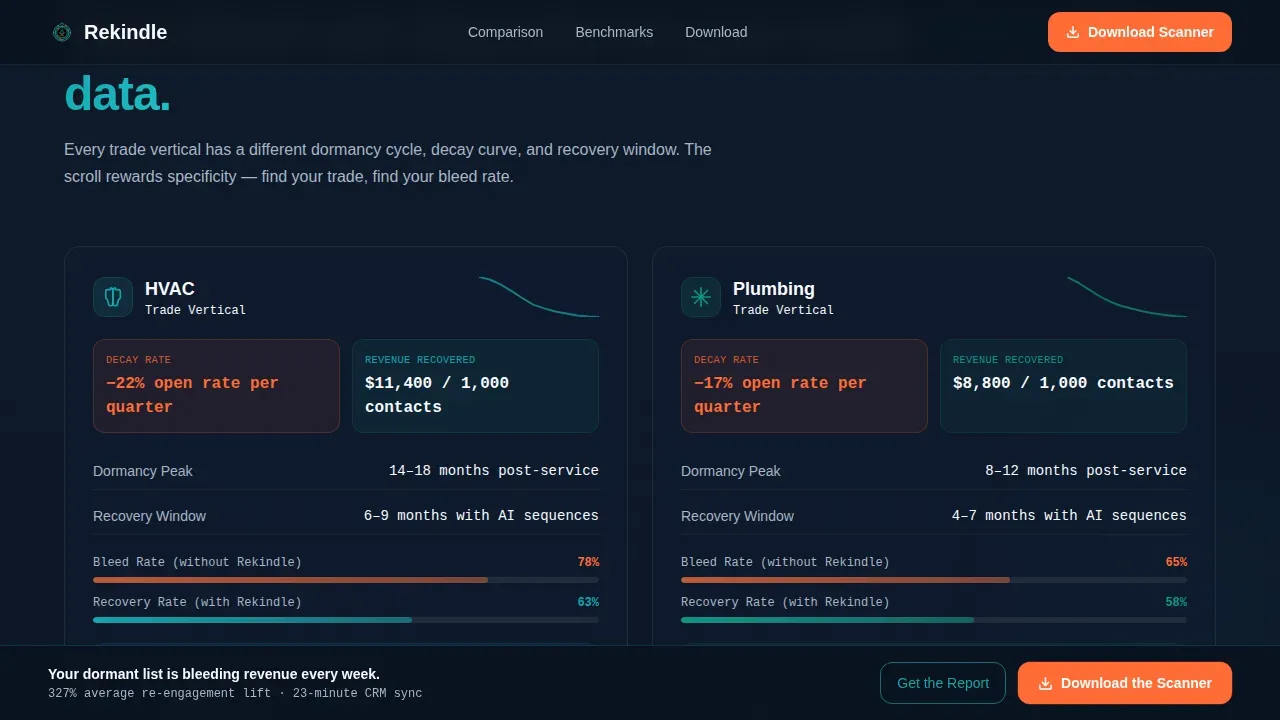
- Four trade-vertical benchmark panels showing decay curves and recovery timelines for HVAC, plumbing, electrical, and landscaping segments, plus a dual-path conversion section with an app download modal and a PDF lead gate
Feature list
This template packs several purpose-built components that support re-engagement marketing at the business level. Each feature maps directly to a specific conversion goal within the landing page layout.
AI-Driven Comparison Table
The comparison table is the spine of the landing page. It positions manual outreach, automated sequences, and the AI-driven platform side by side across four performance columns. Each row is a small confrontation, giving users a clear data point to process before scrolling further. AI landing page tools rarely present this kind of structured competitive framing inside a single template.
Trade-Vertical Benchmark Panels
Four segmented panels cover HVAC, plumbing, electrical, and landscaping. Each panel shows its own decay curve and recovery timeline so operators can find the data that matches their specific trade. This level of personalization in marketing copy makes the benchmark feel diagnostic rather than generic, which drives higher engagement from readers who recognize their own numbers.
Dual-Path Conversion Block
The primary call to action triggers a platform selector modal for iOS or Android, followed by a single email field for CRM sync on first launch. A secondary path offers a PDF gate requiring only an email address. This dual structure captures both ready-to-install users and leads who want to delve deeper into the data before committing.
Sticky Bottom Bar
A persistent call-to-action bar appears after the benchmark section and remains visible as users scroll. This re-engagement mechanism on the page itself mirrors the platform's own philosophy: keep the message in front of the audience until it lands.
Animated Dashboard Metrics
Flatline-to-pulse metric animations and scroll-linked counter reveals bring the control-room aesthetic to life. These ai tools for visual storytelling help communicate momentum at a glance. Coherent, trust-building design elements like these enhance user engagement by immediately communicating value, which is a key principle behind effective AI landing page design.
Logo Trust Bar with Scrolling Marquee
A horizontal ribbon of recognizable home services ecosystem logos scrolls slowly beneath the benchmark stat. This component establishes platform credibility without requiring a word of explanation. It signals that the re-engagement platform works within the tools operators already use.
Page sections overview
| Section | Purpose |
|---|---|
| Hero Logo Bar | Display benchmark stat and scrolling logo trust ribbon |
| Comparison Table | Contrast three re-engagement approaches across key metrics |
| Benchmark Verticals | Show decay and recovery data by trade segment |
| App Download call to action | Drive platform selector modal and email capture |
| Sticky Bottom Bar | Maintain persistent conversion prompt after benchmarks |
| Footer Pattern | Close the page with a clean single-row layout |
Design & branding system
The Teal Catalyst color system gives this landing page its control-room character. Every color has a job, and none of them overlap. The result is a layout that feels like a live operations dashboard rather than a marketing brochure.
- Deep operations teal (#0D7377) anchors headlines and data visualizations; midnight panel (#0F1B2D) sits behind dashboard mockups; clinical white (#F7F9FB) keeps table cells and reading areas open
- Catalyst orange (#FF6B35) appears exclusively on call-to-action elements and upward-trending metric arrows, making every conversion point impossible to miss
- Typography uses DM Sans for headings, IBM Plex Mono for data and numbers, and Manrope for body copy, creating a clear reading hierarchy across all sections of the page
Mobile & speed optimization
The template is designed desktop-first to match the behavior of operators reviewing performance data at their desks. Responsive behavior ensures the layout remains usable across screen sizes, which matters as mobile traffic grows. AI landing page frameworks increasingly rely on fast, lean rendering to keep users on the page.
- Server Components handle all static sections to keep initial load times lean, while Client Components power animations and interactive elements like the platform selector modal
- Scroll-linked animations and the logo marquee are implemented as client-side interactions, keeping static page weight low
- The sticky bottom bar and PDF gate form are built for touch interaction, supporting operators who review pages on a phone or tablet outside office hours
How this template helps you convert
This landing page is structured to turn data-driven curiosity into a conversion action. Re-engagement strategies work best when the cost of inaction is made concrete, and this template does exactly that across every scroll position.
- The benchmark stat in the hero creates immediate interest by quantifying the re-engagement lift operators can expect, setting the stakes before anyone reads a single row of the comparison table
- The comparison table and trade-vertical panels create a personalized experience for each reader, making the data feel specific to their company and their list rather than a generic marketing pitch
- The dual-path conversion block captures both high-intent users ready to download the app and lower-intent leads who prefer to access the full PDF report first, maximizing the value of every visit
Other information about this template
This template sits at the intersection of AI landing page design and home services marketing automation. It is built to support content creation efforts that go beyond standard promotional pages and instead function more like interactive research tools. Marketers who explore this format often notice that the research-paper creative direction creates stronger trust than a conventional hero-plus-features layout.
- The Industry Report creative direction rewards scroll with increasingly specific insights, making the page feel diagnostic rather than promotional and encouraging users to search for their own trade vertical before converting
- Dynamic Content Personalization principles are baked into the template's structure: headlines and benchmark descriptions can be updated to reflect different user segments or a specific period of campaign activity, allowing teams to create content that resonates with each sub-audience
- The Rekindle AI powered re-engagement dashboard pro landing page template supports content generation for re-engagement campaigns by providing a proven layout that marketers can adapt for different trades, regions, or seasonal push windows
- Anticipatory Analytics and Predictive Lead Scoring concepts are reflected in the benchmark panels, which show operators how to identify dormant leads likely to convert if re-engaged, and the template's description of those metrics can be updated as new data becomes available
- Email marketing templates built within this ecosystem can feature customer testimonials, exclusive offer copy, and reactivation incentives, making it straightforward to cross-link re-engagement email sequences from the landing page itself
- The platform is designed to work alongside tools that home services operators already rely on, and the logo trust bar references ecosystem partners to reinforce that compatibility signal
- Survey or feedback request flows can be added as secondary links from the PDF gate section, helping teams collect feedback from leads who are not yet ready to download the app
- Free trials can be surfaced as an alternative conversion path for organizations that want to let users explore the platform before committing, adding a third option alongside the app download and PDF gate
- The template's pages support social media platforms as traffic sources, making it straightforward to run paid campaigns that land on the comparison table section directly via anchor links
- Case studies and catch-up content summarizing what customers may have missed can be embedded in the footer or linked from the benchmark panels to encourage event attendance at webinars or product demos, which can also encourage event attendance among readers who want a live walkthrough before signing up
- The template is designed to help re-engagement programs operate across the entire customer lifecycle, from reminding customers of past services to re-engaging lapsed contacts who have shown renewed interest through email opens or web page visits
- Re-engagement programs built on this template can span social media platforms and web pages simultaneously, giving home services marketers a central hub that links out to every channel in the nurture sequence
Theme
Dashboard Pro
Creative direction
Industry Report
Color system
Teal Catalyst
Style
Comparison Table
Direction
App Download
Page Sections
Ai-driven Three-way Comparison Table
Trade-vertical Benchmark Panels
Dual-path Conversion Block
Persistent Sticky Bottom Bar
Animated Dashboard Metric Cards
Logo Trust Bar with Scrolling Marquee
Related questions
Who is this landing page template designed for?
Can I adapt the comparison table for my specific trade vertical?
How does the dual-path conversion block work?
Does the template support additional content or links beyond the core sections?
Is this template suitable for paid traffic campaigns?