IT Services Company Privacy Policy Website Template
Shield is a Data Command privacy policy landing page template built for IT services companies targeting mid-market SaaS, healthcare, and startup clients. It pairs an interactive compliance dashboard with a scroll-driven Problem-to-Solution arc, converting visitors through a free privacy scan flow. The AI Iridescent color system and modular card grid keep dense policy content readable and visually compelling.
by Rocket studio
Quick Summary
Shield is a single-page, card grid landing page template designed for IT services companies that handle privacy compliance. It opens with an interactive dashboard preview, walks visitors through a Problem-to-Solution arc, and converts them via a freemium privacy scan. The void black and neural cyan palette creates a glass ops-center aesthetic that makes complex policy content feel alive and trustworthy.
Who This Template Is For
This template is built for cybersecurity and privacy compliance firms that serve technical decision-makers at growth-stage companies. If your clients are sweating a SOC 2 renewal, navigating HIPAA requirements, or facing their first enterprise security questionnaire, this template speaks directly to them.
- CTOs and security leads at mid-market SaaS companies managing SOC 2 audits and ongoing privacy obligations
- Healthcare operations directors responsible for keeping patient data handling aligned with shifting regulatory demands
- Startup founders who need to demonstrate credible privacy practices before closing an enterprise deal
What Problem This Template Solves
Most privacy compliance firms look like every other IT vendor online. Their sites use generic layouts that bury the value proposition and give technical buyers no immediate reason to trust the firm or act. Shield solves that by turning the privacy policy page itself into a live demonstration of competence.
- Visitors see a working compliance dashboard before they read a single paragraph, which immediately proves capability
- The card-flip Problem-to-Solution arc removes abstract claims and replaces them with concrete before-and-after evidence
- The freemium scan flow gives prospects an instant, partial result so they feel the value before they commit
What You Get With This Template
You get a fully structured, modular landing page with every section pre-built and sequenced for conversion. The layout is designed desktop-first, reflecting how CTOs and operations directors actually evaluate compliance tools, while still rendering cleanly on smaller screens.
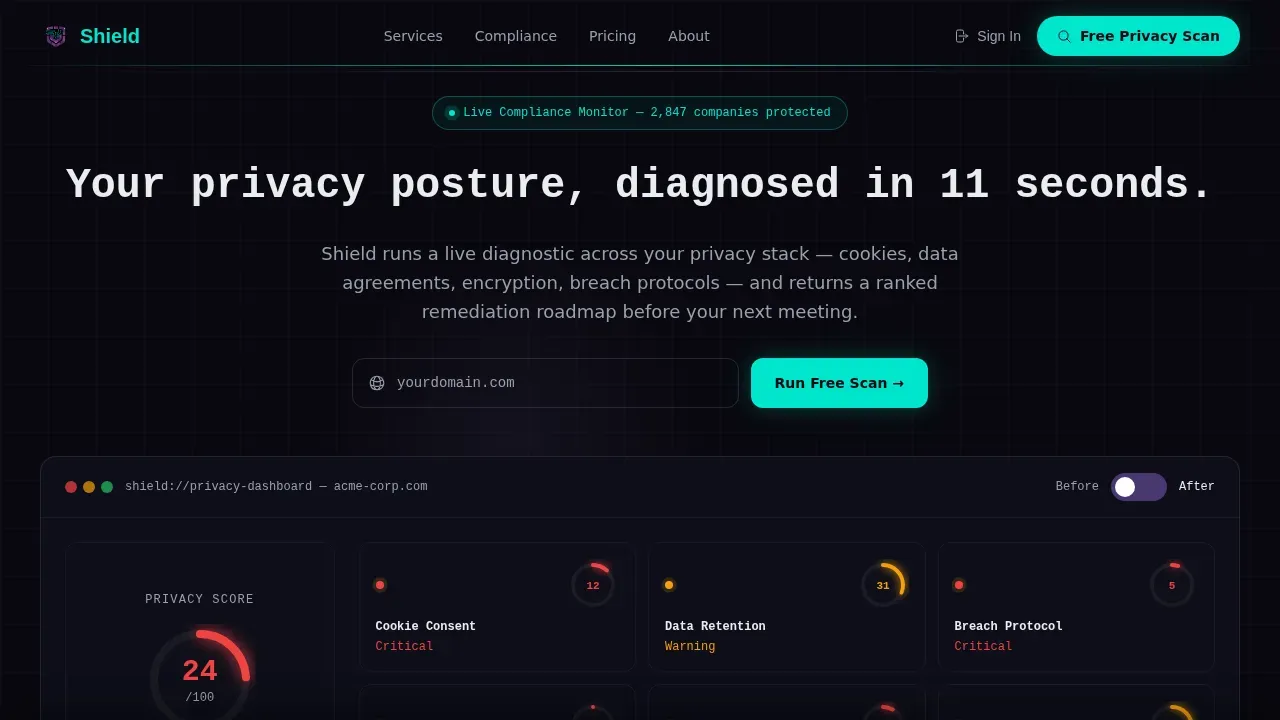
- An interactive hero section with a privacy health score dashboard, typewriter headline, and domain scan input
- A scrollable card grid that transitions risk states from amber warning to cyan resolved with scroll-triggered animations
- A sticky bottom call-to-action bar, a secondary policy template pack download path, and a minimal GitHub-style footer
Feature List
This template is built around a defined set of high-interactivity, high-specificity components. Each one serves a deliberate role in the visitor journey from awareness to conversion.
Interactive Privacy Health Dashboard
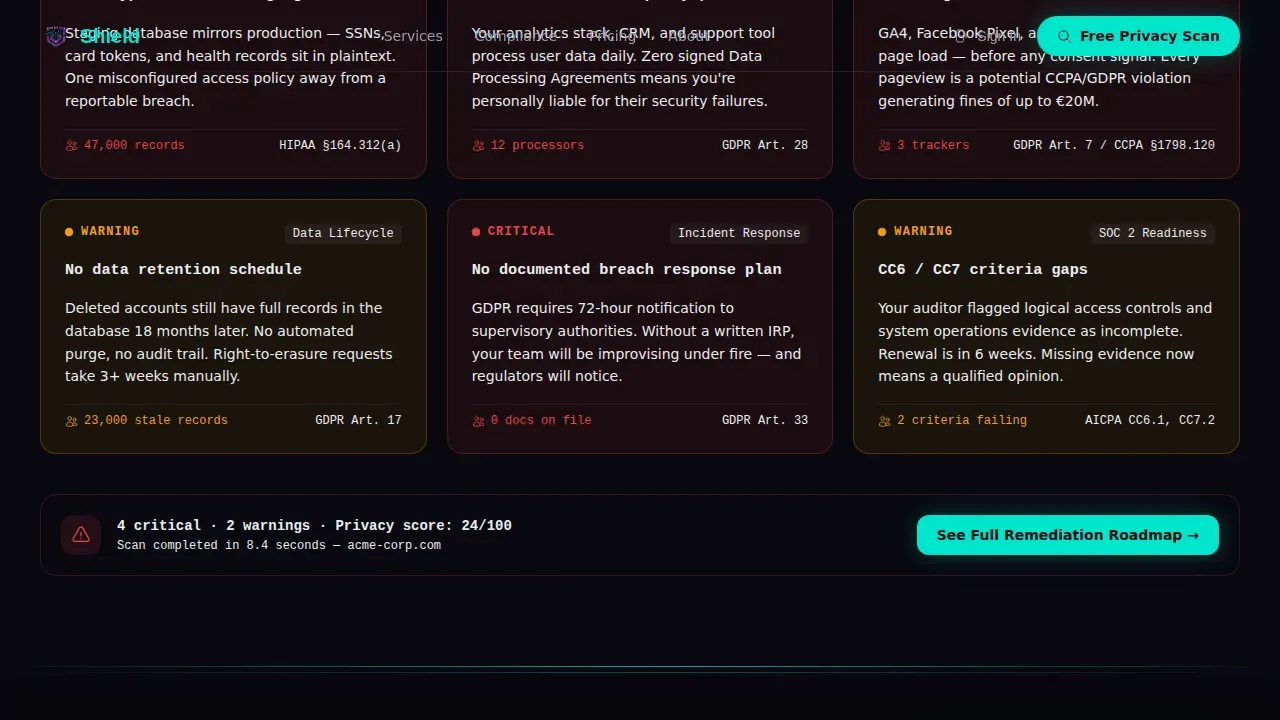
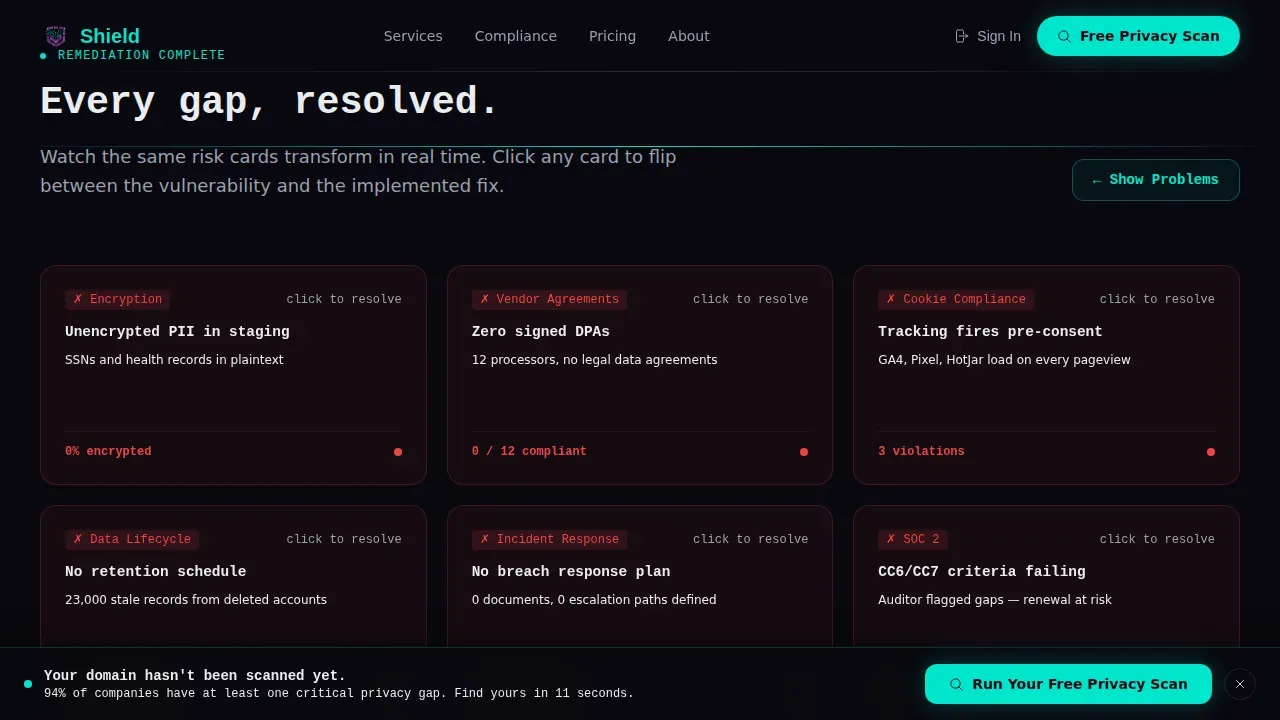
The hero section opens with a mock compliance dashboard that visitors can explore before scrolling. They can toggle between a "before" state showing red flags such as unencrypted fields, expired certificates, and missing data processing agreements, and an "after" state showing a fully green compliance matrix. Individual module cards for cookie consent, data retention, and breach protocol are each clickable, flipping from vulnerability to resolution.
Scroll-Triggered Problem-to-Solution Card Grid
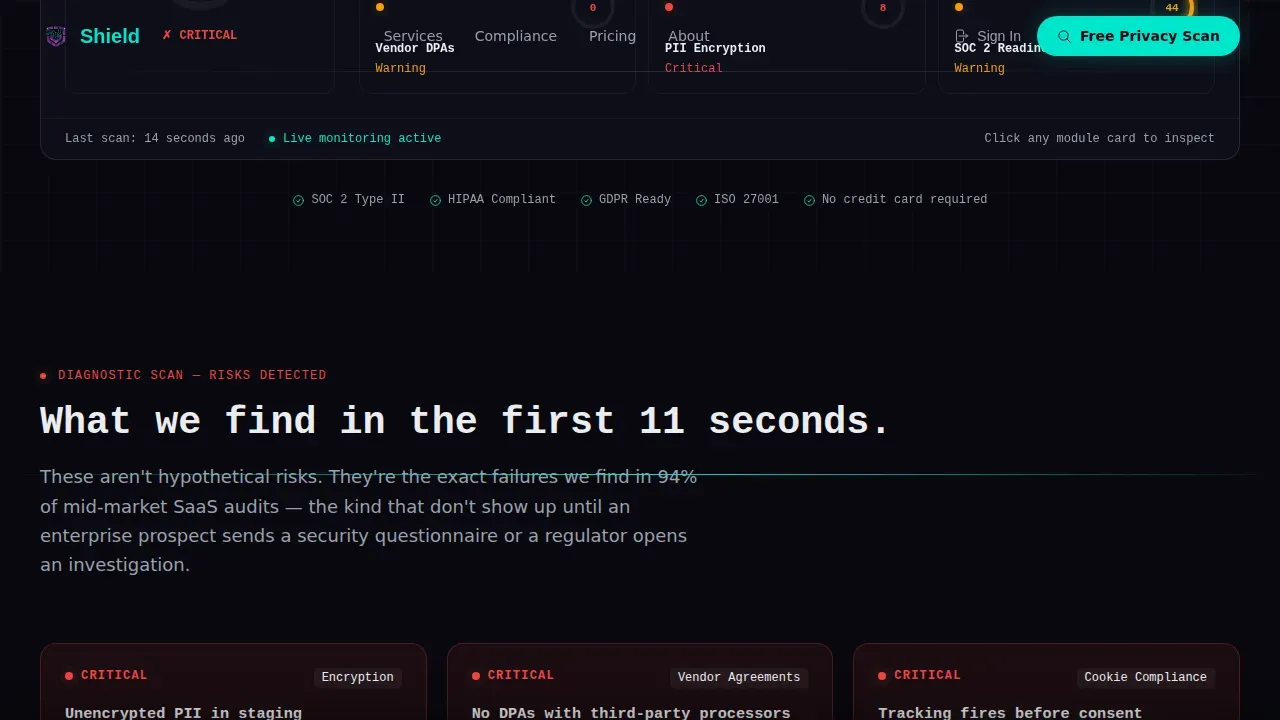
The core content section uses a modular card grid where each card names a specific compliance failure. Cards display pulsing amber indicators for issues such as unencrypted personal identifiable information in staging environments, absent data processing agreements with third-party vendors, and cookie banners that do not actually block tracking. As visitors scroll, the same cards re-animate: amber becomes neural cyan, the problem statement rewrites itself into the implemented solution, and a "covered" badge locks into place. The rhythm accelerates toward a final row that assembles a complete compliance shield from every module above.
Freemium Scan Conversion Flow
The primary call to action is "Run Your Free Privacy Scan," placed inside the interactive header and repeated in a sticky bottom bar that appears after the third card row. The form collects company domain first, triggering an immediate visual scan response, then work email and company size. The scan delivers a real partial result with clear upgrade prompts to unlock the full remediation roadmap.
Secondary Policy Template Pack Path
Visitors who are not ready to run a scan can access a secondary conversion path: "Download the Full Policy Template Pack." This path requires email only, giving the template a low-friction capture option for earlier-stage prospects who want to explore privacy policies before committing to a live scan.
Monospace Data Command Typography System
Technical headlines render in JetBrains Mono, the same typeface used in developer terminals and code environments. Body copy uses DM Sans for readability. The typewriter effect on the hero headline types out in monospace, reinforcing the ops-center aesthetic and signaling technical credibility to CTOs and engineers evaluating the service.
Role-Specific Social Proof Section
A dedicated testimonial section presents social proof framed by role and company context, specifically the CTO persona managing SOC 2 renewal, the healthcare ops director handling HIPAA obligations, and the startup founder closing an enterprise deal. Each testimonial includes company size and industry context so visitors self-identify quickly.
Page Sections Overview
| Section | Purpose |
|---|---|
| Hero Dashboard Preview | Engage visitors with interactive compliance health toggle and domain scan input |
| Problem Risk Grid | Surface specific, named compliance failures with pulsing amber card indicators |
| Solution Transform Grid | Re-animate problem cards to resolved state with cyan badges and scroll reveals |
| Social Proof Section | Build credibility through role-specific testimonials with industry context |
| Pricing and Call to Action | Drive freemium scan signups and capture secondary leads via template pack download |
| Sticky Bottom Bar | Persistent call-to-action that appears after third card row to accelerate conversion |
| Footer | Minimal GitHub-style footer with docs, privacy, terms, and status links |
Design & Branding System
The visual identity follows a Data Command theme using an AI Iridescent color palette. The aesthetic is built to feel like stepping into a glass-walled operations center at night: dark at rest, alive with color when data moves. This tone resonates with technical buyers who associate clean, high-contrast interfaces with systems that are serious and trustworthy.
- Void black (#09090F) backgrounds create depth and focus; holographic violet (#7B5EA7) borders lift cards off the background and brighten on hover
- Neural cyan (#00E5CC) drives all active states, progress indicators, toggle transitions, and call-to-action elements, keeping the eye moving through the conversion flow
- Signal white (#EAECF0) is used for body copy, ensuring that dense policy language remains readable against the dark ground without visual fatigue
Mobile & Speed Optimization
The template is designed desktop-first to match how technical evaluators, specifically CTOs and operations directors, typically review compliance tools. The glass ops-center aesthetic is optimized for full viewport width. That said, the card grid layout and section structure translate to smaller screens with readable type and accessible tap targets.
- Interactive client components handle the dashboard toggle, card flip animations, and scan input feedback, while static sections use server components to keep load behavior predictable
- Card grid columns reflow at smaller breakpoints so the Problem-to-Solution arc reads correctly on tablet and mobile viewports
- The sticky bottom call-to-action bar is designed to remain visible and usable across screen sizes without overlapping key content
How This Template Helps You Convert
Privacy compliance is a high-anxiety purchase. Buyers arrive with specific fears: a failed audit, a breach they did not catch, a questionnaire they cannot answer. This template is engineered to meet those fears with immediate evidence and a low-friction next step.
- The interactive dashboard preview proves capability in seconds. Visitors see a live compliance health score toggle before they read any copy, which establishes trust faster than any written claim and moves them toward the domain scan input.
- The Problem-to-Solution card arc converts skeptics. By naming specific failures that the visitor likely recognizes, such as missing data processing agreements or broken cookie consent flows, the template creates a recognition moment. When those same cards flip to resolved, the visitor can visualize the outcome of working with the firm.
- The dual conversion path captures the full funnel. Visitors ready to act run the free scan. Visitors still evaluating download the policy template pack with email only. Both paths feed a follow-up sequence, so no qualified prospect leaves empty-handed.
Other Information About This Template
This section covers additional practical details that help you evaluate whether this template fits your workflow and compliance context.
Privacy policies are a legal document that every business collecting personal data must maintain. A privacy policy informs users about how you collect and handle their personal data, what personal information you store, and how you protect user data from unauthorized access. This is not just a legal requirement; it is a fundamental trust signal that your clients' customers and enterprise prospects expect to see before sharing any data.
Most data privacy laws, including the General Data Protection Regulation (GDPR), the California Consumer Privacy Act (CCPA), and HIPAA, require businesses to post a clear and accessible website privacy policy. Under these privacy regulations, a data controller must inform users about the purpose and legal basis for processing personal data, explain any data transfer to third parties, and clearly state user rights including the right to access, correction, erasure, portability, and opt out of certain uses. Businesses that operate in the European Economic Area or serve citizens there must address cross-border data transfer requirements as well.
A compliant privacy policy for website use should cover what data is collected directly, such as names, emails, and postal address details, and what is collected indirectly, such as IP addresses and device information captured through tools like analytics services. It should also address third party disclosure, explain how third party services receive or process user data, and state whether the business will sell personal information to any third party companies. Businesses must also protect children's privacy and include a parental consent clause if they collect information from minors under 13, consistent with applicable law and frameworks like COPPA.
Using a generic privacy policy template as a starting point is common, but it carries risk. A generic privacy policy template will not automatically reflect your specific data collection practices, your use of third party services, or the particular data privacy laws applicable to your jurisdiction. A sample privacy policy template can help you understand structure and language, but it must be customized to accurately represent how your business collects personal data, handles data sharing, and manages data processing activities. Never copy someone else's privacy policy; it may not match your practices and can expose you to legal and reputational risk.
A free privacy policy template, a sample privacy policy template, or an automated privacy policy generator can all accelerate drafting. A privacy policy generator asks structured questions about your business and produces a tailored draft quickly. However, even when using a privacy policy generator, legal review is advisable for businesses handling sensitive personal information or operating across multiple jurisdictions.
The Shield Data Command privacy policy landing page template is particularly well-suited for presenting these layers of compliance context in a format that does not overwhelm visitors with legal jargon. Anchor links let users navigate directly to specific sections. Expandable card modules prevent dense policy language from dominating the viewport. Plain-language summaries sit alongside technical clauses so visitors understand their agreements at a glance.
A strong privacy policy also needs to address security measures in practical terms. Businesses should describe how they use encryption, access controls, and electronic storage practices to protect personal data from data breaches. No provider can promise absolute security, and well-written privacy policies acknowledge this while explaining the organizational and technical safeguards in place. The federal trade commission and other legal authorities expect businesses to take reasonable steps to protect personal information and to be transparent when they fall short.
Your website name and contact details, including your mailing address and customer support email, must appear in the policy so that service users know where to direct privacy concerns. Businesses under GDPR must also identify the data controller and provide a mechanism for the data subject to exercise their opt out rights and other user rights. Keep your privacy policies up to date: you should review and revise them whenever your data processing activities change, and at minimum once per year under laws like the CCPA.
- The template uses a card grid layout so compliance modules for cookie consent, data retention, and breach protocol are each independently scannable
- The privacy policy page format supports the inclusion of other legal documents such as terms of service and data processing agreements via footer links
- The footer follows a GitHub Developer Minimal pattern with links for docs, privacy, terms, and status, keeping legal navigation clean and accessible
- Display of security badges and SSL indicators alongside policy content helps reassure visitors about the firm's commitment to data protection
- The template supports a website app privacy policy structure, meaning the same layout logic applies whether the client serves a web platform or a mobile app audience
- Research consistently shows that transparent privacy practices increase consumer engagement, making this template a direct revenue tool as well as a legal compliance asset
- A privacy audit of the page structure is straightforward given the modular card design: each compliance module is self-contained and independently editable
Theme
Data Command
Creative direction
Problem→Solution Arc
Color system
AI Iridescent
Direction
Freemium/Trial
Page Sections
Interactive Compliance Dashboard Hero
Scroll-triggered Problem-to-solution Card Arc
Freemium Privacy Scan Conversion Flow
Secondary Policy Template Pack Download
Role-specific Social Proof Section
Data Command Typography and Animation System
Related questions
Does a landing page need a privacy policy?
How do you display a privacy policy on a website?
What has replaced the Privacy Shield framework for EU-US data transfers?
Is copying someone else's privacy policy acceptable?