AI for Entertainment Professional Website Template
Score is a Bold Brutalist entertainment AI lead scoring landing page built for studios, labels, and streaming platforms. It turns raw fan behavior into ranked heat scores so marketing teams know exactly who is ready to convert. The 50/50 split-screen layout pairs oversized monospace type with a live dashboard mockup, making the value proposition impossible to ignore the moment visitors land on the page.
by Rocket studio
Quick summary
Score is a single-page, split-screen landing page template built for an entertainment AI lead scoring platform. It combines a control-room brutalist design with a live dashboard mockup, four scored feature modules, and a freemium signup path. The page is built to show decision-makers exactly what the platform does before they ever click a button.
Who this template is for
This template is built for B2B SaaS teams in the entertainment industry who need a landing page that converts high-intent professionals, not casual visitors. It fits teams that work with behavioral fan data and need their page to reflect that precision.
- Marketing VPs at film distributors timing paid media pushes around release windows
- A&R coordinators at labels deciding which artists deserve tour support money
- Growth leads at streaming services trying to convert free-tier users into paying subscribers
What problem this template solves
Most landing pages in the entertainment technology space look like every other SaaS page. They fail to reflect the urgency and raw data intensity that marketing and A&R professionals actually understand. This template solves that gap directly.
- Generic pages bury the lead; this design surfaces the highest-value information above the fold
- Visitors leave before they understand the product; the scroll-accumulating feature matrix holds attention section by section
- Long signup forms kill conversions; the built-in form asks only for work email and platform type
What you get with this template
You get a complete, production-ready landing page built around a 50/50 split-screen concept. Every section is designed to earn trust through interface evidence before asking for a signup. The page is structured so visitors mentally place their own data into the product long before they reach the call to action.
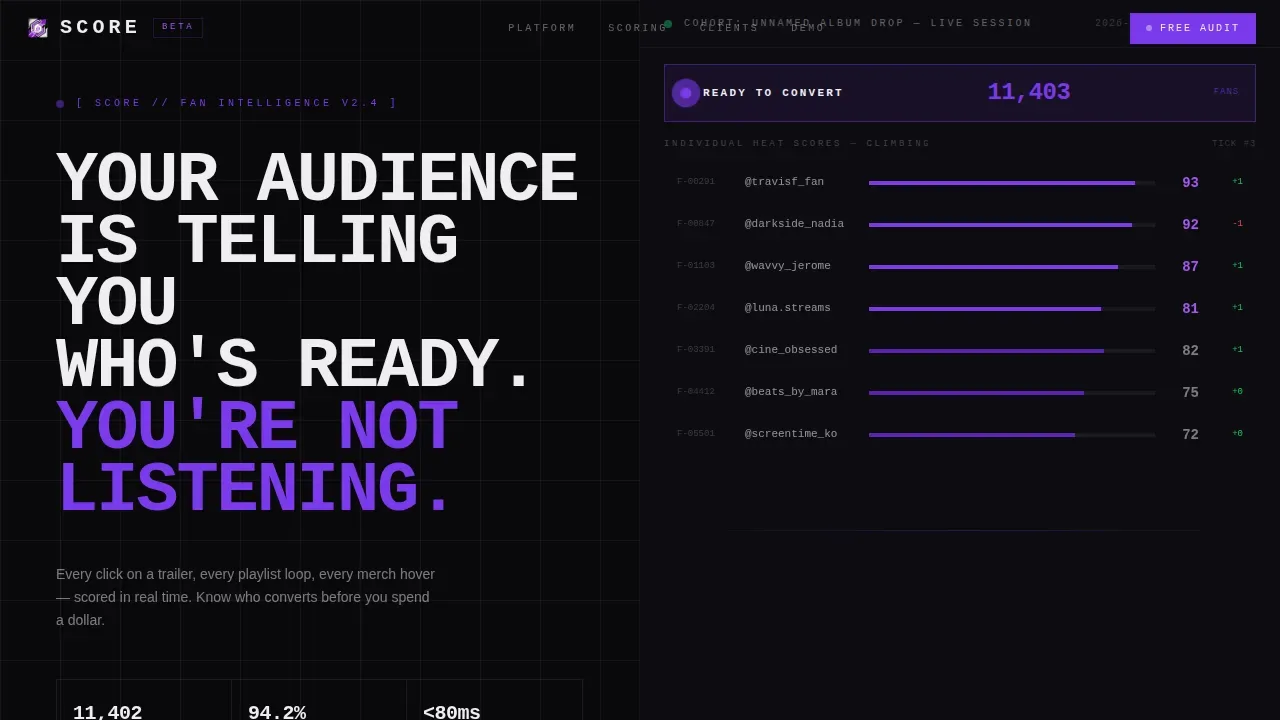
- Hero section with oversized brutalist monospace headline and live dashboard mockup on the right half
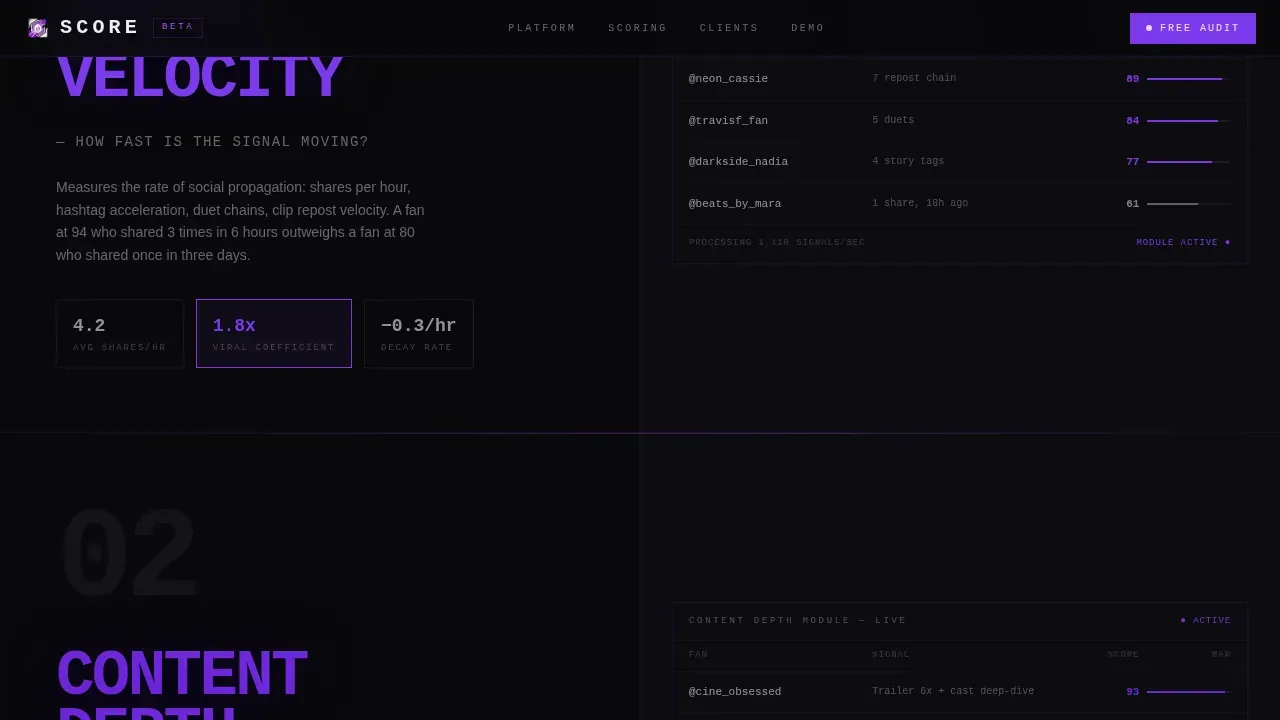
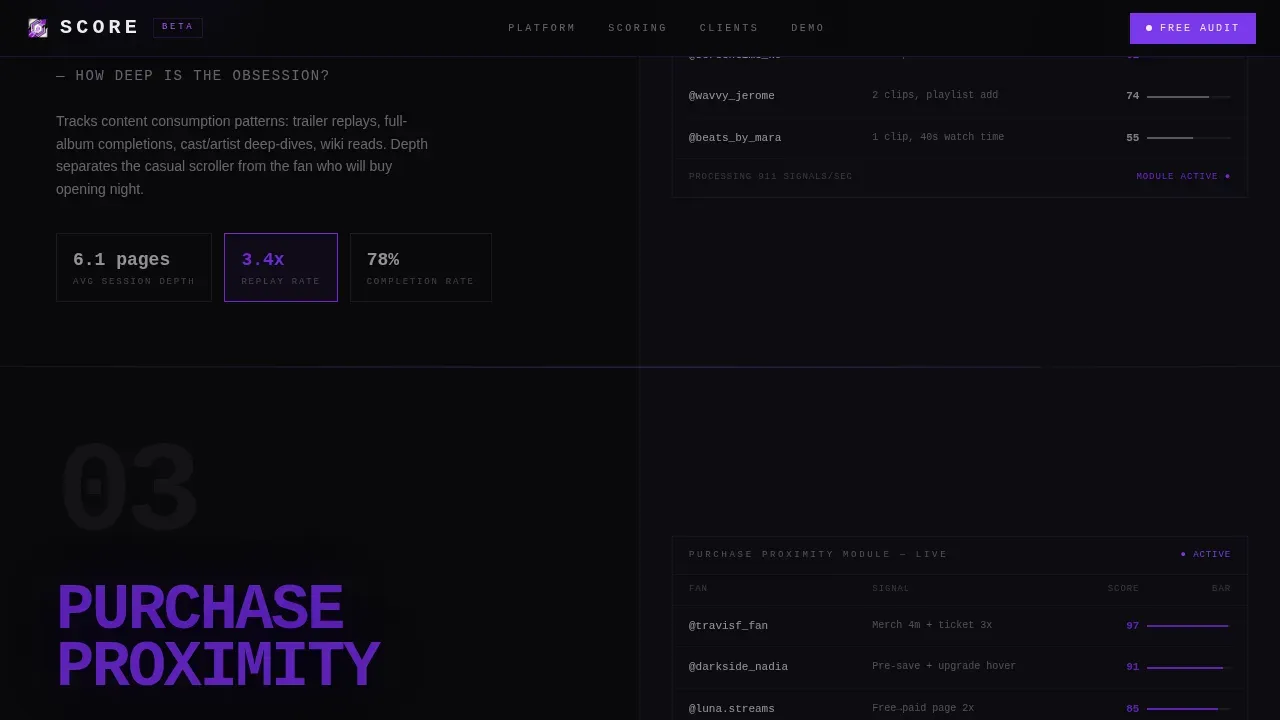
- Four-module scroll-accumulating feature matrix covering Social Velocity, Content Depth, Purchase Proximity, and Churn Risk
- Persistent freemium call-to-action panel and a secondary sandbox demo path
Feature list
This template ships with six purpose-built sections and a tightly engineered brutalist design system. Each built component reflects a deliberate decision about how entertainment professionals find value and act on it.
50/50 Brutalist Hero Split
The hero divides the viewport into two equal halves. The left side carries all-caps monospace headlines in void black and electric violet. The right side displays a high-fidelity dashboard mockup showing fan cohort scores climbing in real time, including a flagged segment labeled "READY TO CONVERT." This concept immediately signals what the platform does.
Scroll-Accumulating Feature Matrix
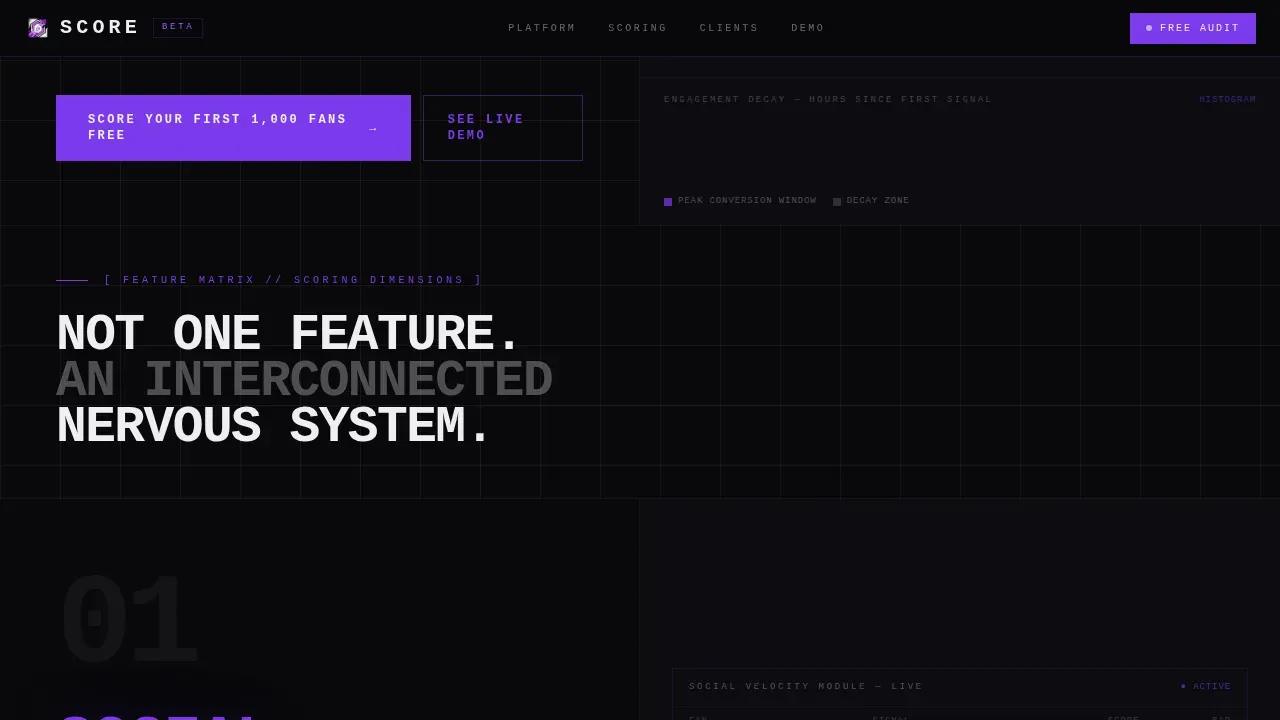
As visitors scroll, four scoring modules appear one by one: Social Velocity, Content Depth, Purchase Proximity, and Churn Risk. Each module splits the screen, with the dimension name in massive type on the left and the actual module user interface with sample data on the right. By the midpoint, the grid lines thicken and the page feels engineered, not decorated.
Persistent Freemium Call-to-Action Panel
After the third scroll section, a sticky left-panel call to action locks to the viewport. It reads "Score Your First 1,000 Fans Free" and stays visible without blocking the content. The form asks only for work email and platform type, with no credit card required. This approach reflects best practice for brutalist landing pages: minimal fields, maximum urgency.
Sandbox Demo Path
Below the feature matrix, a secondary call to action links to a sandbox demo pre-loaded with anonymized entertainment datasets. This path lets visitors see scoring on real-looking data before they sign up. Live score previews like this can enhance user engagement by letting people input lead attributes and watch results respond.
Platform Use Case Cards
Four segment cards cover Film, Music, Streaming, and Live Events. Each card makes the scoring concept tangible for a specific buyer type. This section helps every type of visitor find where their own workflow fits inside the platform.
Brutalist Social Proof Block
A metric wall shows aggregate platform numbers alongside an anonymized client quote, both rendered in brutalist typographic treatment. Raw data visualization in brutalist design uses simple charts and stark numbers rather than polished graphics, so the proof feels honest and direct.
Page sections overview
| Section | Purpose |
|---|---|
| Hero Split Screen | Establish the product concept with oversized type and dashboard mockup |
| Feature Matrix Grid | Build understanding through four scroll-accumulating scoring modules |
| Platform Use Cases | Segment value for Film, Music, Streaming, and Live Events buyers |
| Social Proof Block | Reinforce trust with aggregate metrics and an anonymized client quote |
| Freemium Call to Action | Capture work email and platform type with a persistent sticky panel |
| Sandbox Demo Path | Offer a secondary conversion route through an anonymized data demo |
| Footer | Minimal developer-style footer with essential links |
Design & branding system
The design follows a Void and Violet color system built to feel like a concert venue thirty seconds before the headliner hits. Bold brutalist design in web development draws inspiration from 1950s and 1970s architecture, prioritizing raw functionality and unapologetic simplicity. That ethos runs through every pixel of this template.
- Void black (#09090B) covers all background surfaces with no gradients and no softness
- Electric violet (#7C3AED) activates on score bars, hover states, and live data pulses to guide user focus
- Plasma white (#EEEEF0) is reserved for headlines and data labels set in JetBrains Mono at heavy weights; body copy runs in DM Sans
Mobile & speed optimization
The template is desktop-first by design, built for marketing VPs and A&R coordinators who work on wide viewports where dashboard complexity is fully visible. However, brutalist design elements are optimized for mobile devices to ensure functionality and speed across all screen sizes. Effective brutalist landing pages maintain fast loading times by keeping heavy assets minimal.
- Server Components handle static sections to keep the page running efficiently
- Client Components power the animated dashboard, pulsing score bars, and blinking cursor
- The split-screen layout and sticky call-to-action panel are built to perform cleanly on modern browsers
How this template helps you convert
Brutalist web design emphasizes minimalist interactivity and immediate user engagement with the core message. This template puts that principle to work across every section, so every click a visitor makes moves them closer to signing up.
- The hero dashboard mockup shows real interface data immediately, so visitors understand the product before reading a single line of body copy
- The scroll-accumulating feature matrix builds commitment section by section; by the time visitors reach the call to action, they have already mentally placed their own data into four separate modules
- The freemium signup form asks only for work email and platform type, removing cost and friction as objections at the moment of decision
Other information about this template
This template is the Score Bold Brutalist Entertainment AI Lead Scoring Landing Page Template, built for teams who need a landing page that reflects the speed and precision of AI-powered fan intelligence. Several additional details are worth noting for buyers evaluating whether it fits their projects.
- The template concept is built on vibe coding principles, meaning users can adapt and extend it using natural language prompts in AI-powered app development tools, making it accessible to non-technical builders
- No-code development approaches allow users to build production-ready pages without extensive coding knowledge, and this template is structured to support that workflow
- AI can analyze landing page performance data over time; the modular section structure makes it straightforward to add, remove, or reorder sections as feedback and performance data come in
- AI tools can provide actionable insights to enhance conversion rates, and the template's built-in freemium path and sandbox demo route give teams two distinct conversion loops to test month over month
- Google indexability is supported by the clean semantic structure; teams running paid campaigns can post the page to Google-tracked destinations and measure replies and interactions directly
- The template stores no user data itself; the signup form fields are scoped to work email and platform type only, keeping the information collected minimal and clear
- Builders who love a high-density data aesthetic will find that the brutalist grid lines, counter animations, and pulsing violet accents cheers the aesthetic without adding unnecessary embellishments
- The unlimited scroll accumulation concept means teams can add scoring dimensions beyond the four built-in modules without breaking the layout structure
- Download the template once and it is yours to deploy across multiple projects; the design system scales cleanly whether you are building for a single release campaign or a full-year content calendar
Theme
Bold Brutalist
Creative direction
Feature Matrix
Color system
Void & Violet
Style
Split Screen (50/50)
Direction
Freemium/Trial
Page Sections
50/50 Brutalist Hero Split Screen
Scroll-accumulating Feature Matrix
Persistent Freemium Call to Action Panel
Sandbox Demo Secondary Path
Platform Use Case Segment Cards
Brutalist Social Proof Block
Related questions
Who is this landing page template designed for?
Does the freemium call-to-action form require a credit card?
Can I adapt this template without deep coding knowledge?
How does the scroll-accumulating feature matrix work?
Can the lead scoring layout be adjusted based on feedback over time?