Searchable Faith Traditions Landing Page Template
Codex is a searchable religious traditions comparison landing page template built for depth, neutrality, and discovery. It maps rituals, governance structures, sacred texts, and calendars across world traditions into one navigable architecture. With a dramatic Void and Violet visual identity, interactive tab switching, and scroll-driven exploration sections, Codex turns complex comparative data into an experience that compels visitors to keep digging.
by Rocket studio
Quick summary
Codex is a single-page, dark-themed knowledge base landing page template designed for comparative religion platforms. It features a Feature Tab Switcher header, interactive comparison tables across five tradition categories, and a scroll-driven layout that rewards curiosity at every section. The design is encyclopedic in depth and strictly neutral in tone, built for comprehension rather than conversion pressure.
Who this template is for
Codex is designed for teams and individuals who need to present rich, structured religious knowledge in a format that serious readers will trust and explore. It suits projects where the data itself is the product, and where the visitor's intellectual curiosity is the primary engagement driver.
- Comparative religion students and academic researchers pulling secondary sources for thesis work, needing fast access to structured tradition data
- Interfaith dialogue coordinators and journalists who need verified, side-by-side tradition overviews without editorial bias
- Knowledge base publishers, educators, and digital library curators who want a navigable, visually striking front-end for complex religious datasets
What problem this template solves
Religious tradition data is often scattered across disconnected scholarly journals, institutional pages, and printed materials that are hard to compare side by side. A curious reader trying to understand the difference between governance structures in Roman Catholicism and Theravada Buddhism, or why sacred calendars shift year to year, faces a maze of sources with no shared architecture. Codex solves this by organizing everything into a single, navigable comparison engine.
- Eliminates the need to cross-reference multiple disconnected sources just to compare basic tradition attributes
- Removes the friction that pushes researchers toward paywalled scholarly journals or fragmented digital archives when they need fast, reliable answers
- Gives knowledge base publishers a ready-made front-end that communicates depth and academic standards before a visitor clicks anything
What you get with this template
This template delivers a complete, fully structured landing page layout with every section pre-designed and ready to populate with real tradition data. The visual system, interactive components, and content architecture are all included in a single cohesive build.
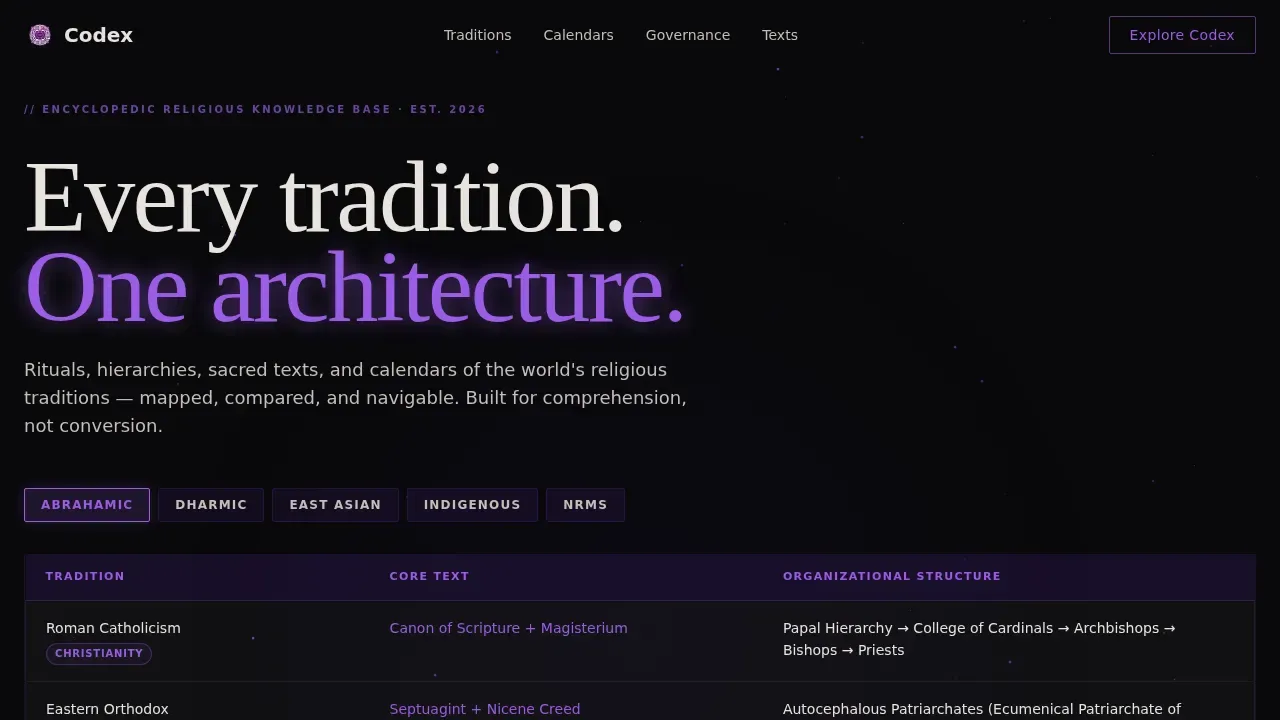
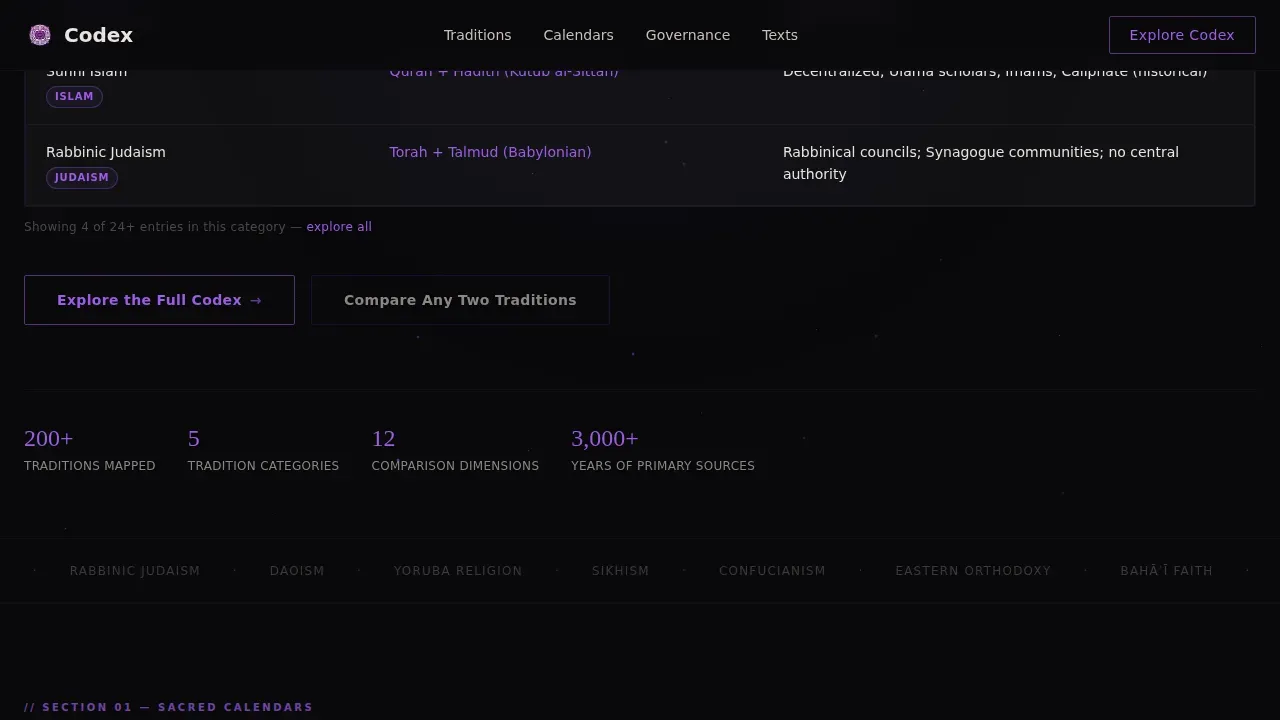
- A five-tab Feature Tab Switcher header with live comparison table previews across Abrahamic, Dharmic, East Asian, Indigenous, and New Religious Movements categories
- Four scroll-driven content sections covering ritual calendars, governance structures, sacred text lineages, and a head-to-head tradition comparator, each with micro-interaction components
- A dual call-to-action strategy: a ghost-outlined primary button beneath the header table and a solid orchid button triggered after scroll engagement, plus a modal selector for direct tradition comparisons
Feature list
This template ships with a carefully considered set of interactive and visual components. Each one is designed to serve a specific research use case while keeping the overall experience coherent and immersive.
Five-Category Tab Switcher Header
The header presents five horizontal tabs labeled by tradition category: Abrahamic, Dharmic, East Asian, Indigenous, and New Religious Movements. Each tab triggers a different comparison table preview below it. The active tab glows in luminous orchid against the void background; inactive tabs rest in muted episcopal purple. The visible table snippet immediately shows real entries, including Roman Catholicism with its Papal Hierarchy and the Pali Canon alongside Sangha Councils for Theravada Buddhism, proving the depth of the database before the visitor scrolls at all.
Ritual Calendars Side-by-Side Section
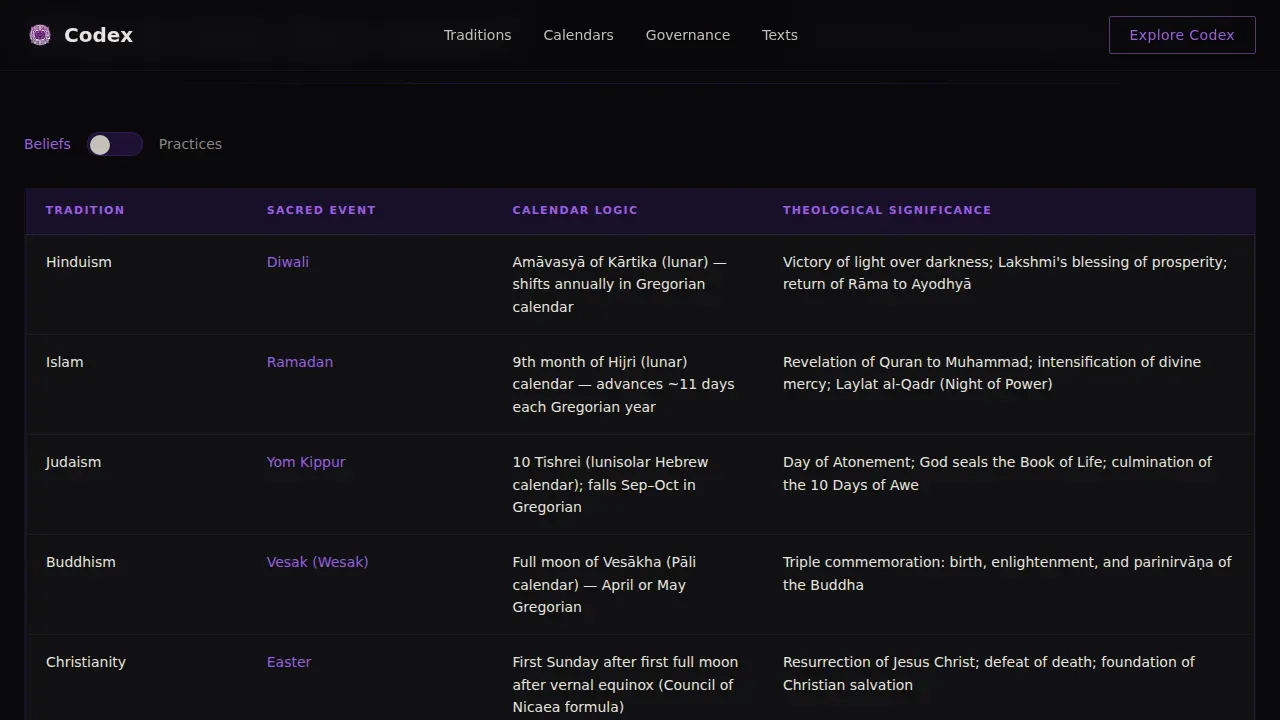
This section presents sacred dates and observance cycles across traditions in a parallel layout, with an interactive toggle between "beliefs" and "practices" views. The toggle means a visitor never passively reads but actively chooses what layer of information to reveal. This is especially useful for researchers trying to understand why dates like Diwali shift each year relative to the Gregorian calendar, or how liturgical cycles in early Christianity compare to observance patterns in other traditions.
Governance Structures Visualizer
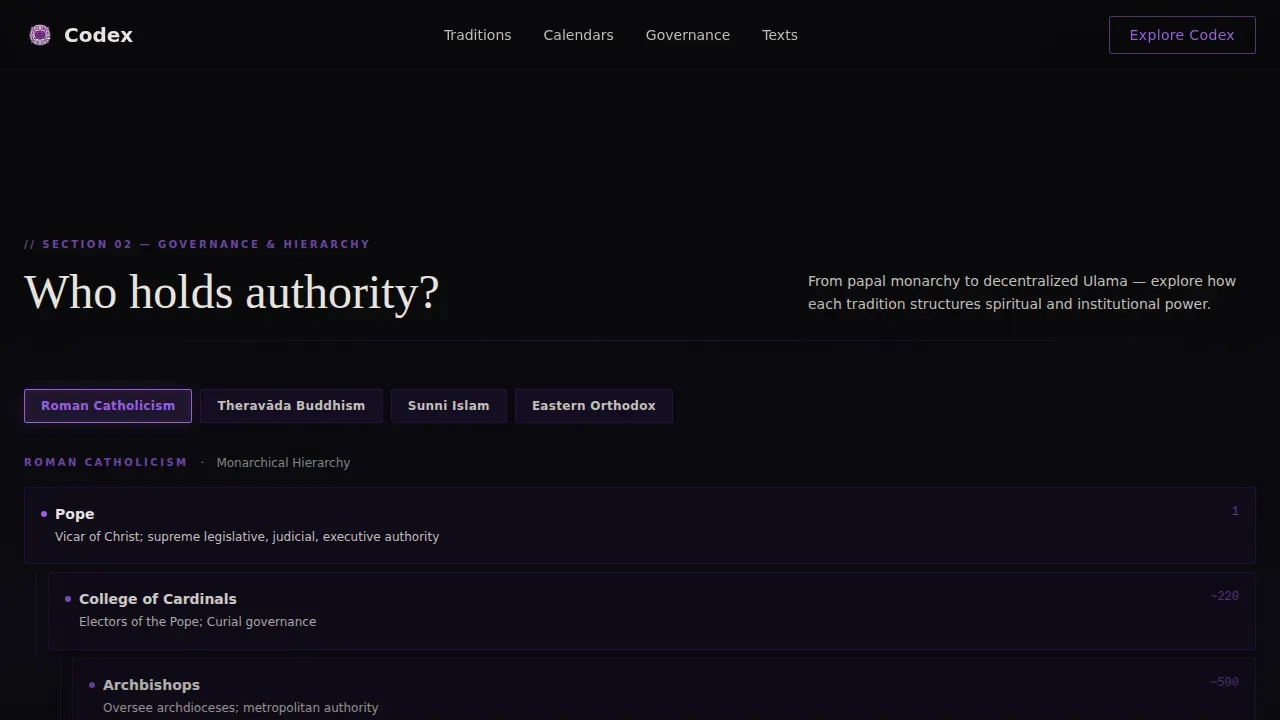
The governance section maps hierarchical religious authority structures as nested organizational chart cards. Each card represents a tradition's internal power architecture, from papal succession lines in Roman Catholicism to the conciliar structures of Eastern Orthodoxy and the decentralized Sangha Councils of Theravada Buddhism. This section gives journalists, coordinators, and scholars a fast, visual answer to questions like the difference between a diocese and an eparchy, without requiring them to dig through printed editions of canon law or institutional directories.
Sacred Text Lineages Timeline
This section renders canonical text histories as branching timeline visualizations. It traces how foundational documents evolved, split, and influenced one another across centuries. Readers can follow how Greek texts from the fourth century gave rise to divergent canonical traditions, how translations such as the English versions derived from the Hebrew Bible and Greek manuscripts shaped different Christian communities, and how the old and new testaments were organized and reorganized across confessional boundaries from the middle ages onward.
Dual Call-to-Action Architecture
The template includes a deliberately sequenced call-to-action strategy. A ghost-outlined "Explore the Full Codex" button appears beneath the header table preview, making the first invitation low-pressure. A solid orchid "Explore the Full Codex" button appears again after the visitor has interacted with at least two comparison sections, rewarding scroll engagement with a stronger nudge. A secondary "Compare Any Two Traditions" call to action opens a lightweight modal selector, letting visitors pick any two traditions for a head-to-head preview before committing to the full database.
Void and Violet Visual Identity System
The entire template is built around a striking dark aesthetic that feels like stepping into a vast, charged library rather than a generic web page. The absolute void black background, episcopal purple section dividers, luminous orchid interactive highlights, and cool parchment table fills work together to create a visual hierarchy that guides the eye without overwhelming it. Fraunces serif headings bring the weight of ancient manuscript typography, while DM Sans body text maintains neutral clarity for dense comparison data.
Page sections overview
| Section | Purpose |
|---|---|
| Hero Tab Switcher | Displays five tradition tabs with live comparison table preview and ghost call-to-action button |
| Ritual Calendars | Shows sacred dates side by side with a belief and practice toggle for active exploration |
| Governance Structures | Maps hierarchical authority structures as nested organizational chart cards per tradition |
| Sacred Text Lineages | Renders canonical text histories as branching timeline visualizations across centuries |
| Tradition Comparator | Modal selector for head-to-head tradition comparison, closing with solid orchid call-to-action |
| Footer | Horizontal flow footer pattern with navigation and platform links |
Design & branding system
The Void and Violet color system defines every visual decision in this template. The palette is built for a dark-library aesthetic where the darkness itself is active and charged, not empty, and where violet accents function like pinpoints of light guiding a reader through a dim but rich space.
- Color palette: absolute void black (#09090B) as the primary background, deep episcopal purple (#3B1F6E) for section dividers and hover states, luminous orchid (#9B5DE5) for active tabs and interactive highlights, and cool parchment (#E8E4DF) for body text and table cell fills
- Typography: Fraunces serif for all headings, delivering the visual weight of ancient manuscript lettering; DM Sans for body copy and table data, keeping information legible and neutrally styled even when content density is high
- Animation and interaction: high-intensity tab switching with scroll reveals, stagger entrance animations, hover glows on table rows and interactive elements, and a lightweight modal for the tradition selector, all designed to feel like discovery rather than distraction
Mobile & speed optimization
This template is designed desktop-first, which reflects the real usage patterns of its core audience. Researchers working with comparison tables need horizontal screen space to read data across multiple columns without losing context. The layout is built to maximize that horizontal real estate on large screens while still providing a responsive fallback for mobile readers.
- Desktop-first layout with full horizontal comparison table columns visible without horizontal scrolling on standard desktop viewports
- Responsive mobile fallback that reflows table data and stacks comparison columns for smaller screens, preserving readability on mobile devices
- Static content is server-rendered at load, with client-side interactivity isolated to specific interactive components such as the tab switcher, belief and practice toggle, and modal selector, keeping the initial page load fast even with high animation intensity
How this template helps you convert
Codex earns clicks by demonstrating real, usable knowledge in every visible table row. The conversion strategy is built on proof, not persuasion. Every interactive element the visitor touches deepens their confidence that the full database behind the button is richer than what is already on screen.
- The Feature Tab Switcher makes the value proposition immediate and tangible. A visitor sees real tradition entries in the header table before they scroll even one section, establishing trust through the quality of the data itself rather than through testimonials or marketing copy.
- The scroll-driven micro-interaction structure compounds curiosity at each section. Every dropdown, toggle, and slider gives the visitor a small reward, a new layer of knowledge revealed, making the solid orchid "Explore the Full Codex" button feel like a natural next step rather than a cold ask.
Other information about this template
This section covers additional context about the scholarly and digital landscape that Codex is designed to serve, as well as platform and resource compatibility relevant to users building or deploying this template.
- The field of Comparative Religious Studies examines similarities and differences across religious traditions, using historical, sociological, and theological methodologies. Codex is built to present this kind of multi-dimensional data clearly and without editorial bias.
- Scholars, journalists, and coordinators working in related fields often rely on access to primary sources in digital form. Digital libraries provide access to a wide range of religious texts and resources, and Codex is designed as a front-end layer that can sit above or alongside such resources.
- The Internet Archive provides access to over 20 million freely downloadable books and texts, including religious works. The post-reformation digital library is a focused resource covering theological development across the Reformation and Post-Reformation eras. Codex can provide direct links to these and other resources within its table architecture.
- Resources such as the Loeb Classical Library offer bilingual printed editions of Greek and Latin texts, including Greek texts relevant to early Christianity, ancient Greek philosophy, and Latin literature from the Roman empire period through the middle ages. Codex's sacred text lineage section can reference and contextualize materials from collections like these.
- Institutions including the British Library and major national library collections hold digital images, Greek manuscripts, oral histories, personal papers, and previously unpublished materials relevant to religious history. Codex's design supports direct links to these kinds of digital collection resources within table cells and citation rows.
- The King James Bible, commissioned in 1604 and published in 1611 as a translation of the Christian Bible for the Church of England, remains one of the most studied English translations of all time. The King James Bible includes 80 books: 39 books of the Old Testament, 14 books of Apocrypha, and 27 books of the New Testament. The translators of the King James Bible were instructed to avoid marginal notes, distinguishing it from earlier translations such as the Geneva Bibles. The King James Bible was the third English translation approved by the Church of England, following the Great Bible and the Bishops' Bible, and the Geneva Bibles that preceded official sanction had circulated widely before it. Codex's biblical texts section can map these translation lineages visually, showing how the old and new testaments were rendered differently across confessional traditions.
- The Hebrew Bible and its relationship to the New Testament, including debates around Hebrew words, Greek texts, and the canonical status of books like those found among the Dead Sea Scrolls, represents exactly the kind of scholarly research territory that Codex's sacred text lineage section is designed to visualize.
- Jewish law, Jewish history, and Jewish culture are represented within Codex's Abrahamic tradition category. Church membership overviews and denominational heritage trees are supported within the governance and tradition overview sections, enabling generating national profiles for individual traditions or confessional groups.
- Scholarly journals, scholarly materials, and journals published by institutions such as Oxford University Press, New York University, and York University represent the secondary sources that Codex users typically consult alongside the platform. Codex can provide direct links to electronic versions and English language articles within its table cells.
- Online features such as the fully searchable table interface, the belief and practice toggle, and the tradition selector modal provide digital access to the entire collection of tradition data within a single page experience.
- The template supports personal account flows on the destination platform, where visitors who click through from Codex can request access to deeper database layers, conference proceedings, or previously unpublished materials held in the full knowledge base.
- Google Maps integration is not built into this template by default, but the table architecture supports direct links to location-based resources for traditions with strong geographic distribution data, such as Asia Minor Christianity or regional indigenous traditions.
- This template is built using the compact memory of a static-rendered front end with isolated client components, meaning the page loads efficiently even with its high animation and interactivity density. The English language interface is the default, with English version copy and English translations of tradition names and text titles used throughout.
- The template is suitable for platforms that generate national profiles, maintain oral histories, or publish conference proceedings related to religious traditions, providing a clean, structured front end for complex institutional digital collection environments.
- The second world war period and its aftermath reshaped many christian communities and religious institutions globally, a historical context that denominational heritage trees within the governance section can reflect. Similarly, traditions that developed or transformed during the world war era can be mapped within the tradition comparison architecture.
- The template pairs naturally with virtual library platforms that provide access to scholarly materials, digital images, and electronic versions of primary texts. This virtual library front-end design makes Codex a practical starting point for any organization wanting to provide access to structured religious knowledge at academic standards.
Theme
Directory & Discovery
Creative direction
Interactive Explorer
Color system
Void & Violet
Style
Comparison Table
Direction
Click-Through
Page Sections
Five-category Feature Tab Switcher
Interactive Scroll-driven Exploration Sections
Belief and Practice Toggle
Dual Call-to-action Conversion Strategy
Void and Violet Visual Identity
Sacred Text Lineage Timeline Visualization
Related questions
Who is this landing page template designed for?
Does this template require coding to set up?
How does the comparison table work?
Can I add my own tradition data to the tables?
Is this template suitable for mobile users?