Liberal Arts College Landing Page Template
The Seminar liberal arts college landing page is a modular card-grid layout built to turn curious visitors into enrolled prospects. It opens with a looping seminar video and a free recorded-class offer, then walks through a Problem-to-Solution arc. The Forest Trust color palette and Community Hearth warmth make every scroll feel like a conversation already in progress.
by Rocket studio
Quick summary
The Seminar landing page template is a single-page, card-grid layout for a liberal arts college. It opens with a looping seminar-table video and a gated free-trial offer, then guides visitors through a Problem-to-Solution arc. The Forest Trust palette and Community Hearth theme create warmth and trust. Two conversion paths capture leads from students, parents, and counselors alike.
Who this template is for
This template is built for small liberal arts colleges that compete on intimacy, faculty access, and intellectual culture. It speaks directly to the three people most involved in a college decision.
- High school juniors and seniors weighing their college choices and drafting application essays
- Parents who worry their student will get lost inside a large lecture-hall university
- High school guidance counselors matching curious, undeclared students to the right campus fit
What problem this template solves
Most college landing pages look identical. They lead with rankings, campus photos, and a generic "Apply Now" button. That approach does nothing for the student who wants to know what learning actually feels like on a campus.
- Lecture-hall anonymity and major-declaration pressure go unaddressed by standard college pages
- Emotionally flat layouts fail to differentiate a small college from any other school
- Visitors leave without experiencing proof that a different kind of education is real and available
What you get with this template
You get a fully designed, single-page layout that delivers an intellectual experience before asking for anything in return. Every section serves a clear purpose in the visitor's decision journey.
- A looping header video section with a gated free-seminar card grid offering three real recorded classes
- A problem-and-solution card arc with flip or transition effects showing anonymity statistics versus mentorship ratios
- Two distinct conversion paths: a "Watch a Real Seminar" lead form and a "Request Your Visit" booking section
Feature list
This template is built around a specific set of designed components and content modules grounded in the source brief.
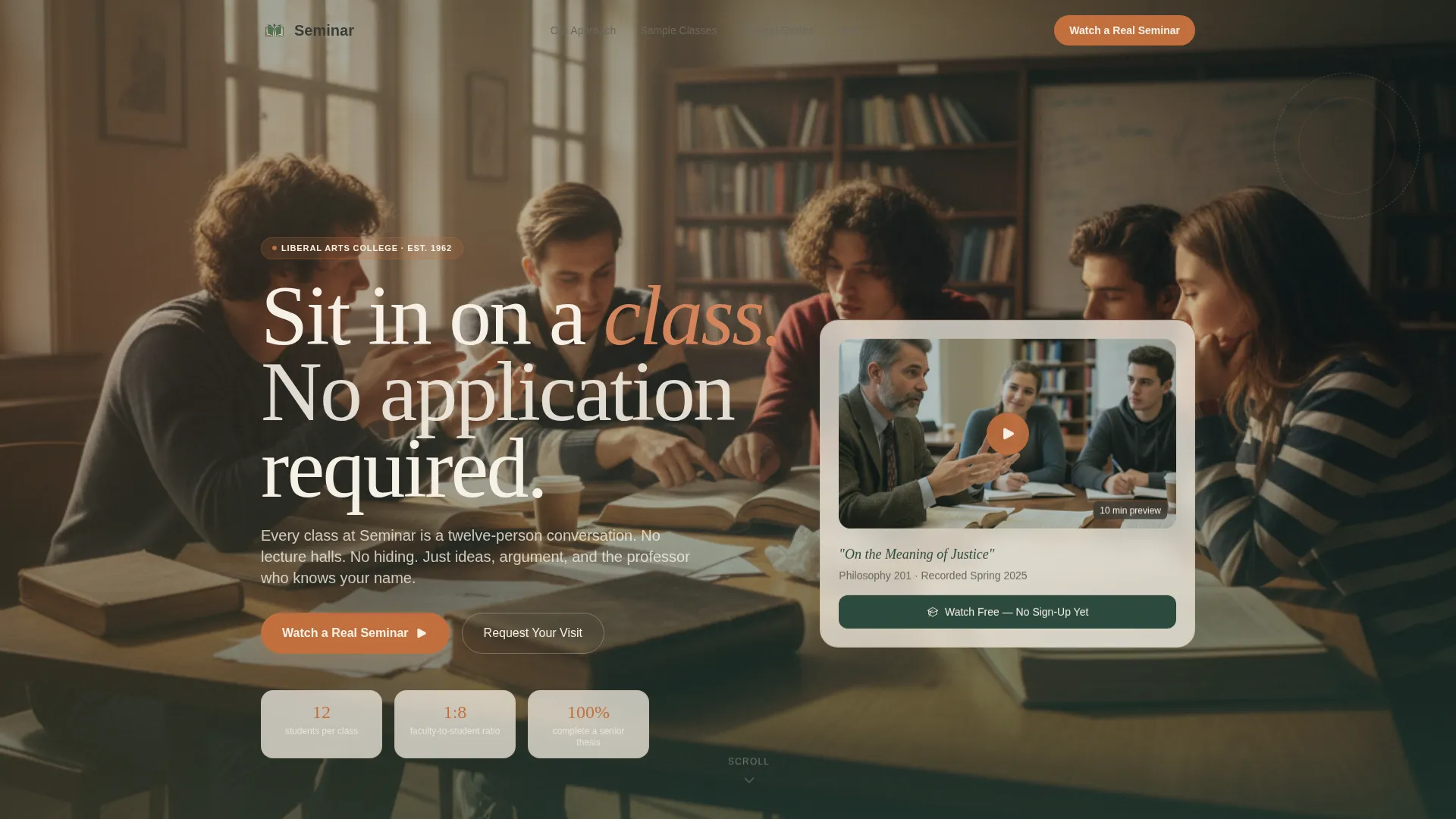
Looping Header Video with Free Trial Offer
The header plays a short looping video filmed at seminar-table height. Faces mid-discussion, open books, and a professor leaning forward fill the frame in golden late-afternoon light. A headline fades in below: "Sit in on a class. No application required."
Free Seminar Card Grid
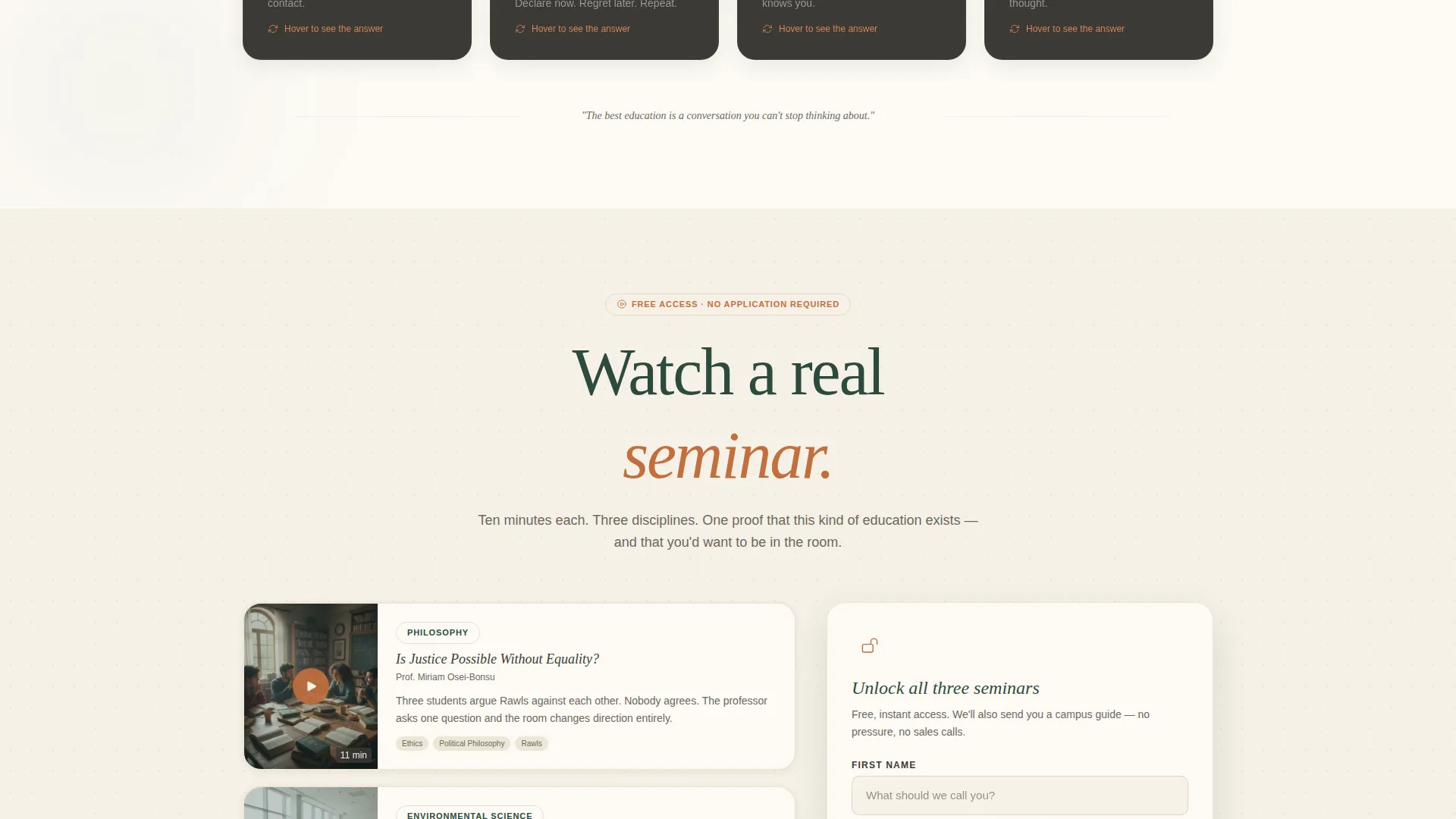
Three recorded seminar cards sit below the header. One covers philosophy, one environmental science, and one literature. Each is watchable in roughly ten minutes and serves as a proof-of-concept for the college's teaching style.
Problem-to-Solution Card Arc
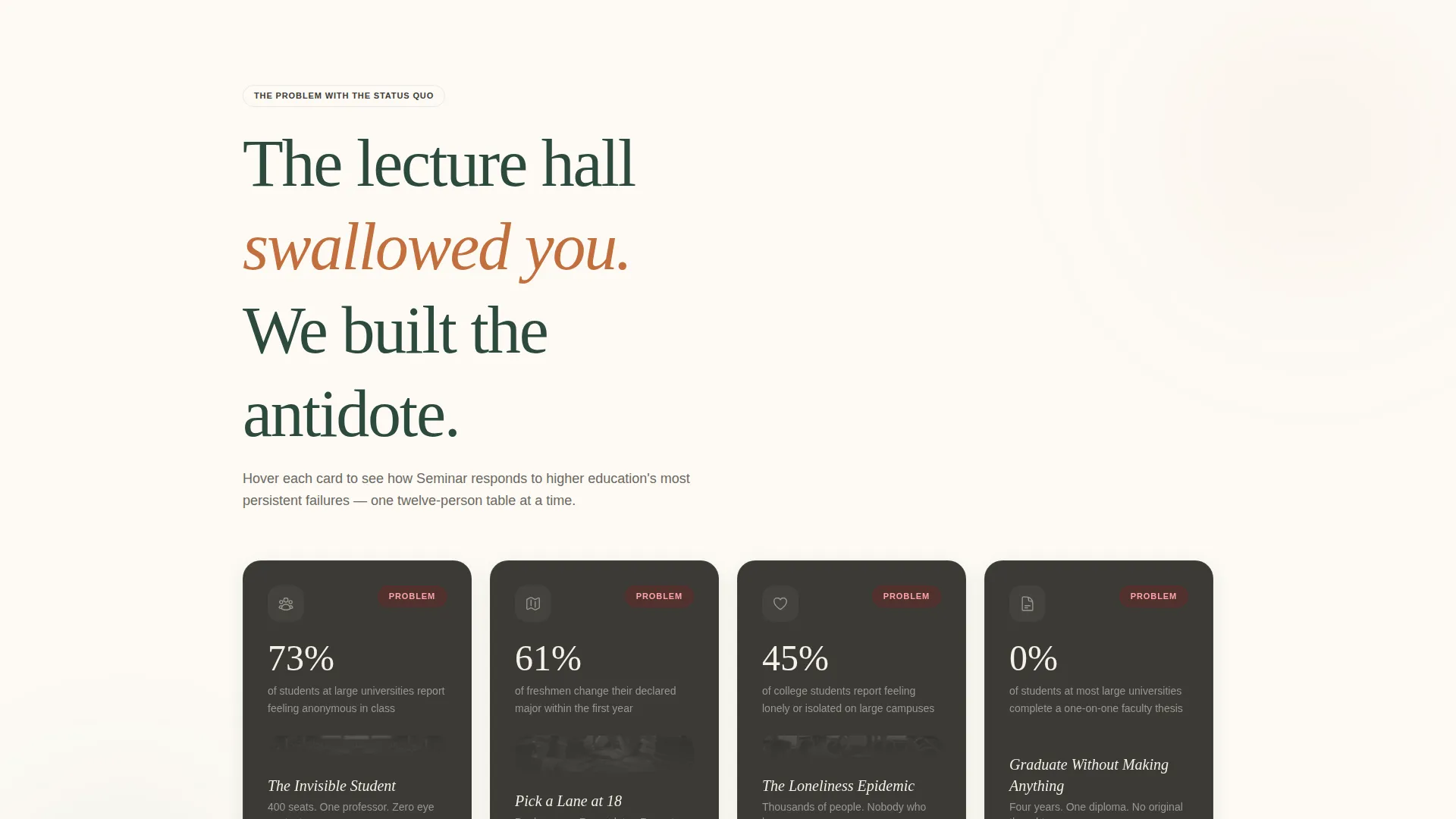
The scroll opens with problem cards showing statistics on lecture-hall anonymity, campus loneliness, and major-declaration pressure. Each card flips or transitions into a matching solution card covering mentorship ratios, an open curriculum, and the senior thesis program.
Gated Lead Capture Form
The primary conversion path gates the recorded seminar videos behind a short form. It collects a first name, an email address, and a single dropdown: "I am a..." with options for student, parent, and counselor. Friction is kept intentionally low.
Visit Request Section
A secondary conversion path sits at the bottom of the page. Visitors can request a campus visit by selecting a date and noting an intended area of academic interest. This path suits parents and students further along in the decision process.
Intimate Student Story Cards
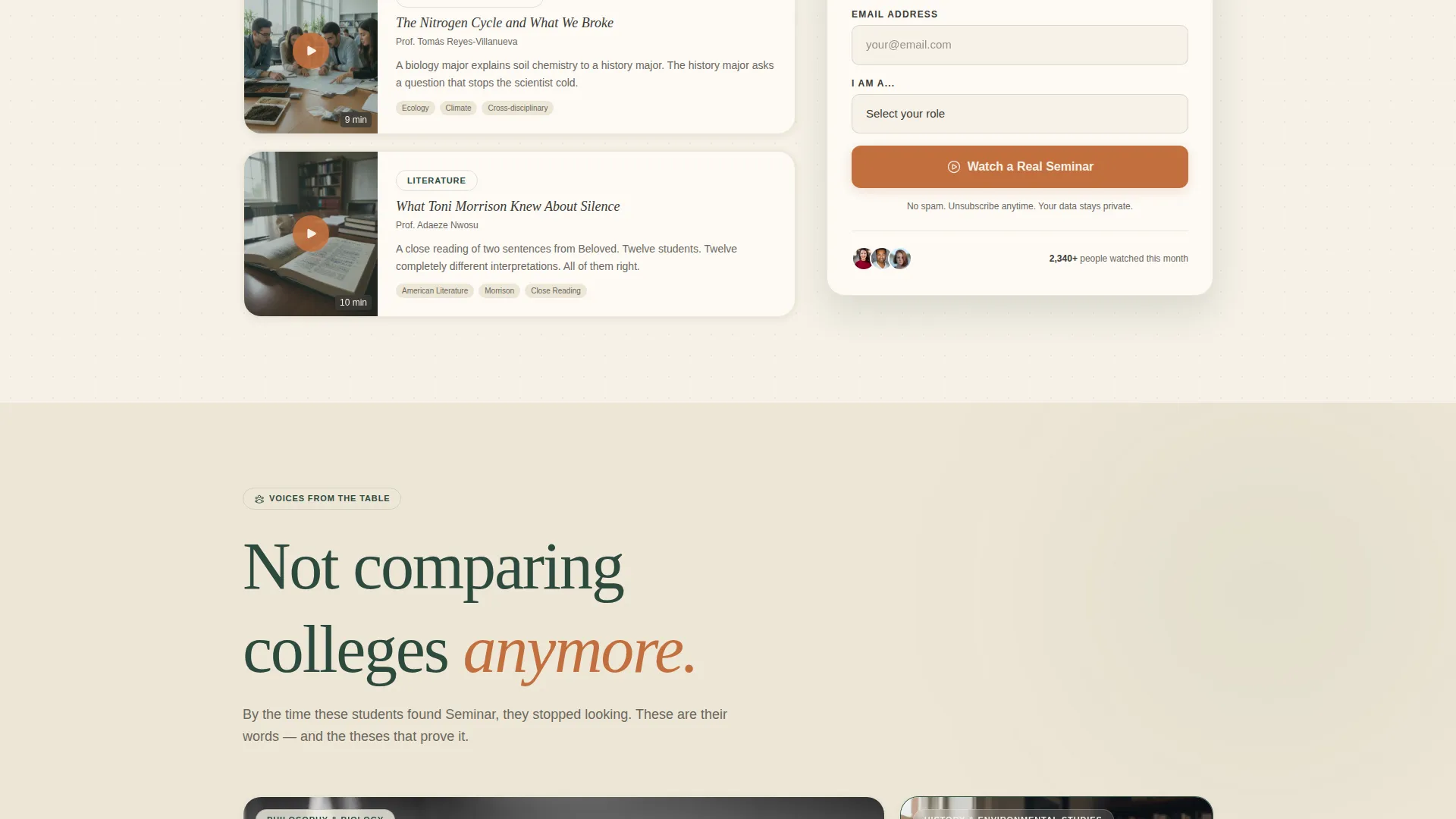
The emotional arc closes with individual student story cards. These shift the visitor's focus from institutional comparison to imagining a specific seat at a specific seminar table. The cards make the college feel personal before any application is submitted.
Page sections overview
| Section | Purpose |
|---|---|
| Header video loop | Opens with live seminar footage and fade-in headline |
| Free seminar cards | Showcases three watchable recorded classes |
| Lead capture form | Gates seminar access behind a short three-field form |
| Problem stat cards | Surfaces lecture-hall anonymity and loneliness data |
| Solution flip cards | Pairs each problem with a college-specific answer |
| Mentorship ratio block | Highlights small class sizes and faculty access |
| Open curriculum section | Explains the undeclared, exploratory academic model |
| Senior thesis feature | Details one-on-one faculty advising for every student |
| Student story cards | Brings the emotional arc to a personal, human close |
| Visit request section | Offers date selection and major interest for campus visits |
Design & branding system
The template uses a Forest Trust color system built around four carefully chosen values. The palette evokes a campus quad under oak canopy on an early October afternoon.
- Old-growth green (#2D4A3E) anchors all headers and navigation elements; hearthstone charcoal (#3B3A36) grounds body text on a dominant parchment cream (#F5F0E6) background
- Warm ember (#C2703E) highlights every button, link, and interactive card border to draw the eye toward action
- The Community Hearth theme carries visual warmth through the layout: wood-panel texture cues, lamplight-inspired card shadows, and a general sense of a lit room on a cool evening
Mobile & speed optimization
The card-grid layout is built modularly, which means sections stack cleanly on smaller screens without breaking the visual hierarchy or the Problem-to-Solution arc.
- Card components reflow into single-column stacks on mobile, keeping flip transitions and video autoplay cues intact
- The lead capture form and visit request section remain accessible and readable on any screen width
- The looping header video is configured to play silently and unobtrusively so it supports rather than interrupts the mobile experience
How this template helps you convert
The page is engineered around two conversion goals. Every design and copy decision moves a visitor closer to one of them.
- The "Watch a Real Seminar" form converts curiosity into a lead by delivering genuine value first. The visitor watches a real class before submitting anything, which removes skepticism and replaces it with experience.
- The "Request Your Visit" section captures warmer prospects who are ready to take the next physical step. Date selection and major interest fields make the visit feel real and personalized from the moment they fill it out.
Other information about this template
This template is part of the Education and Training category, filed under the College and University subcategory with a Liberal Arts College niche focus. A few additional details are worth knowing before you build with it.
- The template style is Card Grid (Modular), which means individual sections can be rearranged or swapped without disrupting the overall layout
- The header concept follows a Free Trial model: content is offered before commitment is requested, which is particularly well-suited to an audience doing slow, high-stakes research
- The creative direction follows a Problem-to-Solution Arc, moving from institutional critique to intimate personal story across the scroll
- The landing page direction is Lead Generation, with both conversion paths designed to collect qualified contact information at different stages of the visitor's decision process
- The theme is Community Hearth, a deliberate choice to counter the cold, transactional feel of standard university websites
Theme
Community Hearth
Creative direction
Problem→Solution Arc
Color system
Forest Trust
Style
Card Grid (Modular)
Direction
Lead Generation
Page Sections
Looping Seminar Header Video
Free Recorded Seminar Card Grid
Problem-to-solution Card Arc
Low-friction Lead Capture Form
Campus Visit Request Section
Student Story Closing Cards
Related questions
Who is this landing page template designed for?
What are the two main ways visitors can convert on this page?
Can I customize the colors or replace the header video?
What makes this template different from a standard college admissions page?
Does the lead form support multiple visitor types?