Defense Contractor & Military Specialist Professional Website Template
Sentinel is a defense-focused landing page template built for autonomous systems firms targeting program managers, prime contractor leads, and government innovation officers. It combines a schematic infographic header, zigzag data-visualization sections, and a dual-path conversion funnel into one precisely structured page that builds an evidence case before asking for a meeting.
by Rocket studio
Quick summary
Sentinel delivers a single-page experience designed for a defense engineering firm operating in military robotics and autonomous systems. The layout follows an industry report cadence, moving from problem definition through capability proof to partnership action. Every section earns its place, and the visual system reinforces technical authority without relying on stock imagery.
Who this template is for
This template is built for defense technology firms that need to communicate complex autonomous systems capabilities to a sophisticated, risk-aware audience. The page speaks directly to buyers who evaluate evidence before they engage.
- Program managers at defense ministries assessing autonomous ground and aerial platforms
- Prime contractor integration leads sourcing subsystem partners for contested-environment programs
- Government innovation officers hunting for capabilities that compress decision-to-action timelines
What problem this template solves
Most marketing pages fail in the defense sector because they look like brochures. Decision-makers at this level expect data, not description. This template solves the credibility gap between a capable firm and a skeptical institutional buyer.
- Operators and program managers need technical proof before they will engage a new partner
- Generic website layouts signal a lack of domain seriousness to defense procurement audiences
- Dual-funnel conversion structures are rarely built into off-the-shelf templates for defense-niche use cases
What you get with this template
The Sentinel template gives you a fully structured landing page ready for a defense engineering firm specializing in autonomous systems. The layout, visual hierarchy, and conversion paths are all pre-built and aligned to the target audience.
- A full-width animated infographic header with a schematic theater map and live-style ticking metrics
- Zigzag alternating sections pairing data-visualization panels with tightly written analytical copy
- A dual conversion funnel: a primary gated form for partnership briefs and a lighter gate for unclassified overview downloads
Feature list
This section describes the core components built into the Sentinel template. Each element is drawn directly from the design and functionality brief.
Animated Schematic Theater Map Header
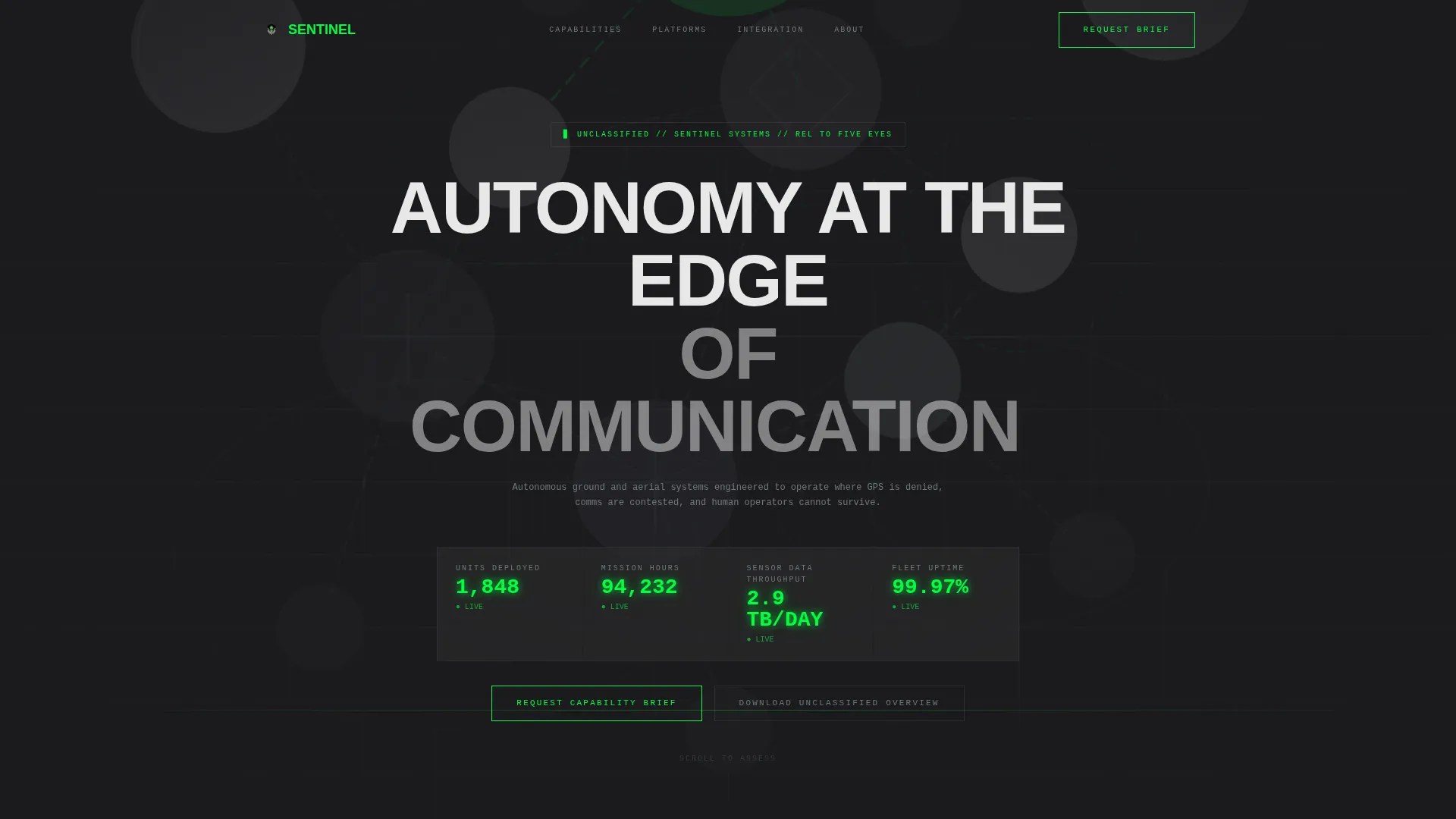
The header spans the full page width and renders a vector-style operational map showing nodes, communication links, and autonomous asset positions. Numerical counters tick upward to display units deployed, mission hours logged, and sensor data throughput. The headline fades in over the map in condensed, uppercase sans-serif type. No photography is used; the data is the visual.
Zigzag Data and Copy Alternating Layout
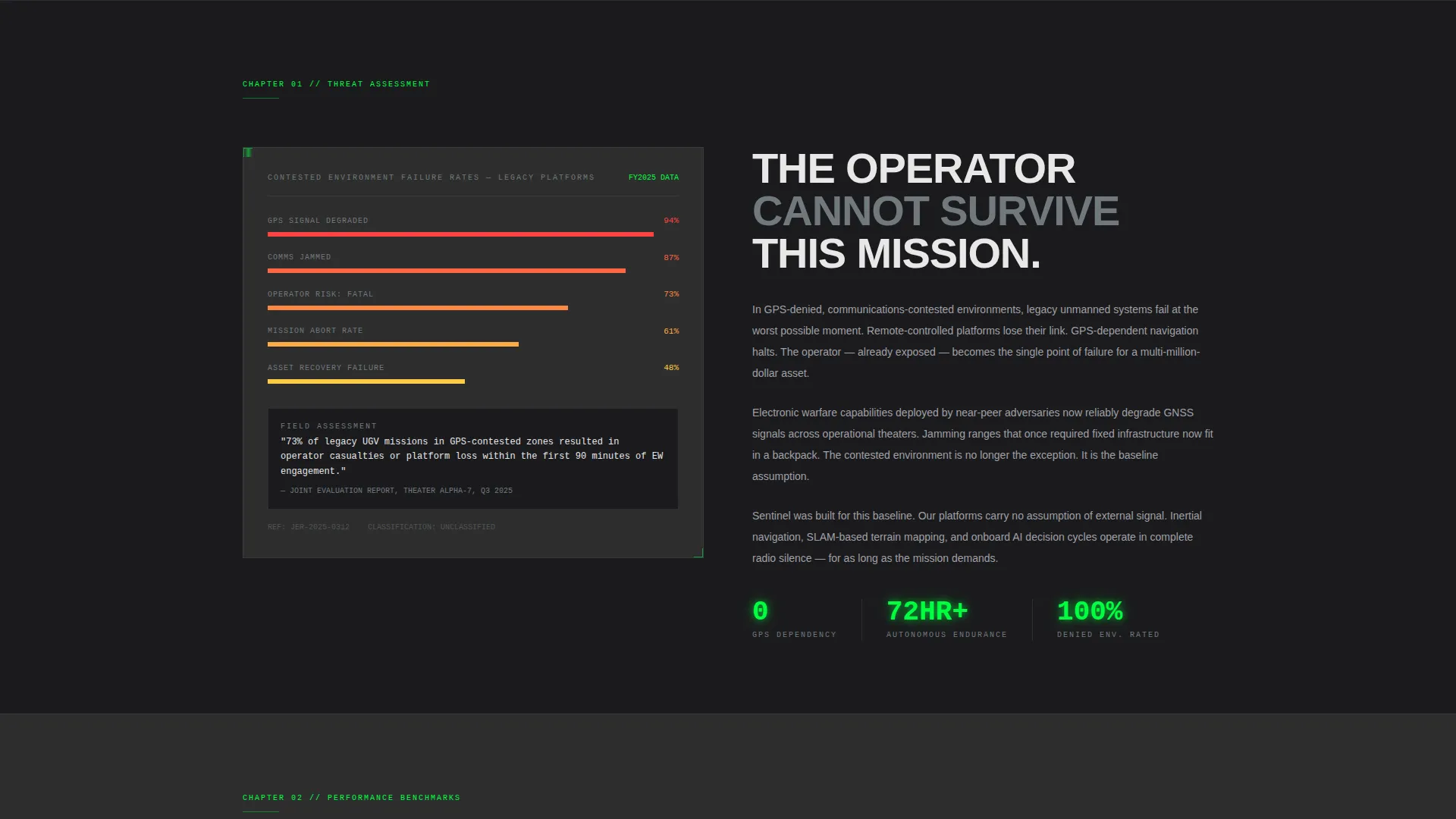
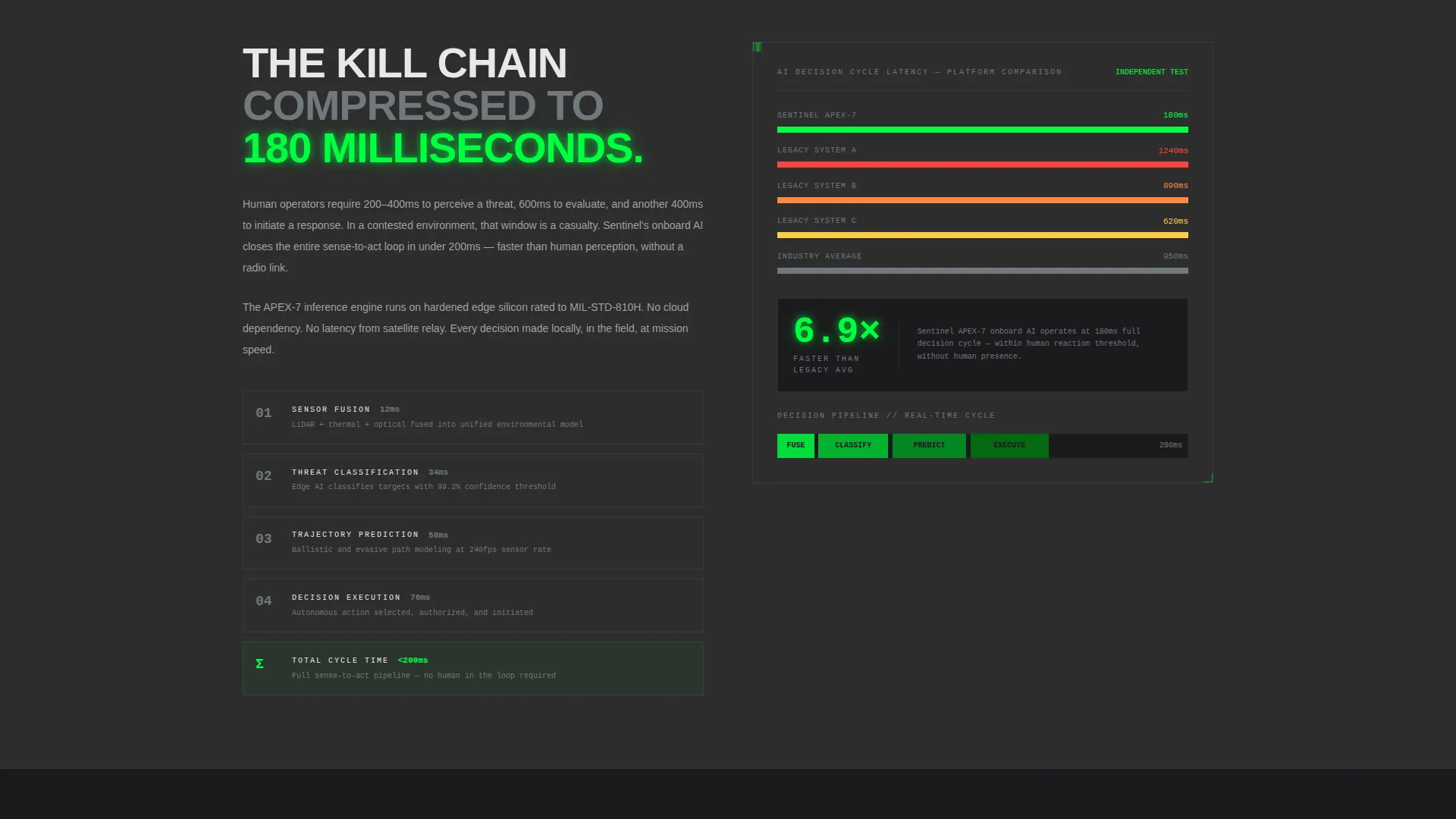
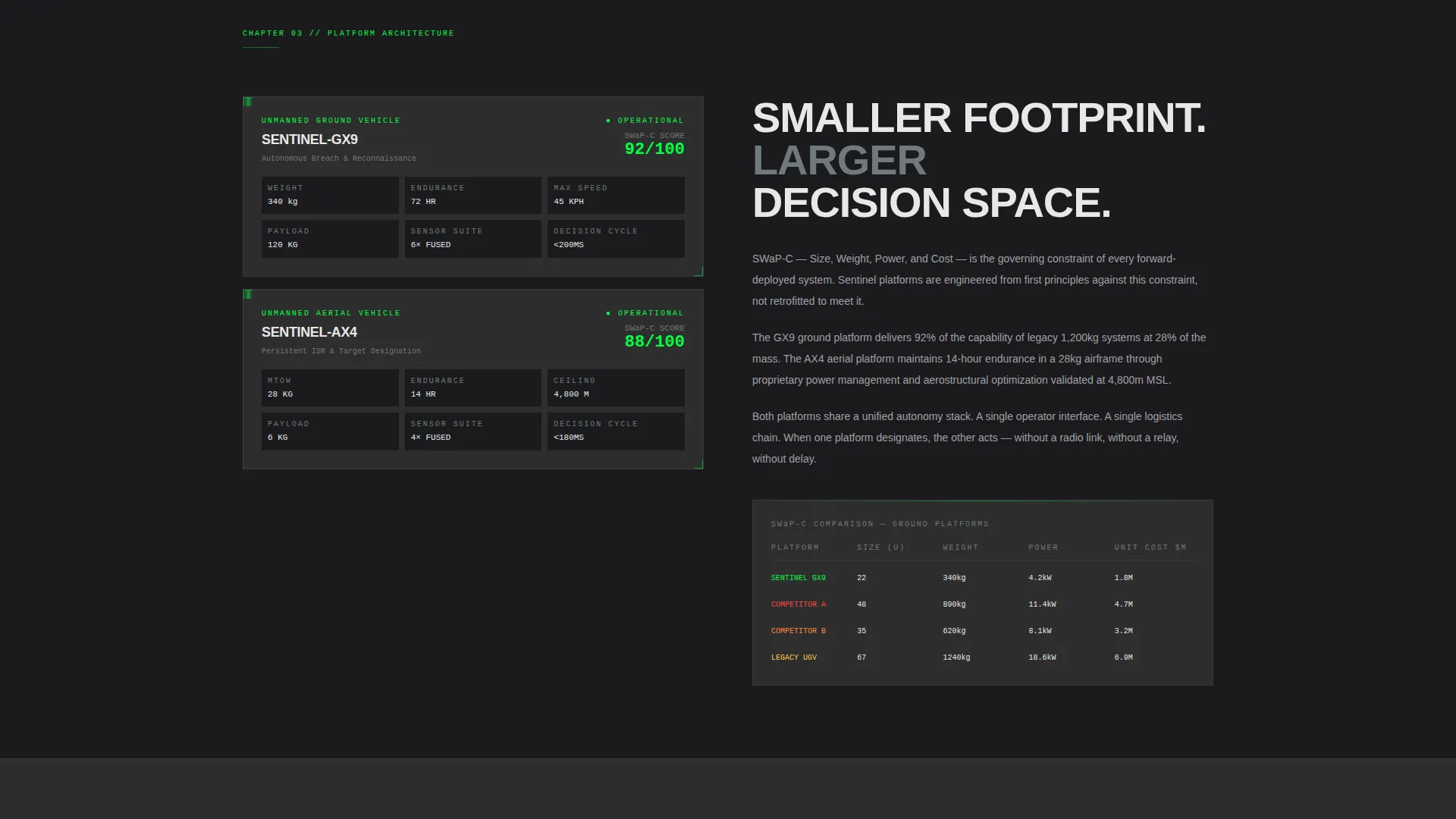
Each section alternates between a data-visualization panel and an analytical paragraph block. Panels can carry survivability metrics, latency benchmarks, and size-weight-and-power comparisons against legacy platforms. The scroll sequence escalates deliberately from problem framing through capability demonstration to integration proof.
Primary Partnership Request Form
The midpoint and bottom of the page both carry a "Request Capability Brief" call to action. The form collects organization name, role title, and a partnership type dropdown covering prime integration, subsystem licensing, joint development, and government evaluation. An email domain validator reinforces that this funnel is reserved for qualified institutional contacts.
Secondary Unclassified Overview Download Gate
A lighter secondary conversion path offers a downloadable unclassified overview. It requires only a name and a verified government or military email address. This path captures early-stage interest without competing with the primary partnership funnel.
Monochrome Steel Visual Identity System
The entire page uses a five-tone palette: gunmetal black, anodized aluminum, tactical matte, cold white data text, and a single status-green accent. The accent color is reserved exclusively for live metrics, hover states, and call-to-action elements. The effect resembles the interior of a ground control station, not a commercial product page.
Industry Report Scroll Narrative
The page is structured like a declassified defense white paper. Each zigzag chapter builds the evidence case in sequence: operator risk in denied environments, onboard artificial intelligence decision cycles under 200 milliseconds, and interoperability with NATO STANAG protocols and existing command-and-control architectures. The reader is moved from problem awareness to partnership inevitability.
Page sections overview
| Section | Purpose |
|---|---|
| Animated Map Header | Establishes technical authority with live-style schematic data and the core positioning headline |
| Problem Definition Block | Frames operator risk in GPS-denied and communications-denied contested environments |
| Capability Evidence Panel | Presents onboard AI decision cycle data and survivability metrics against legacy platforms |
| Integration Proof Section | Demonstrates interoperability with NATO STANAG protocols and existing command-and-control architectures |
| Midpoint call to action Form | Presents the primary "Request Capability Brief" form after the technical evidence is established |
| Secondary Download Gate | Offers the unclassified overview download behind a lightweight name-and-email gate |
| Bottom call to action Anchor | Repeats the primary partnership call to action for readers who scroll the full page |
Design & branding system
The Sentinel visual system is built around a Dashboard Pro theme using the Monochrome Steel color palette. Every design decision reinforces the feeling of a live operational interface rather than a marketing website.
- Five-tone palette: gunmetal black (#1B1B1E), anodized aluminum (#71797E), tactical matte (#2D2D2D), cold white data text (#E8E8E8), and status-green accent (#00FF41)
- Status-green is used only for live metric displays, hover states, and call-to-action elements; the rest of the palette stays strictly neutral
- Typography uses condensed, uppercase sans-serif for headlines with tight tracking, reinforcing a classified-document visual language throughout
Mobile & speed optimization
The Sentinel template is built with responsive layout behavior so the zigzag sections, data panels, and forms reflow cleanly across screen sizes. The schematic header and alternating blocks are structured to adapt without breaking the visual hierarchy.
- Zigzag alternating sections stack vertically on smaller screens while preserving the data-visualization and copy pairing
- Form components, including the partnership type dropdown and email validator, are sized and spaced for touch interaction on mobile devices
How this template helps you convert
The conversion architecture in Sentinel is intentional and sequenced. The page does not ask for commitment before it has built the case.
- The animated data header and escalating zigzag sections establish credibility through evidence, so visitors arrive at the call-to-action already convinced rather than skeptical.
- The dual-funnel structure captures both high-intent partners ready to request a capability brief and earlier-stage contacts willing to download the unclassified overview, widening the addressable pipeline without diluting the primary form.
Other information about this template
Sentinel is a single landing page template categorized under Aerospace and Defense, specifically within the Defense Contractor and Military subcategory and the Military Robotics niche. It is part of the Dashboard Pro theme family and is designed for Partnership and Business-to-Business outreach use cases.
- The template style is Zigzag and Alternating, with an Infographic header concept and an Industry Report creative direction
- The Monochrome Steel color system and Dashboard Pro theme are the designated design foundations for this template
- This template is suited for firms presenting autonomous ground systems, unmanned aerial platforms, or adjacent defense technology capabilities to institutional buyers
Theme
Dashboard Pro
Creative direction
Industry Report
Color system
Monochrome Steel
Style
Zigzag/Alternating
Direction
Partnership/B2B
Page Sections
Animated Schematic Theater Map Header
Zigzag Alternating Section Layout
Primary Partnership Request Form
Secondary Download Gate
Monochrome Steel Color System
Industry Report Scroll Narrative
Related questions
Who is the primary audience for the Sentinel template?
Can I adapt the data panels to show my own technical metrics?
What does the dual conversion funnel include?
Does the template include the actual animated map or is it a design layout?
Is the status-green accent color customizable?