AI-Powered Enterprise Software Professional Website Template
Sentinel is a dashboard and data grid landing page template built for AI-powered Security Information and Event Management (SIEM) platforms. It speaks directly to overworked security operations teams at mid-market enterprises. The layout uses live-data aesthetics, interactive comparison modules, and a focused conversion flow designed to make legacy tools look outdated before the visitor reaches the call to action.
by Rocket studio
Quick summary
Sentinel is a single-page landing page template designed for AI-powered SIEM platforms. It features a living dashboard header, interactive data-grid comparison modules, and a Comparison/Versus conversion flow. The design targets security operations teams who are drowning in alert noise and ready to see what modern threat detection actually looks like.
Who this template is for
This template is built for security-focused software companies and managed security service providers (MSSPs) who need to convince technically sharp buyers without oversimplifying the pitch. It speaks the language of the operations floor, not the boardroom brochure.
- Security operations center (SOC) leads and Chief Information Security Officers (CISOs) evaluating a platform switch
- MSSP operators and product marketers positioning an AI-powered SIEM against legacy vendors
- Enterprise software teams launching a threat detection product to mid-market security buyers
What problem this template solves
Legacy SIEM tools create more noise than signal. Security teams spend hours correlating events manually, paying per gigabyte ingested, and toggling between six disconnected tools. This template solves the conversion challenge of making that pain visible so buyers feel the gap before they ever fill out a form.
- Buyers need to see the difference before they believe it, not read about it in bullet points
- Most landing pages for security software bury the value proposition under generic enterprise copy
- Prospects comparing tools need a structured, interactive reason to choose the new platform
What you get with this template
You get a fully structured, dashboard-style landing page that puts the product's intelligence front and center. Every section is designed to reward curiosity and build conviction through direct comparison.
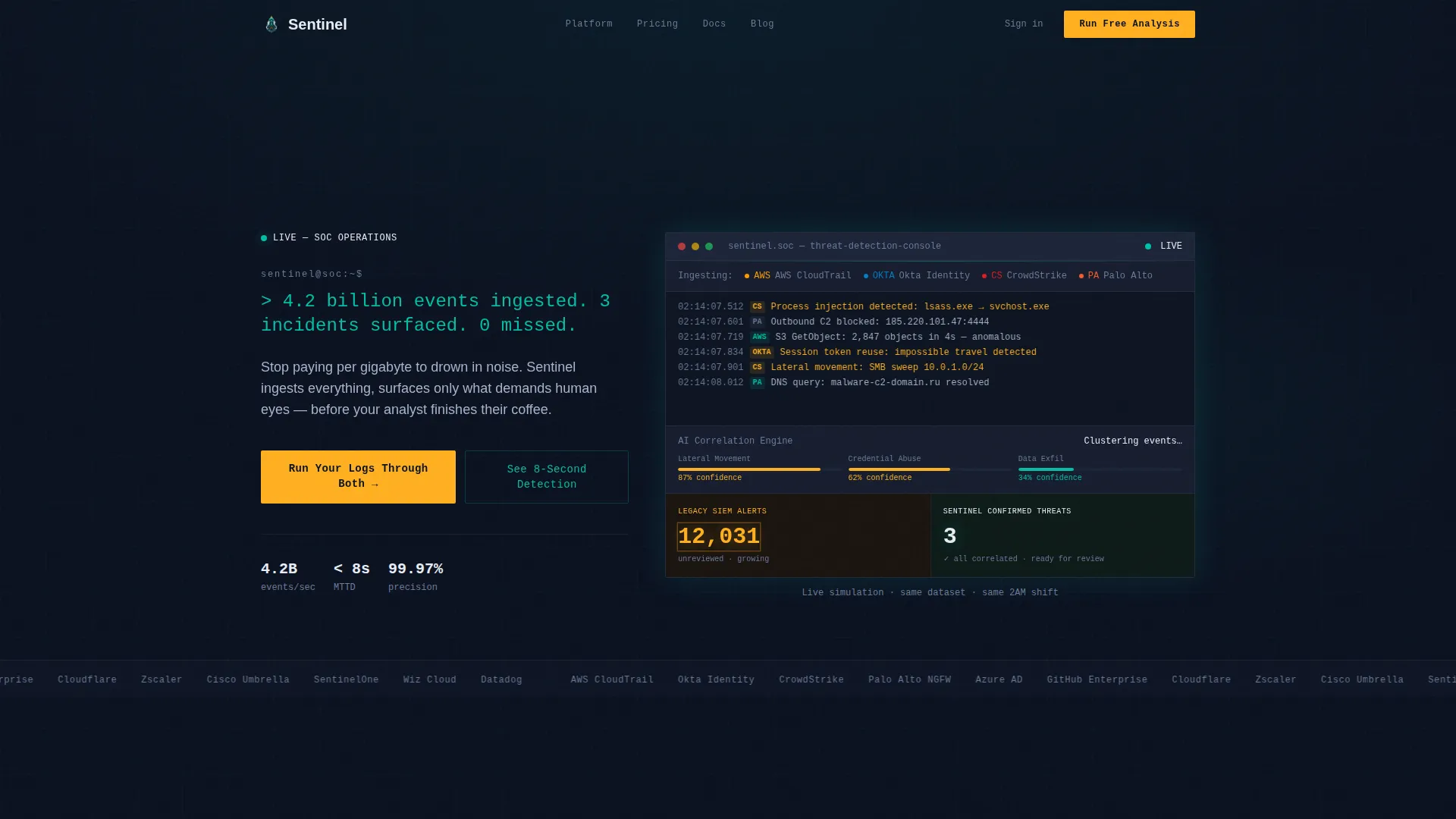
- A terminal-style animated headline section with a live SIEM console preview showing real log sources and a resolved-incident counter
- Three interactive data-grid modules: a pricing divergence slider, a side-by-side detection timeline, and an expandable feature comparison grid
- A dual-call to action conversion section with a two-field parallel-analysis form and a gated Total Cost of Ownership (TCO) calculator
Feature list
This section describes the core functional components built into the Sentinel landing page template.
Animated Dashboard Header
The header renders a fully interactive SIEM console preview. Log events stream in from the left, an AI correlation engine visibly clusters related events in the center, and a resolved-incident counter ticks upward on the right. The headline types itself like a terminal command, immediately communicating scale and precision.
Live Pricing Divergence Slider
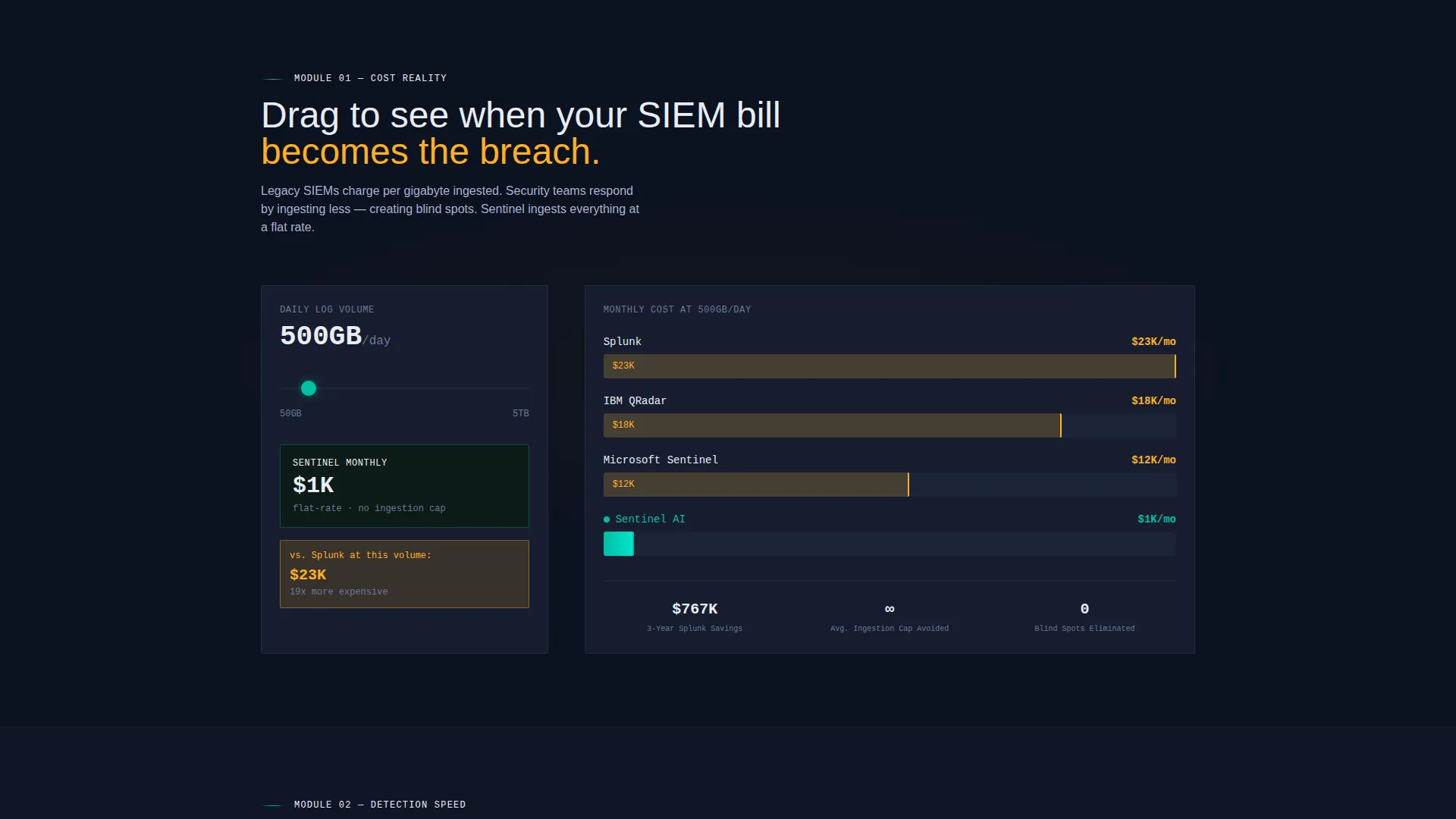
Visitors drag a data-volume slider from 50 gigabytes per day to 5 terabytes per day and watch pricing diverge in real time between a legacy model and the AI platform. This single interaction makes the per-gigabyte cost problem tangible without requiring any sales explanation.
Side-by-Side Detection Timeline
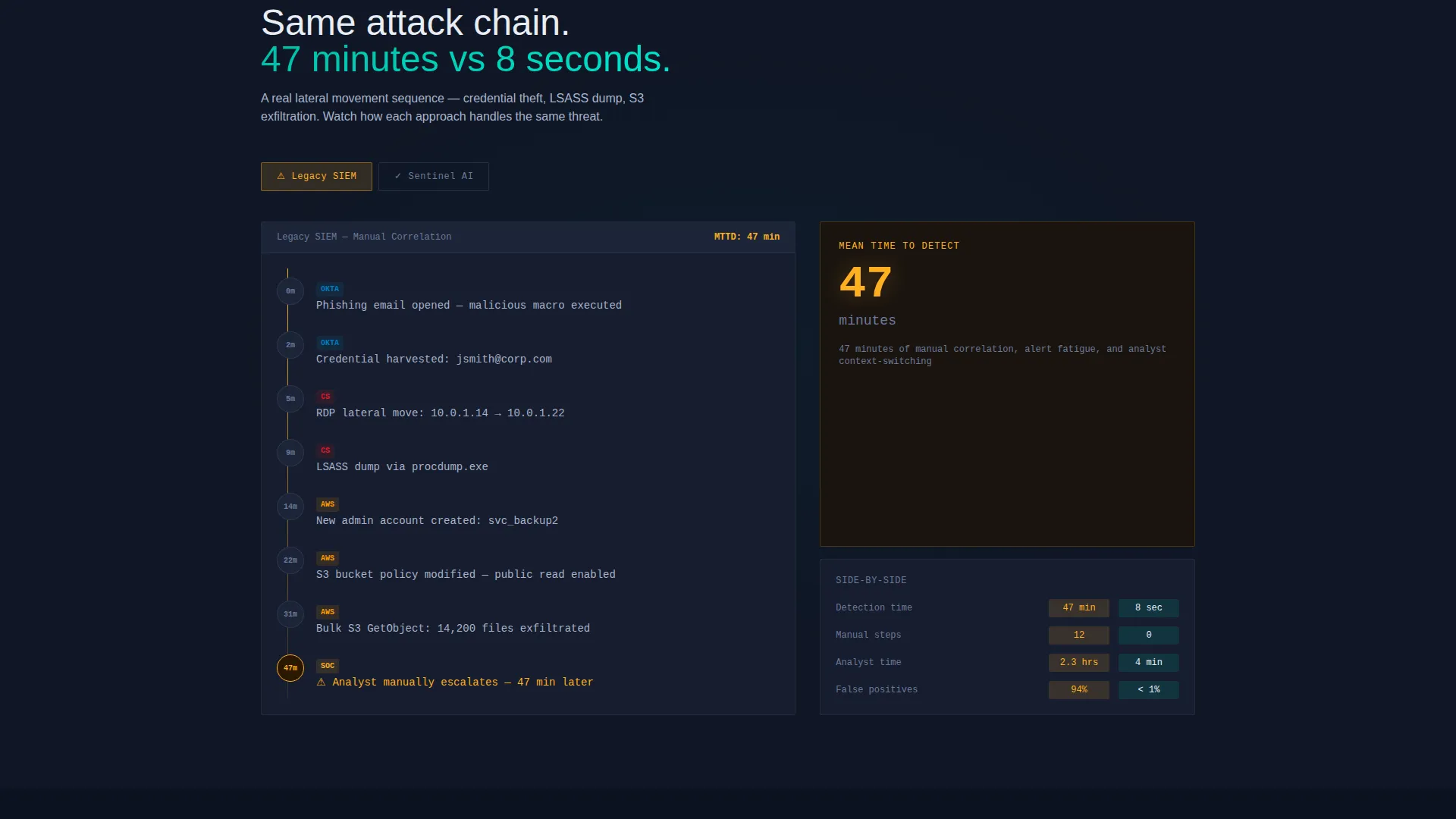
An identical lateral movement attack chain plays out on both sides of the screen. The legacy detection path takes 47 minutes of manual correlation. The AI-powered path resolves the same sequence in 8 seconds. The contrast is the argument.
Expandable Feature Comparison Grid
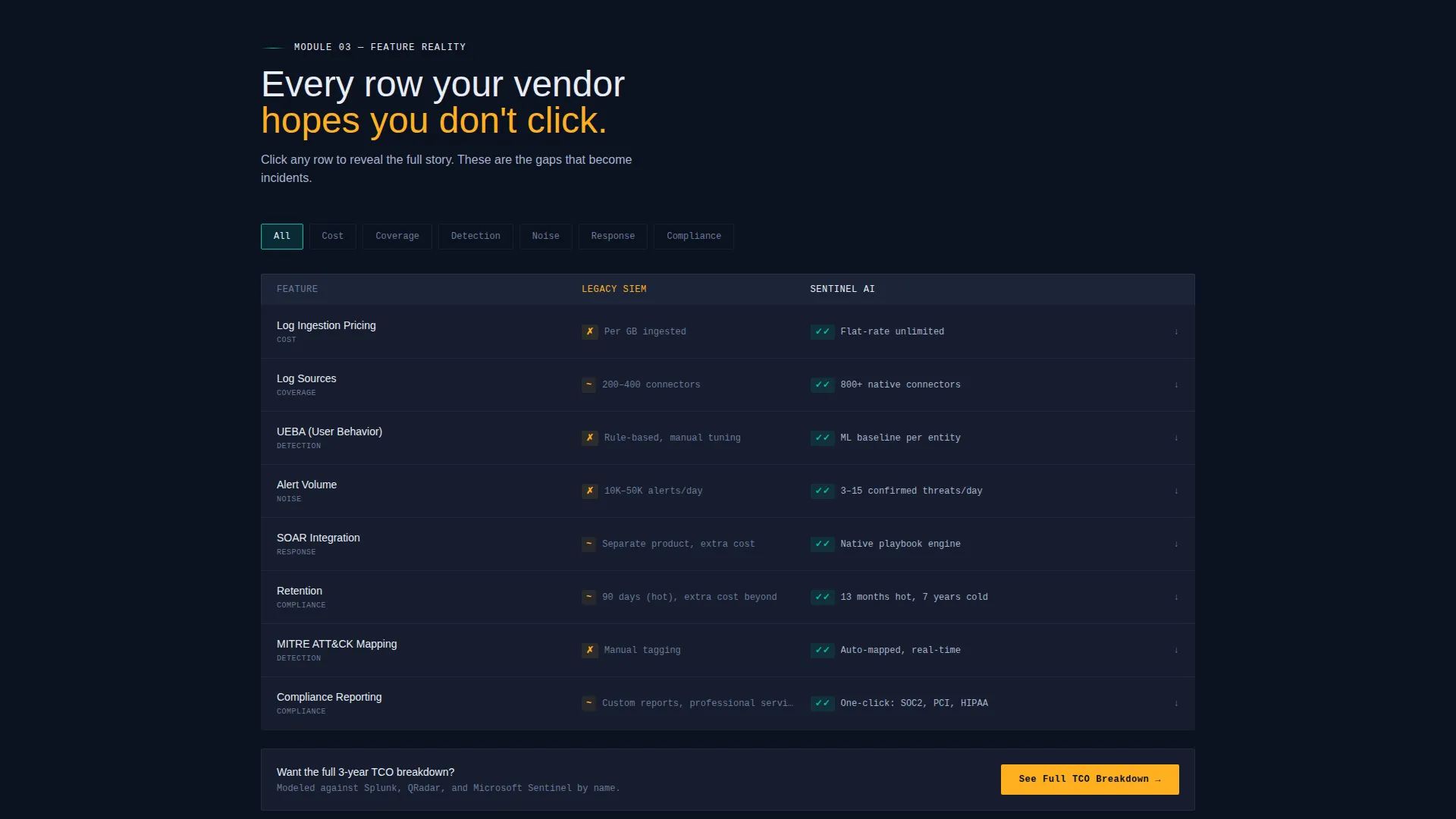
A structured grid covers log sources, data retention, User and Entity Behavior Analytics (UEBA), Security Orchestration Automation and Response (SOAR) integration, and compliance mapping. Each row is clickable and expands into a detail panel, letting technically minded visitors go as deep as they need.
Parallel-Analysis Conversion Form
The primary call to action captures a work email and estimated daily log volume. An optional dropdown for the visitor's current SIEM vendor pre-populates a personalized comparison page. The form feels like the next logical step after the interactive sections have already done the convincing.
Gated TCO Calculator
A secondary conversion point offers a full three-year cost breakdown modeled against competing platforms. It gates access behind a simple form, turning a financial concern into a lead-generation moment.
Page sections overview
| Section | Purpose |
|---|---|
| Dashboard header | Renders the live SIEM console preview and animated terminal headline |
| Pricing slider module | Shows real-time cost divergence across data volumes |
| Detection timeline module | Compares legacy and AI detection speeds on the same attack chain |
| Feature comparison grid | Lets visitors explore log sources, retention, UEBA, SOAR, and compliance |
| Parallel-analysis call to action | Captures email and log volume for a personalized comparison report |
| TCO calculator gate | Converts cost concerns into a secondary lead generation moment |
Design & branding system
The visual identity follows a Directory and Discovery theme built on the Teal Catalyst color system. The palette is designed to feel like the glow of a security operations floor at 2 AM, with teal light across dark panels and amber only appearing when something demands immediate attention.
- Deep operations black (#0B1120) dominates the background; console-surface charcoal (#161D2E) is used for card and panel surfaces; active-threat teal (#00BFA6) drives data visualizations and interactive elements
- Muted log-stream gray (#6B7A99) handles secondary text and log metadata, keeping the interface readable without competing with the signal colors
- Incident-critical amber (#FFB020) is reserved exclusively for call-to-action buttons and the competitor comparison columns where legacy tools fall short, ensuring it always reads as urgent
Mobile & speed optimization
The template is structured to maintain its data-grid clarity and interactive depth at smaller screen sizes. The dashboard-heavy design uses a layout system that collapses panels gracefully without losing the comparison narrative.
- The pricing slider, detection timeline, and feature grid each adapt to a stacked single-column layout on smaller viewports
- Interactive elements are touch-friendly and the two-field conversion form remains prominent and easy to complete on mobile devices
How this template helps you convert
This template earns the conversion before it asks for it. By the time a visitor reaches the call to action, they have already interacted with the data, run their own numbers, and watched their current tool lose a side-by-side comparison.
- The interactive modules create a progression of conviction: pricing, detection speed, and feature depth each land a separate blow against legacy tools, so the call to action feels like a natural conclusion rather than a cold ask.
- The dual-call to action structure captures two distinct buyer intents: the operations-focused visitor who wants to see a real detection comparison, and the budget-conscious buyer who needs to justify the switch with a three-year cost model.
Other information about this template
The Sentinel template is designed to work for any AI-powered SIEM product competing in a market where buyers are already familiar with established platforms. The comparison-led structure is especially effective when prospects are mid-evaluation and need a concrete reason to reconsider their current vendor.
- The personalized comparison page flow, triggered by the optional SIEM vendor dropdown, supports a high-intent conversion path without requiring additional page builds
- The amber color rule keeps the design from ever crying wolf: by reserving #FFB020 strictly for calls to action and failing legacy columns, every amber element on the page carries real urgency
- The template style is Dashboard and Data Grid, making it suitable for any enterprise software product that needs to demonstrate analytical depth and operational clarity at a glance
Theme
Directory & Discovery
Creative direction
Interactive Explorer
Color system
Teal Catalyst
Style
Dashboard/Data Grid
Direction
Comparison/Versus
Page Sections
Animated Terminal Dashboard Header
Real-time Pricing Divergence Slider
Side-by-side Detection Timeline
Expandable Feature Comparison Grid
Parallel-analysis Lead Capture Form
Gated TCO Calculator
Related questions
Who is this landing page template designed for?
Can I update the interactive comparison modules with my own product data?
What does the primary call to action flow include?
Is there a cost comparison tool built into the template?
How does the color system handle urgency without overusing it?