Complete Architecture Firm Software Professional Website Template
Ledger is a bento grid landing page template built for architecture firm payment platforms. It pairs a Void & Violet dark visual system with a Feature Tab Switcher header, a Problem-to-Solution scroll arc, and a Billing Score audit widget. Firm principals, office managers, and solo architects get a high-trust, conversion-focused layout designed to turn 90-day invoice cycles into same-week settlements.
by Rocket studio
Quick summary
The Ledger fast settlement architecture firm payment processing landing page template is a single-page bento grid layout purpose-built for a B2B FinTech payment service targeting architecture studios. It opens with a live-switching Feature Tab Switcher, drives urgency through stark pain-stat cards, and closes with a Billing Score widget that shows firm owners exactly how much revenue is trapped in their pipeline right now.
Who this template is for
This template is built for founders and product teams launching a payment service aimed squarely at the architecture industry. It speaks the language of AIA billing, phased retainers, and consultant pass-throughs, vocabulary that generic payment gateways never bother to learn.
- Firm principals managing six-figure receivables across three to twelve active projects who need a payment system that handles phased billing natively.
- Office managers reconciling AIA G702 and G703 draw schedules who spend roughly 23 hours per month on manual billing tasks.
- Solo architects losing 3% or more to generic payment service providers that do not understand milestone-based invoicing or retainer splits.
What problem this template solves
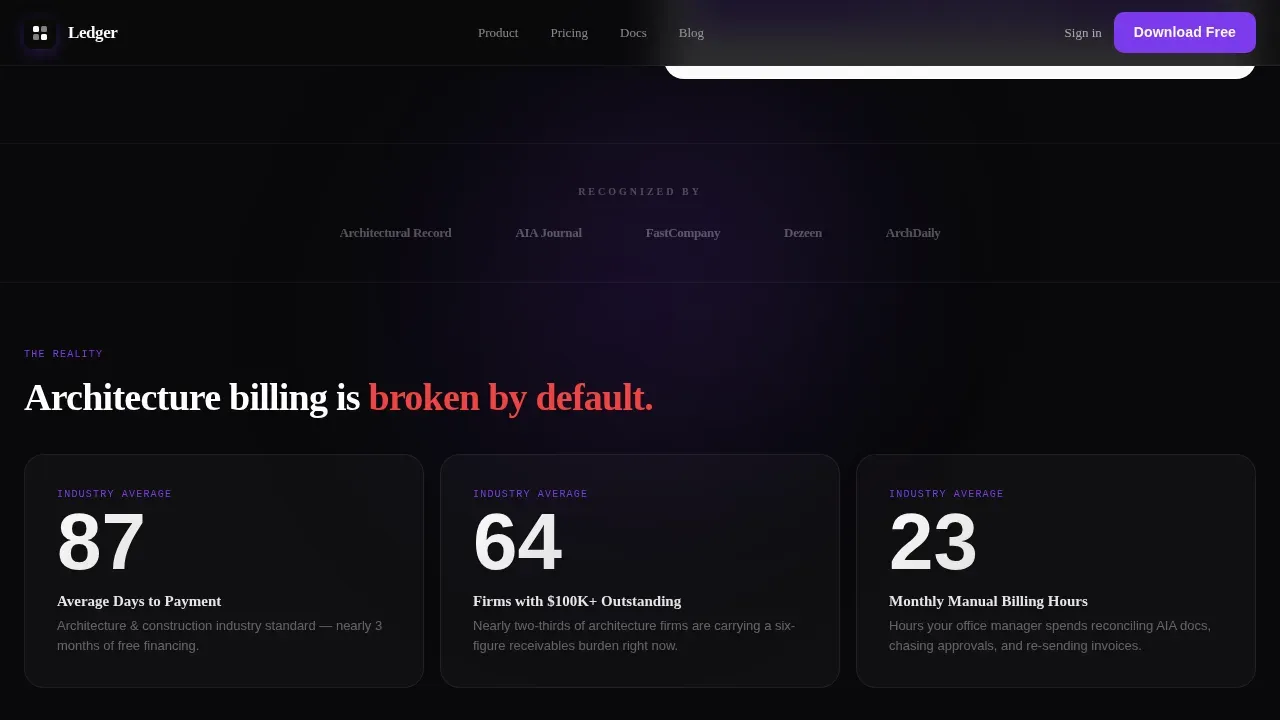
Architecture firms live inside a broken payment cycle. The average days-to-payment in the industry sits at 87, and 64% of firms carry more than $100,000 in outstanding receivables at any given time. A generic payment service does nothing to fix that. It processes a credit card payment and moves on. The Ledger template gives a payment platform the right visual language and conversion structure to reach the people who actually feel that pain.
- Payment processing delays stretch from weeks into months, leaving firm principals chasing pending payment after pending payment with no clear current payment status visible in one place.
- Retainer disputes, missed draw deadlines, and consultant holds block cash flow in ways that standard payment gateways cannot resolve without architecture-specific workflow design.
- Handling payment processing delays communication between a firm and its clients is awkward without a structured, professional hosted payment page that reflects the firm's credibility.
What you get with this template
You get a complete, production-ready bento grid landing page with high animation fidelity and a structured conversion flow from the first scroll to the final call to action. Every section maps to a specific moment in the buyer's journey, from recognizing the pain of a stalled pay in flow to committing to a faster pay out flow with a purpose-built payment system.
- A three-tab Feature Tab Switcher hero that presents the Invoice, Track, and Collect states of the payment service with live mockup swaps and GSAP scroll reveals.
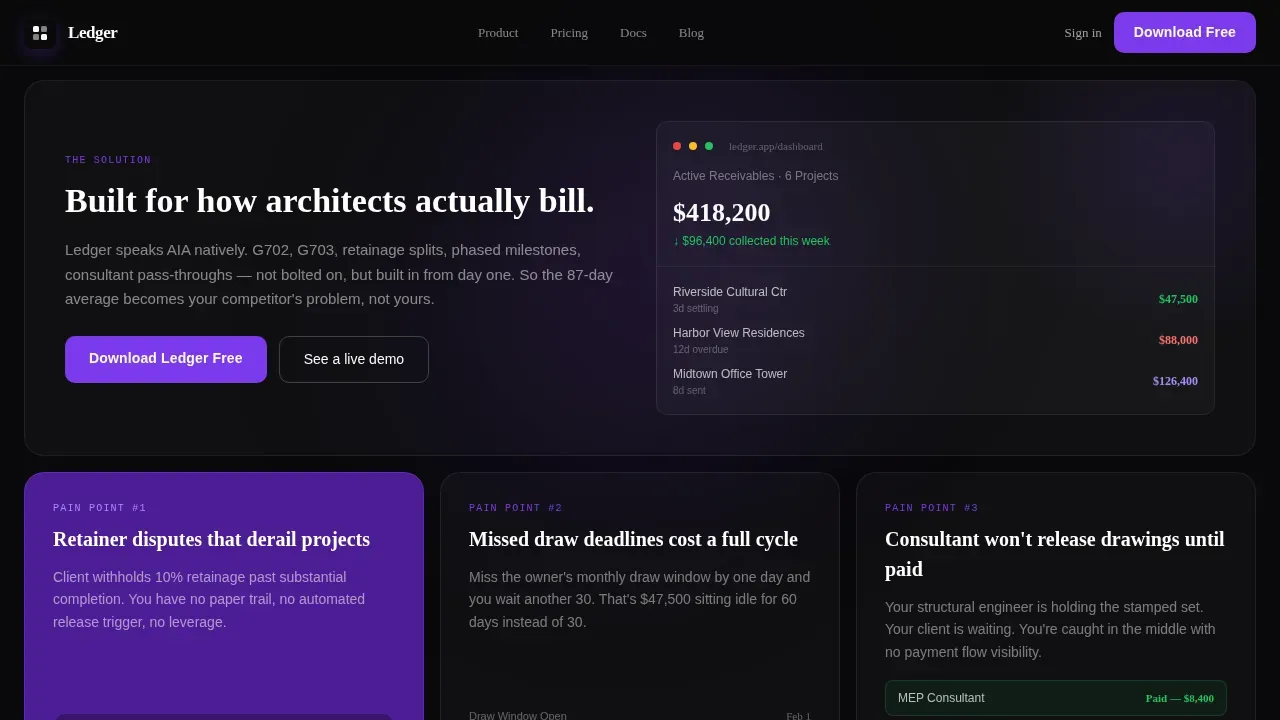
- A Problem-to-Solution bento arc with single-stat pain cards, a wide solution card, and tension-release feature rows that alternate between a specific billing pain point and the feature that eliminates it.
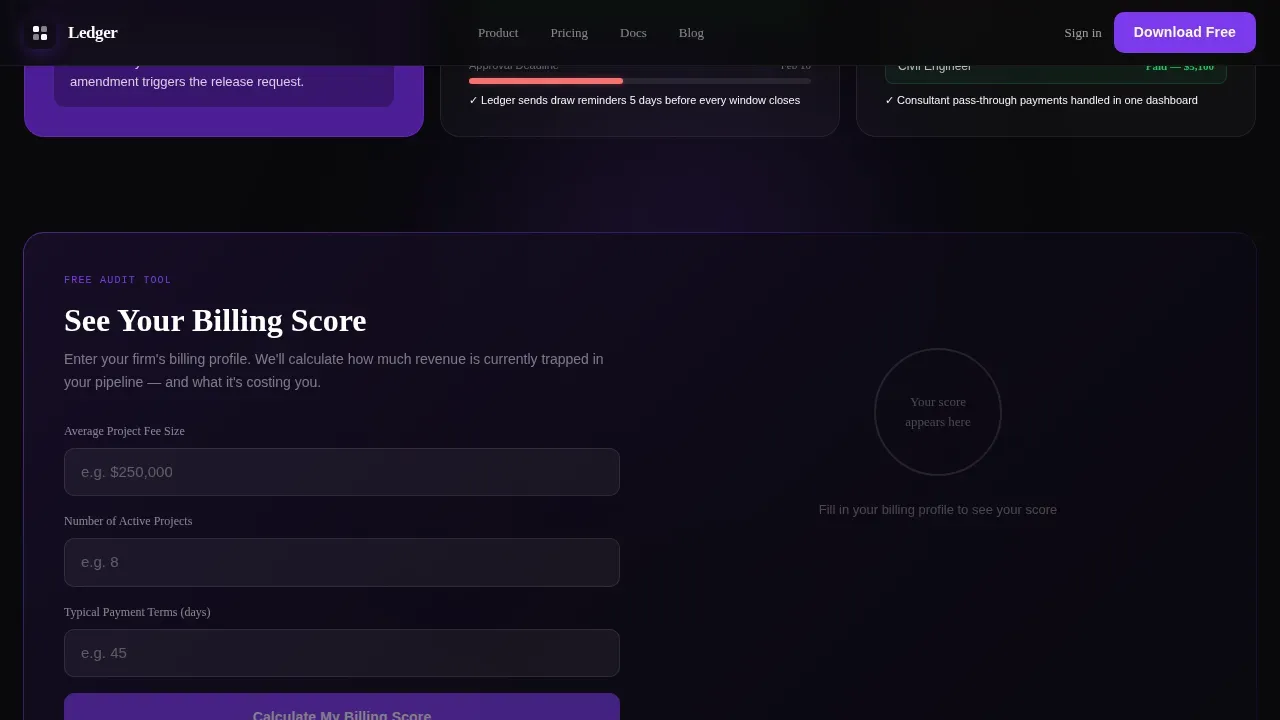
- A Billing Score audit widget that calculates how much revenue is currently at risk in a firm's pipeline, creating immediate urgency and driving app downloads.
Feature list
This section covers the core designed capabilities included in the Ledger template, each grounded in the source brief.
Feature Tab Switcher Hero
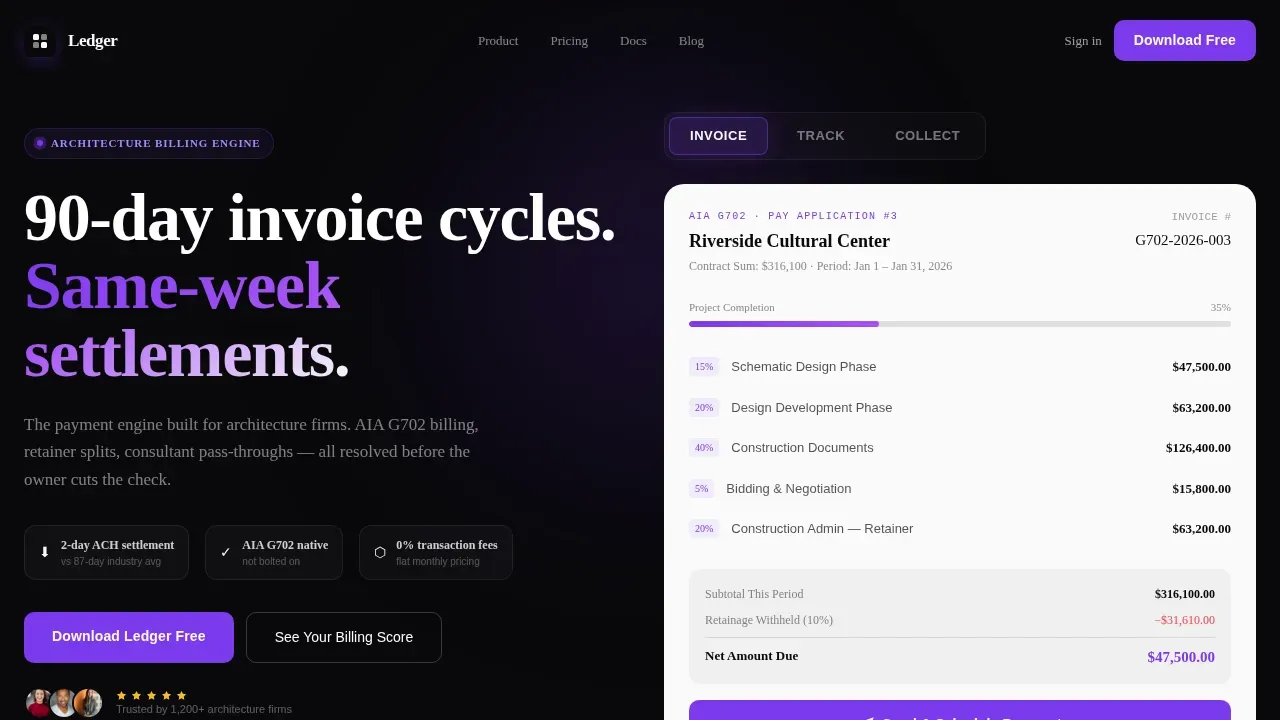
The header uses three clickable tabs labeled Invoice, Track, and Collect. Each tab swaps the central bento product mockup with animated content. The default Invoice tab shows a generated AIA G702 form with real line items visible, including a Schematic Design Phase entry at $47,500, plus a glowing violet "Send & Schedule" button. The payment registration request moment is made tangible and immediate.
Pain-Stat Bento Row
Three stark single-stat cards open the scroll with hard numbers: 87 average days-to-payment, 64% of firms with $100,000 or more outstanding, and 23 hours per month lost to manual billing. These cards sit white on void black, no softening language. They make the case that the current payment cycle is broken before the solution is introduced. The payment system handles the emotional weight of the argument through data alone.
Tension-Release Feature Grid
Below the pain stats, the bento grid alternates between micro-pain stories and specific feature responses. A retainer dispute card pairs with the retainer split dashboard. A missed draw deadline card pairs with the milestone tracker. A consultant-hold card pairs with the pass-through payout tool. Each pay out flow problem gets a named, visual answer. The rhythm accelerates until the grid resolves into a testimonial card.
Billing Score Audit Widget
A secondary call-to-action section offers firm owners a free billing score calculation. They enter their average project size, number of active projects, and typical payment terms. The widget instantly returns a dollar figure showing revenue trapped in their pipeline, such as $318,000 currently at risk. This single payment event of clarity turns the app download from a choice into an obvious next step.
Testimonial with Receivables Graph
The page closes with a firm principal testimonial card. A receivables graph sits alongside the quote and shows a visible cliff-drop in outstanding payments after adopting the platform. A counter reading "$214,800 recovered this quarter" and a five-star rating pill provide social proof grounded in real payment transaction outcomes.
Sticky Mobile Call-to-Action Bar
The primary call to action, "Download Ledger Free," appears first inside the Invoice tab mockup. On mobile, it repeats as a fixed sticky bar at the bottom of the screen. The payment request to download is always one thumb tap away, regardless of where the user is in the scroll. The form stays minimal, honoring the principle that financial trust is built through simplicity.
Page sections overview
| Section | Purpose |
|---|---|
| Feature Tab Switcher | Live product mockup hero with Invoice, Track, and Collect tabs driving the first download call to action |
| Pain Stat Cards | Three single-stat bento cards quantifying the broken payment cycle in architecture |
| Wide Solution Card | Introduces the payment platform with a product screenshot and a direct positioning statement |
| Tension-Release Grid | Alternates billing pain stories with specific feature responses in an accelerating bento rhythm |
| Billing Score Widget | Interactive audit calculator showing trapped pipeline revenue to create download urgency |
| Testimonial Card | Firm principal quote with receivables cliff-drop graph and recovered-revenue counter |
| Footer Row | Linear single-row footer with navigation, compliance signals, and brand close |
Design & branding system
The Ledger template runs on a Startup Velocity visual theme expressed through the Void & Violet color system. The palette was designed to feel like a terminal screen at 2 AM when a difficult build finally resolves, dark, luminous, and precise. The overall design approach balances high-end architectural aesthetics with the high-trust requirements of a financial technology product. Designing a landing page for an architecture firm requires that both sides of that equation feel equally resolved.
- Void black (#09090B) dominates the background; deep ultraviolet (#4C1D95) surfaces float as bento cards; electric violet (#7C3AED) pulses through progress bars, active states, monetary figures, and the primary payment request buttons; interface white (#FAFAFA) carries all card surfaces and typography.
- Typography uses Plus Jakarta Sans for headers, DM Sans for body copy, and JetBrains Mono for all numerical figures and code-style data displays, keeping monetary values legible and distinct from descriptive text.
- The layout uses a clean, minimalist aesthetic, no decorative imagery, no hero photograph. The product mockup itself is the hero, keeping visual weight focused on the payment service interface and the numbers it surfaces.
Mobile & speed optimization
The Ledger template is designed desktop-first because firm principals typically review financials on workstations. However, the mobile experience is fully considered and structured to support thumb-friendly interaction. In 2026, clients expect consumer-grade convenience for professional services on every device, and the template reflects that standard.
- The sticky bottom bar on mobile keeps the primary "Download Ledger Free" call to action visible at all times, ensuring the payment request button is always reachable without scrolling back to the top.
- The Billing Score widget input fields are sized and spaced for easy tap interaction on smaller screens, making it straightforward for architects reviewing finances on a phone to complete the audit without frustration.
How this template helps you convert
Conversion in a financial technology product depends on trust, clarity, and urgency, in that order. The Ledger template builds all three across a structured scroll flow. Financial transactions require high trust signals to reduce friction, and every section of this layout is engineered with that in mind. The payment service registers credibility before it asks for anything.
- The Feature Tab Switcher leads with the product itself rather than a marketing claim. Visitors see a real hosted payment page mockup with genuine AIA line items. Trust is established by showing, not telling, and the pay in flow from invoice creation to settlement is made visually legible in the first viewport.
- The Pain-Stat arc forces recognition. When a firm owner sees 87 days and $100,000-plus outstanding rendered in stark void-black cards, the current payment status of their own receivables becomes impossible to ignore. The tension created by the bento arc makes the solution feel genuinely necessary rather than optional.
- The Billing Score widget converts curiosity into urgency. Seeing a personalized figure like $318,000 currently at risk makes downloading the app feel less like a marketing decision and more like pulling a fire alarm. Action-oriented copy throughout the page reinforces this with language like "Enable Instant Payouts" and "Make a Secure Payment" at every relevant touchpoint.
Other information about this template
This section covers additional technical and design context relevant to teams building or customizing the Ledger template, including payment system architecture concepts that inform the layout's data display choices.
- The template's dashboard mockup is designed to reflect a large scale payment system logic, where the payment executor calls the appropriate payment gateways and the payment executor stores results against each project milestone. The payment order database table concept is surfaced visually, with the payment order table stores pattern informing how invoice rows are displayed inside the bento card.
- The pay in flow and pay out flow are both represented in the Track tab mockup. The payment system receives money from the client's side and the payment system sends money to the seller's bank account after milestone approval. The seller's bank account information is abstracted into a clean status display rather than shown as raw data.
- The double entry system underlies the ledger's financial record keeping. The double entry bookkeeping principle, recording every payment transaction into two separate ledger accounts, one debited and one credited, ensures that all the transactions remain auditable. The double-entry system states that the sum of all entries must be zero, providing end-to-end consistency throughout the payment cycle.
- The payment event table concept informs the Track tab's milestone timeline. Each payment event cascades down the project Gantt with a completion dot, giving principals a clear view of payment execution status across all active projects. A single payment event can trigger visual state changes across multiple bento cards simultaneously.
- The reconciliation system parses internal and external states to verify consistency. In the template context, this is reflected in the pending payment indicator and the current payment status display inside the dashboard mockup. The reconciliation system parses discrepancies and surfaces them clearly so office managers can act without switching tools.
- The hosted payment page concept is central to the template's trust architecture. A hosted payment page provided by a payment service provider (PSP) collects sensitive payment information without requiring the firm to store credit card data internally. This approach lets the payment service collects sensitive payment information securely and keeps the platform compliant. Sensitive credit card data never touches the firm's own servers, which reduces regulatory burden.
- The wallet server stores seller's balance information in a distributed system architecture. The payment system integrates with multiple payment gateways to support both credit card payment and digital wallet payments. The payment system handles credit card payment processing and can process credit card operations across different card networks. The buyer's credit card account is charged through the payment service provider PSP, and the buyer's credit card details are never stored directly by the platform.
- Payment processing delays are a structural problem in the architecture industry. Handling payment processing delays requires the payment service to maintain a retry queue. When a payment transaction fails, the system retries failed payment transactions using that queue. Payment error handling routes persistently failing messages to a dead letter queue for inspection. The payment system consumes events from this queue to correctly handle payment transactions and update the payment event record.
- The payment service registered state is visible inside the Track tab as an early milestone dot. Payment service calls trigger payment service updates that flow through to the dashboard in near real time. Payment service stores the current status against the payment registration, and payment executor sends confirmation back to the firm's dashboard when a payment registration request is resolved. The pending payment requests counter inside the Collect tab updates as the streaming payment system processes outstanding items.
- The pay in flow begins when a client receives the hosted payment link generated from the Invoice tab. The payment system handles the pay in flow from the moment the client submits card payment details through to settlement. The pay out flow is triggered after milestone approval, and the payment executor calls the designated payment gateways to route funds to the seller's bank account. The payment service provider PSP moves the approved amount from the buyer's credit card account to the seller's bank account information on record, completing the pay out flow cleanly.
- The payment service updates the payment event and logs it in the payment event table. The reconciliation system parses those logs against external payment service provider records to verify that all the transactions match. This distributed system approach ensures that how many payment transactions are in flight at any moment is always visible and auditable. The payment system interacts with third party payment processors where needed, and the payment system integrates fallback routes when a primary gateway is unavailable.
- Amazon's bank account is often used in payment system design literature as a canonical example of a seller's bank account in a large-scale marketplace. The same pay sellers logic applies here: the payment executor stores each payout result and the wallet server stores the updated seller's balance information after each settlement. Separate ledger accounts are maintained per project, and the double entry system ensures that all the transactions reconcile cleanly at month end.
- The payment web pages in this template are built to load fast and present a payment request clearly. Cash payment is not a supported flow in the platform's digital-first model. Digital wallet payments and credit card payment are the primary methods supported through the payment gateways connected to the platform. The payments system chapter of the platform documentation would map directly to the flow shown in the three-tab mockup.
- Payment processing delays communication is handled through the auto-reminder sequence shown in the Collect tab. The Collect view shows a counter reading "$214,800 recovered this quarter," surfacing the direct impact of consistent payment service calls on a firm's receivables. Payment retry operations are visualized as a sequence of reminder touchpoints, giving office managers a clear picture of how the system pursues a pending payment without manual follow-up.
- The template is compatible with standard web build environments and supports high animation fidelity through GSAP-based scroll reveals, staggered bento entries, and counting number animations. The tab-switching mechanic uses client-side rendering for interactive components, while static sections use server components for performance efficiency.
- Store sensitive payment information guidelines inform the design of the hosted payment section. The template's payment page design does not store credit card data on the firm's servers. A payment service provider PSP collects sensitive payment information through the hosted payment page, and the platform stores only the payment execution status and payment event reference. This approach to store sensitive payment information keeps the firm's liability minimal.
- The payment flow from invoice creation to funds reaching the seller's bank account is compressed from the industry average of 87 days to a same-week settlement. Automated milestone billing enables instant payouts upon client approval of specific design phases. The payment cycle closes faster because the payment service speaks the billing language architects already use, removing the translation layer that causes most payment processing delays.
Theme
Startup Velocity
Creative direction
Problem→Solution Arc
Color system
Void & Violet
Style
Bento Grid
Direction
App Download
Page Sections
Feature Tab Switcher Hero with Live Mockups
Pain-stat Bento Cards with Solution Arc
Tension-release Feature Grid
Billing Score Audit Widget
Testimonial Card with Receivables Graph
Sticky Mobile Download Bar
Related questions
What sections are included in the Ledger template?
Who is the intended audience for this landing page template?
Does the template include the interactive Billing Score widget?
How does the three-tab hero switcher work?
Is this template suitable for a desktop-first audience?