Warehouse & Distribution Careers Website Template
The Freight landing page template is built for third-party logistics providers targeting mid-market e-commerce brands and manufacturers. It combines a dark Charcoal and Amber visual system with a stats-first zigzag layout, an animated map hero, and a head-to-head comparison table. Every section is designed to prove value through data before asking visitors to act.
by Rocket studio
Quick summary
The Freight template is a precision-built logistic landing page designed for third-party logistics companies that compete on data, not promises. It opens with an animated route-map hero, escalates through four oversized stat panels, and drives toward a cost-comparison form. The entire landing page speaks directly to operations managers and supply chain leads who make decisions by the numbers.
Who this template is for
This logistic landing page template is built for logistics businesses that handle fulfillment on behalf of other companies. It targets third-party logistics providers serving mid-market e-commerce brands and manufacturers who need warehousing, kitting, and last-mile solutions without managing their own distribution infrastructure. The template is ideal if your company positions itself through measurable logistics operations performance rather than brand storytelling.
- Third-party logistics providers serving e-commerce brands processing between 5,000 and 50,000 orders per month
- Manufacturers that outsource transportation management, kitting, labeling, and last-mile delivery to a logistics provider
- Logistics companies ready to make a data-forward case for why prospects should switch from in-house fulfillment
What problem this template solves
Mid-market logistics companies face a specific conversion challenge. Potential clients already know they have a supply chain problem. What they need is proof that switching to a third-party logistics provider will actually cost less, move faster, and scale further than their current setup. Generic logistics website designs do not make that case. They list services but never prove the math. This template is structured to close that gap.
- Buyers stall because they cannot see a clear cost comparison between their current setup and outsourced third-party logistics
- Logistics services pages built on stock visuals and vague copy fail to build trust with data-driven operations managers
- Landing pages that lead with features rather than performance numbers miss the value proposition that moves B2B supply chain buyers
What you get with this template
This template offers a fully structured, single-page layout that covers every stage of the third-party logistics sales argument. From the animated hero to the gated benchmark report, the page is built to guide operations-minded visitors through proof, then action. Every design choice reinforces the operational efficiency and reliability that logistics companies need to communicate.
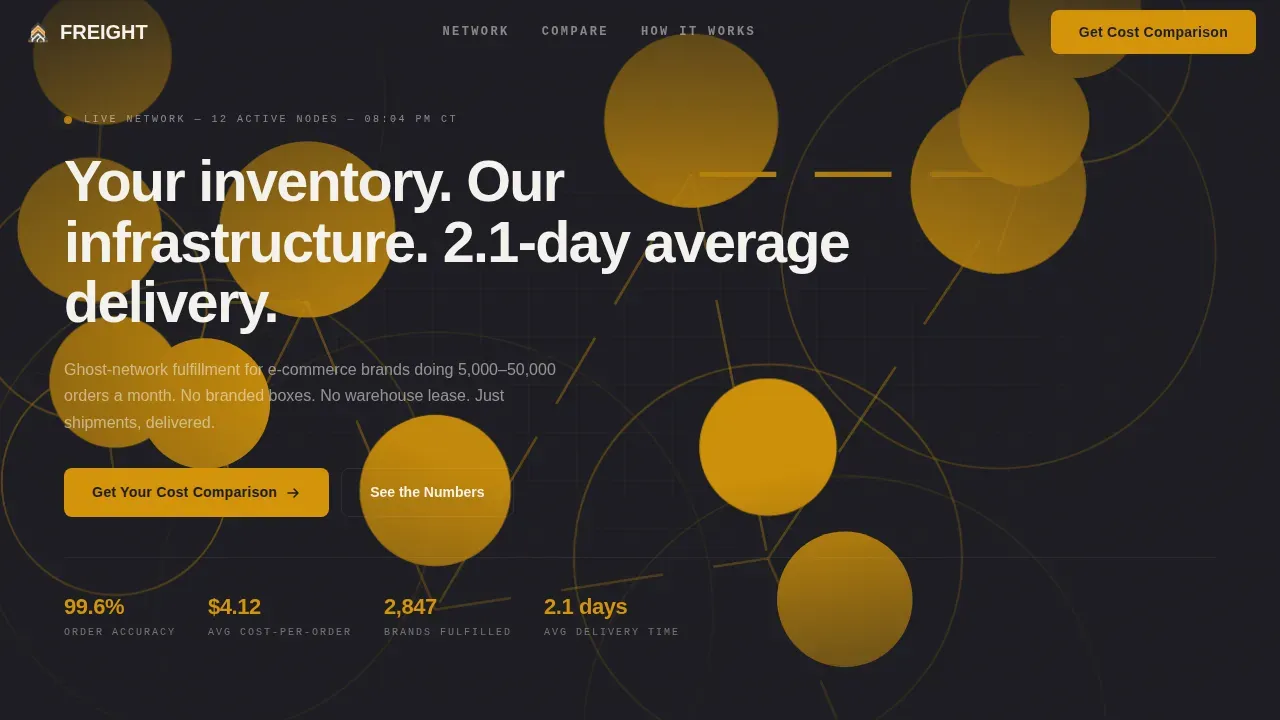
- An animated map hero section with live-style warehouse node counters, amber route pulse lines, and a typewriter headline that establishes your logistics network in seconds
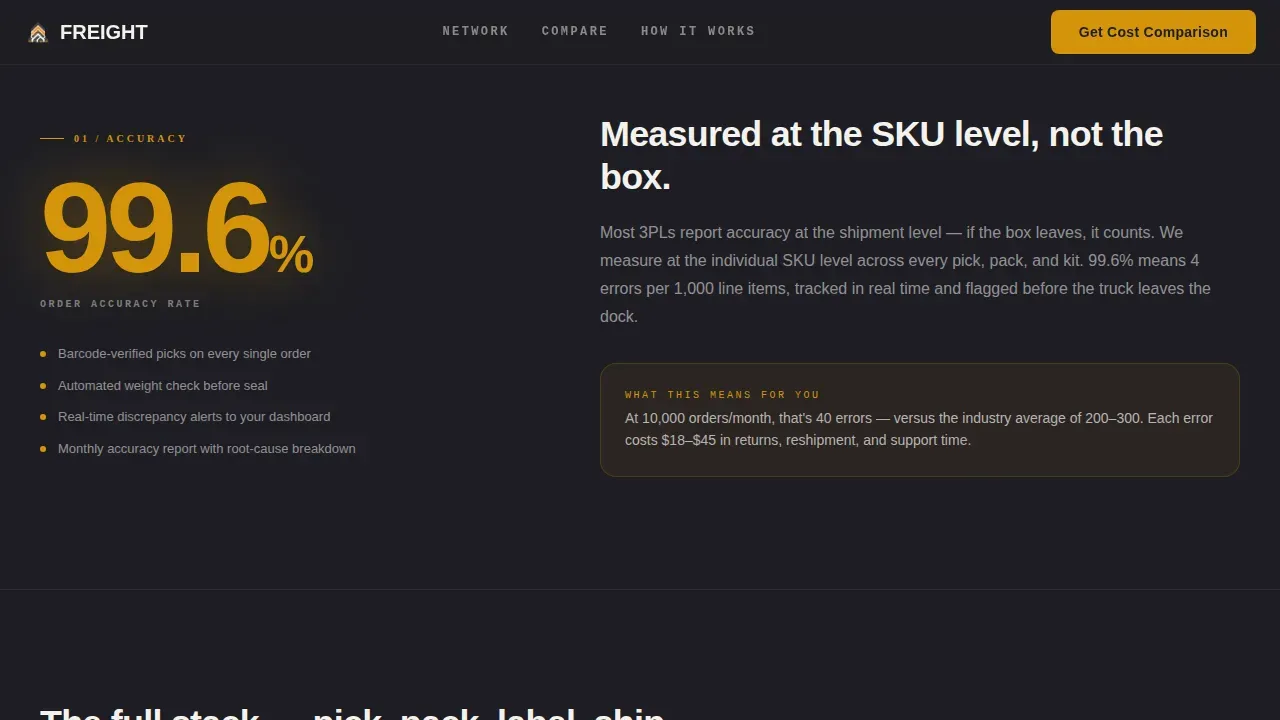
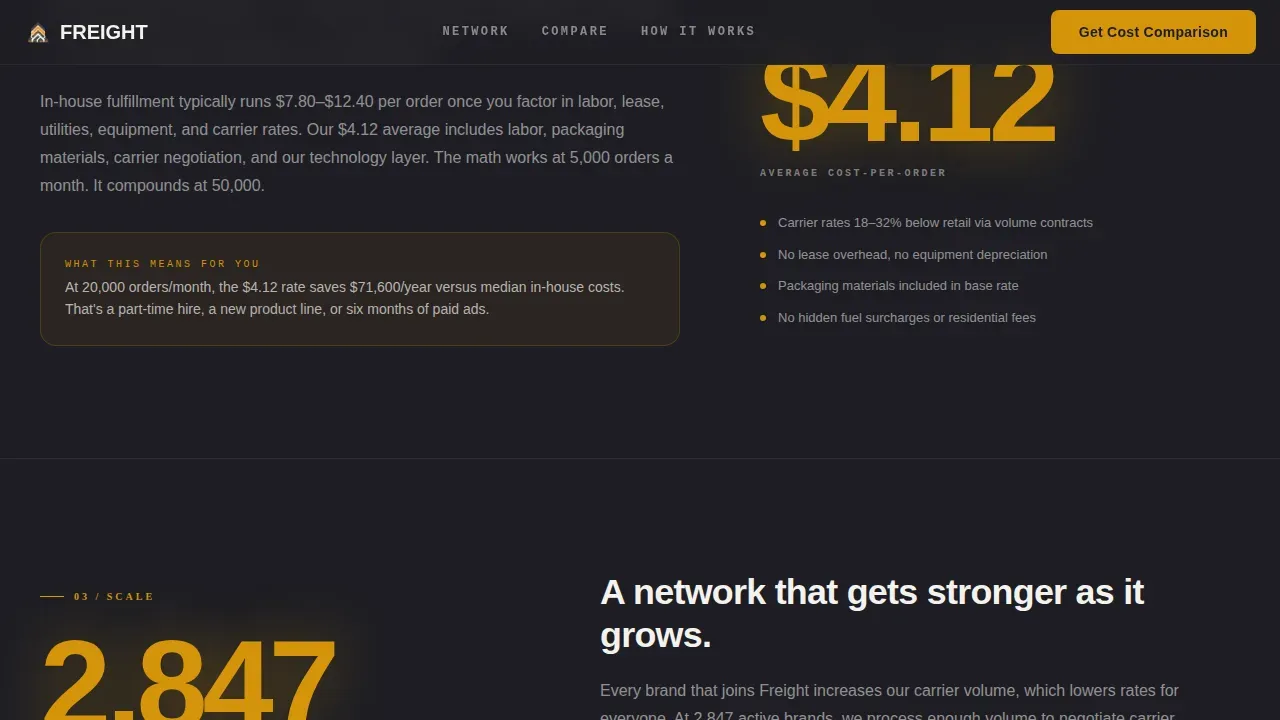
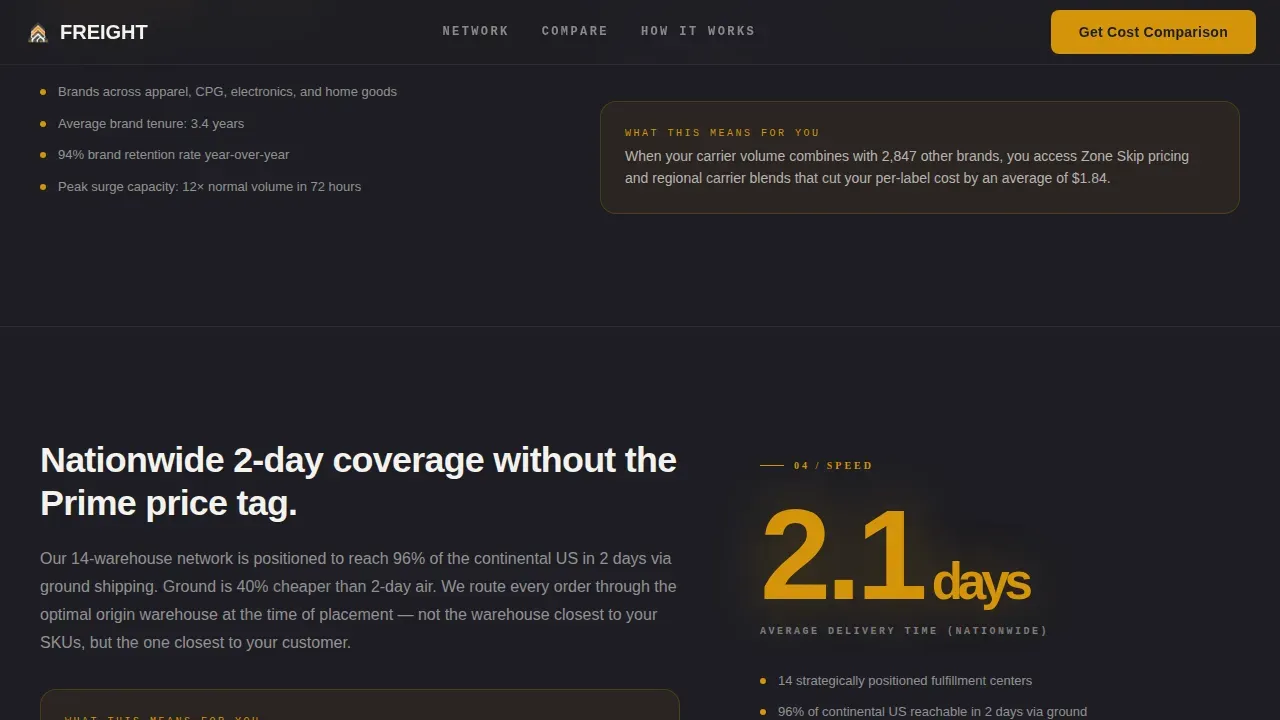
- A four-panel stats zigzag layout presenting oversized performance metrics including order accuracy, cost-per-order, brand count, and average delivery time, each paired with a plain-language explanation
- A sticky head-to-head comparison table showing your setup versus the provider, a short cost-comparison request form, and a secondary gated PDF path requiring only an email
Feature list
This logistic landing page template is built around six core design and layout capabilities. Each one is drawn directly from the template brief and serves a specific role in the third-party logistics conversion process.
Animated Map Hero with Live Node Counters
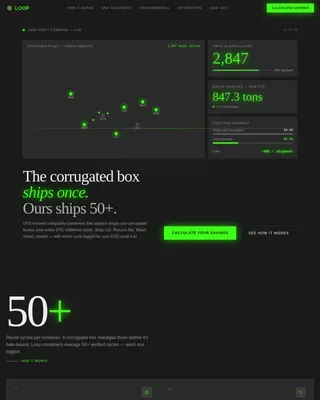
The hero section renders a dark cartographic view of the continental United States with animated amber route lines pulsing between warehouse nodes. Each node displays a live-style counter showing pallets processed, orders shipped, and average delivery hours. A typewriter headline types in over the map, communicating the logistics provider's core value proposition in real time. This approach replaces stock photography with a genuine visualization of logistics operations, which enhances authenticity and trust far more than posed warehouse imagery.
Stats-First Zigzag Sections
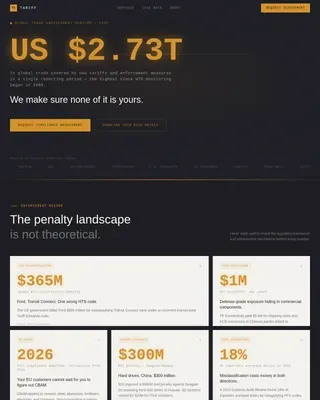
Four alternating panels present oversized performance statistics in amber type, each followed by a plain explanation on the opposite side. The layout escalates from order accuracy (99.6%) to cost-per-order ($4.12) to brand count (2,847) to average delivery time (2.1 days). This zigzag structure keeps the eye moving diagonally through the page while building a compounding, data-backed argument. It reflects the Stats-First Impact creative direction, where every scroll transition leads with a number before the narrative.
Sticky Comparison Table
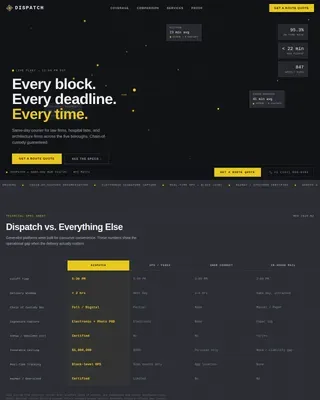
A persistent two-column table sits mid-page and compares the visitor's current fulfillment setup against the third-party logistics provider's offering. Line items include cost-per-shipment, warehouse lease overhead, staff headcount, shipping zone coverage, and technology stack. This section directly addresses the friction points that cause supply chain buyers to hesitate, making a transparent, side-by-side case for outsourcing logistics and supply chain management tasks to a specialized provider.
Cost Comparison Request Form
The primary call to action is a short form requesting monthly order volume, current fulfillment method via dropdown, average stock-keeping unit count, and work email. The secondary path offers a gated PDF benchmark report behind a single email field. High-contrast form buttons and clear input labels ensure the conversion experience is direct and low-friction. A landing page for third-party logistics must prioritize trust, technology, and clarity to convert B2B prospects, and this form is built to do exactly that.
Bento Grid Fulfillment Flow
A bento-style grid section illustrates the full dock-to-doorstep process: inbound receiving, warehouse management, routing, and last-mile delivery. Each cell in the grid represents one stage, giving visitors a precise, visual timeline of how their inventory is handled. Operational process timelines like this visually illustrate the precision of cargo handling and give prospects a concrete sense of what third-party logistics looks like in practice.
Scrolling Brand Logo Ticker
A horizontal ticker displays the logos of brands already using the platform, reinforcing scale and social proof. This element runs between the stats zigzag and the comparison table, positioning the "2,847 brands" data point as a live, visible reality rather than an abstract claim. Industry certifications, client logos, and testimonials build credibility, and this ticker delivers that credibility in a continuous, low-effort visual format.
Page sections overview
| Section | Purpose |
|---|---|
| Map Hero | Establish network scale and deliver the core value proposition through animated route visualization and typewriter headline |
| Stats Zigzag | Present four escalating performance metrics in alternating oversized amber panels paired with plain-language explanations |
| Brand Logo Ticker | Reinforce social proof and operational scale with a continuous scrolling display of client logos |
| Comparison Table | Show a sticky side-by-side breakdown of in-house or alternative fulfillment versus the third-party logistics offering |
| Fulfillment Flow Grid | Visualize the dock-to-doorstep logistics process using a bento grid layout covering each operational stage |
| call to action Form Section | Capture leads through a short cost-comparison form and a secondary gated PDF benchmark report path |
| Footer | Linear single-row footer with essential company links and contact information |
Design & branding system
The template runs on a Service Utility visual theme that feels like a loading bay at golden hour. Deep operations-floor charcoal (#1E1E24) dominates every background and section divider, creating the dark control-tower atmosphere the template is built around. Warm dock-light amber (#D4940A) marks every interactive element, stat callout, and live data point. Mid-tone asphalt (#3A3A42) carries body text and secondary containers, while manifest white (#F4F2ED) opens up the comparison table and stat cards so the numbers breathe clearly against the dark canvas. The typography system pairs DM Sans for headings, JetBrains Mono for data and statistics, and Manrope for body text, creating a clear hierarchy that separates narrative from numbers.
- Color roles: charcoal for backgrounds, amber for interactive elements and data points, asphalt for body text, manifest white for stat cards and comparison table cells
- Typography: DM Sans headings, JetBrains Mono for all numerical data and statistics, Manrope for body paragraphs
- Animation system: GSAP scroll reveals, SVG amber route pulse animation, count-up number transitions, typewriter headline effect, and staggered bento grid entrance
Mobile & speed optimization
The template is designed desktop-first to match the workflow of operations managers reviewing logistics data at a desk. Full mobile responsiveness is built into every section so the landing page delivers a consistent experience across screen sizes. The hero map, zigzag stat panels, and comparison table all reflow cleanly for smaller screens.
- Desktop-first layout prioritized for operations and supply chain management teams working at workstations, with full responsive reflow for tablet and mobile
- Server Components handle static sections such as the footer, comparison table, and stats panels to keep the page fast and stable
- Client-side rendering is scoped to animated sections including the hero map and the interactive comparison table toggle, keeping animation performance isolated
How this template helps you convert
This landing page is built as a Comparison and Versus engine. The entire page structure is designed to present the third-party logistics provider's case mathematically before asking for anything. By the time a visitor reaches the form, the numbers have already made the argument. The call to action simply asks them to confirm it with their own data.
- The stats zigzag builds a four-step proof sequence from order accuracy to cost to scale to speed, so the value proposition is fully established before the comparison table appears
- The sticky comparison table turns abstract supply chain claims into a concrete, line-by-line cost breakdown that directly addresses the friction points preventing logistics buyers from switching providers
- The cost-comparison form closes the loop by inviting visitors to input their own monthly order volume and fulfillment method, making the conversation feel personalized rather than generic
Other information about this template
This template is part of a broader set of logistic landing page examples built for the logistics sector. It is specifically designed for logistics businesses operating in the third-party logistics provider category, where the competitive advantage depends on demonstrating operational excellence through real data rather than marketing language. The template covers the full range of supply chain services a modern third-party logistics company offers, from inventory management and warehousing to freight forwarding and last-mile solutions.
The freight precision driven third party logistics landing page template reflects how the logistics industry is evolving. The landscape of third-party logistics is shifting from a cost-center conversation into a strategic partnership discussion. Companies that treat third-party logistics as a core part of their growth strategy have reported measurable gains in market share over those that manage supply chain management in-house. This template is built to communicate that strategic value clearly.
The template can support relevant content additions such as a blog section for sharing logistics industry insights, tips on managing regulatory changes, and guidance on customs clearance processes for logistics businesses targeting international markets. An integrated blog section on a logistics website can engage clients with valuable content while adding context for prospects evaluating freight forwarding service options across various industries. Logistics companies that publish consistent relevant content also position themselves as authoritative voices in the logistics sector.
This logistic landing page template is fully customizable so logistics companies can personalize the design to reflect their brand identity. The color system, typography, and section content can all be adapted to match existing brand guidelines. Data security considerations are left to the deploying team's infrastructure choices, and teams should evaluate their own data security protocols when collecting form submissions and storing customer data.
- The template is ready to use and can be customized to suit specific business needs and preferences across various industries including e-commerce, manufacturing, and distribution
- Logistics businesses can adapt the comparison table line items to reflect their own supply chain services, pricing models, and service offerings
- The gated PDF section can support future growth by capturing leads at different stages of the buyer journey, including prospects not yet ready to submit a full cost-comparison form
- Consumer expectations in logistics are rising steadily. The template is built to address those consumer expectations by leading with transparency, real data, and clear service quality indicators
- Repeat business in logistics depends on customer satisfaction. The landing page communicates reliability through verified performance metrics and trust signals that reduce prospect anxiety
- Regulatory changes and evolving transportation management requirements can be communicated through the blog or body content sections as the template supports text updates across all panels
- The demand for third-party logistics providers serving international markets is increasingly common as e-commerce brands scale beyond domestic distribution. This template can be adapted to highlight freight forwarding service capabilities and international supply chain services
- Google Analytics and other tracking tools can be integrated at the deployment level by the team implementing the template, providing valuable insights into visitor behavior and conversion patterns
Theme
Service Utility
Creative direction
Stats-First Impact
Color system
Charcoal & Amber
Style
Zigzag/Alternating
Direction
Comparison/Versus
Page Sections
Animated Map Hero with Live Node Counters
Stats-first Zigzag Layout
Sticky Head-to-head Comparison Table
Cost Comparison Request Form
Bento Grid Fulfillment Flow
Scrolling Brand Logo Ticker
Related questions
Who is this landing page template built for?
Can the comparison table and stats be updated with real numbers?
Does the template support mobile devices?
Can I adapt this template to highlight freight forwarding or international services?
What makes this template different from a standard logistics website template?