Philosophy Education Appointment Booking Website Template
Dialectic is a single-column philosophy tutoring landing page built around an intellectual quiz-first funnel. It opens with a provocative syllogism, unfolds through student-voiced questions, and leads visitors through a five-question diagnostic before inviting them to book a free trial tutorial. The Soft Mist palette and serif typography give it the quiet authority of a seminar room.
by Rocket studio
Quick summary
Dialectic is a philosophy tutoring landing page template designed for rigorous, Socratic-style tutoring services. It opens with a quiz starter that tests the visitor's reasoning, moves through a series of real student questions answered with pedagogical depth, and closes with a branching diagnostic and a booking form. The result is a page that demonstrates the tutor's quality before a single pound changes hands.
Who this template is for
This template is built for philosophy tutoring services that want to attract students who take the subject seriously. It speaks directly to people who are under real academic pressure and need a tutor who can meet them where they are.
- Second-year undergraduates who are staring at a blank essay document the night a formative assignment is due and need targeted help fast
- Postgraduate students preparing for vivas who want a skilled instructor to stress-test their arguments and identify every weak point before the examination
- Mature learners returning to school or college after years away from academia who need someone patient and rigorous to rebuild their analytical confidence
What problem this template solves
Philosophy tutoring services often struggle to communicate their value online. A plain list of credentials does not show prospective students what a tutorial actually feels like. Most landing pages in this subject area look like watered-down school notices: correct but unconvincing. Visitors arrive anxious and leave without booking because nothing on the page earns their trust.
- Students cannot tell from a typical tutor profile whether the lessons will actually help them write better arguments, pass their exam, or survive a viva
- Tutoring pages rarely demonstrate the tutor's method in action, so the quality of the instruction stays abstract until after money is spent
- The gap between a student's level of confidence and the rigour of an academic standard is never addressed head-on, leaving potential clients feeling misunderstood
What you get with this template
You get a complete, single-column flow landing page that earns visitor trust through intellectual demonstration rather than credentials alone. Every section is purposefully ordered to move a worried student toward a confident booking, section by section.
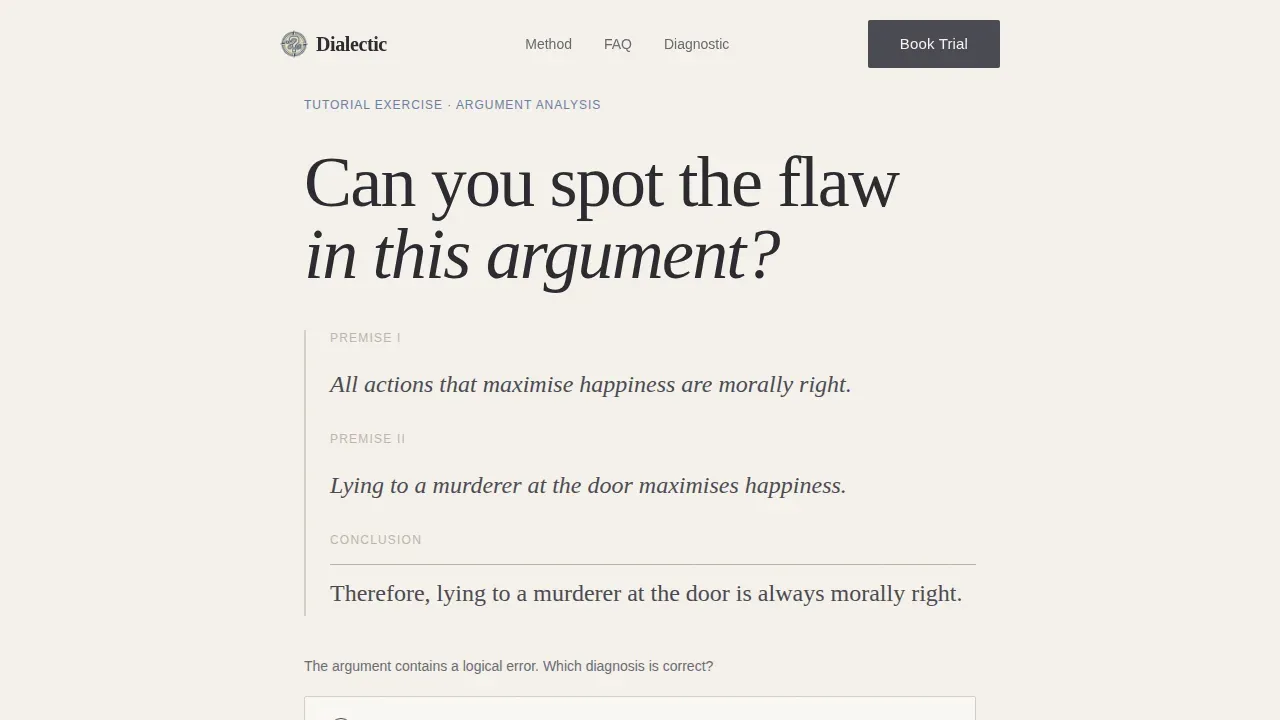
- A quiz-starter hero with a three-line syllogism and a two-option diagnosis button, so the very first scroll feels like a tutorial already in progress
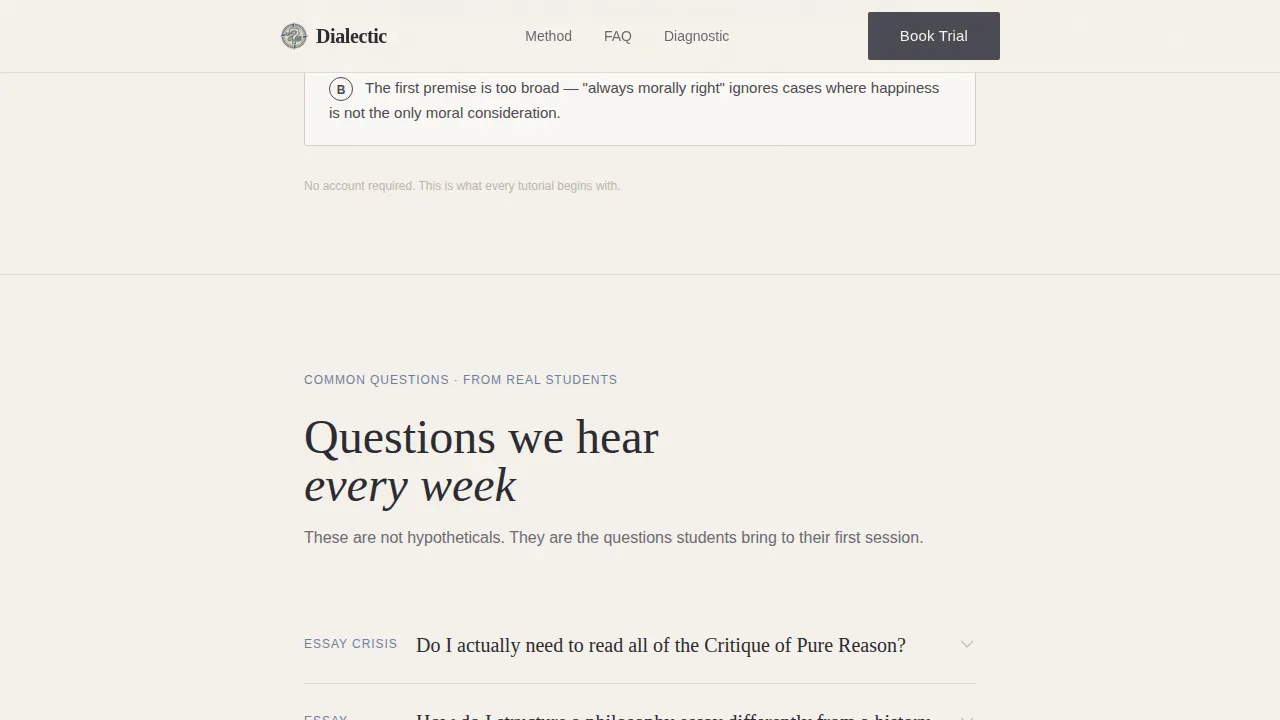
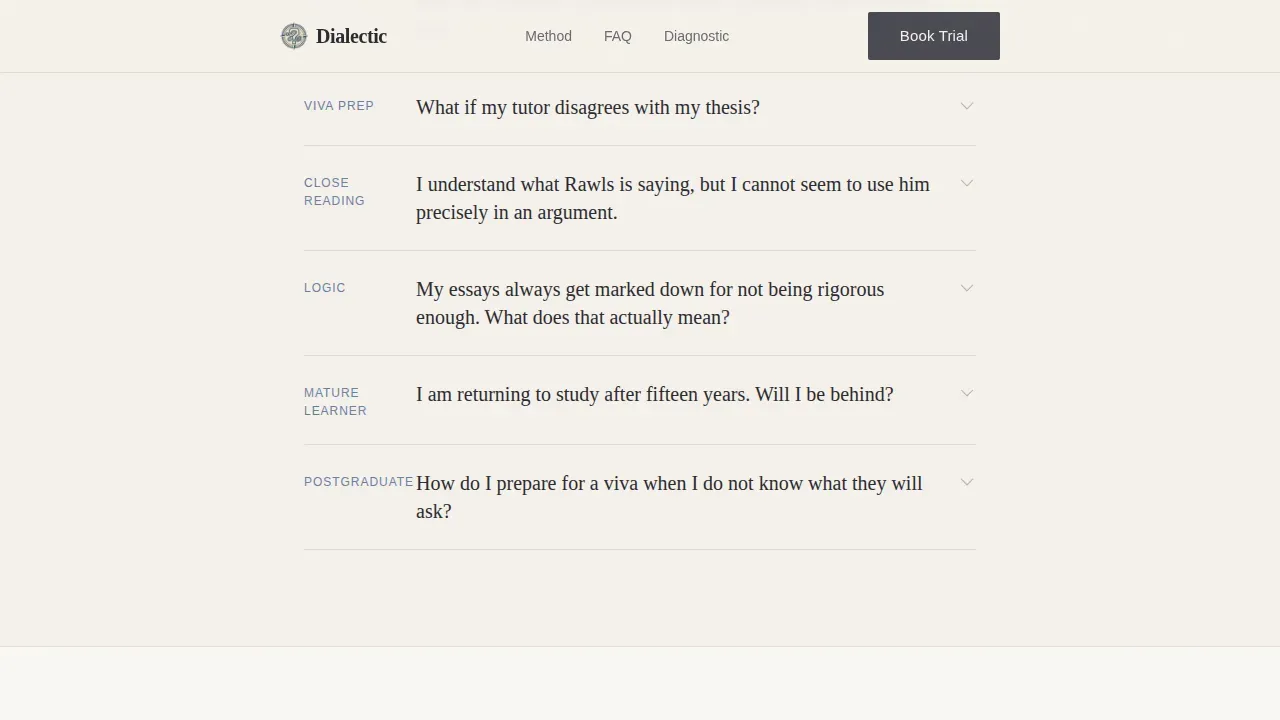
- A frequently asked question section written in authentic student voice, answering the real questions students ask when they are anxious about their course and not sure where to begin
- A five-question branching diagnostic called "Find Your Weak Spot" that tests argument analysis, close reading, and essay structure, then delivers a written assessment and a personalised tutoring focus area before presenting the booking call to action
Feature list
This landing page template is structured around a small number of high-impact interactive features. Each one is designed to serve the philosophy tutoring context directly.
Quiz-Starter Hero Section
The page opens with a large serif question set against the parchment field: "Can you spot the flaw in this argument?" Below it sits a three-line syllogism containing a subtle logical error. The visitor chooses between two diagnoses. There are no images, no illustrations, only text and thought. This sparseness is intentional. It mirrors the exact atmosphere of a philosophy tutorial and signals immediately that this service is serious about its subject.
Frequently Asked Question-Driven Content Flow
After the quiz hook, the page unfolds through a series of real student questions written in a slightly informal register. Early questions are anxious and practical: questions about reading lists, essay structure, and what happens when the tutor disagrees with the student's thesis. Later questions grow intellectually bolder, pulling the visitor from worry into genuine curiosity. Each answer is a calm, knowledgeable paragraph. The scroll rhythm mimics a live conversation growing in confidence, which is exactly how good lessons feel.
Five-Question Branching Diagnostic
The central interactive feature is a five-question diagnostic quiz. It tests the visitor across three skill areas: argument analysis, close reading comprehension, and essay writing structure. The quiz branches based on answers, so each path feels personalised. At the end, the visitor receives a short written assessment of their philosophical reasoning and a recommended focus area. This is the core of the quiz-first funnel: it gives genuine intellectual feedback before asking for any commitment, making the visitor feel already tutored.
Booking Form with Module Selector
Following the diagnostic, a secondary call to action invites the visitor to book a free trial tutorial. The booking section includes a simple calendar picker and a module selector. Available modules are Ethics, Epistemology, Political Philosophy, Logic, and Aesthetics. The form is optimised for a straightforward lead capture process with minimal friction, so a student who has just received their assessment can move directly to booking without losing momentum.
Credibility and Method Section
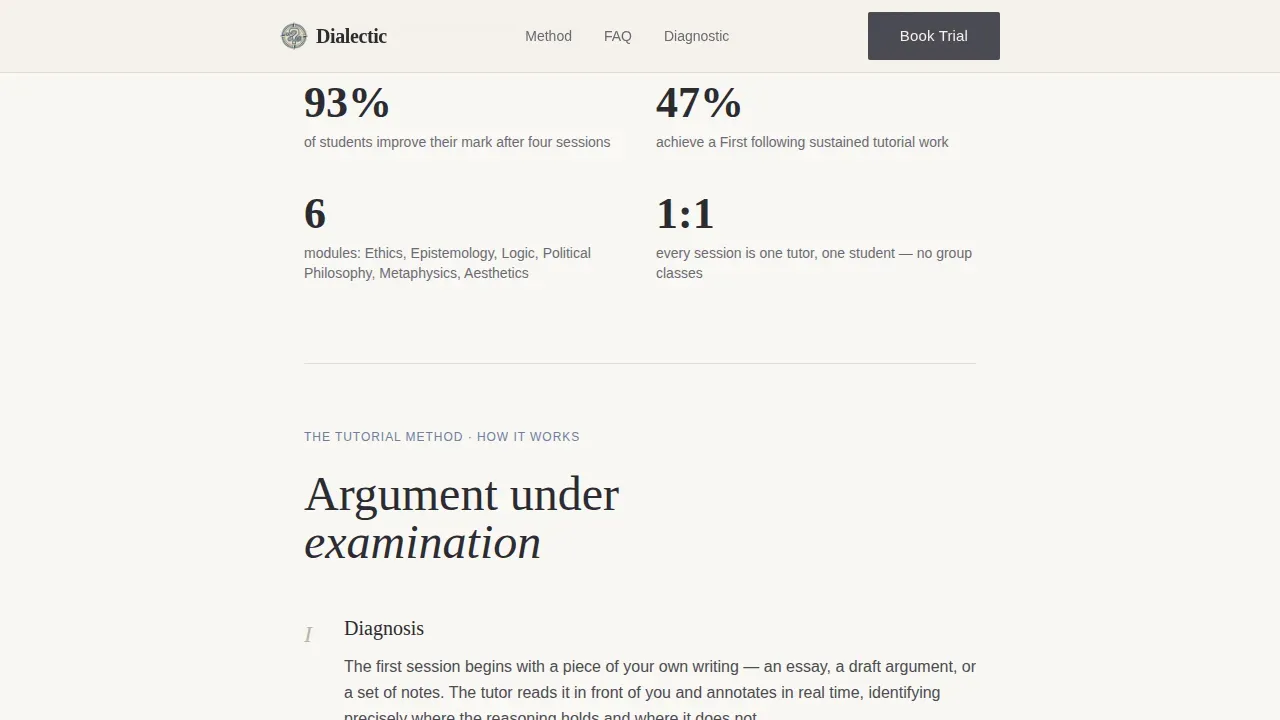
Between the student questions and the diagnostic, the template includes a dedicated credibility section. This is where tutor credentials, success rate statistics, and student outcomes sit. The section is designed to reinforce trust at exactly the moment when the visitor has already been engaged by the content and is starting to consider whether to commit to a paid course of lessons.
Soft Mist Typography System
The template uses Fraunces, a contemporary serif display typeface, for headings and quiz questions. DM Sans handles all body copy. This pairing keeps the page readable and gives it the unhurried quality of well-annotated reading material. The type system does the visual work that photography would do on a different kind of page, which suits a philosophy tutoring service that wants to project intellectual authority through words alone.
Page sections overview
| Section | Purpose |
|---|---|
| Hero Quiz Starter | Opens with a syllogism and two-option diagnosis button to immediately engage the visitor's reasoning |
| Student Questions (frequently asked question flow) | Answers real student anxieties in informal, expert voice to build trust through pedagogical depth |
| Credibility and Method | Presents tutor credentials, success statistics, and a clear explanation of how tutorials work |
| Five-Question Diagnostic | Delivers a branching quiz that assesses argument skill and returns a personalised written assessment |
| Booking Call to Action | Calendar picker and module selector for booking a free trial tutorial with minimal friction |
| Footer | Linear single-row footer pattern with essential navigation and contact links |
Design & branding system
The visual identity follows an Institutional Authority theme built on the Soft Mist colour system. The palette is quiet and deliberate, chosen to feel like morning light through a leaded window falling across a seminar table.
- Core colours are parchment white (#F5F1EB) for page backgrounds, library fog (#D6CFC7) for surface contrast, and academic slate (#4A4A52) for body text, with margin-note blue (#6B7FA3) reserved for links, quiz buttons, and active interface states
- Typography pairs Fraunces serif display for headings and quiz prompts with DM Sans for body paragraphs, keeping reading comfortable across long sections of philosophical prose
- Animation is kept at a low to medium level: scroll reveals, quiz answer transitions, and word-by-word reveals for the opening question add just enough motion to feel considered without distracting from the ideas on the page
Mobile & speed optimization
The template is built desktop-first, reflecting the reality that most philosophy students write their essays at a desk with the page open on a laptop or monitor. Full mobile support is included so that students who discover the service on their phone can still navigate, read, and complete the diagnostic without friction.
- Interactive components, including the branching quiz and the booking form, are built as client-side components, while the rest of the page uses a static-first approach to keep load times low
- The frequently asked question accordion, quiz transitions, and booking form are the only sections that require client-side rendering, keeping the overall page architecture lean and the reading experience immediate
- The single-column flow layout naturally collapses to mobile without needing complex responsive breakpoints, so the scroll narrative stays intact on every screen size
How this template helps you convert
The conversion logic of this template is built around a simple idea: demonstrate the value of the tutoring before asking for money. The page earns the click by giving something real first.
- The quiz-starter hero creates immediate intellectual engagement. The visitor is already doing philosophy within the first ten seconds. That experience builds the kind of trust that a paragraph of credentials could never produce on its own. Students who get the diagnosis right feel smart. Students who get it wrong are curious to learn. Both responses pull them further into the page.
- The frequently asked question-driven content flow resolves the specific anxieties that stop students from booking lessons. Questions about reading volume, essay structure, and disagreeing with a tutor are answered with the calm authority of an ideal tutor who has heard every worry before and knows how to address it. By the time the visitor reaches the diagnostic, they already feel that this is someone worth talking to.
- The five-question diagnostic and the personalised written assessment make the secondary call to action feel like a natural next step rather than a sales push. The visitor has already invested time and received insight. Booking a free trial tutorial is simply the logical continuation of a process that has already started to help them.
Other information about this template
This template is part of a growing library of subject-specific tutoring landing page designs. It is built with the UK academic context in mind, using British English throughout and pricing formatted in GBP. The page is localised for the British school and college system, including references to formative assignments, vivas, and tutorial-style teaching that are familiar to students at UK universities.
- The template is adaptable. While its core design is built for philosophy, the frequently asked question-driven structure and quiz mechanic can be repurposed for other humanities subjects where analytical writing and close reading are central skills. A tutor specialising in history, political theory, or even science communication could adapt the sections with minimal restructuring.
- The Dialectic find your weak spot philosophy tutoring landing page template is also a useful reference point for tutoring services in other disciplines where identifying a student's level of understanding is the first step in a meaningful course of lessons. Teachers working in subjects such as mathematics, calculus, or physics could take the same diagnostic-first approach and adapt the module selector accordingly.
- The branching quiz mechanic is a pattern that works well beyond philosophy. Any instructor who wants to give students a meaningful test of their aptitude before booking, rather than simply listing credentials, will find the structure immediately useful. Language tutors, for example, could adapt the quiz to assess reading comprehension, grammar accuracy, and speech clarity before recommending a specific course of lessons.
- Parents researching tutoring options for school-age students will find the frequently asked question section particularly reassuring. The informal question format and calm, expert answers model exactly the kind of online lesson experience a good instructor provides. The page suggests, through its own structure, that this is a person who listens before they teach.
- The template supports a wide range of tutoring contexts where demonstrating subject aptitude upfront builds more trust than a standard biography page. Whether the subject is formal logic, political philosophy, or a related humanities discipline, the core design communicates that the instructor has both passion for the subject and a clear process for improving student outcomes.
Theme
Institutional Authority
Creative direction
FAQ-Driven
Color system
Soft Mist
Style
Single Column Flow
Direction
Quiz/Assessment
Page Sections
Quiz-starter Hero with Live Syllogism
Faq-driven Conversation Flow
Five-question Branching Diagnostic
Booking Form with Module Selector
Credibility and Method Section
Soft Mist Colour and Type System
Related questions
What pages does this template include?
Can the quiz and booking form be customised for a different philosophy module?
Is this template suitable for a tutoring service that offers online lessons?
Does the template include social proof elements?
What technology does this template use?