Dog Expert Pricing Website Template
Sortie is a single-column defense landing page template built for unmanned aerial system (UAS) manufacturers selling into government procurement. It leads with a split FLIR/electro-optical before-and-after, then walks procurement officers through operational problem framing, platform specifications, sustainment data, and a deployment record, all structured to earn a qualified request for a technical data package.
by Rocket studio
Quick summary
Sortie is a single-column landing page template for defense UAS manufacturers targeting procurement officers and prime contractor program managers. It opens with a case study split frame, then scrolls through four numbered chapters of escalating operational evidence, ending with a gated technical data package request. The layout reads like a declassified white paper, not a commercial website.
Who this template is for
This template is built for business-to-government (B2G) hardware companies where the buyer is a credentialed professional, not a casual browser. The tone, structure, and data density are calibrated for defense acquisition workflows.
- Defense procurement officers writing capability statements for Group 3 UAS programs
- Program managers at prime contractors sourcing intelligence, surveillance, and reconnaissance (ISR) platforms
- Special operations logistics teams replacing attrited platforms mid-deployment
What problem this template solves
Most commercial landing page templates are built for consumer conversion. They rely on animation, lifestyle imagery, and emotional copy. Defense procurement audiences reject that immediately. They need load-bearing data, not decorative design.
- Procurement officers cannot brief their chain of command from a brochure page alone
- Legacy platform comparisons are buried in PDFs that visitors never reach
- There is no structured path from capability claim to qualifying for a technical data package
What you get with this template
You get a fully structured, single-column landing page that front-loads operational proof and routes qualified visitors into a gated data request. Every section is a numbered chapter with a defined purpose.
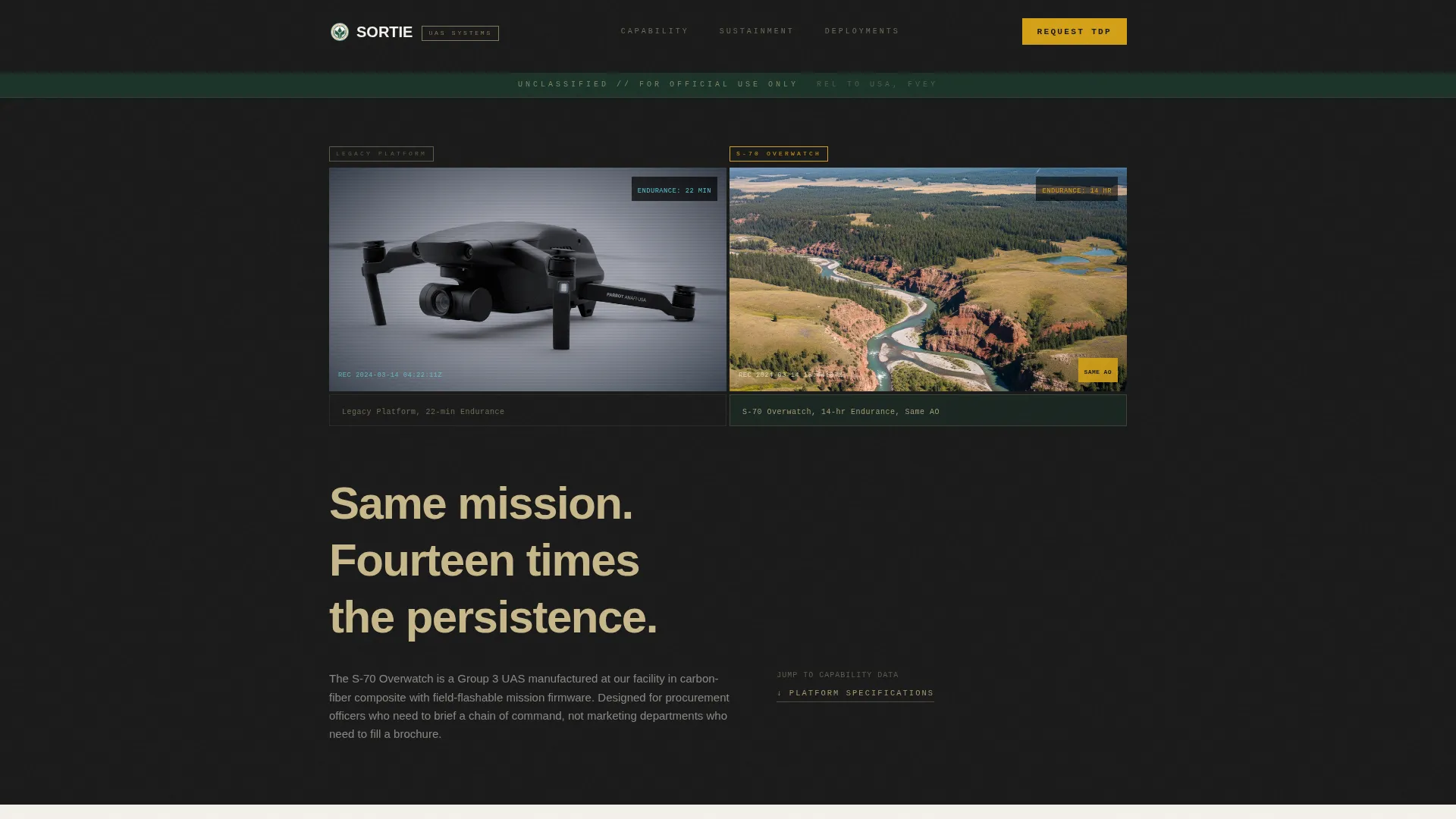
- A split-frame hero with a FLIR/electro-optical before-and-after and a single declarative headline
- Four sequential content chapters covering operational problem, platform specifications, sustainment and logistics, and deployment record
- Two primary call-to-action placements and a secondary text-link path for visitors further along in acquisition
Feature list
This section covers the functional and structural capabilities built into the Sortie template as described in the source brief.
Split-Frame FLIR/EO Case Study Hero
The header opens with a side-by-side still frame. The left panel shows a grainy, blue-tinted forward-looking infrared (FLIR) image labeled with legacy platform endurance data. The right panel shows a crisp electro-optical capture labeled with S-70 Overwatch performance figures. The contrast communicates the capability gap before the visitor reads a single word.
Numbered Chapter Architecture
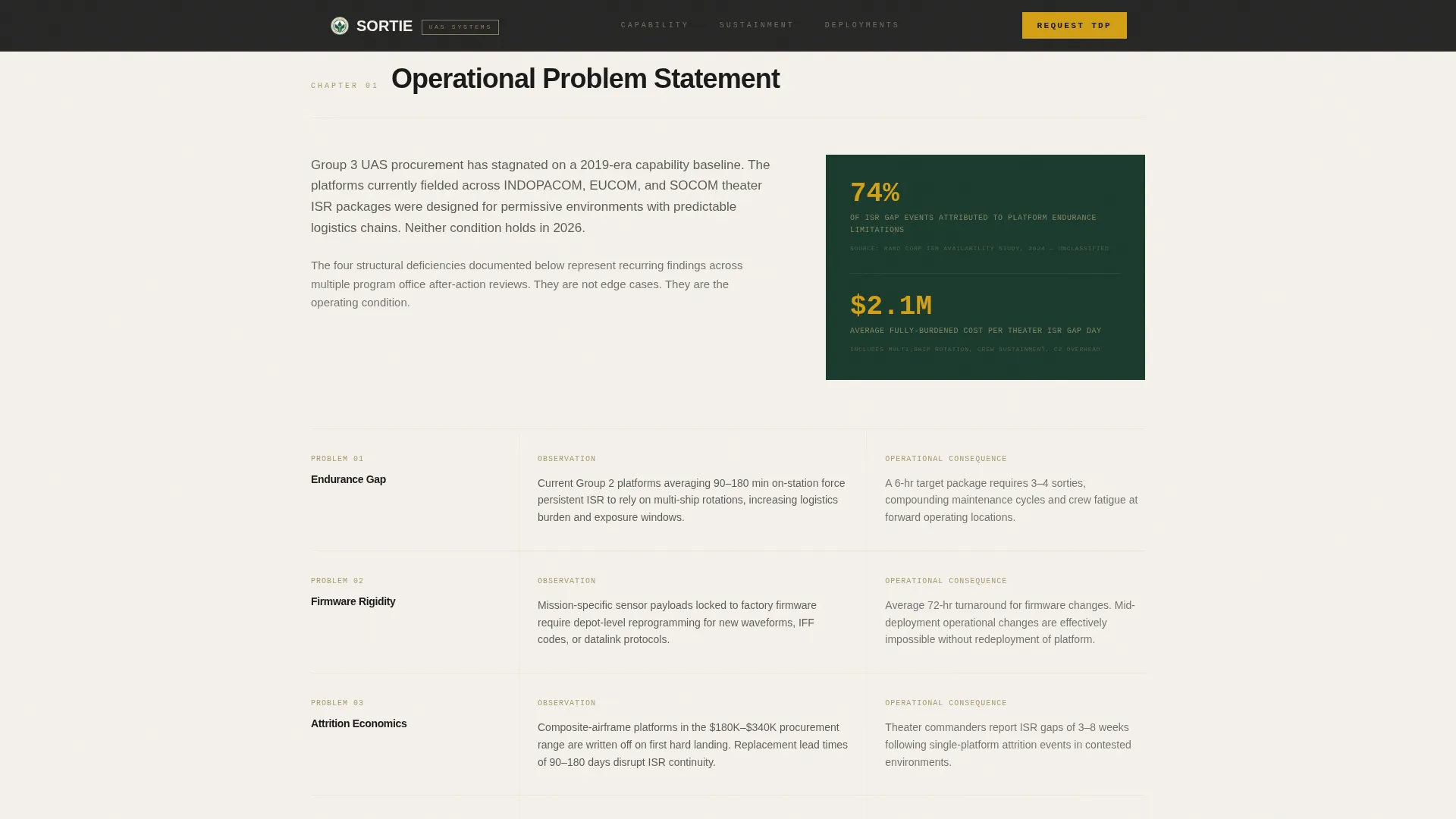
The page is organized into four sequential chapters rather than generic sections. Each chapter builds on the last, moving from operational problem framing through platform specifications, sustainment metrics, and deployment evidence. This mirrors the structure of a declassified white paper and respects how procurement professionals read technical documents.
Tabular Platform Specifications with Competitor Comparison
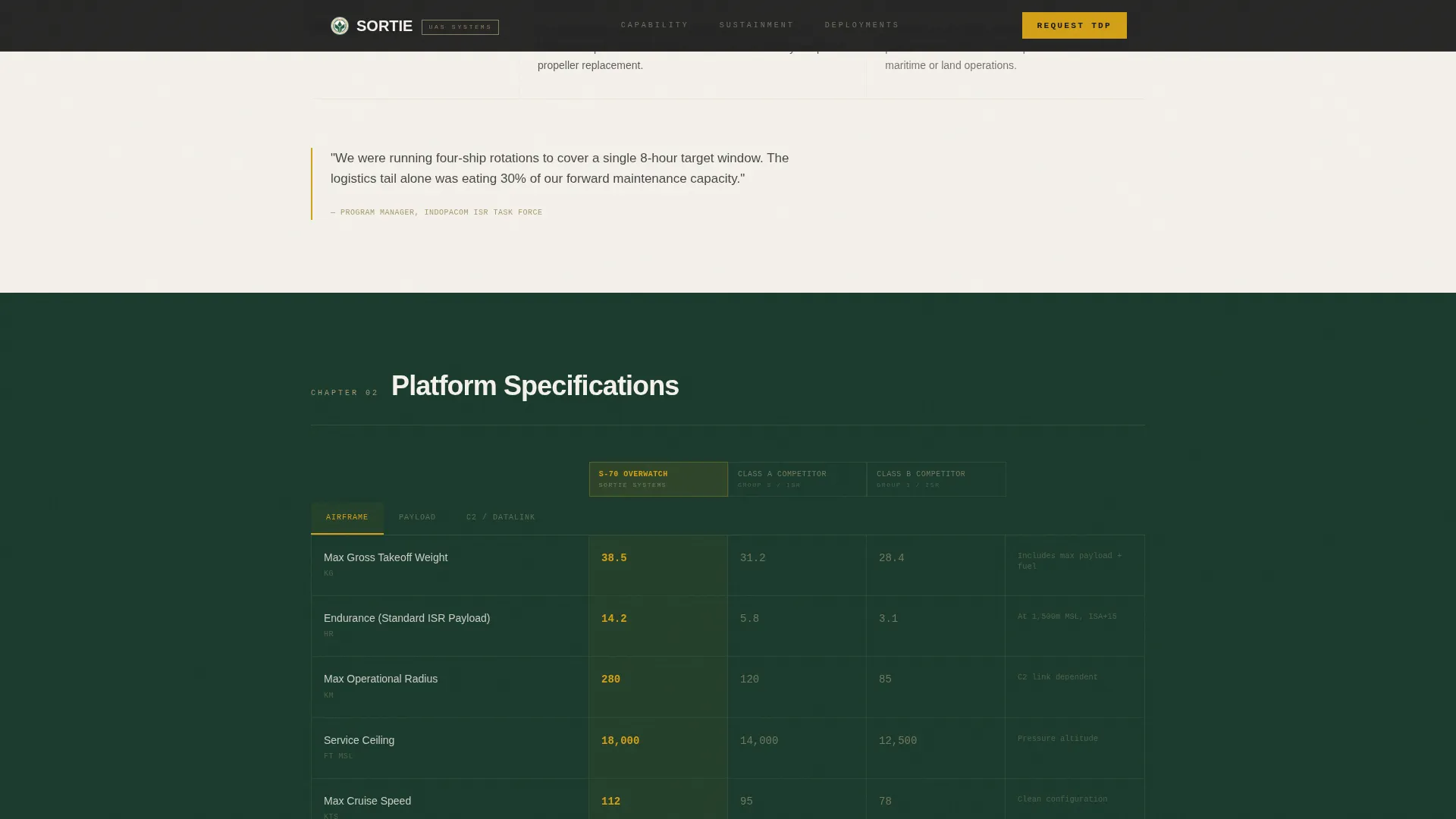
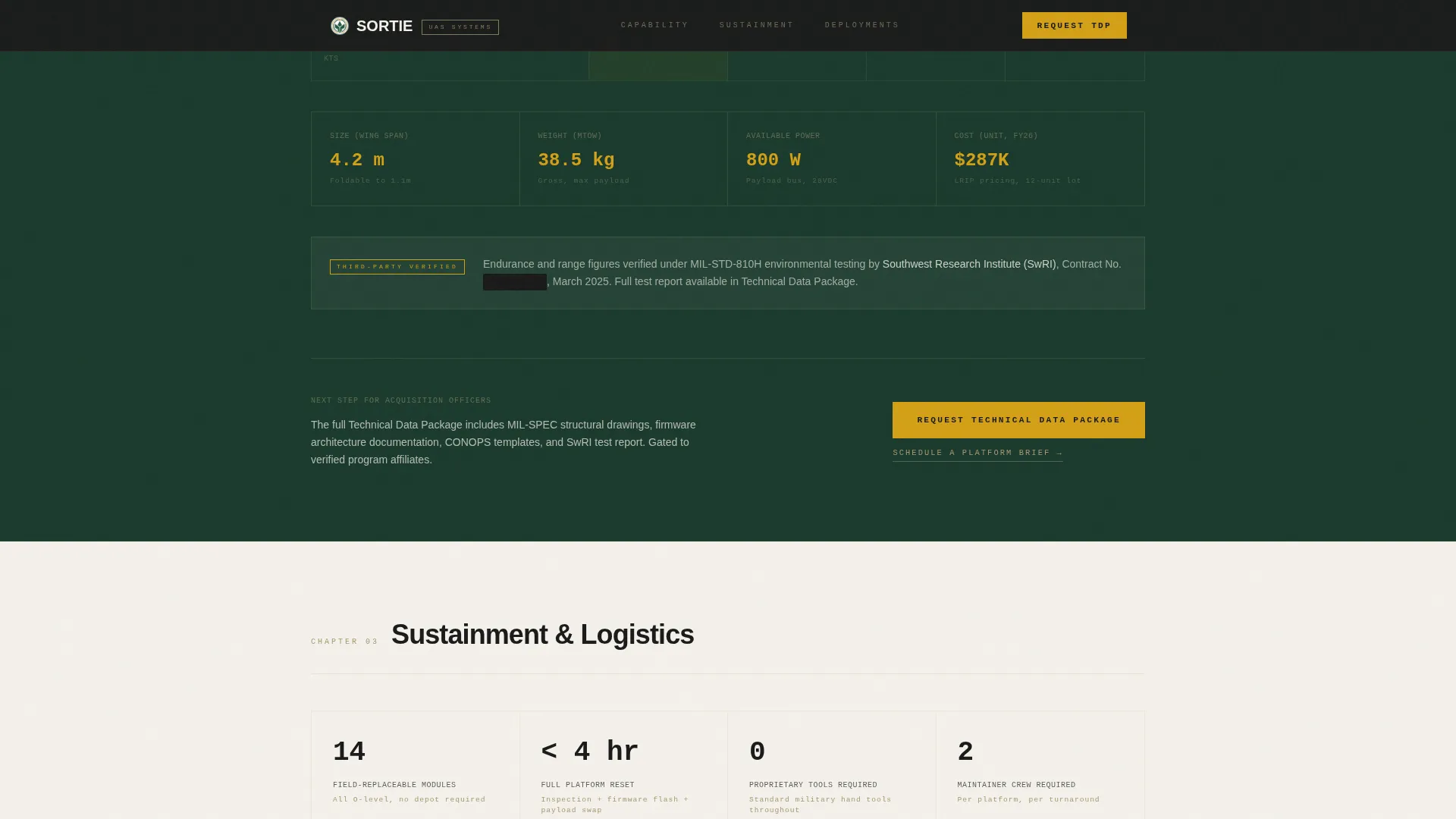
Chapter 02 presents size, weight, power, and cost (SWAP-C) data in a structured table with comparison columns against named competitor platform classes. Table rows include hover states for desktop readability. This gives procurement officers a defensible comparison they can carry into internal briefings.
Gated Technical Data Package Call to Action
The primary call to action, "Request Technical Data Package," appears twice: once after the specifications table and once after the deployment map. Clicking routes to a short qualifying page that collects name, organization, role, and program affiliation before releasing the full PDF. A secondary text link, "Schedule a Platform Brief," sits beneath each primary call to action for officers further along in acquisition.
Role-Attributed Social Proof
Pull quotes are attributed to roles rather than names, for example "Program Manager, INDOPACOM ISR Task Force." Redacted after-action report (AAR) excerpts and third-party test data callouts appear throughout. This escalating evidence structure builds credibility without disclosing operationally sensitive information.
Theater Deployment Map with Anonymized Markers
Chapter 04 includes a theater-by-theater deployment map with anonymized unit markers. This section demonstrates operational breadth without revealing unit-level details. It gives procurement officers geographic context for platform maturity and field exposure.
Page sections overview
| Section | Purpose |
|---|---|
| Hero Split Frame | Establish capability gap visually before any copy is read |
| Chapter 01: Operational Problem | Frame the ISR gap and limitations of legacy platforms |
| Chapter 02: Platform Specifications | Present SWAP-C table with competitor comparison columns |
| Primary call to action Block | Route qualified visitors to the technical data package request |
| Chapter 03: Sustainment and Logistics | Show mean time between failures and field-replaceable module data |
| Chapter 04: Deployment Record | Display theater map with anonymized operational unit markers |
| Secondary call to action Block | Repeat technical data package request after deployment evidence |
| Footer | Minimal single-row linear footer |
Design & branding system
The visual identity follows a Service Utility theme built on a Forest Trust color palette. Every design choice reinforces authority and operational seriousness. There is no decorative motion, no parallax, and no lifestyle photography.
- Core colors: deep canopy green (#1B3A2D), worn field-manual tan (#C8B88A), parchment (#F4F1EB), matte black (#1A1A1A) for primary text, and signal amber (#D4A017) reserved exclusively for calls to action and key metrics
- Typography: JetBrains Mono for data callouts and tabular figures, DM Sans for all body copy and headings
- Backgrounds alternate between parchment (#F4F1EB) light sections and deep green (#1B3A2D) dark sections that read like redacted briefing slides
Mobile & speed optimization
The template is designed desktop-first, reflecting the reality that procurement officers review capability statements on workstations. However, the single-column flow adapts cleanly for tablet and mobile without restructuring content.
- Static-first build approach supports fast load times on secure government network environments
- Low animation footprint: scroll reveals only, with no parallax effects or decorative motion
- FAQ section uses an accordion interaction pattern to keep long pages navigable on any screen size
How this template helps you convert
The conversion strategy is built on earning the click before asking for it. By the time a visitor reaches the call to action, they have enough data to justify requesting the full technical data package internally.
- Front-loaded SWAP-C data and the FLIR/EO case study establish credibility in the first scroll, so procurement officers trust the page before they commit to a request
- The two-path call-to-action structure serves visitors at different acquisition stages: those ready to request a technical data package and those who prefer to schedule a platform brief first
Other information about this template
Sortie is purpose-built for the defense UAS market where the sales cycle is long, the buyer is technical, and emotional appeals do not work. The template's structure reflects that reality at every scroll depth.
- The Industry Report creative direction means the page reads as a primary source document, not a marketing asset
- The qualifying gate before PDF delivery is designed to pre-screen visitors by organization and program affiliation, supporting a qualified lead workflow
- Imperial measurements, USD pricing references, and military date format conventions are baked into the localization assumptions for this template
- The Click-Through landing page direction keeps all conversion effort focused on a single outcome: a completed technical data package request form
Theme
Service Utility
Creative direction
Industry Report
Color system
Forest Trust
Style
Single Column Flow
Direction
Click-Through
Page Sections
Split-frame Flir/eo Hero
Numbered Chapter Page Structure
Swap-c Competitor Comparison Table
Dual-path Call-to-action System
Role-attributed Social Proof Blocks
Theater Deployment Map
Related questions
Who is this template designed for?
Can I adapt the specifications table for a different platform?
Does the template include the gated PDF delivery mechanism?
How many times does the primary call to action appear?
Is this template suitable for secure or restricted network environments?