Religious Organization Digital Presence Professional Website Template
The Tithe Sacred Supply Command Center landing page template is a bento grid storefront built for churches and religious organizations that need to order supplies at scale. It combines a data-command visual identity with interactive inventory tiles, liturgical calendar demand charts, bulk savings comparisons, and a lead-capture flow. Church administrators land on a page that reads like an operations briefing, not a catalog.
by Rocket studio
Quick summary
The Tithe template turns a religious supply storefront into a precision command center. It is a single-page, bento grid landing page designed for church office administrators, worship directors, and pastors who need to order everything from communion wafers to baptismal robes with the efficiency of a logistics dashboard. Every section builds a data-backed case for bulk purchasing before a visitor ever clicks the catalog.
Who this template is for
This template was built for people who manage the operational side of church life. They are not casual shoppers. They are responsible for making sure the right supplies land in the right house of worship before the right season. They think in bulk quantities, budget lines, and liturgical calendars. They want to know exactly what they are getting and how much they will save before they commit.
- Church office administrators at large congregations who place quarterly bulk orders and need inventory-grade clarity on what is in stock, what is selling, and what the volume discount tiers look like before they fill a cart.
- Small-town pastors and worship directors stretching tight budgets across Vacation Bible School materials, advent candles, Lenten supplies, and seasonal décor who need to see cost-per-member comparisons presented plainly.
- Supply coordinators at any church organization that is tired of managing sacred goods through spreadsheets, email threads, and guesswork, and wants a storefront that respects their time and their fund management responsibilities.
What problem this template solves
Ordering church supplies has historically felt like searching a disorganized basement rather than operating a professional procurement system. Leaders responsible for sacred goods, from printed scripture materials to vestment textiles, often have no single source of truth for pricing, availability, or seasonal demand. That confusion costs money. It also costs the spirit of good stewardship that the whole idea of tithing and consecration is built on.
- There is no clear presentation of bulk pricing tiers, so buyers pay retail when they could have paid significantly less by ordering in volume, wasting consecrated funds that could support the poor or fund building projects.
- Seasonal demand spikes across the liturgical calendar, such as advent, Lent, and Easter, catch administrators unprepared, forcing last-minute orders at premium prices rather than planned purchases at lower cost.
- Donors and church leaders cannot easily see where money is going, creating a trust gap between the congregation and the people responsible for procurement and stewardship of church property.
What you get with this template
The template delivers a complete, production-ready bento grid landing page. Every section is designed and laid out. The visual system, the interactive states, the call to action placement, and the data presentation cards are all included. There is no blank canvas to fill in. You adapt the copy and product data to your store, and the structure does the rest.
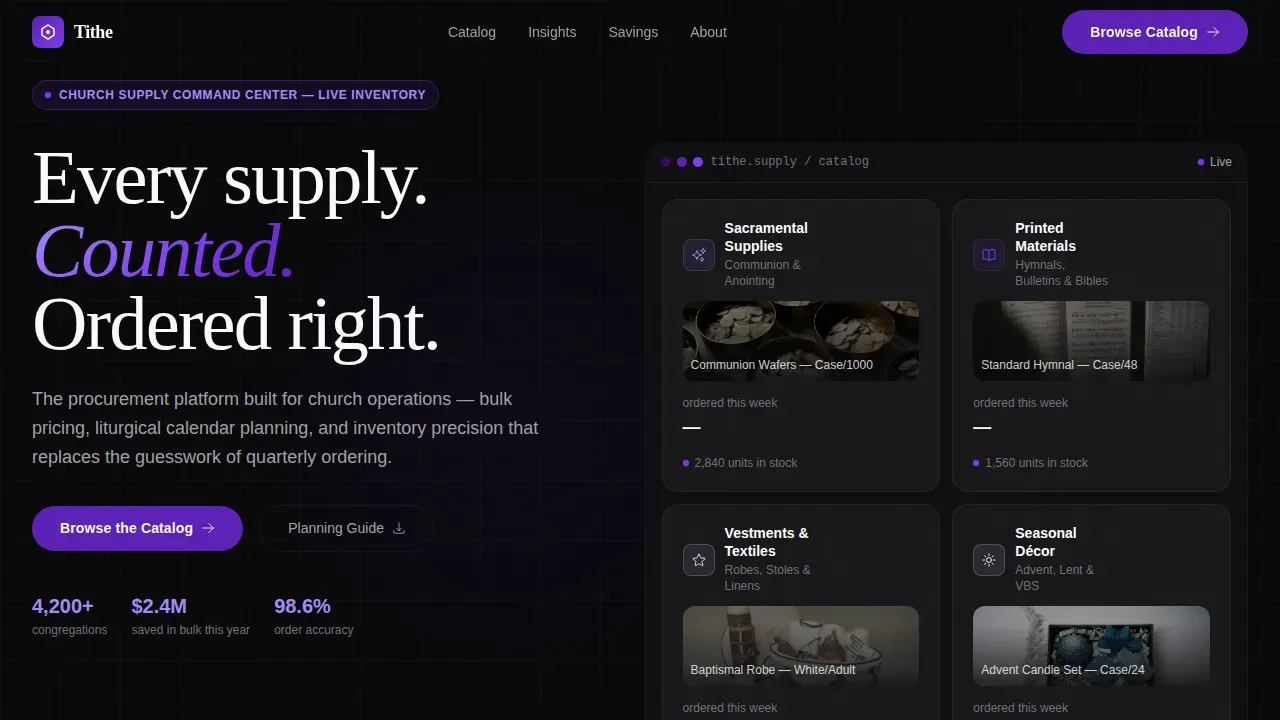
- A fully designed bento grid hero with four interactive product category tiles, hover-activated inventory counters, bestseller badges, and volume discount tickers that animate as quantity increases, giving administrators an immediate sense of operational intelligence.
- Five complete page sections covering the hero, an industry data panel with congregation size charts and liturgical calendar demand maps, a savings analysis block with bulk versus retail comparisons, a social proof section with named church testimonials, and a lead capture panel with a planning guide download form.
- A Void and Violet design system built on void black, liturgical violet, ash gray, and pale lavender, with Fraunces serif display type and DM Sans body text, delivering a stained-glass command center aesthetic that communicates authority and trust.
Feature list
This template was designed with one core truth in mind: church administrators make better purchasing decisions when they have clear, organized data in front of them. The law of good stewardship is that clarity precedes commitment. Every feature below serves that principle directly.
Interactive Bento Category Tiles
The hero section is built around four animated product category tiles covering Sacramental Supplies, Printed Materials, Vestments and Textiles, and Seasonal Décor. Each tile contains a small product thumbnail. On hover, the tile reveals an inventory count, a bestseller badge, and a volume discount percentage that ticks upward as quantity increases. Visitors do not just browse; they see the business logic of buying in bulk before they scroll a single pixel.
Liturgical Calendar Demand Map
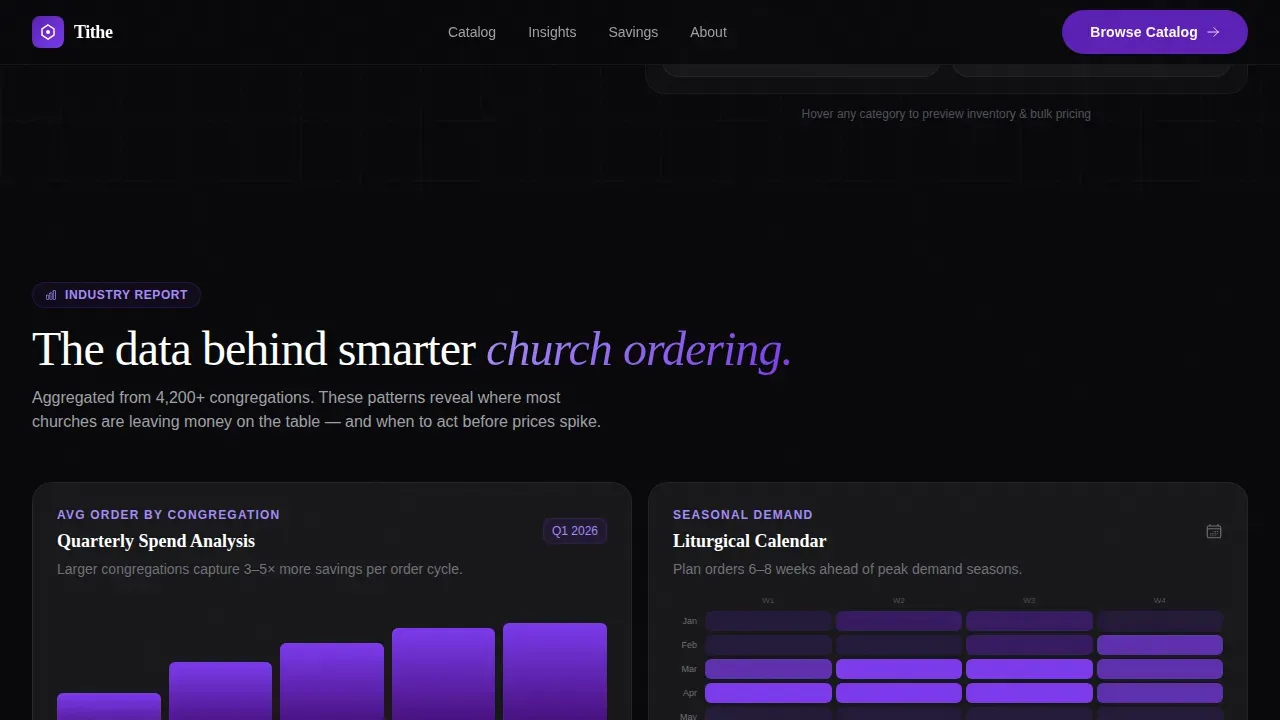
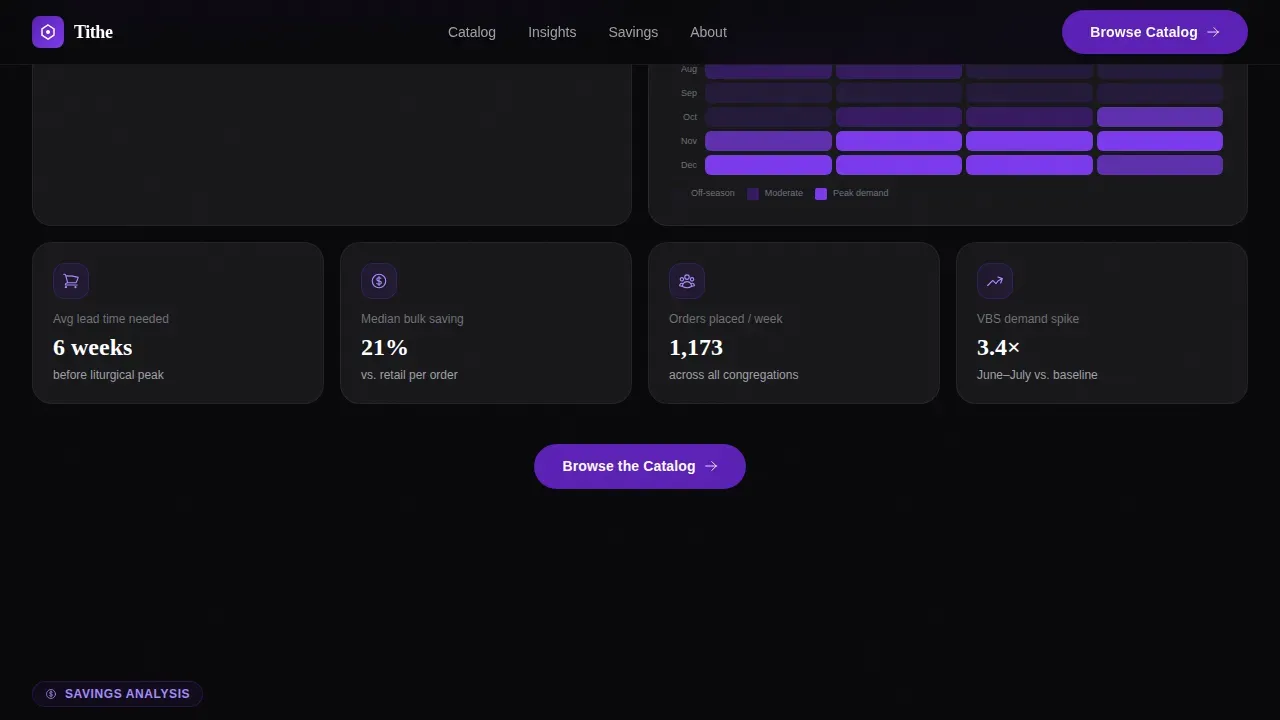
One of the core data cards maps seasonal demand spikes across the full church year. Advent, Lent, Easter, and Vacation Bible School summer all register as distinct peaks. This card helps an administrator understand when to place orders ahead of time, turning reactive purchasing into planned stewardship of the congregation's budget and property.
Congregation Size Bar Chart
A violet bar chart displays average order value segmented by congregation size. This is not decorative data. It gives a small-town pastor an honest benchmark and gives a megachurch administrator a reference point for their own spending. The chart makes the case that the template's store is built for organizations at every scale, from a modest family church to a large regional body.
Bulk Versus Retail Savings Analysis
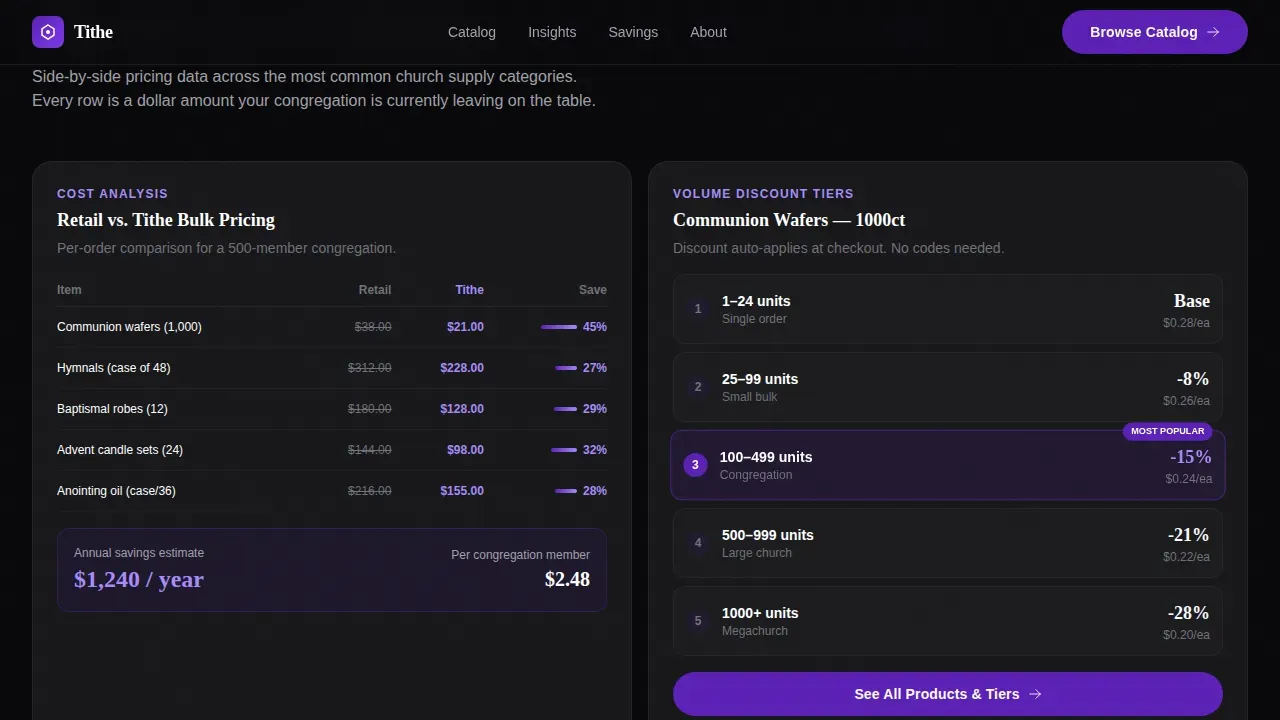
A dedicated savings block presents a direct cost-per-member comparison between bulk and retail purchasing. Volume discount tiers are shown clearly. A visitor can sit with the numbers and see exactly how much money is left on the table when orders are placed piecemeal. This section earns the click to the catalog by proving the financial principle before asking for any commitment.
Social Proof with Documented Savings
The testimonial section does not use generic quotes. It presents named church testimonials with congregation size, total order value, and savings percentage documented. Live "ordered this week" counters and a total orders fulfilled metric reinforce that this is an active, trusted supply source, not a static catalog.
Lead Capture with Planning Guide Download
A secondary conversion path offers a Church Supply Planning Guide in exchange for an email address and a congregation size selection. This path captures administrators who are thinking about next quarter but are not ready to order today. The form is presented inside a bento card that fits naturally into the page flow without interrupting the primary catalog call to action.
Page sections overview
| Section | Purpose |
|---|---|
| Hero Category Tiles | Interactive bento grid with animated inventory data and volume discount tickers per product category |
| Industry Data Panel | Asymmetric bento cards with congregation size bar chart and liturgical calendar demand map |
| Savings Analysis Block | Cost-per-member bulk versus retail comparison and volume discount tier display |
| Social Proof Section | Named church testimonials with order volumes, savings percentages, and live order counters |
| Lead Capture Panel | Planning guide download form with email and congregation size fields |
| Footer Row | Linear single-row footer with navigation and legal links |
Design & branding system
The Void and Violet color system is the visual backbone of this template. It draws from the feeling of a stained-glass window lit from behind in a dark nave. The violet glows with sacred authority. The black recedes into depth. Pale lavender surfaces float in the darkness like illuminated scripture cards. The overall effect is that of a data command center that has been built inside a sanctuary, where precision and reverence occupy the same space.
- Colors follow a strict hierarchy: void black at #09090B forms every background, liturgical violet at #5B21B6 drives all interactive elements, data highlights, and call-to-action buttons, ash gray at #A1A1AA surfaces secondary bento cards, and pale lavender at #EDE9FE appears on card surfaces and hover states.
- Typography uses Fraunces as the serif display face for headlines and data callouts, giving the page a sense of written authority and weight, while DM Sans handles body copy, labels, and data figures with clean, legible precision suited to dashboard-style reading.
Mobile & speed optimization
The template is built desktop-first, reflecting the reality that church office administrators typically work from workstations when placing quarterly bulk orders. The bento grid layout is dense with data and designed to be experienced at full width. However, the layout is fully responsive and collapses gracefully for pastors reviewing orders on tablets or accessing the lead capture form on a mobile device. Mobile-responsive design is essential for staff managing inventory or reviewing giving on the go, and the template accounts for that use case without sacrificing the desktop command center experience.
- Mobile-responsive breakpoints reflow the bento grid into a single-column card stack on smaller screens, preserving all interactive states, hover data reveals, and call-to-action button visibility without requiring the user to scroll sideways or zoom in to read pricing data.
- Interactive components are built using server components for static sections and client components for the animated bento tiles, keeping the initial load light while ensuring the hover counters and discount tickers function correctly across device types.
How this template helps you convert
Every design and content decision in this template is oriented toward one outcome: moving a church administrator from initial interest to clicking the catalog or submitting the planning guide form. The page earns both conversions by presenting hard evidence before making any ask. A visitor who has seen the cost-per-member savings comparison, the liturgical calendar demand map, and the documented testimonials already knows the financial case for ordering here. The call to action is the natural next step, not a cold ask.
- The persistent violet "Browse the Catalog" button appears in the top-right corner of every view and reappears at the close of every second bento row, ensuring the primary path is always within one click. High-contrast call-to-action buttons placed prominently guide users without confusion, and the violet color against void black creates maximum visual contrast that draws the eye at every scroll position.
- The secondary lead capture path collects an email address and congregation size in exchange for the Church Supply Planning Guide, creating a low-commitment entry point for buyers who need more time. This means the template converts visitors at two different stages of purchase readiness: those ready to order today and those who will order next quarter after reviewing the guide.
Other information about this template
The Tithe template operates at the intersection of sacred mission and operational discipline. Understanding the broader context of church finances, tithing principles, and the history of consecration helps clarify why this kind of tool matters to the people who will use it.
The law of tithing is one of the oldest financial principles in scripture. The Lord requires his people to consecrate their lives and temporal possessions for the building of his kingdom and to provide for the poor. The foundational principle of the law of consecration holds that the Lord is the Creator of the earth and therefore all property is his. To consecrate property is to set it apart for sacred purposes, which involves making a covenant with God. After consecrating property, a member receives a stewardship to oversee that property for their own use and the benefit of others. The law of tithing requires members to pay one-tenth of their increase annually, which is distinct from the broader principle of consecration. Consecration is a higher law than tithing when it involves dedicating all of one's time, talent, and energies to the building up of the Lord's kingdom. These principles of consecration and stewardship are intended to provide for the needs of the poor and for the building up of the kingdom of God on earth.
In the New Testament, jesus and his disciples speak repeatedly about the relationship between money, sacrifice, and faithfulness. The word of the Lord on giving money is clear: stewardship is not optional. Those who are called to lead a congregation carry a responsibility to manage every fund well, whether it comes from tithing, donations, or the sale of church property.
In the early history of the restored church, figures like joseph smith taught that the spirit of consecration meant more than writing a deed. It meant aligning all of one's temporal interests with the kingdom. joseph smith and the early saints consecrated land, property, and income to build up temples and support the needy. The idea that joseph smith articulated, that the earth and all things belong to the lord, echoes through every decision a modern administrator makes when they choose to pay for supplies wisely rather than wastefully.
The church held, and continues to hold, significant financial resources. Critics note that church spending on for-profit projects can overshadow humanitarian aid efforts. The church has assets likely worth tens of billions of dollars, and some argue that a greater share of profits from church-owned businesses should go toward aid for the poor rather than commercial ventures. These are real conversations that church leaders and administrators engage with. Being responsible with consecrated funds, choosing bulk purchasing over retail waste, and keeping every dollar accountable is part of the same spirit of stewardship that scripture calls every congregation toward.
The principle that ye are stewards, not owners, runs through both Old and New testament teachings. The revelation given to the saints was always that temporal order and spiritual faithfulness go together. A church that is blessed with land, with property, with a full house of worship, and with a growing family of disciples is a church that must also be organized in its procurement, its inventory, and its financial record-keeping.
Platforms like Deseret Book have long served religious communities by providing a reliable source for faith materials and scripture study resources. Deseret Book and similar religious publishers understand that the word of God in printed form is a tangible good with real inventory, real shipping logistics, and real demand spikes tied to the liturgical calendar. Church supply stores exist in this same world: they are not merely a business but a support system for the practice of faith.
The template also reflects best practices that apply broadly to command center interfaces for church finances. A centralized giving portal should include a visual dashboard showing how tithes are allocated. Fundraising thermometers and progress bar elements help a congregation see how close their organization is to a giving goal. Real-time giving dashboards provide a high-level view of tithes, offerings, and donations. Effective dashboards display key metrics like total giving and recent transactions without requiring the user to scroll through dense tables. Automated donor reporting tools generate giving statements for tax purposes, which can also help members when they pay taxes and need documentation of their donations. Donor management systems allow members to view their private giving history and download official records. Trust indicators like security badges foster confidence in the handling of data. Transparency messaging should explain what percentage of funds go directly to causes. Role-based access control ensures only authorized personnel can access sensitive financial or inventory data.
No-code platforms and AI-powered tools have made it easier than ever to build effective church websites and landing pages without needing deep technical skills. AI tools can streamline the process of creating a landing page by automating design and content generation, and they can help with A/B testing to find which version performs better. Integrating these tools can reduce the time needed to launch a campaign. Professional templates like this one give non-technical users a strong foundation that would otherwise take three years of development experience to produce from scratch.
- The template is designed for the Religious Organization Online Store niche within the broader Religious Organization Digital Presence category, making it purpose-fit for church supply businesses rather than a generic e-commerce theme.
- GSAP ScrollTrigger animations handle staggered bento reveals as the visitor scrolls, giving the page a sense of descending deeper into operational intelligence with each new section.
- The footer follows a linear single-row pattern, keeping the bottom of the page clean and uncluttered while still providing navigation and legal link access.
- The template's Data Command theme is unique in the market for religious supply stores; it treats church procurement as the serious, data-driven discipline that it truly is, applying the same rigor that a logistics dashboard would bring to any large-scale property or inventory system.
- Church leaders who speak to their congregations about the responsibility to pay tithing and to give money faithfully will find that this template's emphasis on transparency and clear data presentation aligns with those same values at the operational level.
- The template supports the idea that a congregation's decision to pay for supplies in bulk is itself an act of stewardship, allowing more of the budget to rest in the fund set aside for mission, for the needy, and for the building of the kingdom.
Theme
Data Command
Creative direction
Industry Report
Color system
Void & Violet
Style
Bento Grid
Direction
Click-Through
Page Sections
Animated Bento Category Tiles
Liturgical Calendar Demand Map
Cost-per-member Savings Analysis
Congregation Size Bar Chart
Social Proof with Live Order Counters
Lead Capture Planning Guide Form
Related questions
Who is this landing page template designed for?
What sections are included in this template?
Does this template support both desktop and mobile viewing?
How does the template convert visitors who are not ready to buy today?
Can non-technical users work with this template?