Specialty Farming Professional Website Template
Swarm is a single-column flow landing page template built for industrial insect protein producers. It presents a climate-controlled black soldier fly bioconversion operation with scroll-driven storytelling, animated lifecycle diagrams, live-ticking counters, and two clear conversion paths: a white paper download and a sample kit request. The design is diagrammatic, botanical, and built for B2B procurement audiences.
by Rocket studio
Quick summary
Swarm is a single-column flow landing page template designed for insect protein producers who convert organic waste into high-grade protein, animal feed oil, and organic fertilizer using black soldier fly larvae. It combines scroll-triggered animations, a lifecycle infographic header, stacking waste-statistics visuals, and a dual call-to-action structure to move procurement researchers from curiosity to commitment.
Who this template is for
This template is purpose-built for B2B operations in the insect protein and sustainable agriculture space. It speaks directly to buyers who need hard evidence before they commit resources to a new protein supply chain.
- Pet food formulators sourcing alternative proteins to replace conventional protein sources like soy or fishmeal
- Aquaculture operations evaluating insect meal and aquaculture feed options to reduce dependence on wild-caught fish
- Agricultural co-ops and sustainability officers at consumer packaged goods companies looking to close the waste loop and offset supply chain emissions
What problem this template solves
Insect protein is scientifically credible but commercially unfamiliar. Procurement teams, feed formulators, and sustainability leads need to see operational proof before they will engage with a new supplier. A generic page cannot carry that weight.
- Buyers arrive skeptical. They need throughput data, certifications, lab assay results, and regulatory context before they will request a sample or download a white paper.
- Conventional landing pages present claims without evidence. Swarm builds a layered evidence case across every scroll section, so trust accumulates before any form appears.
- The insect protein market is growing rapidly, and first-mover suppliers need a page that reflects the seriousness of that opportunity without looking like a startup side project.
What you get with this template
Swarm delivers a fully structured single-column flow landing page with five distinct content sections, two conversion paths, and a high-animation design system. Every component is specified to support B2B procurement research on desktop, with responsive layout for mobile.
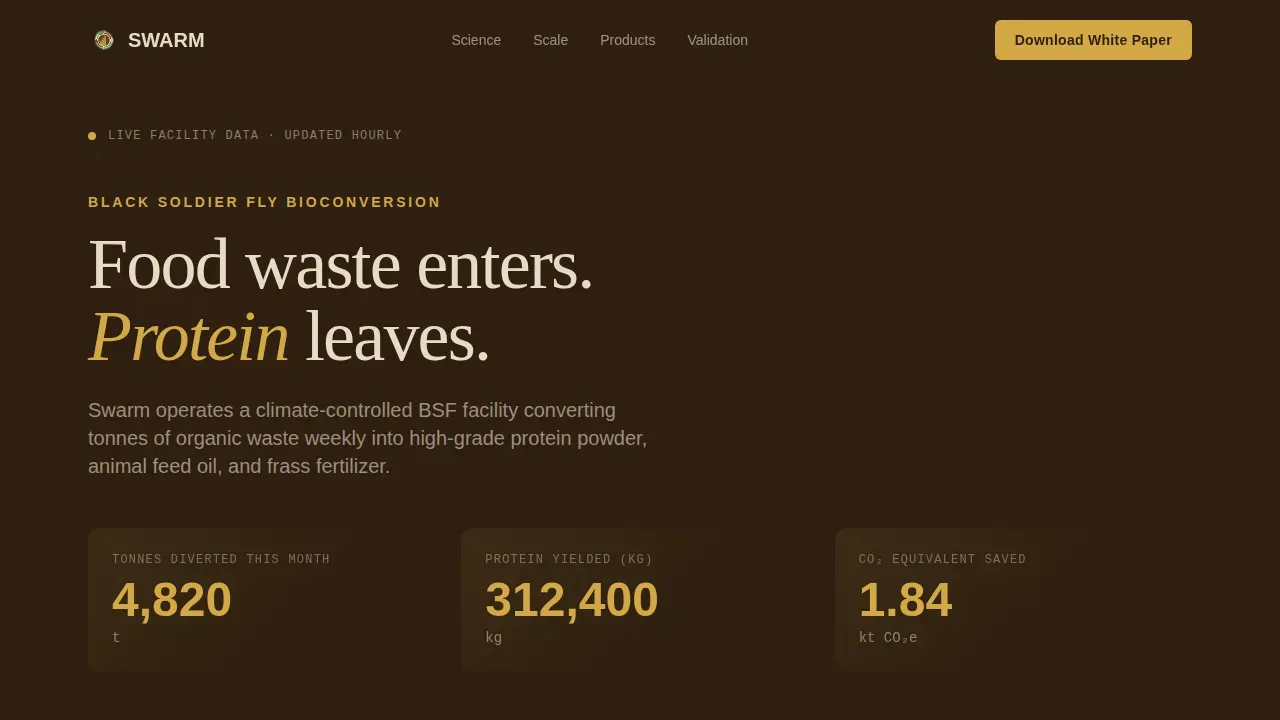
- An animated hero infographic with live-ticking counters showing tonnes of waste diverted, protein yielded, and carbon dioxide equivalent saved
- A white paper download modal form collecting name, company, role, and email, paired with a secondary "Request a Sample Kit" call to action
- Five scroll-driven sections moving from problem framing through biological mechanism, scale data, and third-party validation to the final conversion ask
Feature list
The following features define what Swarm includes and how each one supports the landing page's conversion objective.
Animated Lifecycle Infographic Header
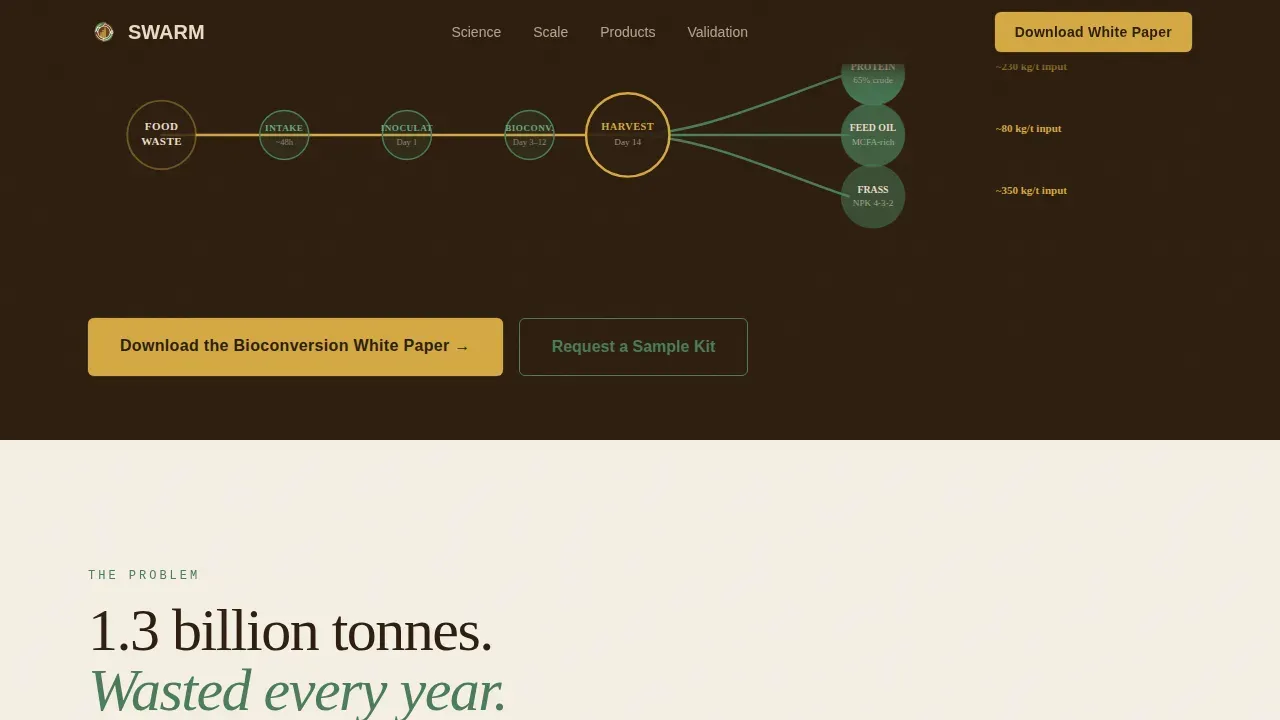
The full-width hero is a simplified lifecycle diagram rendered as a clean, diagrammatic SVG illustration. Food waste enters from the left. Black soldier fly larvae consume and convert organic matter in the center. Three output streams, protein powder, animal feed oil, and organic fertilizer, branch to the right. Live counters tick upward in real time, making the production numbers feel urgent and credible rather than static.
Scroll-Triggered Waste Statistics Section
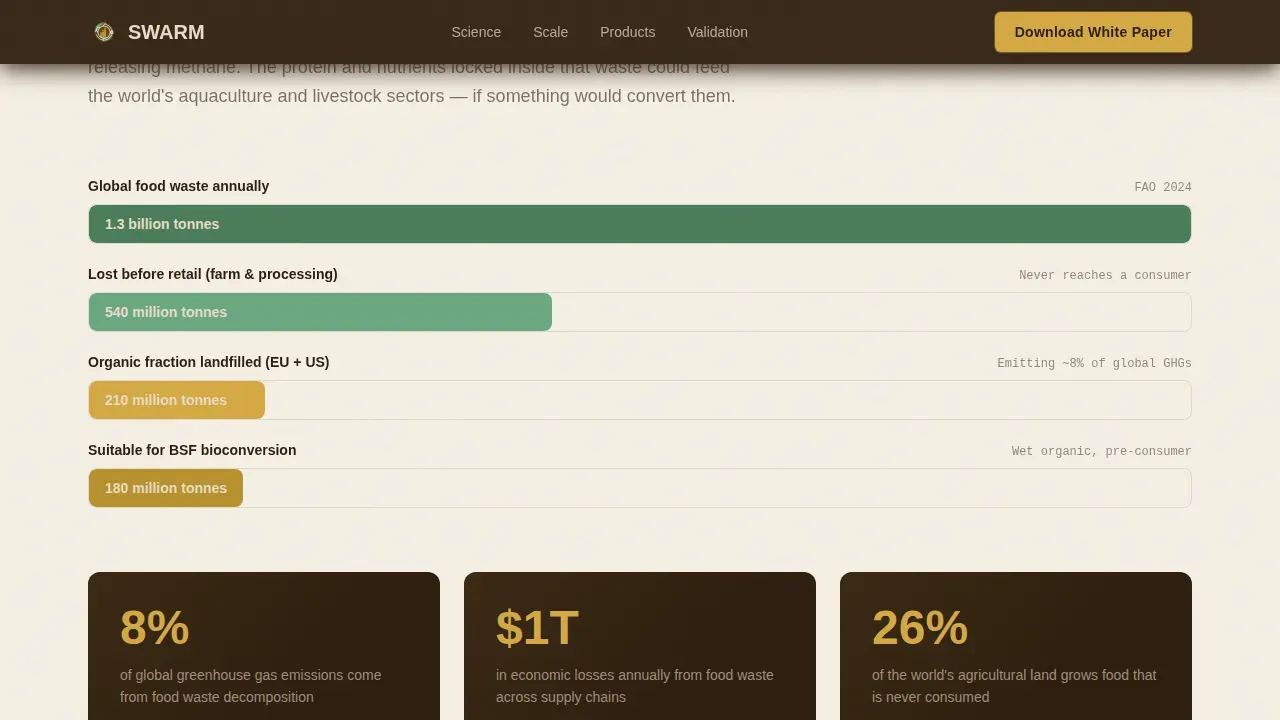
The problem section uses scroll-driven stacking bars to visualize food waste data physically accumulating on screen. As the visitor scrolls, waste statistics stack on top of each other, creating a visceral sense of scale. This approach makes the case for insect bioconversion technology without requiring the visitor to interpret a static chart.
14-Day Larva Lifecycle Timeline
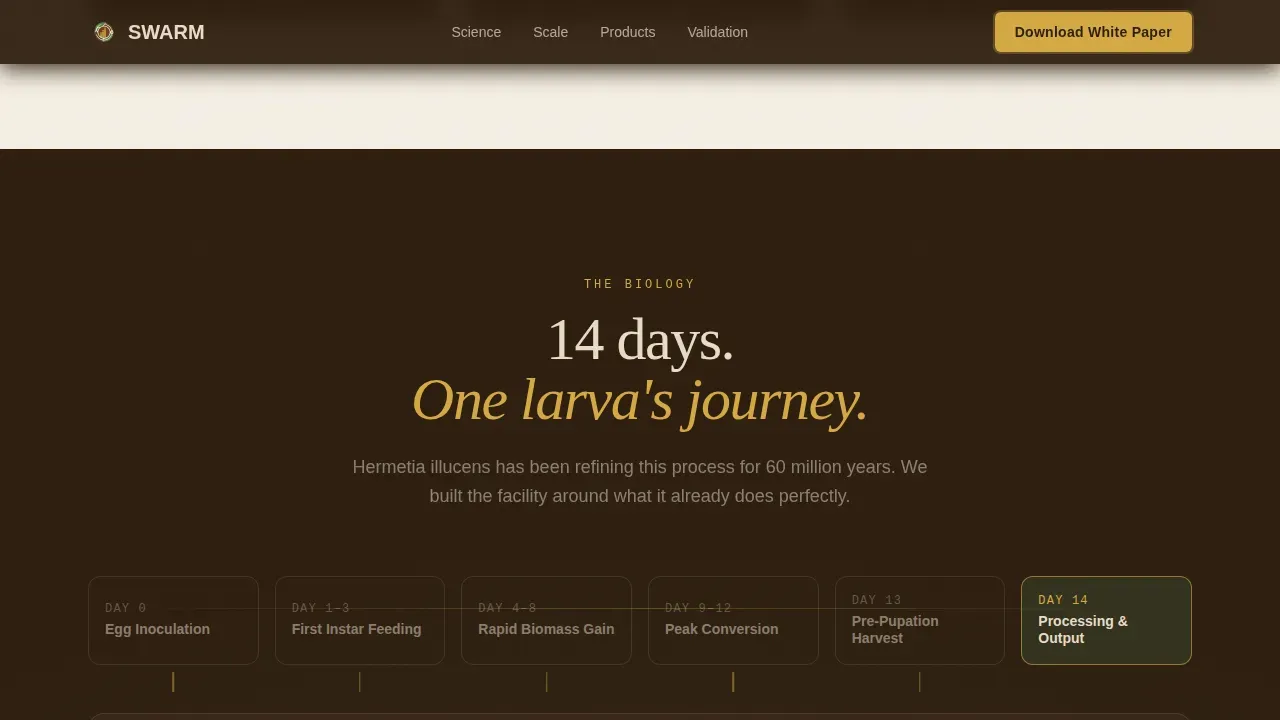
A horizontal timeline traces a single larva's journey across the full 14-day growth cycle. The short life cycle of black soldier flies is one of the most compelling production advantages in insect farming, and this section visualizes that efficiency in a way that is immediately readable for non-specialist procurement audiences.
Throughput Scale Comparison Section
Facility output data is presented as comparative equivalents. For example, the protein volume produced is shown alongside the equivalent hectares of soybean cultivation it replaces. This framing connects insect protein production to the language of conventional agriculture, helping buyers from livestock, poultry, and aquaculture sectors understand the scale in familiar terms.
Dual Conversion Path with Modal Form
The primary call to action, "Download the Bioconversion White Paper," appears after the lifecycle section and again after the scale comparisons. The modal form collects name, company, role (formulator, farmer, sustainability lead, or researcher), and email. A secondary path offers "Request a Sample Kit" for visitors ready to test product specifications directly.
Validation and Certification Section
The final content section surfaces third-party certifications, lab assay callouts, and partner organization logos. Displaying certifications related to safety, organic status, and regulatory approvals builds authority for buyers who need documented evidence before they can advance a supplier through internal procurement processes.
Page sections overview
| Section | Purpose |
|---|---|
| Hero Infographic | Animated lifecycle with live counters |
| Waste Problem Block | Scroll-stacking waste statistics |
| Larva Lifecycle Timeline | 14-day bioconversion journey |
| Scale Data Comparisons | Throughput versus. soy equivalents |
| Validation and Proof | Certifications, assays, partner logos |
Design & branding system
Swarm follows a Service Utility theme expressed through a Botanical color system. The palette feels agricultural and credible, not decorative. Every color choice carries functional meaning.
- Deep loam (#2D1E0F) grounds the layout, chlorophyll green (#4A7C59) signals biological production, sun-bleached hemp (#E8DCC8) provides readable contrast for body text, and larval gold (#D4A843) marks calls to action, data callouts, and progress indicators
- Typography uses DM Sans for body copy and Fraunces as a serif display accent, pairing scientific legibility with a sense of natural authority
- The illustration style is diagrammatic and textbook-credible throughout, prioritizing clarity and operational confidence over aesthetic decoration
Mobile & speed optimization
Swarm is designed desktop-first to match the B2B procurement research context, where buyers spend meaningful time comparing protein sources and reviewing facility data on larger screens. The layout is fully responsive for mobile access.
- Scroll-triggered animations use IntersectionObserver for performance-conscious delivery, activating only when sections enter the viewport
- SVG lifecycle diagrams and server-rendered static components keep the page structured for both high-animation desktop experiences and leaner mobile rendering
- The stacking bar animations, live counters, and modal form interactions are built as client components, isolated from static content to keep initial load stable
How this template helps you convert
Swarm earns conversions by giving away real data generously across every section, so the white paper feels like the complete version of something already proving its worth.
- The hero counter section creates immediate credibility by showing live production metrics, tonnes of waste diverted, protein yielded, CO2 equivalent saved, before the visitor has read a single paragraph of copy.
- The lifecycle timeline and scale comparison sections build a layered evidence case that accumulates trust section by section, so by the time the white paper call to action appears, it feels like the natural next step rather than a cold ask.
- The dual conversion path captures visitors at different readiness levels: those in research mode download the white paper, while those ready to evaluate product specifications request a sample kit directly.
Other information about this template
Swarm is specifically positioned for the insect protein market, which is expanding across multiple regions and feed application categories. The template reflects the market and regulatory context that buyers in this space actively research.
- The global insect protein market is projected to grow from USD 834.38 million in 2025 to USD 4,079.82 million by 2035, reflecting a CAGR of 17.2%. The insect protein market size in Europe was valued at USD 133.10 million in 2024 and is expected to grow at a CAGR of 44.80% through 2033.
- Black soldier fly larvae accounted for 58.3% of the Europe insect protein market share in 2024, reflecting their exceptional bioconversion efficiency and regulatory approval for use across multiple feed applications.
- The European Commission authorized the use of processed insect protein in poultry and pig feed in 2021, and in aquaculture feed as early as 2017. Regulatory approvals continue to expand across the European Union, propelling market growth during the forecast period.
- The dry weight of black soldier fly larvae contains up to 50% crude protein and up to 35% lipids. Insects are rich in essential amino acids, vitamins, and minerals, making insect protein a credible alternative to conventional protein sources. Crickets consist of about 70% protein on a dry weight basis and contain all essential amino acids. Mealworms contain 54% crude protein and all nine essential amino acids, placing them nutritionally comparable to meat.
- Insect protein can be processed into flour suitable for pet food, animal feed, protein bars, sports nutrition products, and as a supplement relevant to human consumption. The powdered segment holds approximately 68% of the insect protein market due to its versatility across food products and feed applications.
- The European Food Safety Authority authorized dried yellow mealworm as a novel food in January 2021, enabling its use in bakery snacks and protein bars. The European Union's Farm to Fork Strategy encourages alternative proteins to reduce reliance on imported soy, which accounts for nearly 70% of the bloc's protein feed needs.
- Consumer awareness remains a key growth factor. Only 28% of respondents in a 2023 survey indicated willingness to consume food products containing insect ingredients. The widespread adoption of edible insects for human consumption will depend on processing methods, product familiarity, and continued regulatory progress. In developing countries, insects already serve as recognized protein sources with lower consumer resistance.
- Catering waste approval as an input substrate remains under the jurisdiction of individual member states within the European Union, creating regulatory fragmentation that affects insect farming operations in western Europe and other regions.
- The united nations has recognized insects as a sustainable food and feed resource, highlighting their potential to address growing demand for protein while reducing the environmental impact of agriculture. Insect farming uses significantly less land and water compared to conventional livestock production.
- Key players in the insect protein sector, including agriprotein holdings and other companies, continue to drive market entry strategies focused on animal feed, aquaculture, and pet food. The circular economy alignment of insect farming, converting organic matter and catering waste into high-quality protein and organic fertilizer, is creating new development opportunities across regions.
- The swarm insect protein bioconversion landing page template is built to reflect this commercial and ecological context honestly, giving procurement buyers, formulators, and sustainability leads the evidence they need to move forward confidently.
Theme
Service Utility
Creative direction
Movement & Cause
Color system
Botanical
Style
Single Column Flow
Direction
Content/Resource
Page Sections
Animated Lifecycle Infographic Hero
Scroll-driven Waste Statistics
Day Larva Lifecycle Timeline
Throughput Scale Comparison Block
Dual Call-to-action Conversion Paths
Certification and Validation Section
Related questions
What types of buyers is this landing page template designed for?
What are the two conversion paths included in this template?
Does this template include animation and interactive components?
Why does the template use a diagrammatic illustration style instead of photography?
How does the validation section support procurement decisions?