Authoritative Sociology Guide Landing Page Template
This sociology study guide landing page template is built for students who need organized, exam-ready theory coverage fast. It presents annotated notes, concept maps, and chronological era sections in a sidebar companion layout. The design follows an Institutional Authority style with a Teal Catalyst color palette, making the page feel credible, structured, and easy to navigate under deadline pressure.
by Rocket studio
Quick summary
This landing page template turns a sociology study resource into a compelling, conversion-focused experience. It walks visitors chronologically through sociological theory, from classical foundations to contemporary perspectives, using annotated note cards, a fixed sidebar table of contents, and two lead capture paths that feel natural rather than pushy.
Who this template is for
This template is designed for educators, course creators, and academic content publishers who want to convert student visitors into email subscribers. It suits anyone offering structured study materials in the social sciences.
- Second-year undergraduate sociology students preparing for midterms or final exams
- Pre-med and elective students who need efficient, high-yield theory coverage
- Mature learners returning to education who want a clear, organized starting point
What problem this template solves
Most students land on a study resource page with no sense of where to begin. A flat, undifferentiated page loses them before they reach the sign-up form. This template solves that by structuring content the way a semester actually unfolds, building trust era by era before asking for anything.
- Visitors leave because they cannot see the depth or quality of the notes upfront
- A single generic call to action placed too early converts very few hesitant students
- Students on mobile or desktop need different navigation cues to stay oriented
What you get with this template
You get a fully structured single-page layout built around a Timeline Progression creative direction. Every section has a defined role, from credibility building in the hero to quiet urgency at the lead capture form.
- A fixed sidebar companion with scroll-spy that highlights the current era and lets visitors jump between theory periods
- Three chronological content sections covering classical, mid-century, and contemporary sociology, each with distinct visual density
- Two lead capture paths: a full vault sign-up form and a free PDF download requiring only an email
Feature list
This template includes several purposefully designed components. Each one serves the goal of keeping students engaged long enough to understand the value of the full resource.
Fixed Sidebar Table of Contents
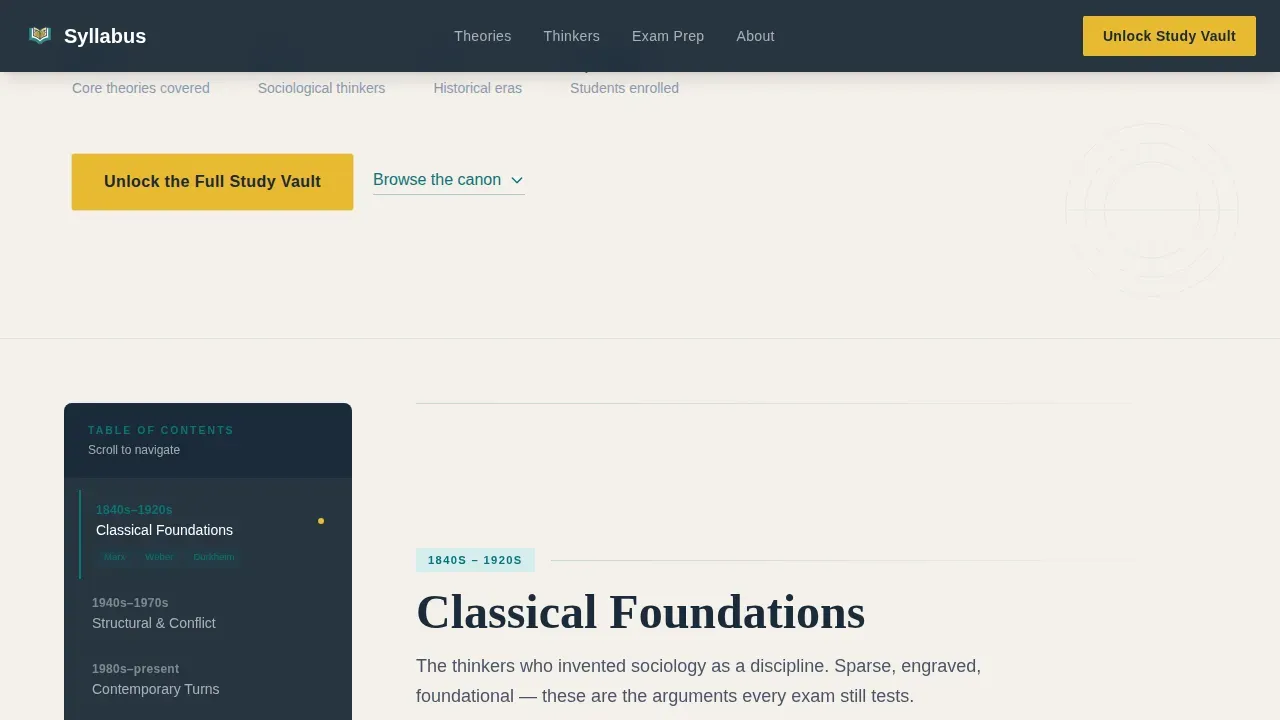
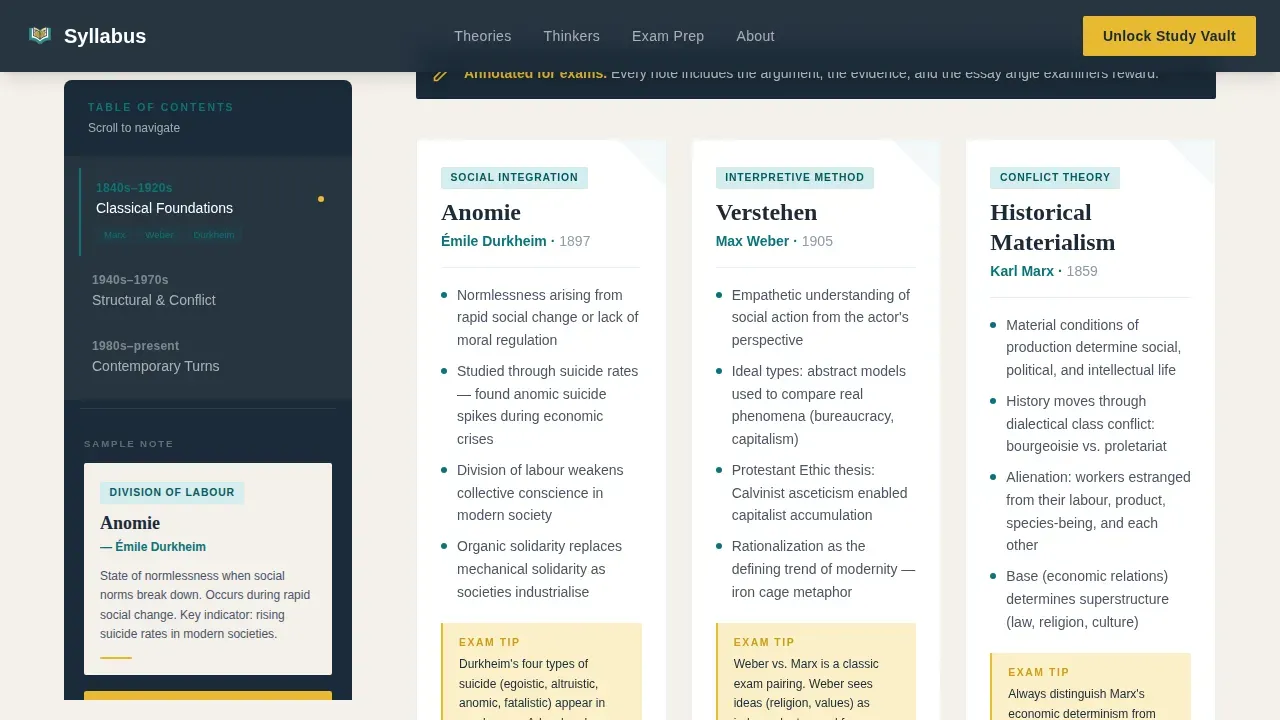
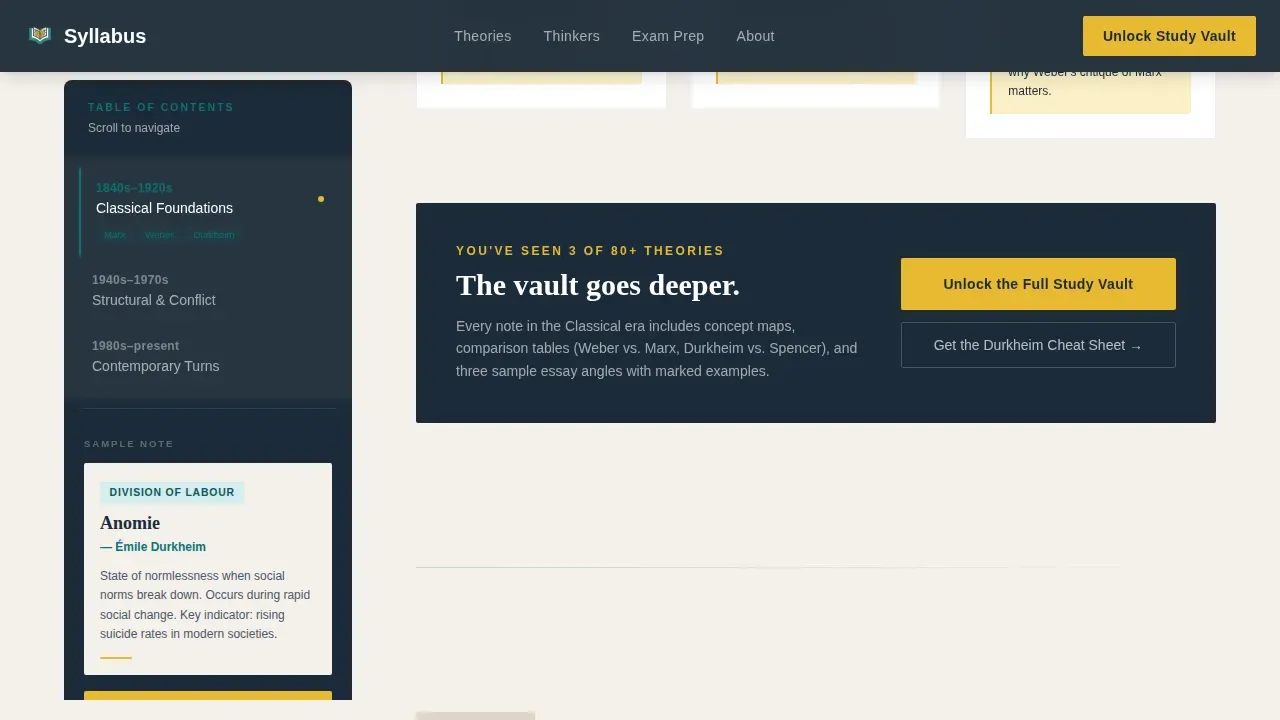
The sidebar stays in view as the visitor scrolls. It highlights the current era, lets users jump to any theory period, and displays a contextual note preview that updates as the section changes. This keeps orientation effortless on desktop.
Chronological Theory Sections
Three distinct content eras are laid out in sequence: Classical Foundations covering Marx, Weber, and Durkheim; Mid-Century Theories including Parsons, Merton, Goffman, and conflict theory; and Contemporary Sociology spanning intersectionality and digital sociology. Each era uses its own visual density to signal the shift in academic tone.
Dual Lead Capture Paths
The primary form collects first name, university email, and current sociology module via a dropdown. A secondary path offers a free downloadable PDF requiring only an email, giving hesitant visitors a lower-commitment entry point.
Logo Bar Header Strip
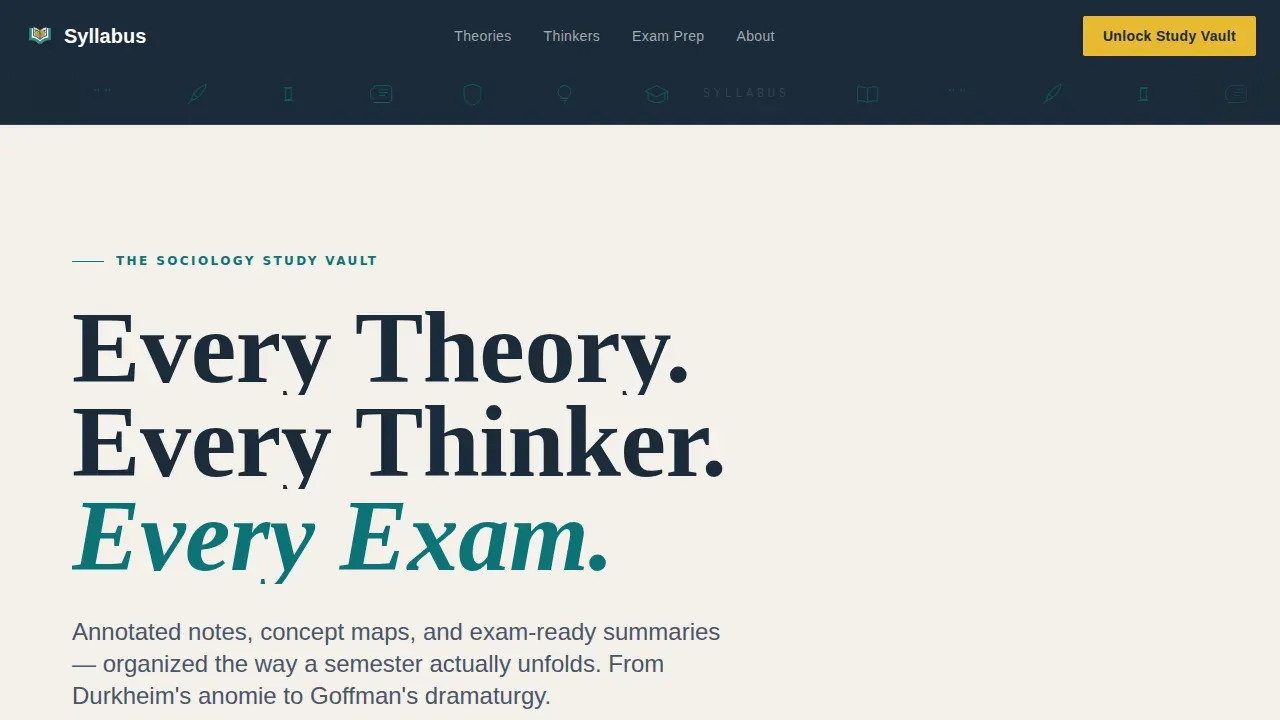
A horizontal ticker strip opens the page with university crest-style icons and institutional motifs rendered in monochrome teal. The strip scrolls slowly like a ticker, setting an authoritative academic tone before the headline even loads.
Annotated Note Card Components
Theory sections use styled note card blocks to present key concepts in a format that mirrors real study notes. Visitors can immediately see what the resource looks like, which builds confidence in the product before any sign-up is requested.
Student Social Proof Blocks
Testimonial components display specific exam outcomes alongside theory count badges. This gives the page measurable credibility rather than vague endorsements.
Page sections overview
| Section | Purpose |
|---|---|
| Logo Bar Hero | Establish institutional credibility before the headline |
| Serif Headline Block | Deliver the core value statement with editorial weight |
| Fixed Sidebar TOC | Keep visitors oriented and navigating through theory eras |
| Classical Foundations | Showcase Marx, Weber, Durkheim annotated note cards |
| Mid-Century Theories | Cover Parsons, Merton, Goffman, and conflict theory |
| Contemporary Sociology | Present intersectionality and digital sociology content |
| Social Proof Strip | Display student testimonials and theory count badges |
| Primary Lead Capture | Collect name, email, and module for full vault access |
| PDF Secondary call to action | Offer Durkheim cheat sheet for email-only sign-up |
| Footer | Close with horizontal flow pattern and navigation links |
Design & branding system
The visual identity follows an Institutional Authority theme that feels like a university building after hours. The palette is serious enough to earn trust and warm enough to hold attention.
- Deep lecture-hall teal (#0D7377) anchors the primary interface, blackboard slate (#1B2A38) defines the sidebar and typographic weight, chalk dust white (#F4F0EB) covers content backgrounds, and catalyst yellow (#E8B931) is reserved exclusively for interactive highlights, progress indicators, and call-to-action buttons
- Typography pairs Fraunces serif for display headlines with DM Sans for body text and interface elements, creating an editorial rhythm that feels academic without being dry
- Animation is set to medium intensity, with scroll reveals, a marquee ticker in the header, sidebar highlight updates on scroll, and text masking transitions between era sections
Mobile & speed optimization
The template is built desktop-first because the fixed sidebar companion requires screen real estate to function as intended. A mobile fallback is included for visitors on smaller screens.
- On mobile, the fixed sidebar collapses into a top-level navigation element so theory navigation remains accessible without obscuring content
- Static section architecture and IntersectionObserver-based scroll-spy keep the interactive sidebar responsive without heavy scripting overhead
How this template helps you convert
The page is structured around a Lead Generation direction, meaning every design and layout decision is made to move visitors toward one of two sign-up actions.
- The primary call to action, "Unlock the Full Study Vault," first appears at the end of the Classical Foundations section, after the annotated note cards have already demonstrated value. It repeats at each era transition so visitors are always one step away from converting.
- The free PDF secondary path, "Get the Durkheim Cheat Sheet," captures visitors who are interested but not yet ready to commit. It requires only an email address, reducing friction and growing the subscriber list from traffic that would otherwise leave without converting.
Other information about this template
This template is part of the Syllabus product concept, a digital study vault designed to make sociological theory accessible and exam-ready for undergraduate students. A few additional details worth noting:
- The template style is Sidebar Companion, a layout format suited to content-dense resources where navigation depth and context matter
- The footer uses a Vercel Horizontal Flow pattern for a clean, structured close to the page
- The header headline, "Every Theory. Every Thinker. Every Exam." is set in heavy Fraunces serif and is designed to read like the front matter of an academic text
- English (United States) localization is built in, with academic calendar language used throughout the copy placeholders
- The page works within the Education and Training category, specifically the Sociology Education subcategory, making it well matched for course creators and academic publishers in that niche
Theme
Institutional Authority
Creative direction
Timeline Progression
Color system
Teal Catalyst
Style
Sidebar Companion
Direction
Lead Generation
Page Sections
Fixed Sidebar Table of Contents
Chronological Theory Era Sections
Dual Lead Capture Paths
Logo Bar Header Strip
Annotated Note Card Components
Student Social Proof Blocks
Related questions
Who is this landing page template best suited for?
Can I adapt the theory era sections to a different course structure?
What are the two ways visitors can sign up through this template?
Does the sidebar navigation work on mobile devices?
How does the page build trust before asking visitors to sign up?